

Tales of Teams, Trophies & Trinkets - Vol 2
By
Ron Pesch
MHSAA historian
February 9, 2017
A picture may be worth a thousand words – but often, we can learn as much from a traveling trophy, game ticket, and even an old megaphone.
Michigan’s high school sports history is more than a century old and filled with legends passed on of games, teams and athletes and the roles they played as our communities rolled forward toward present day. Following up last year’s “Tales of Teams, Trophies & Trinkets,” we present a second chapter highlighting artifacts that tell some of those stories.
|
1909 |
Saginaw vs. Saginaw Arthur Hill |
Football Trophy |
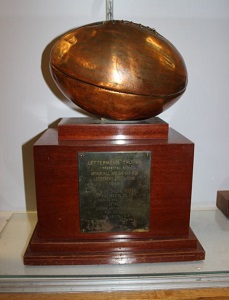 This bronzed football was the original used in the 1909 Thanksgiving Day contest played between Saginaw High and Saginaw Arthur Hill, and won by Saginaw, 5-0 at Burkart Park. In 1948, the ball was stylized into a trophy by the Letterman’s Associations of the rival schools, designed to travel between schools as the reward for winning the annual contest. When the Lumberjacks of Arthur Hill ripped off 24 straight victories beginning in 1971 (the teams played twice in 1974), ownership of the trophy was mostly forgotten. When talk of closing Saginaw High School mounted, the trophy was placed on display at Saginaw’s Castle Museum, then donated to the Saginaw County Sports Hall of Fame.
According to Jeffrey Cottrell, the multi-media specialist at the Historical Society of Saginaw County, when plans to close Saginaw High did not materialize, “it was decided amongst the Saginaw County Sports Hall of Fame and the Arthur Hill Letterwinners Association that it was time to put it back into use. This past fall, the Sports Hall of Fame awarded the trophy to Saginaw High when they beat Arthur Hill 40-0.”
Going forward, the Letterman's Trophy will continue to be presented to the winner of the football game between the Trojans and the Lumberjacks.
|
1921 |
Detroit Cass Tech vs. Flint Central |
Football Program |
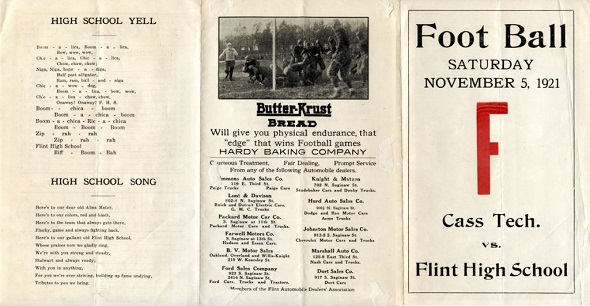
A crowd of 2,500 was on hand for this contest as Detroit Cass Tech downed Flint Central, 34-20, in an aerial battle between the squads. The Detroit Free Press arraigned for a special interurban run, with special railcars earmarked for Cass Tech students interested in attending the Saturday game at Flint. Between 200 to 300 made the trip to cheer their team to victory.
Flint Central completed 14 of 34 passes for 176 yards, but was intercepted on six occasions. Cass Tech arms were accurate on only 7 of 24 attempts for 160 yards, with four interceptions, but two completions went for touchdowns of 18 yards and 50 yards. A third pass of 35 yards helped set up the visitor’s first score. Bruno Murkobred, Cass Tech’s speedy quarterback, was the star of the contest, scoring three of his team’s five touchdowns.
|
1939 |
Kalamazoo Central vs. Battle Creek Central |
Basketball Program |
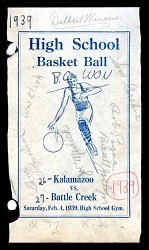 This tattered memento, from a scrapbook kept by historian Dick Kishpaugh, illustrates the modest design of a high school basketball program back in 1939. Likely created by the high school print shop, this single sheet, printed specifically for distribution at the game, features autographs gathered by its owner. Wes Clark, one of the names captured on the cover, led Battle Creek Central with 10 points, including a pair of buckets in the final minute to secure a 27-26 win by the Bearcats.
Newspaper reports from the time indicate that halftime of the contest would feature “a table tennis exhibition between Helen Van Dyke of Flint, four-time state champion, and Floyd Painter, Battle Creek champion.” Miss Van Dyke was a sophomore at Olivet College at the time.
|
1940 |
Lansing Eastern vs. Lansing Central |
Football Program |
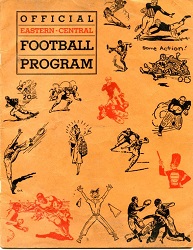 This is the program cover from the 13th annual Football Classic between the Quakers of Eastern and the Big Reds of Central. Fans were requested to “refrain from making unnecessary noise as they drive away from the stadium … due to the nearness of Sparrow Hospital.”
At the time of the 1940 contest, Lansing Central led the series with six wins against five defeats. The series featured a single tie, a 6-6 result in 1935.
Eastern’s 1940 squad, coached by Walter Graff, was able to knot the series at six wins apiece with a thrilling 7- 6 victory over the crosstown rivals, coached by Al Bovard.
The 16-page document was hand set and printed by the Eastern and Central High School Vocational Printing Classes, and included rosters, messages from the two school principals and athletic directors, as well as comments from each member of the coaching staffs, team captains, student council presidents and numerous team members from each school with their views on the game. Of course there is a photograph of each high school football team, but also photos of each band, their directors, and a list of the band members for both Eastern and Central. Finally, there are photos of the Eastern and Central Yell Leaders, nine for the Quakers and six for the Big Reds.
It is a true work of art.
|
1950 |
Central Michigan College Relays |
Track Medal |
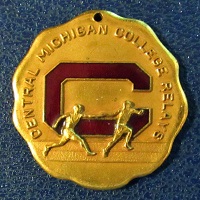 More than 2,300 athletes from 97 high schools descended upon Mt. Pleasant for the Tenth Annual Central Michigan Relays. Ecorse in Class B and Flint School for the Deaf in Class D earned team titles on Friday, May 5th while on Saturday, the 6th, Flint Northern and Milan won Class A and Class C, respectively. Six event records fell during the two-day event, three in the broad jump.
This medal, honoring a member of the winning Class C sprint relay team, was awarded at the event. The winning team, and therefore, the name of the individual awarded the medal, remain a mystery.
|
1962 |
Saginaw Sacred Heart |
Megaphone |
 As at the majority of schools across the state at the time, athletic competition against other schools was not an option for Gloria Groll and her female classmates during her days as a student at Saginaw Holy Rosary High School. So, from the fall of 1959 until her graduation with 27 other students in the spring of 1962, she was a cheerleader for the Greyhounds. This beautiful megaphone, donated by Groll to the Saginaw County Sports Hall of Fame, is a memento from those times.
Holy Rosary was one of nine Catholic high schools operating in the Saginaw area in the 1950s and 1960s. Population shifts from the cities to the suburbs over the coming years would impact enrollment figures at schools nationally. In Saginaw, the opening of the Buena Vista School District in 1956 directly impacted Holy Rosary. In 1970 the school closed. A year later only three schools – SS Peter and Paul, St. Mary and Saginaw St. Stephen – remained. In 1984, those schools were consolidated to form Saginaw Nouvel Catholic Central.
|
1963 & 1930 |
Grosse Pointe St. Paul |
League Trophies |
 On the left, we find the trophy awarded to Grosse Pointe St. Paul's after winning the 1963 city championship. Bob Martin, a 6-foot-6 junior who earned first division all-Catholic honors, scored 14 of his 22 points in the fourth quarter to lead the Lakers to a 55-46 upset-victory over Detroit Pershing. The game was played at University of Detroit Memorial before 6,979 spectators. It was the first time since 1958 that the Catholic League won the annual matchup with the champions of the Public School League.
To the right is the trophy awarded to St. Paul for winning the first golf tournament of the South Michigan Catholic High School League. The school's four golfers shot 710 over 36 holes on the day, 69 fewer strokes than second-place Detroit St. Rose. Played at Clinton Valley, the event saw Bill Beaupre win individual honors with a total of 158, including 76 in the morning. His cousin and teammate, Harold Beaupre, finished second with 169, while Peter Bononis of Detroit Holy Name was third with 171 strokes.
|
1965 |
Fennville vs. Kalamazoo Hackett |
Ticket Stub |
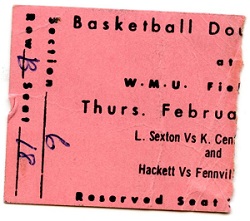 This ticket stub from a doubleheader hosted at Western Michigan University’s Read Fieldhouse on February 18, 1965 was the first chance for many to witness lightning in a bottle. A capacity-plus crowd of 9,100 fans slid through the gate to watch a rumor.
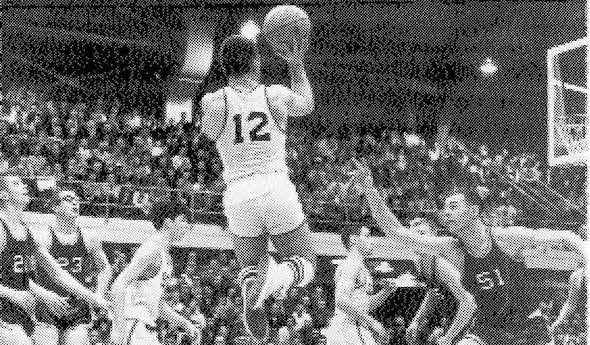
The antics of 5-foot-7½ guard Richie Jordan had been talked about around the Kalamazoo area, but few had actually seen him play. His skills were on full display on this Thursday night, as he netted a fieldhouse scoring record with 49 points in a come-from-behind 76-72 win over a much taller team from Kalamazoo Hackett. Jordan’s output during the evening’s second game eclipsed the 45 points Manny Newsome scored for Western Michigan University against Toledo, just over a year before.
The evening hadn’t started well. According to the Kalamazoo Gazette, “Jordan hit only six of his 13 field shots in the first half and threw the ball away eight times. Trailing Hackett by 17 points, 50-33, with two minutes to play in the third quarter, the Blackhawks were able to cut the deficit to 13, 60-47 as the teams entered the final frame.
Quickly, everyone in the fieldhouse knew who was getting the ball during the comeback attempt. Jordan grabbed control; with his drives for layups and “softly-arched” jump shots against intense pressure, he hit seven of nine field goals, wowing the crowd. With 2:36 to play, Jordan nailed a pair of free throws to tie the game at 72 all. Then, with 57 seconds left, the “Fennville Flash” nailed the go-ahead basket, followed by two insurance free throws to seal the win. For many, his 24 points in the fourth quarter sealed his journey from rumor to legend and, no doubt, inspired the single-sentence first paragraph of the next morning’s coverage in the Gazette.
“Yes, there is a Richie Jordan!”
(P.S. – Kalamazoo Central upset eighth-ranked Lansing Sexton, 67-57, in the evening’s opening contest).
 Ron Pesch has taken an active role in researching the history of MHSAA events since 1985 and began writing for MHSAA Finals programs in 1986, adding additional features and "flashbacks" in 1992. He inherited the title of MHSAA historian from the late Dick Kishpaugh following the 1993-94 school year, and resides in Muskegon. Contact him at [email protected] with ideas for historical articles.
PHOTO: Fennville's Richie Jordan pulls up for a jumper, showing off the form that's become iconic when recalling the high school phenom. (Photos of Letterman's Trophy and Megaphone were provided by Jeffery Cottrell, and photo of Grosse Pointe trophies was provided by Bill Roose.)
Rep Council Wrap-up: Spring 2019
May 8, 2019
By Geoff Kimmerly
Second Half editor
The addition of seeding at the District level in basketball and soccer and multiple adjustments to the process used to select the playoff field for 11-player football were among the most notable actions taken by the Representative Council of the Michigan High School Athletic Association during its annual Spring Meeting, May 5-6 in Gaylord.
The Spring Meeting of the 19-member legislative body of the Association’s more than 1,500 member schools is generally the busiest of its three sessions each year. The Council considered 26 committee proposals and dealt with a variety of eligibility rule, postseason tournament and operational issues.
Beginning with the 2019-20 school year, girls and boys basketball and soccer will employ a seeding process to place the top two teams in every District on opposite sides of that bracket, guaranteeing those two teams could not play each other before the District championship game.
The two teams to be seeded in each District will be determined using a Michigan Power Ratings computer formula based on regular-season results against other MHSAA Tournament-eligible teams and opponents’ strength of schedule. (Games against out-of-state or non-MHSAA opponents will not count in the MPR formula.) The MHSAA will draw all brackets two weeks before the start of District play. After the top seeds are determined and separated to opposite sides of the bracket, the draw process will place the remaining teams on the bracket based on a randomly-selected order determined earlier in the season. However, the draw process does not guarantee the seeded teams will receive byes or serve as home teams.
The MPR is being used this spring to seed the Boys Lacrosse Tournament. Separate seeding proposals were recommended to the Council by the MHSAA committees for both soccer and basketball.
The changes to the 11-Player Football Playoffs selection process were proposed by the MHSAA Football Committee and are designed to reward teams that play more successful opponents. Beginning with the 2020 season, eight divisions will be determined before the season, and 32 playoff qualifiers from each division will be selected at the end of the regular season based on playoff-point average – there no longer will be automatic qualification based on win total. The adjusted playoff points formula will award bonus points for all opponents’ wins, regardless of whether the team beat or lost to those opponents. Currently bonus points are awarded only if the team defeated an opponent. More points also are awarded for defeating teams from larger divisions. The Football Committee proposed these changes believing the bonus points received for a “good loss” – combined with the elimination of automatic qualifiers – will be enough incentive for teams to schedule more successful opponents, easing the annual difficulty in football scheduling and taking away arguably the most cited reason for the breakup of leagues and conferences.
Also on recommendation by the Football Committee, the Council approved an enrollment limit of 215 students for teams to be eligible for the MHSAA 8-Player Playoffs. This too will take effect for the 2020 season. Currently, a school must be Class D to be eligible for the postseason, or in a one-year grace period if it grew larger than Class D for the current school year. While the Class D enrollment line changes annually, the 8-player line of 215 students will remain static year to year. The grace period also will remain for schools that might receive a one-year enrollment bump before falling back below 215 students.
The Council also approved a committee recommendation to add limited video review of scoring plays or potential scoring plays, or of turnovers or potential turnovers at MHSAA Football Finals for both the 11 and 8-player formats. This process will be available at Finals only because of the availability of camera coverage provided by broadcasts of those highest-level games of the tournament. Although all scoring and turnover plays could be reviewed, a play will be reversed only when there is indisputable video evidence showing the original call was incorrect.
Continuing its focus on safety in football, the Council also approved a committee recommendation to adopt revised definitions and limits on contact allowed during preseason practices and practices after games have begun. Beginning with this 2019 football season, teams will be allowed no more than six hours of full-pads collision contact per week during the preseason and no more than 30 minutes of collision contact during a week of in-season (after games begin) practice. “Collision” is defined as contact at game speed, with the execution of full tackles at a competitive pace, taking players to the ground.
However, while “collision” contact will be limited, “thud” contact will be unlimited. “Thud” is defined as full speed but above the waist only, with no player taken to the ground and no winner or loser. Thud contact is not considered collision contact. The revised definitions of “collision” and “thud” and related time limitations are products of collaboration between the MHSAA, Michigan High School Football Coaches Association and Practice Like Pros, a national movement dedicated to safety in high school football. The recommendation was brought to the Football Committee by leadership of the Michigan High School Football Coaches Association and further defines the degree and amount of practice contact following similar practice safety changes approved by the Council for football in 2014 and 2017.
The new sport-specific transfer rule will take effect with the 2019-20 school year, and the Council approved a series of corresponding changes. Most notably, the Council approved a change to the athletic-related (links) rule to not grant immediate eligibility with a residential change if a student follows a coach from his or her former school to a school where the coach has been newly hired. The Council also approved a sport-specific penalty for the athletic-motivated transfer rule so that a student would not be eligible during the current school year in the sport played the previous school year if that student was confirmed to have made an athletic-motivated transfer.
The Council additionally approved clarifications under the sport-specific transfer rule for multi-school districts which have schools that are both geographical boundary schools and schools which are district-wide, for students transferring to nonpublic or charter schools and for students who have taken part in international student exchange programs and chosen to stay in Michigan.
To provide consistency for officials’ jurisdiction across all sports, the Council approved the addition of wording that allows an official to disqualify a student or coach following the conclusion of a contest – but before the official has left the facility and/or grounds – if that student or coach commits an offense worthy of ejection and disqualification against the official. (Example: A player or coach verbally berates an official while following that official to his or her vehicle.) This penalty also would include the next-day-of-competition suspension. This does not apply if the official has remained at the facility and encounters the offense while as a spectator for another event.
Here is a summary of other notable actions taken by the Representative Council at the Spring Meeting, which will take effect during the 2019-20 school year unless noted:
Regulations
• The Council approved an increase from $25 to $40 as the maximum value for any award (trophies, medals, plaques, etc.) that an athlete may receive for participation in an athletic event without conflicting his or her amateur status.
Sport Matters
• In track & field, the Council approved a Cross County/Track & Field Committee recommendation to allow Upper Peninsula and Lower Peninsula Regional competitions to be conducted on Thursdays, in addition to the current Fridays and Saturdays, to provide for more flexibility for tournament hosts and participants when up against other school activities and college entrance exam testing dates.
• Also in track & field, the Council approved a recommendation to allow for use of a double waterfall mark and step-up start in the 800, 1,600 and 3,200 meters, beginning in 2020 when those events will begin employing a one-turn stagger.
• In golf, a committee recommendation was approved allowing golfers to use cell phones during play in four circumstances – to call a coach or tournament administrator for a health and safety issue, for use in inputting scores for live scoring or other scoring applications, to contact a rules official with questions, and for use as a distance-measuring device.
• The Council approved a Golf Committee recommendation setting the maximum allowable score at 12 strokes per hole, in part to help improve pace of play.
• The Council also approved a Golf Committee recommendation to allow for a Lower Peninsula Regional to be played any day, Monday through Saturday, during the week reserved for that round of the tournament. Similar to track & field, this allowance was made to increase scheduling flexibility.
• In girls competitive cheer, the Council approved a committee recommendation allowing for non-braced static inversions at the high school level only with the following stipulations: the original base or spotter maintains constant contact with the flyer, prior to the static inverted position the flyer must originate from below shoulder level, and the inversion must dismount to the cheering surface, cradle, any waist-level position or a non-inverted stunt at shoulder level. Also, twists from inversions and inversions released to extended level are illegal.
• The Council also approved a recommendation to allow for the review and possible restructuring of the girls competitive cheer format as early as the 2020-21 season, keeping athlete safety and efforts to increase participation as the primary focuses.
• In girls gymnastics, the Council approved a committee recommendation solidifying language stating that when four judges are contracted for a meet in which two events are conducted simultaneously, a total of 28 gymnasts may compete per event in a double-dual or quad meet, with up to 14 per school per event (for schools with A and B teams).
• In boys lacrosse, the Council approved a committee recommendation allowing for a multi-team tournament option of playing two full games (four 12-minute quarters) with a possible four-minute sudden-victory overtime period, instead of three running-time games (25-minute halves) with no overtimes allowed.
• In soccer, the Council approved a recommendation to allow for multi-team tournaments to be played not only on non-school days, but on days not followed by a school day.
• The Council also approved a committee recommendation in soccer removing a rule that previously required District and Regional Finals to begin after 5 p.m. on SAT and ACT national testing days.
• In diving, the Council approved a Swimming & Diving Committee recommendation requiring divers who enter MHSAA Qualifying Meets to provide a name of a designated MHSAA-certified coach to serve on the judging panel. After volunteers are accepted from the list, a random draw of those designated coaches will fill out the rest of the seven-judge panel.
• In tennis, the Council approved two committee recommendations regarding MHSAA Tournament play. The first requires any lineup substitution be made before the end of the last scheduled coaches meeting prior to play to allow for the automatic redrawing of a bracket if a seeded player is unable to play. The Council also approved the allowance of three coaches on the first day of MHSAA Finals, when play often takes place at many courts and at multiple sites. In the case of multiple sites, an additional coach may be added for each site (all coaches must continue to meet MHSAA coaching requirements). On the second day of the Finals, only two coaches are allowed.
• Additionally in tennis, the Council approved a committee recommendation allowing coaches who are on-court for coaching purposes during matches to text coaches or players not engaged in matches, as long as it is not disruptive to play. The Council also approved a committee recommendation allowing coaches at the subvarsity and middle school levels to offer coaching at any time during a match as long as the coach remains off court and does not disrupt the flow of play.
In an effort to increase recruitment of young officials, the Council approved a staff proposal to expand the Student Officials Legacy Program to include freshman and sophomore students at least 14 years of age. These underclassmen will be allowed to officiate with a mentor official at the junior high/middle school level only.
The Council also discussed various other topics, including work by the Multi-Sport Task Force toward a possible awards program and the MHSAA’s growing efforts as a presenting sponsor at junior high/middle school events and at high school events that have ties to MHSAA member schools but are not MHSAA-sponsored sports (that is by competition rules, governance, etc.).
The Council also reviewed reports on membership, with 750 senior high schools and 810 junior high/middle schools in 2018-19 plus 56 elementary schools with 6th-grader participation; cooperative programs, with 313 programs for 552 teams during 2018-19; eligibility advancement applications, which totaled three for this school year; the use of Educational Transfer Forms, out-of-state practice requests, school violations, attendance at athletic director in-service workshops and Coaches Advancement Program sessions, officials’ registrations, rules meetings attendance and officials reports submitted for the past three sports seasons. The Association’s $11.9 million budget for the 2019-20 school year also was approved.
The Representative Council is the 19-member legislative body of the MHSAA. All but five are elected by member schools. Four members are appointed by the Council to facilitate representation of females and minorities, and the 19th position is occupied by the Superintendent of Public Instruction or designee.
The MHSAA is a private, not-for-profit corporation of voluntary membership by more than 1,500 public and private senior high schools and junior high/middle schools which exists to develop common rules for athletic eligibility and competition. No government funds or tax dollars support the MHSAA, which was the first such association nationally to not accept membership dues or tournament entry fees from schools. Member schools which enforce these rules are permitted to participate in MHSAA tournaments, which attract more than 1.4 million spectators each year.