

Tales of Teams, Trophies & Trinkets - Vol 2
By
Ron Pesch
MHSAA historian
February 9, 2017
A picture may be worth a thousand words – but often, we can learn as much from a traveling trophy, game ticket, and even an old megaphone.
Michigan’s high school sports history is more than a century old and filled with legends passed on of games, teams and athletes and the roles they played as our communities rolled forward toward present day. Following up last year’s “Tales of Teams, Trophies & Trinkets,” we present a second chapter highlighting artifacts that tell some of those stories.
|
1909 |
Saginaw vs. Saginaw Arthur Hill |
Football Trophy |
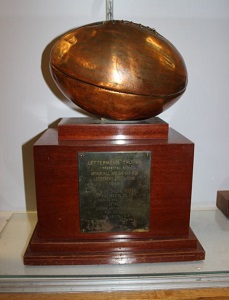 This bronzed football was the original used in the 1909 Thanksgiving Day contest played between Saginaw High and Saginaw Arthur Hill, and won by Saginaw, 5-0 at Burkart Park. In 1948, the ball was stylized into a trophy by the Letterman’s Associations of the rival schools, designed to travel between schools as the reward for winning the annual contest. When the Lumberjacks of Arthur Hill ripped off 24 straight victories beginning in 1971 (the teams played twice in 1974), ownership of the trophy was mostly forgotten. When talk of closing Saginaw High School mounted, the trophy was placed on display at Saginaw’s Castle Museum, then donated to the Saginaw County Sports Hall of Fame.
According to Jeffrey Cottrell, the multi-media specialist at the Historical Society of Saginaw County, when plans to close Saginaw High did not materialize, “it was decided amongst the Saginaw County Sports Hall of Fame and the Arthur Hill Letterwinners Association that it was time to put it back into use. This past fall, the Sports Hall of Fame awarded the trophy to Saginaw High when they beat Arthur Hill 40-0.”
Going forward, the Letterman's Trophy will continue to be presented to the winner of the football game between the Trojans and the Lumberjacks.
|
1921 |
Detroit Cass Tech vs. Flint Central |
Football Program |
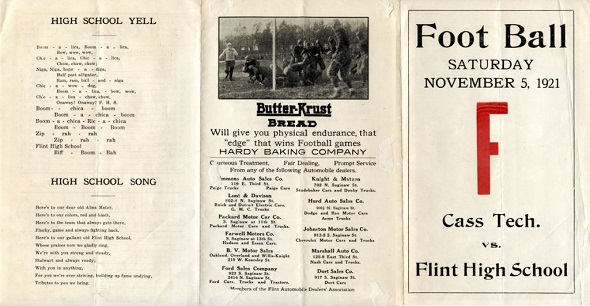
A crowd of 2,500 was on hand for this contest as Detroit Cass Tech downed Flint Central, 34-20, in an aerial battle between the squads. The Detroit Free Press arraigned for a special interurban run, with special railcars earmarked for Cass Tech students interested in attending the Saturday game at Flint. Between 200 to 300 made the trip to cheer their team to victory.
Flint Central completed 14 of 34 passes for 176 yards, but was intercepted on six occasions. Cass Tech arms were accurate on only 7 of 24 attempts for 160 yards, with four interceptions, but two completions went for touchdowns of 18 yards and 50 yards. A third pass of 35 yards helped set up the visitor’s first score. Bruno Murkobred, Cass Tech’s speedy quarterback, was the star of the contest, scoring three of his team’s five touchdowns.
|
1939 |
Kalamazoo Central vs. Battle Creek Central |
Basketball Program |
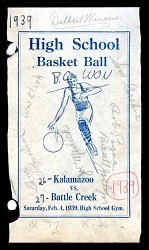 This tattered memento, from a scrapbook kept by historian Dick Kishpaugh, illustrates the modest design of a high school basketball program back in 1939. Likely created by the high school print shop, this single sheet, printed specifically for distribution at the game, features autographs gathered by its owner. Wes Clark, one of the names captured on the cover, led Battle Creek Central with 10 points, including a pair of buckets in the final minute to secure a 27-26 win by the Bearcats.
Newspaper reports from the time indicate that halftime of the contest would feature “a table tennis exhibition between Helen Van Dyke of Flint, four-time state champion, and Floyd Painter, Battle Creek champion.” Miss Van Dyke was a sophomore at Olivet College at the time.
|
1940 |
Lansing Eastern vs. Lansing Central |
Football Program |
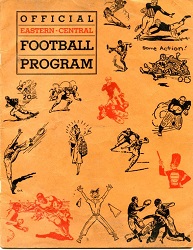 This is the program cover from the 13th annual Football Classic between the Quakers of Eastern and the Big Reds of Central. Fans were requested to “refrain from making unnecessary noise as they drive away from the stadium … due to the nearness of Sparrow Hospital.”
At the time of the 1940 contest, Lansing Central led the series with six wins against five defeats. The series featured a single tie, a 6-6 result in 1935.
Eastern’s 1940 squad, coached by Walter Graff, was able to knot the series at six wins apiece with a thrilling 7- 6 victory over the crosstown rivals, coached by Al Bovard.
The 16-page document was hand set and printed by the Eastern and Central High School Vocational Printing Classes, and included rosters, messages from the two school principals and athletic directors, as well as comments from each member of the coaching staffs, team captains, student council presidents and numerous team members from each school with their views on the game. Of course there is a photograph of each high school football team, but also photos of each band, their directors, and a list of the band members for both Eastern and Central. Finally, there are photos of the Eastern and Central Yell Leaders, nine for the Quakers and six for the Big Reds.
It is a true work of art.
|
1950 |
Central Michigan College Relays |
Track Medal |
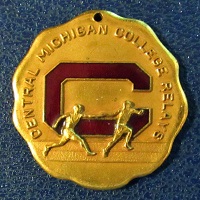 More than 2,300 athletes from 97 high schools descended upon Mt. Pleasant for the Tenth Annual Central Michigan Relays. Ecorse in Class B and Flint School for the Deaf in Class D earned team titles on Friday, May 5th while on Saturday, the 6th, Flint Northern and Milan won Class A and Class C, respectively. Six event records fell during the two-day event, three in the broad jump.
This medal, honoring a member of the winning Class C sprint relay team, was awarded at the event. The winning team, and therefore, the name of the individual awarded the medal, remain a mystery.
|
1962 |
Saginaw Sacred Heart |
Megaphone |
 As at the majority of schools across the state at the time, athletic competition against other schools was not an option for Gloria Groll and her female classmates during her days as a student at Saginaw Holy Rosary High School. So, from the fall of 1959 until her graduation with 27 other students in the spring of 1962, she was a cheerleader for the Greyhounds. This beautiful megaphone, donated by Groll to the Saginaw County Sports Hall of Fame, is a memento from those times.
Holy Rosary was one of nine Catholic high schools operating in the Saginaw area in the 1950s and 1960s. Population shifts from the cities to the suburbs over the coming years would impact enrollment figures at schools nationally. In Saginaw, the opening of the Buena Vista School District in 1956 directly impacted Holy Rosary. In 1970 the school closed. A year later only three schools – SS Peter and Paul, St. Mary and Saginaw St. Stephen – remained. In 1984, those schools were consolidated to form Saginaw Nouvel Catholic Central.
|
1963 & 1930 |
Grosse Pointe St. Paul |
League Trophies |
 On the left, we find the trophy awarded to Grosse Pointe St. Paul's after winning the 1963 city championship. Bob Martin, a 6-foot-6 junior who earned first division all-Catholic honors, scored 14 of his 22 points in the fourth quarter to lead the Lakers to a 55-46 upset-victory over Detroit Pershing. The game was played at University of Detroit Memorial before 6,979 spectators. It was the first time since 1958 that the Catholic League won the annual matchup with the champions of the Public School League.
To the right is the trophy awarded to St. Paul for winning the first golf tournament of the South Michigan Catholic High School League. The school's four golfers shot 710 over 36 holes on the day, 69 fewer strokes than second-place Detroit St. Rose. Played at Clinton Valley, the event saw Bill Beaupre win individual honors with a total of 158, including 76 in the morning. His cousin and teammate, Harold Beaupre, finished second with 169, while Peter Bononis of Detroit Holy Name was third with 171 strokes.
|
1965 |
Fennville vs. Kalamazoo Hackett |
Ticket Stub |
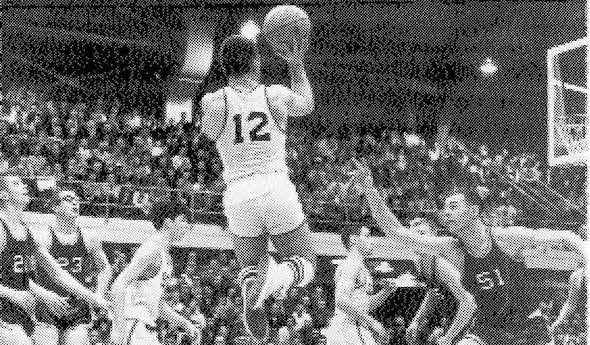
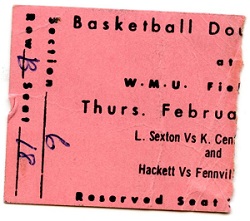 This ticket stub from a doubleheader hosted at Western Michigan University’s Read Fieldhouse on February 18, 1965 was the first chance for many to witness lightning in a bottle. A capacity-plus crowd of 9,100 fans slid through the gate to watch a rumor.
The antics of 5-foot-7½ guard Richie Jordan had been talked about around the Kalamazoo area, but few had actually seen him play. His skills were on full display on this Thursday night, as he netted a fieldhouse scoring record with 49 points in a come-from-behind 76-72 win over a much taller team from Kalamazoo Hackett. Jordan’s output during the evening’s second game eclipsed the 45 points Manny Newsome scored for Western Michigan University against Toledo, just over a year before.
The evening hadn’t started well. According to the Kalamazoo Gazette, “Jordan hit only six of his 13 field shots in the first half and threw the ball away eight times. Trailing Hackett by 17 points, 50-33, with two minutes to play in the third quarter, the Blackhawks were able to cut the deficit to 13, 60-47 as the teams entered the final frame.
Quickly, everyone in the fieldhouse knew who was getting the ball during the comeback attempt. Jordan grabbed control; with his drives for layups and “softly-arched” jump shots against intense pressure, he hit seven of nine field goals, wowing the crowd. With 2:36 to play, Jordan nailed a pair of free throws to tie the game at 72 all. Then, with 57 seconds left, the “Fennville Flash” nailed the go-ahead basket, followed by two insurance free throws to seal the win. For many, his 24 points in the fourth quarter sealed his journey from rumor to legend and, no doubt, inspired the single-sentence first paragraph of the next morning’s coverage in the Gazette.
“Yes, there is a Richie Jordan!”
(P.S. – Kalamazoo Central upset eighth-ranked Lansing Sexton, 67-57, in the evening’s opening contest).
 Ron Pesch has taken an active role in researching the history of MHSAA events since 1985 and began writing for MHSAA Finals programs in 1986, adding additional features and "flashbacks" in 1992. He inherited the title of MHSAA historian from the late Dick Kishpaugh following the 1993-94 school year, and resides in Muskegon. Contact him at [email protected] with ideas for historical articles.
PHOTO: Fennville's Richie Jordan pulls up for a jumper, showing off the form that's become iconic when recalling the high school phenom. (Photos of Letterman's Trophy and Megaphone were provided by Jeffery Cottrell, and photo of Grosse Pointe trophies was provided by Bill Roose.)
Lessons From Banner Run Still Ring True
February 20, 2019
By Tim Miller
Mio teacher, former coach and graduate
If you were to travel to northern Michigan to canoe or fish the famous AuSable River, you might find yourself in a small town named Mio.
With one stoplight and a host of small businesses that line Main Street, Mio is well known for its access to the AuSable River and its high school sports team. And like so many small towns across America, the school is the main focal point of the community. Mio is the home of the Mio Thunderbolts, which is the mascot of the only school in town.
On Saturday, December 29, head boys basketball coach Ty McGregor and fans from around the state gathered in the Mio gymnasium to welcome back two former boys basketball teams. The two teams being honored that night were the 1989 state championship team who went undefeated and the 1978 boys basketball team who made it to the Semifinals.
As we stood there watching the former players of those teams, and coach of the 1978 team Paul Fox, make their way across the gym floor, we were reminded of the deceased players Cliff Frazho, Rob Gusler, Dave Narloch and John Byelich – the coach of the 1989 state championship team – that were no longer with us. All of them leaving us way too soon and a reminder of how fragile life can be.
The ’89 team would be a story in itself. That team was the most dominating team in Mio’s history.
After recognizing these two teams and visiting with many of them in the hallway, I stepped into the gym and began looking at the banners hanging from our walls. I found the state championship banner that the ’89 team won and the ’78 banner, and I began remembering those teams and how they brought so much excitement, happiness and pride to our small community.
Like so many schools throughout the state, the banners are a reminder of a team’s success and the year that it was accomplished. It’s a topic of conversation as former players share their memories with others about the year they earned their spot in history.
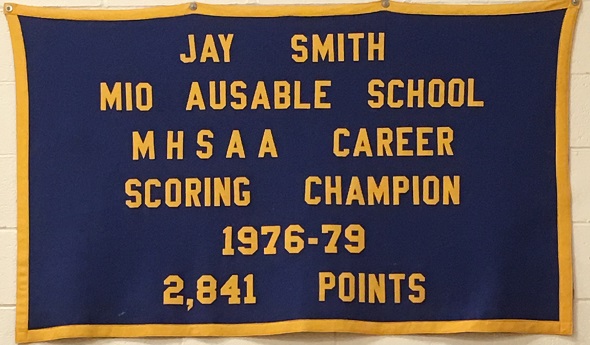
However, hanging on the south wall of the gym, all by itself, is a banner that only hangs from the walls of the Mio AuSable gym. No other school in Michigan has one like it. It has a weathered look, and the color has slightly faded over time. It’s been the conversation piece at deer camp, restaurants, and any other social gathering concerning Mio sports history. Basketball players throughout the state have dreamed of taking it away, but none have succeeded. It’s been hanging there for close to 40 years.
It reads:
Jay Smith
Mio AuSable School
MHSAA Career Scoring Champion
1976 – 1979
2,841 points
That banner represents something far greater than one person’s accomplishments. The story of how it got there and why it hasn’t left is a lesson that every sports team should learn – such a rare story in teamwork, coaching, parental support, the will to win, and the coach who masterfully engineered the plan.
The night Jay Smith broke the state scoring record, the Mio gym was packed with spectators from all parts of Michigan. The game was stopped and people rose to their feet to acknowledge the birthplace of the new record holder. After clapping and cheering for what seemed like an eternity, the ceremony was over and the game went on.
Although I wasn’t on the team, like so many people from Mio, I followed that group of basketball players from gym to gym throughout northern Michigan.
I had a front row seat in the student section where every kid who wasn’t on the team spent their time cheering for the Thunderbolts.
We were led by our conductor, “Wild Bill,” who had a knack for writing the lyrics to many of the cheers the student body used to disrupt our opponents or protest a referee’s call.
The student section was also home to the best pep band around. During home games they played a variety of tunes that kept the gym rocking. They were an integral part of the excitement that took place in that gym, game after game.
 I also ate lunch and hung out at school with some of those guys. I got to hear the details of the game, the strategy, the battles between players, and the game plan for the next rival’s team.
I remember the school spirit, the pep assemblies, and the countless hours our faithful cheerleaders put into making and decorating our halls and gym with posters.
It was like a fourth of July parade that happened every Tuesday and Friday night. The bleachers were filled with people anxiously awaiting tip off.
Showing up late meant you were stuck trying to get a glimpse of the game from the hallway.
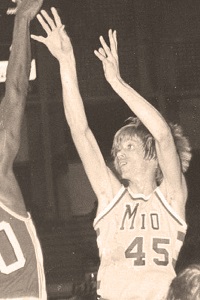
So here’s what I saw. Jay Smith was a tall, skinny kid who could shoot the ball with such accuracy that it must have been miserable for opposing coaches and players. Once it was in his hands, they had two options: watch him score or foul him and hope that he missed the free throws.
If you fouled him, you gambled wrong. He stood there and calmly shot the ball through the hoop with the sound of the net swishing as opposing players and coaches watched helplessly.
If you chose to let him shoot, you lost that bet too.
He shot often and rarely did he miss. It was no secret to our opponents or Jay’s teammates who would be doing the bulk of the shooting in Mio.
The game plan was simple: get the ball to Jay and watch him score. The Thunderbolts were coached by Paul Fox, a teacher at the school. He was demanding and intense as a coach, and his players played hard and respected him both in school and on the court. It wasn’t until I had the opportunity to coach a couple of high school teams that I realized and recognized what an incredible job he did.
I also realized what an outstanding group of players he was blessed to coach.
He was a step ahead of everybody.
Like Bill Belichick the famous coach of the New England Patriots, Paul Fox understood how to build a team around one person. He convinced everyone on the team that the way to the promised land was through the scoring of Jay. However, the type of players who buy into such a plan have to be special. And they were. Jay was blessed his first two years on varsity. He was surrounded by a very talented group of ball players who allowed him to be successful.
His last two teams weren’t as talented, but just as special.
Most of those guys were classmates of mine, so here’s what I can tell you.
Not one time during that stretch did I ever hear one of them complain about playing time. There was no pouting on the bench or kicking it because you were taken out.
No one complained the next day about their stats. They were happy to win, and if that meant Jay shooting most of the time, that was okay with them. After the game, no one ran to the scorer’s table to check their stats. Or went off in the corner of the locker room to act like a preschooler in timeout. Their parents didn’t march over to the coach and demand answers on why their son wasn’t playing or shooting more. Players didn’t quit the team because their individual needs weren’t being met. There were expectations from the coach, the parents, and everyone else involved. After each home game, the whole community gathered at the local bar/ bowling alley. Players, parents, and fans were happy their team had won and celebrated together in the victory. It was a simple blueprint that every sports team should follow.
Forget about your own personal gratification and do what’s best for the team.
It’s a lost concept these days. And the question many of us in Mio talk about from time to time is will the record ever be broken?
There’s more than one factor to consider when discussing the topic.
Jay set that record long before the 3-point shot was implemented.
Can a coach like Paul Fox assemble a group of players who would put their ego aside and desire winning more than their own personal satisfaction?
Can you find a humble kid like Jay who would crush the dreams of opposing teams with his shooting ability?
Can you find a group of parents out there willing to watch a kid like him put on a show, game after game, and not be offended?
 Can you find a student body like the one we had to fill the student section with loud, rowdy fans?
The scoring banner represents the scoring accomplishments of Jay. And to his credit, I never once heard him brag about his success on the court.
He simply said, “We won.”
But that banner represents more than points. It’s an amazing story of what happens when a group of people come together with a common cause – the will to win.
What we saw during that time was special!
The state scoring record was set by Jay and a large list of supporting teammates who helped him.
He was fortunate to have a coach who understood how to manage and convince a group of players to buy into his system.
A group of parents who understood what was going on and supported it.
A student body section that rattled the best players from the other teams game after game.
A dedicated group of cheerleaders who spent countless hours making posters to decorate our school with pride.
A pep band that brought their best sound, game after game.
A teaching staff who understood how a bunch of kids wanted to get ready for the next big game, and gave us their blessing.
It was the culture of our school and community. Get ready for the game.
The anticipation, those long lines waiting outside in the cold, those packed gyms, that noise.
It was all part of it.
Perhaps somewhere in Michigan a group of coaches, players, parents, teachers, and fans could copy the formula from the ’70s that brought our team, school, and town so much success.
If a coach can find a group of players that only care about one thing, and that’s winning, it can be done. Doing that will require a group of people who think they understand the concept to execute it. As a society we see it at every level of sports: the “I” syndrome, the selfishness, the lack of respect for coaches and teammates. It’s the fiber that destroys any chance for success.
My guess is the banner will hang in our gym until someone in the school decides to replace the old one. Perhaps Jay’s children or grandchildren will want the old one to add to their family memorabilia. And after the new one is hung up and another forty years have passed, someone else will write a story about the banner that continues to hang in Mio’s gym.
NOTE: Jay Smith went on to play at Bowling Green and Saginaw Valley State University, and coach at Kent State, University of Michigan, Grand Valley State, Central Michigan, Detroit Mercy, and currently as head coach at Kalamazoo College. He was diagnosed with prostate cancer last summer and faces another round of radiation treatments after undergoing surgery in September. Click for a recent report by WOOD TV.
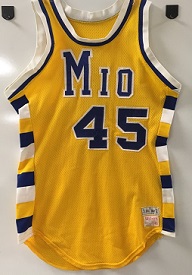
PHOTOS: (Top) The banner celebrating Jay Smith’s state high school career scoring record continues to greet fans at Mio High School’s gym. (Middle) Smith was a standout for the Thunderbolts through his graduation in 1979. (Below) Smith scored 2,841 points over four seasons, averaging 29 points per game.