

Tales of Teams, Trophies & Trinkets - Vol 2
By
Ron Pesch
MHSAA historian
February 9, 2017
A picture may be worth a thousand words – but often, we can learn as much from a traveling trophy, game ticket, and even an old megaphone.
Michigan’s high school sports history is more than a century old and filled with legends passed on of games, teams and athletes and the roles they played as our communities rolled forward toward present day. Following up last year’s “Tales of Teams, Trophies & Trinkets,” we present a second chapter highlighting artifacts that tell some of those stories.
|
1909 |
Saginaw vs. Saginaw Arthur Hill |
Football Trophy |
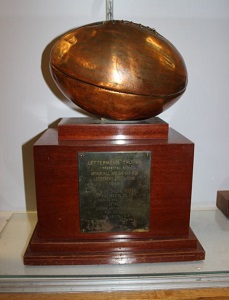 This bronzed football was the original used in the 1909 Thanksgiving Day contest played between Saginaw High and Saginaw Arthur Hill, and won by Saginaw, 5-0 at Burkart Park. In 1948, the ball was stylized into a trophy by the Letterman’s Associations of the rival schools, designed to travel between schools as the reward for winning the annual contest. When the Lumberjacks of Arthur Hill ripped off 24 straight victories beginning in 1971 (the teams played twice in 1974), ownership of the trophy was mostly forgotten. When talk of closing Saginaw High School mounted, the trophy was placed on display at Saginaw’s Castle Museum, then donated to the Saginaw County Sports Hall of Fame.
According to Jeffrey Cottrell, the multi-media specialist at the Historical Society of Saginaw County, when plans to close Saginaw High did not materialize, “it was decided amongst the Saginaw County Sports Hall of Fame and the Arthur Hill Letterwinners Association that it was time to put it back into use. This past fall, the Sports Hall of Fame awarded the trophy to Saginaw High when they beat Arthur Hill 40-0.”
Going forward, the Letterman's Trophy will continue to be presented to the winner of the football game between the Trojans and the Lumberjacks.
|
1921 |
Detroit Cass Tech vs. Flint Central |
Football Program |
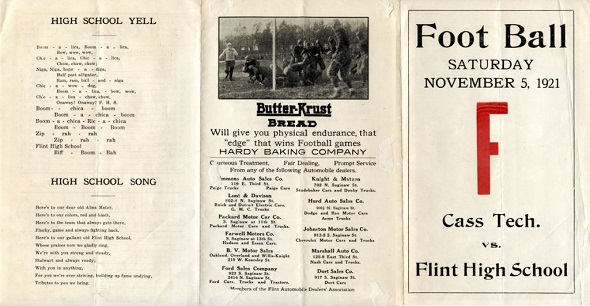
A crowd of 2,500 was on hand for this contest as Detroit Cass Tech downed Flint Central, 34-20, in an aerial battle between the squads. The Detroit Free Press arraigned for a special interurban run, with special railcars earmarked for Cass Tech students interested in attending the Saturday game at Flint. Between 200 to 300 made the trip to cheer their team to victory.
Flint Central completed 14 of 34 passes for 176 yards, but was intercepted on six occasions. Cass Tech arms were accurate on only 7 of 24 attempts for 160 yards, with four interceptions, but two completions went for touchdowns of 18 yards and 50 yards. A third pass of 35 yards helped set up the visitor’s first score. Bruno Murkobred, Cass Tech’s speedy quarterback, was the star of the contest, scoring three of his team’s five touchdowns.
|
1939 |
Kalamazoo Central vs. Battle Creek Central |
Basketball Program |
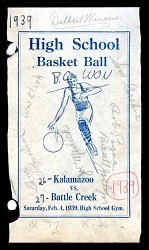 This tattered memento, from a scrapbook kept by historian Dick Kishpaugh, illustrates the modest design of a high school basketball program back in 1939. Likely created by the high school print shop, this single sheet, printed specifically for distribution at the game, features autographs gathered by its owner. Wes Clark, one of the names captured on the cover, led Battle Creek Central with 10 points, including a pair of buckets in the final minute to secure a 27-26 win by the Bearcats.
Newspaper reports from the time indicate that halftime of the contest would feature “a table tennis exhibition between Helen Van Dyke of Flint, four-time state champion, and Floyd Painter, Battle Creek champion.” Miss Van Dyke was a sophomore at Olivet College at the time.
|
1940 |
Lansing Eastern vs. Lansing Central |
Football Program |
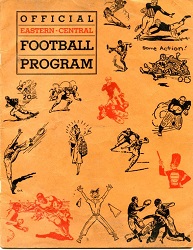 This is the program cover from the 13th annual Football Classic between the Quakers of Eastern and the Big Reds of Central. Fans were requested to “refrain from making unnecessary noise as they drive away from the stadium … due to the nearness of Sparrow Hospital.”
At the time of the 1940 contest, Lansing Central led the series with six wins against five defeats. The series featured a single tie, a 6-6 result in 1935.
Eastern’s 1940 squad, coached by Walter Graff, was able to knot the series at six wins apiece with a thrilling 7- 6 victory over the crosstown rivals, coached by Al Bovard.
The 16-page document was hand set and printed by the Eastern and Central High School Vocational Printing Classes, and included rosters, messages from the two school principals and athletic directors, as well as comments from each member of the coaching staffs, team captains, student council presidents and numerous team members from each school with their views on the game. Of course there is a photograph of each high school football team, but also photos of each band, their directors, and a list of the band members for both Eastern and Central. Finally, there are photos of the Eastern and Central Yell Leaders, nine for the Quakers and six for the Big Reds.
It is a true work of art.
|
1950 |
Central Michigan College Relays |
Track Medal |
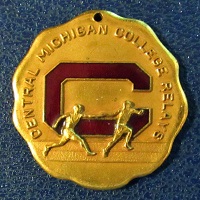 More than 2,300 athletes from 97 high schools descended upon Mt. Pleasant for the Tenth Annual Central Michigan Relays. Ecorse in Class B and Flint School for the Deaf in Class D earned team titles on Friday, May 5th while on Saturday, the 6th, Flint Northern and Milan won Class A and Class C, respectively. Six event records fell during the two-day event, three in the broad jump.
This medal, honoring a member of the winning Class C sprint relay team, was awarded at the event. The winning team, and therefore, the name of the individual awarded the medal, remain a mystery.
|
1962 |
Saginaw Sacred Heart |
Megaphone |
 As at the majority of schools across the state at the time, athletic competition against other schools was not an option for Gloria Groll and her female classmates during her days as a student at Saginaw Holy Rosary High School. So, from the fall of 1959 until her graduation with 27 other students in the spring of 1962, she was a cheerleader for the Greyhounds. This beautiful megaphone, donated by Groll to the Saginaw County Sports Hall of Fame, is a memento from those times.
Holy Rosary was one of nine Catholic high schools operating in the Saginaw area in the 1950s and 1960s. Population shifts from the cities to the suburbs over the coming years would impact enrollment figures at schools nationally. In Saginaw, the opening of the Buena Vista School District in 1956 directly impacted Holy Rosary. In 1970 the school closed. A year later only three schools – SS Peter and Paul, St. Mary and Saginaw St. Stephen – remained. In 1984, those schools were consolidated to form Saginaw Nouvel Catholic Central.
|
1963 & 1930 |
Grosse Pointe St. Paul |
League Trophies |
 On the left, we find the trophy awarded to Grosse Pointe St. Paul's after winning the 1963 city championship. Bob Martin, a 6-foot-6 junior who earned first division all-Catholic honors, scored 14 of his 22 points in the fourth quarter to lead the Lakers to a 55-46 upset-victory over Detroit Pershing. The game was played at University of Detroit Memorial before 6,979 spectators. It was the first time since 1958 that the Catholic League won the annual matchup with the champions of the Public School League.
To the right is the trophy awarded to St. Paul for winning the first golf tournament of the South Michigan Catholic High School League. The school's four golfers shot 710 over 36 holes on the day, 69 fewer strokes than second-place Detroit St. Rose. Played at Clinton Valley, the event saw Bill Beaupre win individual honors with a total of 158, including 76 in the morning. His cousin and teammate, Harold Beaupre, finished second with 169, while Peter Bononis of Detroit Holy Name was third with 171 strokes.
|
1965 |
Fennville vs. Kalamazoo Hackett |
Ticket Stub |
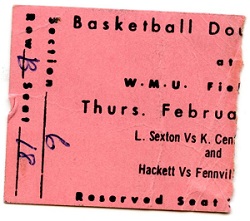 This ticket stub from a doubleheader hosted at Western Michigan University’s Read Fieldhouse on February 18, 1965 was the first chance for many to witness lightning in a bottle. A capacity-plus crowd of 9,100 fans slid through the gate to watch a rumor.
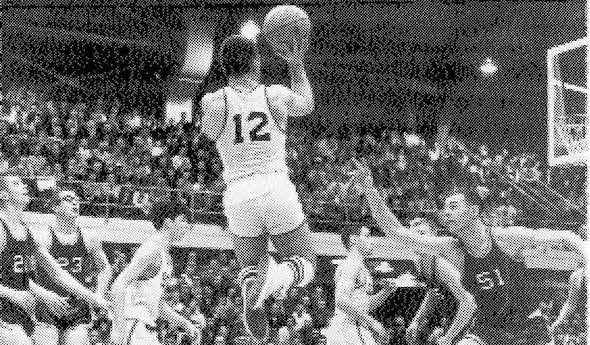
The antics of 5-foot-7½ guard Richie Jordan had been talked about around the Kalamazoo area, but few had actually seen him play. His skills were on full display on this Thursday night, as he netted a fieldhouse scoring record with 49 points in a come-from-behind 76-72 win over a much taller team from Kalamazoo Hackett. Jordan’s output during the evening’s second game eclipsed the 45 points Manny Newsome scored for Western Michigan University against Toledo, just over a year before.
The evening hadn’t started well. According to the Kalamazoo Gazette, “Jordan hit only six of his 13 field shots in the first half and threw the ball away eight times. Trailing Hackett by 17 points, 50-33, with two minutes to play in the third quarter, the Blackhawks were able to cut the deficit to 13, 60-47 as the teams entered the final frame.
Quickly, everyone in the fieldhouse knew who was getting the ball during the comeback attempt. Jordan grabbed control; with his drives for layups and “softly-arched” jump shots against intense pressure, he hit seven of nine field goals, wowing the crowd. With 2:36 to play, Jordan nailed a pair of free throws to tie the game at 72 all. Then, with 57 seconds left, the “Fennville Flash” nailed the go-ahead basket, followed by two insurance free throws to seal the win. For many, his 24 points in the fourth quarter sealed his journey from rumor to legend and, no doubt, inspired the single-sentence first paragraph of the next morning’s coverage in the Gazette.
“Yes, there is a Richie Jordan!”
(P.S. – Kalamazoo Central upset eighth-ranked Lansing Sexton, 67-57, in the evening’s opening contest).
 Ron Pesch has taken an active role in researching the history of MHSAA events since 1985 and began writing for MHSAA Finals programs in 1986, adding additional features and "flashbacks" in 1992. He inherited the title of MHSAA historian from the late Dick Kishpaugh following the 1993-94 school year, and resides in Muskegon. Contact him at [email protected] with ideas for historical articles.
PHOTO: Fennville's Richie Jordan pulls up for a jumper, showing off the form that's become iconic when recalling the high school phenom. (Photos of Letterman's Trophy and Megaphone were provided by Jeffery Cottrell, and photo of Grosse Pointe trophies was provided by Bill Roose.)
Walkerville Earns Back-to-Back Title Trips
January 2, 2019
By Ron Pesch
Special for Second Half
Holton’s trip to the 2018 MHSAA Division 8 Football Semifinals was another return to the past of sorts for Angela Slowik.
Her youngest son, Nathan, was the kicker on the Red Devils football team. The little city celebrated the school’s deep run with public “welcome back” celebrations that were heartwarming and inspirational. Cars and people lined the streets, sirens and horns blasted, and people smiled, cheered and waved as the team returned home.
“I’ve been very fortunate,” said the mother of three. “My daughter’s softball team made it to the state semifinals, my oldest son’s teams went to state in track, and both sons went in cross country. It never gets old.”
The celebrations were strikingly similar to the ones Slowik, formerly Angela Frick, and her high school teammates had experienced in her hometown just more than 30 years ago.
Walkerville is located in Oceana County, 25 miles north of Holton and about 35 miles southeast of Ludington. In the days when girls basketball was played in the fall, the town was gifted two straight MHSAA Class D basketball championships in 1987 and 1988 by its daughters. Christmas had come early.
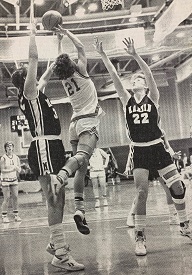 Three players, each graduating a year apart, stood out in the media reports from the time. Angela Frick (now Slowik) was a senior in 1987, a track star and perhaps an even better basketball player. A stellar free-throw shooter, 5-foot-10 Debbie Bettys (now Claeys) was in her junior year in 1987, while Angie Bond (now Patton), a long-range bomber, was a sophomore. They represented an impressive array of talent, but in the eyes of each, Walkerville’s success came from an unselfish, team-first mindset, with starters and non-starters all contributing when needed most.
“That’s what made Walkerville special,” said Patton. “We were a team.”
“It was bigger than you,” added Slowik, describing the feeling. “You were playing for the community.”
“There was just overwhelming support from our area and the surrounding towns,” recalled Claeys.
The area is best known as the “Asparagus Capital of the World.” Little has changed in this farming community, at least population-wise. According to census numbers, Walkerville still totals around 300 residents – but like many school districts, graduating classes are down due to a variety of factors. The area’s migrant worker population has influenced enrollment numbers over the years. Graduating classes were never huge, averaging around 24 students during the championship run.
“That included at least two foreign exchange students in my class,” noted Slowik, laughing.
Girls basketball at Walkerville dates back at least into the early 1930s. You wear many hats at a small school. Home Economics and English instructor Leona Kitchen coached the team from the early 1950s into the late 1960s during the days of the 6-player game.
During the second half of that era, the hoops news out of Walkerville related to a long losing streak by the boys basketball team.
“If there was a “bottom 10” high school basketball poll,” wrote Larry Paladino for The Associated Press in 1975, “Walkerville probably would have led the list at least three years running in the mid-1960s.”
The boys basketball team had landed in the AP’s weekly poll with a 10-0 record and Paladino was discussing the sudden rise in Wildcat stock. According to Woody Millspaugh, head coach of the boys since 1971, the success was due to the creation of an elementary school athletic program that had altered the sports climate at the high school. It was started around the low-point of the streak.
“Kids started developing skills early when they should be developed,” Millspaugh said, referring to teams established for fifth and sixth graders. “The juniors I have now are the first ones who came all the way through the program.”
Girls basketball coach Tom Kicas had been a 1,000-point scorer while in high school at Pentwater. Following graduation from Central Michigan University, he began his teaching career at Walkerville, and led a talented bunch of Wildcats girls to the state quarterfinals in volleyball in the spring of 1977, then to a 20-3 record on the basketball court in the fall of the following school year – a run that included the first District crown in school history. Millspaugh followed Kicas as girls coach in the early 1980s, leading both basketball programs for a short span.
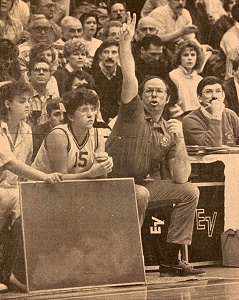 Following his record-setting days playing basketball at Pentwater, Greg Gregwer headed to St. Thomas Aquinas College in Grand Rapids, and then spent two summers in Ecuador with the Peace Corp. When he returned, he took over the boys basketball team at Walkerville for a single season during the 1968-69 school year. The consecutive game losing streak had recently been ended. Gregwer’s team quickly put an end to a conference losing streak that was still active.
“The past records are records, but not ones we want to cling to or even think about,” said Gregwer to the Ludington Daily News in 1968 after that win. “We’re starting it right now.”
In the mid-1980s, Gregwer then took over the girls team from Millspaugh.
“Mr. Gregwer was our sixth grade teacher. He knew us pretty well,” recalled Claeys. “I remember watching my older sisters play basketball. We started playing in fourth grade and rode the bus to games. Not many schools did that, I guess. When I was a sophomore (in 1986), we were pretty good. We won our league for the first time in over a decade, and that was a big deal. But we lost early in the Districts to North Muskegon that year.”
Walkerville trailed the Norsemen by double digits early that day, and the loss may have been inevitable. But it became certain when the Wildcats lost Slowik to a knee injury late in the second quarter. She had torn her meniscus and would require surgery.
“It wasn’t even a question that I was coming back for my senior year,” said Slowik, remembering the time. “I did every one of those exercises they give you to make sure.”
After the team had been eliminated from the postseason, Gregwer suggested to his team that they travel down and watch the girls state championship contests. At the time, the games were held in Allendale at Grand Valley State, about an hour away.
“Of course, it’s not unusual for a team to go watch the games,” said Claeys. “Lots of coaches do that. It was a neat experience to watch. It opened your eyes. You could see how good we could be.”
“We’re watching the games and Debbie suddenly says, ‘We could play here next year,’” said Slowik, laughing about the visit. “I was thinking, ‘Umm. Okay Debbie, we’ll see about that.’ That next year, each win was another stepping stone and I started to believe she was right.”
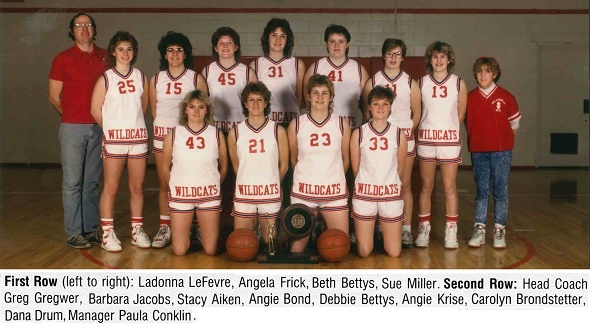 Indeed, the Wildcats, it seemed, could do no wrong in the fall of 1987 and ended the regular season undefeated. They cruised through the early rounds of the tournament, survived a scare in the Regionals against McBain, and then pulled into the Quarterfinals at Wexford Arena in Cadillac (on Slowik’s birthday) with a 25-0 record for their game against Johannesburg-Lewiston.
For the most part, it was business as usual. Walkerville trailed by a point after the first quarter, but outscored the Cardinals 21-9 in the second to take a 39-28 lead into the locker room at the half. The team was up 49-34 late in the third, when the Cards began their comeback. With 50 seconds to play in the quarter, Johannesburg-Lewiston had cut the lead to eight, 55-47. Rattled by the press and man-to-man pressure, the Wildcats turned the ball over repeatedly. With 1:03 left in the game, the teams were tied, 70-70.
Claeys put Walkerville up by a point, 71-70, with a free throw on a one-and-one, but missed the second. Slowik grabbed the rebound and was fouled. With 54 seconds to play, she missed the front end of the opportunity. Cardinals all-stater Vickie Ellison snagged the carom, ran the length of the floor and nailed a jumper with 43 seconds remaining, giving Johannesburg-Lewiston its first lead since the first quarter, 72-71.
Slowik was again fouled with 19 seconds to play, but again missed the first shot of another one-and-one opportunity. Ellison grabbed the board, but this time was immediately fouled by Claeys.
“We had two fouls to give,” said Gregwer following the game. “Debbie did a great job in fouling right away.”
The Cardinals were forced to inbound the ball. On the play, Patton stole the pass, and immediately fed Slowik underneath for an easy lay-up and a 73-72 lead with 12 seconds to go. On another inbounds play, this time at the Cardinals’ end with five seconds remaining, the sophomore guard again stole the ball, and dribbled down court as the horn sounded, sealing the nerve-rattling win.
“I told Angie after the game, ‘Thank you so much. I love you!’” said Slowik, who ended with 38 points on the night. “This is the best birthday I’ve ever had.”
“A friend of mine’s dad was so mad at us for giving up that lead that he went out to the car early and sat there,” Claeys remembered. “Then the crowd came pouring out after the game, celebrating. Then he was mad that he missed it!”
“That was too close,” said Slowik three decades later. “I had missed those free throws. It changed my mindset. After the game, I was in the gym with my track coach and shot free throws over and over. I was not going to let that happen again.”
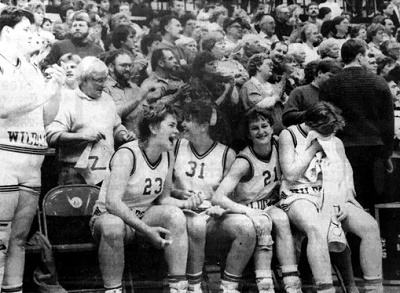 Slowik scored 28 in their 67-52 Semifinal win over DeTour, as the Wildcats advanced to the championship.
“It was just strange that the next year we would be one of the teams playing,” added Claeys. “It was a lot of fun, but it didn’t seem real. Everyone fell into roles, and everything just clicked.”
“Starters and non-starters, all the supporting cast contributed,” said Patton. “No one cared who scored.”
Slowik caught much of the media spotlight as her 99 points over the final three rounds of the tourney set a state mark that still stands today. The total topped the previous mark of 88 points scored by Detroit Northeastern’s Helen Williams in 1975. Slowik’s total was matched by Detroit Country Day’s Peggy Evans in 1989.
Slowik scored 33 points in the Final – a point shy of the then-tournament record for scoring in a championship game – while leading the Wildcats to a 65-59 win over Martin before a packed house of nearly 3,000. The 5-foot-8 forward grabbed 13 offensive rebounds and 16 total, tops in the game.
“We beat No. 1. We were No. 2 in the final poll, so it was considered an upset. But we didn’t necessarily think it was an upset,” exclaimed Claeys laughing and enjoying the memory.
Martin had jumped out to a 19-11 advantage with under a minute to play in the first quarter, led by 5-foot-11 all-stater Julie Davis, who scored 11 of her team’s points. Davis would finish the day with 31.
The 1987 season was the first with the 3-point shot, and Patton was the one girl for Walkerville who had the green light to shoot them anytime she was open. The lightning-quick guard knocked down three of four 3-point shots early and helped to close that gap. The Wildcats were down by only two, 33-31, at the intermission.
“Coach was happy,” said Claeys. “He felt since it was close, we had a chance. We were very fast. If we got into a shootout, we had good outside shooters.”
“I was so pleased at the half that all I did was hug all the girls,” said Gregwer at the time. “We looked to be five points down at the half. If we had been down by more, it wouldn’t have been in our game plan.”
Martin pushed the lead to six, 41-35, on a baseline jumper by Davis with 3:43 to go in the third quarter. But the Wildcats rallied back and the teams were deadlocked, 43-43, entering the fourth. A pair of unexpected buckets late in the game by 5-foot-3 junior Carolyn Brondstetter, the first player off the bench for the Wildcats, put Walkerville up 58-55. It was a lead they wouldn’t relinquish.
The team finished the season with a flawless 28-0 record.
Genealogy roots run deep in small villages like Walkerville, and the championship was celebrated by many with ties to past girls and boys teams. Perhaps the title and the undefeated mark meant the most to the fathers of Slowik, Patton and starting guard Stacy Aiken. Each of the men had been part of the boys program during the long losing streak.
The ride home along the backroads was long, and included tons of well-wishers, pulled off to the side, blasting their horns as the team bus rolled by. Slowik earned first team all-state honors from The Associated Press and the Detroit Free Press at season’s end. In the spring she won two MHSAA track titles and then was off to college.
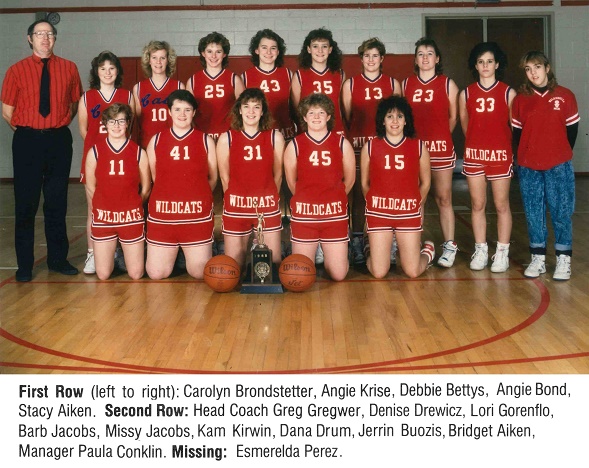
Come the 1988 season, the team’s win streak ended quickly. Early in September, the reigning champs lost their season opener to Kent City, 66-43. Combined with the loss of Slowik to graduation after the 1987 run, statewide expectations fell surprisingly fast.
“After that (first) game I thought, ‘This is going to be a long season. I felt so bad,’” said Claeys, recalling the moment for a Detroit Free Press reporter a few months later.
The team dropped a game to West Michigan D League rival Mason County Eastern in late September, falling to 1-1 in conference play and 6-2 for the season.
“That was tough,” said Patton. “Debbie picked it up a lot. Everyone stepped it up.”
“It just took a while to find our own identity,” said Claeys recalling the challenge. “Then we were good to go.”
The Wildcats didn’t drop another regular-season game that fall, but throughout the span remained unranked in the weekly Detroit Free Press prep rankings and the regular poll conducted by the Basketball Coaches Association of Michigan. Gregwer played up the fact that the team wasn’t getting any respect.
“That inspired me,” said Patton. “Scoring didn’t motivate me. I worked hard and wanted to show other teams that we were real; that we weren’t just some little hick town.”
“Walkerville’s good. I have no idea why they’re not ranked,” said Mason County Eastern coach Kristy Stark following her team’s defeat at the hands of the Wildcats in the Class D Regional Finals. Eastern was ranked 17th in the final coaches poll. Freesoil, another conference foe who was twice beaten by the Wildcats, finished as an honorable mention in that poll.
“They should be in the Top 10 – especially with their reputation from last year,” Stark added. “If they play like they did tonight, they should go quite far. They’re peaking right now, and they look good.”
Claeys, now a senior, finished with 24 points and 16 rebounds in the game, while Patton added 13 points. Brondstetter, now a starter, scored 10 as did backup Missy Jacobs, a freshman who was 6-for-7 at the free throw line.
Once again, the Quarterfinal contest, also played at Wexford, nearly upset the path to glory.
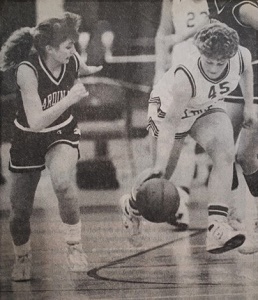 With 2:33 remaining, Walkerville had lost Patton to fouls. Claeys had played like an All-American, scoring 31 points on the night including 12 of the Wildcats’ 17 points in the fourth quarter, but the outcome of the game with Maple City Glen Lake hinged on the shoulders of Jacobs. The freshman was sent to the foul line with the game knotted 57-57 with 34 seconds to play, and hit the first free throw of a one-and-one opportunity.
“After Jacobs’ second free throw missed the mark and bounced off the rim, Glen Lake rebounded the ball and had two more shots to win the game,” wrote Don Vanderveen for the Muskegon Chronicle, “but missed them both.”
“They had a player that hasn’t played much step up to the foul line, and I felt good about that. But then she canned it,” said Maple City coach Ted Swierad about the 58-57 defeat. “Let’s hand it to those girls from Walkerville. I can’t understand why they’re not rated.”
Patton posted the first triple-double in MHSAA title game history, scoring 14 points, dishing out 11 assists and grabbing 10 rebounds, as Walkerville cruised to a 70-52 win over Portland St. Patrick. Claeys poured in 30 points to become the eighth player in Finals history to reach the 30-point plateau. (Two other players would join that exclusive club by the end of the day.) Stacy Aiken added 20 points.
Claeys earned first team all-state from the AP and second team honors from the Free Press, while Patton was named to the fourth team by the Free Press and was an honorable mention by AP. (A year later as a senior, Patton would earn first-team AP all-state and second team honors from the Free Press.)
“The whole gym was packed; look at the photos. It took so long to get back home. Car after car. Sirens and car horns. All the way from GVSU,” remembered Patton. “I loved to ride the bus together, the team atmosphere, listening to music together.”
The school celebrated the 30-year anniversary of the championships this past January, inviting team members back for a dinner, a meeting with the current team and an introduction at the game.
“I still have my MHSAA sweatshirt, so I wore that,” Claeys said, reminiscing about the time.
“(Both years) we had escorts all the way back,” she continued. “We went the long way. We were tired and hungry, and I remember that first year, my sister Beth (the team’s starting center) joked, ‘We’re never getting off this bus.’”
“We just wanted to get home.”
Ron Pesch has taken an active role in researching the history of MHSAA events since 1985 and began writing for MHSAA Finals programs in 1986, adding additional features and "flashbacks" in 1992. He inherited the title of MHSAA historian from the late Dick Kishpaugh following the 1993-94 school year, and resides in Muskegon. Contact him at [email protected] with ideas for historical articles.
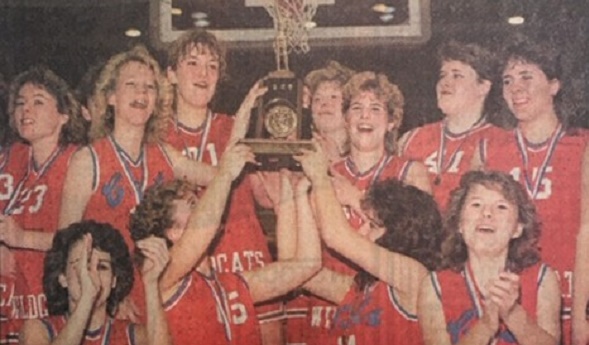
PHOTOS: (Top) Walkerville's 1988 girls basketball team celebrates its second straight Class D title. (2) Angela Frick (21) and her team take on Martin and star Julie Davis (22) in 1987. (3) Coach Greg Gregwer calls the shots from Walkerville's bench. (4) The 1987 Walkerville team. (5) The Wildcats celebrate their 1987 championship game win. (6) The 1988 Walkerville team. (7) Angie Bond (45) pushes the ball upcourt against Johannesburg-Lewiston during the teams' 1987 tournament matchup. (Photos collected by Ron Pesch.)