

Tales of Teams, Trophies & Trinkets - Vol 2
By
Ron Pesch
MHSAA historian
February 9, 2017
A picture may be worth a thousand words – but often, we can learn as much from a traveling trophy, game ticket, and even an old megaphone.
Michigan’s high school sports history is more than a century old and filled with legends passed on of games, teams and athletes and the roles they played as our communities rolled forward toward present day. Following up last year’s “Tales of Teams, Trophies & Trinkets,” we present a second chapter highlighting artifacts that tell some of those stories.
|
1909 |
Saginaw vs. Saginaw Arthur Hill |
Football Trophy |
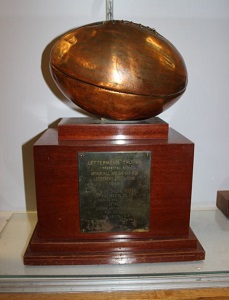 This bronzed football was the original used in the 1909 Thanksgiving Day contest played between Saginaw High and Saginaw Arthur Hill, and won by Saginaw, 5-0 at Burkart Park. In 1948, the ball was stylized into a trophy by the Letterman’s Associations of the rival schools, designed to travel between schools as the reward for winning the annual contest. When the Lumberjacks of Arthur Hill ripped off 24 straight victories beginning in 1971 (the teams played twice in 1974), ownership of the trophy was mostly forgotten. When talk of closing Saginaw High School mounted, the trophy was placed on display at Saginaw’s Castle Museum, then donated to the Saginaw County Sports Hall of Fame.
According to Jeffrey Cottrell, the multi-media specialist at the Historical Society of Saginaw County, when plans to close Saginaw High did not materialize, “it was decided amongst the Saginaw County Sports Hall of Fame and the Arthur Hill Letterwinners Association that it was time to put it back into use. This past fall, the Sports Hall of Fame awarded the trophy to Saginaw High when they beat Arthur Hill 40-0.”
Going forward, the Letterman's Trophy will continue to be presented to the winner of the football game between the Trojans and the Lumberjacks.
|
1921 |
Detroit Cass Tech vs. Flint Central |
Football Program |
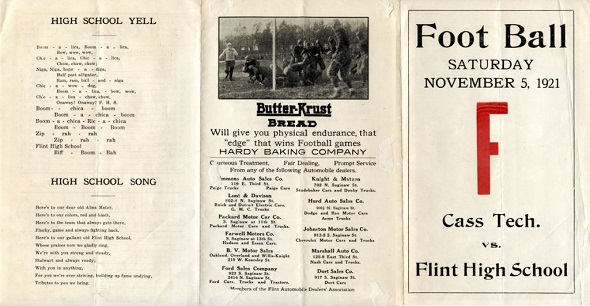
A crowd of 2,500 was on hand for this contest as Detroit Cass Tech downed Flint Central, 34-20, in an aerial battle between the squads. The Detroit Free Press arraigned for a special interurban run, with special railcars earmarked for Cass Tech students interested in attending the Saturday game at Flint. Between 200 to 300 made the trip to cheer their team to victory.
Flint Central completed 14 of 34 passes for 176 yards, but was intercepted on six occasions. Cass Tech arms were accurate on only 7 of 24 attempts for 160 yards, with four interceptions, but two completions went for touchdowns of 18 yards and 50 yards. A third pass of 35 yards helped set up the visitor’s first score. Bruno Murkobred, Cass Tech’s speedy quarterback, was the star of the contest, scoring three of his team’s five touchdowns.
|
1939 |
Kalamazoo Central vs. Battle Creek Central |
Basketball Program |
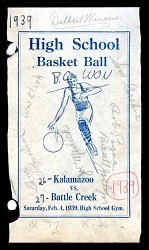 This tattered memento, from a scrapbook kept by historian Dick Kishpaugh, illustrates the modest design of a high school basketball program back in 1939. Likely created by the high school print shop, this single sheet, printed specifically for distribution at the game, features autographs gathered by its owner. Wes Clark, one of the names captured on the cover, led Battle Creek Central with 10 points, including a pair of buckets in the final minute to secure a 27-26 win by the Bearcats.
Newspaper reports from the time indicate that halftime of the contest would feature “a table tennis exhibition between Helen Van Dyke of Flint, four-time state champion, and Floyd Painter, Battle Creek champion.” Miss Van Dyke was a sophomore at Olivet College at the time.
|
1940 |
Lansing Eastern vs. Lansing Central |
Football Program |
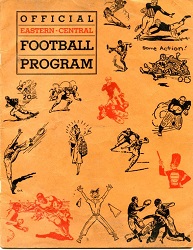 This is the program cover from the 13th annual Football Classic between the Quakers of Eastern and the Big Reds of Central. Fans were requested to “refrain from making unnecessary noise as they drive away from the stadium … due to the nearness of Sparrow Hospital.”
At the time of the 1940 contest, Lansing Central led the series with six wins against five defeats. The series featured a single tie, a 6-6 result in 1935.
Eastern’s 1940 squad, coached by Walter Graff, was able to knot the series at six wins apiece with a thrilling 7- 6 victory over the crosstown rivals, coached by Al Bovard.
The 16-page document was hand set and printed by the Eastern and Central High School Vocational Printing Classes, and included rosters, messages from the two school principals and athletic directors, as well as comments from each member of the coaching staffs, team captains, student council presidents and numerous team members from each school with their views on the game. Of course there is a photograph of each high school football team, but also photos of each band, their directors, and a list of the band members for both Eastern and Central. Finally, there are photos of the Eastern and Central Yell Leaders, nine for the Quakers and six for the Big Reds.
It is a true work of art.
|
1950 |
Central Michigan College Relays |
Track Medal |
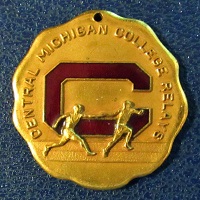 More than 2,300 athletes from 97 high schools descended upon Mt. Pleasant for the Tenth Annual Central Michigan Relays. Ecorse in Class B and Flint School for the Deaf in Class D earned team titles on Friday, May 5th while on Saturday, the 6th, Flint Northern and Milan won Class A and Class C, respectively. Six event records fell during the two-day event, three in the broad jump.
This medal, honoring a member of the winning Class C sprint relay team, was awarded at the event. The winning team, and therefore, the name of the individual awarded the medal, remain a mystery.
|
1962 |
Saginaw Sacred Heart |
Megaphone |
 As at the majority of schools across the state at the time, athletic competition against other schools was not an option for Gloria Groll and her female classmates during her days as a student at Saginaw Holy Rosary High School. So, from the fall of 1959 until her graduation with 27 other students in the spring of 1962, she was a cheerleader for the Greyhounds. This beautiful megaphone, donated by Groll to the Saginaw County Sports Hall of Fame, is a memento from those times.
Holy Rosary was one of nine Catholic high schools operating in the Saginaw area in the 1950s and 1960s. Population shifts from the cities to the suburbs over the coming years would impact enrollment figures at schools nationally. In Saginaw, the opening of the Buena Vista School District in 1956 directly impacted Holy Rosary. In 1970 the school closed. A year later only three schools – SS Peter and Paul, St. Mary and Saginaw St. Stephen – remained. In 1984, those schools were consolidated to form Saginaw Nouvel Catholic Central.
|
1963 & 1930 |
Grosse Pointe St. Paul |
League Trophies |
 On the left, we find the trophy awarded to Grosse Pointe St. Paul's after winning the 1963 city championship. Bob Martin, a 6-foot-6 junior who earned first division all-Catholic honors, scored 14 of his 22 points in the fourth quarter to lead the Lakers to a 55-46 upset-victory over Detroit Pershing. The game was played at University of Detroit Memorial before 6,979 spectators. It was the first time since 1958 that the Catholic League won the annual matchup with the champions of the Public School League.
To the right is the trophy awarded to St. Paul for winning the first golf tournament of the South Michigan Catholic High School League. The school's four golfers shot 710 over 36 holes on the day, 69 fewer strokes than second-place Detroit St. Rose. Played at Clinton Valley, the event saw Bill Beaupre win individual honors with a total of 158, including 76 in the morning. His cousin and teammate, Harold Beaupre, finished second with 169, while Peter Bononis of Detroit Holy Name was third with 171 strokes.
|
1965 |
Fennville vs. Kalamazoo Hackett |
Ticket Stub |
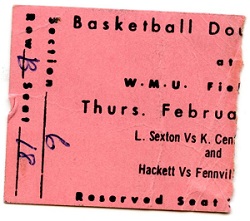 This ticket stub from a doubleheader hosted at Western Michigan University’s Read Fieldhouse on February 18, 1965 was the first chance for many to witness lightning in a bottle. A capacity-plus crowd of 9,100 fans slid through the gate to watch a rumor.
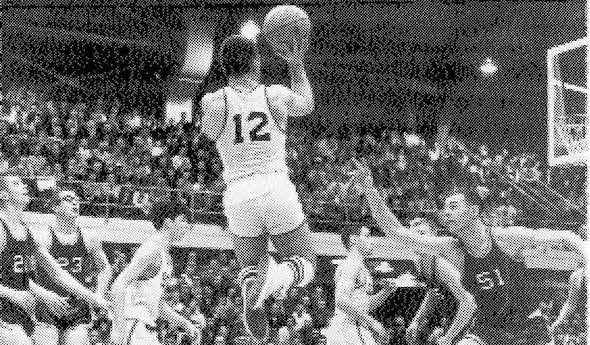
The antics of 5-foot-7½ guard Richie Jordan had been talked about around the Kalamazoo area, but few had actually seen him play. His skills were on full display on this Thursday night, as he netted a fieldhouse scoring record with 49 points in a come-from-behind 76-72 win over a much taller team from Kalamazoo Hackett. Jordan’s output during the evening’s second game eclipsed the 45 points Manny Newsome scored for Western Michigan University against Toledo, just over a year before.
The evening hadn’t started well. According to the Kalamazoo Gazette, “Jordan hit only six of his 13 field shots in the first half and threw the ball away eight times. Trailing Hackett by 17 points, 50-33, with two minutes to play in the third quarter, the Blackhawks were able to cut the deficit to 13, 60-47 as the teams entered the final frame.
Quickly, everyone in the fieldhouse knew who was getting the ball during the comeback attempt. Jordan grabbed control; with his drives for layups and “softly-arched” jump shots against intense pressure, he hit seven of nine field goals, wowing the crowd. With 2:36 to play, Jordan nailed a pair of free throws to tie the game at 72 all. Then, with 57 seconds left, the “Fennville Flash” nailed the go-ahead basket, followed by two insurance free throws to seal the win. For many, his 24 points in the fourth quarter sealed his journey from rumor to legend and, no doubt, inspired the single-sentence first paragraph of the next morning’s coverage in the Gazette.
“Yes, there is a Richie Jordan!”
(P.S. – Kalamazoo Central upset eighth-ranked Lansing Sexton, 67-57, in the evening’s opening contest).
 Ron Pesch has taken an active role in researching the history of MHSAA events since 1985 and began writing for MHSAA Finals programs in 1986, adding additional features and "flashbacks" in 1992. He inherited the title of MHSAA historian from the late Dick Kishpaugh following the 1993-94 school year, and resides in Muskegon. Contact him at [email protected] with ideas for historical articles.
PHOTO: Fennville's Richie Jordan pulls up for a jumper, showing off the form that's become iconic when recalling the high school phenom. (Photos of Letterman's Trophy and Megaphone were provided by Jeffery Cottrell, and photo of Grosse Pointe trophies was provided by Bill Roose.)
Uyl Follows Roberts in MHSAA SUCCESSion
By
Rob Kaminski
MHSAA benchmarks editor
December 7, 2018
The strength of the MHSAA decade after decade has been solid local school administration under the direction of insightful leaders at the state office in Lansing. New Executive Director Mark Uyl is prepared to build on that foundation while meeting challenges old and new as his tenure begins.
Even if he didn’t know it while it was happening, Mark Uyl spent a great deal of his life honing skills that would lead to his selection as the fifth-ever executive director of the Michigan High School Athletic Association.
Growing up in the world of sports officiating, communication, conviction and the ability to enforce rules and regulations come with the territory. Those who can’t cultivate such skills quickly get out, or get found out.
A decorated and lengthy career in officiating at the high school and collegiate levels serve as testimony that Uyl indeed excelled in those areas.
Those traits, Uyl says, figure to serve him well as he trades in his 14-year-old assistant director’s chair for his seat at the helm of the Association.
“I think the biggest adjustment is that you have to have thick skin and the stomach for enforcement of regulations,” Uyl said. “As an assistant director, I worked with committees and forwarded ideas. Now, as the ultimate decision-maker, I know that some people are going to be happy and some will be upset. I understand that some of this comes with territory.
“I think my officiating background helps. At the end of the day, our members expect that we will follow our rules and enforce our rules. Everyone loves having rules until the day comes when those rules affect ‘our school,’ or ‘our community.’ That’s when the ability to stand firm by the rules determined by our membership will help guide us through the process.”
Officials also listen a lot, many times to people who aren’t happy. That, too, is a skill Uyl brings to the table, not only through his experience in stripes or behind the mask, but also from his years as an educator and assistant director with the MHSAA.
“One of the things I am most proud of since coming to the MHSAA is that I believe I served as a caring voice for officials. They are too often the last people to be defended,” Uyl said. “I think people knew they had a guy who could relate to them and was walking in those same shoes. The relationships I was able to build with many officials in our state is important, and I think that's still an incredibly important function today.”
Other satisfactions came from sports more unfamiliar to Uyl prior to his employment at the MHSAA. Again, listening proved valuable.
“Directing our cross country and wrestling tournaments for many years taught me to be a better listener. Some of the really good things we did in both those sports were improved because we listened to those in the trenches,” Uyl said. “It was a really good lesson. I was probably a better administrator in cross country and wrestling because I was less familiar with those sports and relied on committee expertise. I know baseball, and because of that maybe had too many sacred cows – so to speak – and maybe wouldn’t be as open to ideas.”
Prior to his time at the MHSAA, Uyl first taught and coached and then served as athletic director and assistant principal at Middleville Thornapple-Kellogg High School, the latter from 2001-04. Before becoming an administrator there, Uyl served as athletic director at Caledonia High School in 2000-01.
In his 20-plus years of involvement with educational athletics plenty has changed, some for better and some for worse. Ironically, Uyl cites the same catalyst for both ends of the spectrum.
“Where sports have changed for the better, there are more opportunities than there have ever been. The number of sports – not only in-season, but out-of-season – has increased. There are more options available than ever before. That is often a good thing for kids,” he said.
“But, one of the biggest threats to school sports is the non-school sports economy. More people are making more money at youth, travel and club sport levels. Teachers and coaches in school sports are there to help students learn and grow, to become better people – not just athletes. That’s not always the case outside school sports. Too often, there’s a business dynamic that comes with those sports programs. Parents are quicker to get upset because of the money they've invested; they perceive that their kids are shortchanged by coaches’ decisions or officials’ calls.”
Such experiences can put a dent in officials retention throughout the state, a trend that needs to be reversed.
Uyl knows first-hand the values of positive early experiences in officiating.
“My dad has now been a registered official for 50 years. I grew up seeing what it was like to be an official,” Uyl said. “He ran the youth football, basketball and baseball leagues, and when your dad runs the youth program, you become an emergency official. I’ve always been kind of a rules guy anyway, so I liked that aspect and I also liked the money it put in my pocket. That was my job. I never had a job in fast food, landscaping, or anything like that. It was officiating.”
Uyl officiated collegiate baseball from 1997 until last June, putting away the gear following his 11th NCAA Division I Regional assignment. Working major conference baseball across the United States already put Uyl in elite company, but the pinnacle came with his appointment to the 2014 and 2017 College World Series crews in Omaha. He served as a college football referee for 10 years with several NCAA postseason assignments, and was coordinator of officials for the Michigan Intercollegiate Athletic Association. He was registered with the MHSAA for at least three sports beginning in 1992 and worked the Baseball Finals in 1999.
Uyl graduated from Caledonia High School in 1992 and from Calvin College in 1996 with a bachelor’s degree in history and physical education. He later received a master’s in educational leadership from Grand Valley State University. At Calvin, Uyl was a four-year starter on the baseball team, earning all-conference honors twice and serving as team captain.
Following college, there was little doubt as to his career path.
“In high school, I was just very, very fortunate to have a handful of people who made a huge impact on me as role models. Those people were teachers and coaches,” Uyl said. “I thought, ‘These are pretty impressive people, and hopefully there will be a day when I can give others the same kind of great experiences I had.’ Those coaches and teachers at Caledonia were great motivators.”
His passion for education and athletics made it difficult to imagine ever wanting to make a change professionally, until the opportunity at the MHSAA presented itself. Again, it was officiating that helped tilt the scales.
“At that time it was probably the hardest decision I have had to make in my life because I enjoyed teaching and coaching so much, but saw this opportunity in 2004 as the chance of a lifetime,” Uyl recalled. “Being able to help train and support 10,000 officials statewide was too good of an opportunity. If I didn't like officiating so much, I'd likely have stayed in the school system.”
As a sport director, Uyl has sought to create the best experiences for Michigan high school teams, including with the move of the MHSAA Baseball and Softball Finals to Michigan State University in 2014.
 “The foundation built here by Jack Roberts over the last 32 years is the strongest in the country, and I’m honored to have the opportunity to lead our staff in building on that foundation,” Uyl said. “There will be many ways we’ll continue to protect the same values of educational athletics, while also looking for new ways and new opportunities to best serve the students and our member schools in Michigan.”
As assistant director, Uyl was instrumental as the MHSAA became the first state high school athletic association to offer concussion care insurance, which provides gap coverage to assist in covering costs for athletes who are injured while participating in MHSAA-sponsored sports.
As the new school year is underway with more immediate targets such as the changing transfer rule for 2019-20 and football playoffs and scheduling, Uyl and the MHSAA staff will also keep the well-being of student-athletes in their scope.
“Shortly after beginning my new role here, I met with some folks in the medical community, and it was interesting to hear that mental health among adolescents has become a huge priority,” Uyl said. “I had a doctor tell me that where he used to spend most of his days treating injuries and illnesses, now it’s just as much – or more – depression, anxiety and other mental health issues among school-age children that he is seeing. This certainly is an area that we have to keep at the forefront; how can we assist or provide programs to heighten awareness?
“We always assume that kids who play sports are the most healthy because they are busy and engaged and have it together, but now we are hearing that there are real mental topics that we need to discuss.”
Another long-range and continuing point of emphasis focuses on participation and multi-sport participation.
“While we have decisions to make regarding football playoffs and scheduling, the conversation needs to turn to participation numbers in that sport,” Uyl said. “We are losing freshman teams, JV teams, and at the youth level the numbers are down, too. Communities that used to have three and four teams now have one. If we don’t get our arms around participation, then all the playoff and scheduling stuff won’t matter in a few years.”
Participation is a hot topic for more than just the traditional sports like football. The MHSAA will continue to focus efforts toward multi-sport participation to combat specialization trends, and also bolster its presence at the junior high/middle school level, where students get their first taste of school-based athletics.
And even with 18 sports available to MHSAA member schools, Uyl promises to evaluate changing interests of students, which could lead to expanded opportunities.
“We will look with an objective eye to determine whether what we've traditionally offered continues to fit, and also look at expansion,” Uyl said. “The one that gets eyes rolling to anyone over 35 is e-sports, but to 20-somethings that could be the next big thing. We will also continue to be an inclusive organization, working closely with organizations such as Special Olympics. Our goal and purpose needs to involve all kids as their interests change with the times.”
Uyl is the fifth full-time executive in the MHSAA’s 94-year history, following Charles E. Forsythe (1931-42, 1945-68), Allen W. Bush (1968-78), Vern L. Norris (1978-86) and Roberts (1986-2018).
Uyl resides in DeWitt with his wife Marcy, an accomplished educator who has served as a high school varsity basketball coach since 1994. They have three children: Jackson (17), Grant (15) and Madison (11).
“Mark was the obvious choice to become the next executive director of the MHSAA,” said Roberts, who passed the torch after 32 years, and whose name now adorns the Association’s headquarters on Ramblewood Drive in East Lansing. “Mark has the proper student-focused perspective of educational athletics, excellent person-to-person communications skills and a deep practical understanding of what is happening day to day in school sports here and nationally.”
As they say in officiating, it was a good call.
Leading State's Schools a Labor of Love
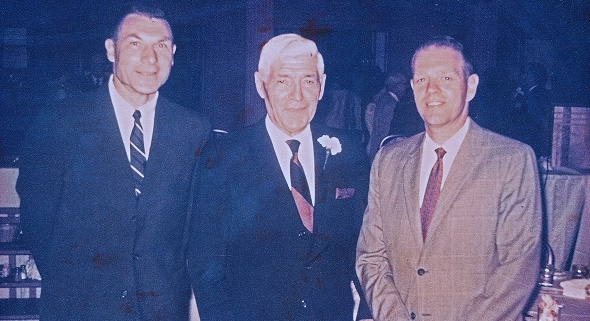
The names – Norris, Bush, Forsythe – at one time synonymous with school sports in Michigan, are sometimes today more connected to MHSAA awards or meeting rooms at the home office in East Lansing.
But before the Norris Award recognized excellence in officiating, or the Bush Award lauded contributions to the MHSAA, or the Forsythe Award heralded excellence in athletics, these were the men who captained the MHSAA ship ahead of recently retired Jack Roberts.
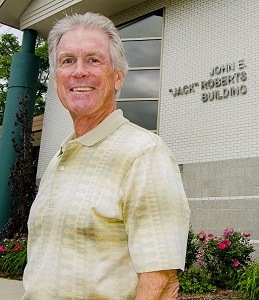
Charles Forsythe was the MHSAA’s first executive director, guiding the Association from 1931-68. He was followed by Allen Bush, who took the reins from 1968-78 after serving under Forsythe as an assistant director from 1960-63 and as associate director from 1963-68. Vern Norris succeeded Bush in 1978 and would direct the MHSAA until 1986. From there it would be Roberts, whose 32-year term was second in length only to Forsythe’s span. During Roberts’ final days in August, he enjoyed a ceremony during which the current MHSAA building was named for him.
The four former executive directors had in common the traits of leadership, vision and passion, and always placed the good of scholastic sports at the forefront when weighing proposals and decisions.
The MHSAA was founded in 1924, when a different Forsythe, L.L., began an 18-year term as president of its Representative Council. In 1931, Charles Forsythe became the MHSAA’s first full-time executive director, a post he would occupy for 37 years.
A native of Milan and graduate of University of Michigan, Charles Forsythe was the athletic director at Lansing Central High School from 1923 until 1929 when he became the assistant director of athletics with the MHSAA. Two years later, he became the first executive director, guiding the Association until 1968 for all but a 37-month tour during World War II as a Navy Commander.
Forsythe was one of the first and finest authors on the topic of interscholastic athletics, and his “Administration of high school athletics” was used by administrators around the globe at that time.
In 1951, he received the Honor Award for the American Association for Health, Physical Education and Recreation, and in 1965 Eastern Michigan University presented him with an honorary Doctor of Laws degree.
Forsythe died in December 1968, months after his August retirement from the MHSAA.
Bush served under Forsythe from 1960 until he began his 10-year term as executive director in 1968. Bush oversaw some of the most significant developments in MHSAA history, chiefly the addition of girls sports – MHSAA tournaments existed for nine girls sports when he retired – plus the addition of football playoffs in 1975, and MHSAA tournaments in baseball, ice hockey and skiing.
Bush was a graduate of Kalamazoo University and later earned multiple bachelor’s degrees from Western Michigan University and a master’s in school administration from University of Michigan. He was captain of the football team at WMU and received its Most Valuable Player and Athletic-Scholarship awards as a senior, and later was named Man of the Year in 1975 by WMU’s Alumni W Club.
Bush also studied at Princeton University and the University of Arizona and served six years of active duty with the U.S. Marine Corps during World War II and the Korean War. He was discharged with a rank of first lieutenant.
Bush died in 2013 at age 90.
Norris served under both Forsythe and Bush, beginning his work at the MHSAA in 1963. He would succeed Bush at the top in 1978.
Norris brought to the MHSAA a wealth of experience having coached at Traverse City, Rockford and Hillsdale high schools. He served as Assistant Director of Placement at Western Michigan University for the five years prior to joining the MHSAA staff, and during that time Norris built a reputation as a highly-regarded game official in the Kalamazoo area – and worked as a referee during the 1963 MHSAA Class A Boys Basketball Final.
Norris served on a number of national rules-making bodies during his 23-year tenure with the MHSAA, and as president of the Executive Board of the National Federation of State High School Associations (NFHS) during the 1983-84 school year. But he was best known for his work with Michigan’s coaches and especially officials.
Norris remained a frequent visitor to the MHSAA office prior to his death last February.
Roberts took the controls in 1986 at age 37, then the youngest leader of a high school athletic association, and would leave last August as the longest-serving active director in the nation after 32 years.
Under Roberts’ leadership, overall participation in high school athletics in Michigan increased 10 percent, and the MHSAA added more than 200 schools in increasing its membership by more than 15 percent at the high school and junior high/middle school levels combined. Most recently, in 2016, 6th-graders were allowed to compete for member schools for the first time as a push was made to increase junior high/middle school membership and serve the state’s students at an earlier age.
But the most significant and arguably lasting work influenced by Roberts came on topics not related to specific sports or competition. The MHSAA has led nationally in concussion care with its first programming in 2000 and return-to-play protocols enacted in 2010, and with concussion pilot testing, mandated reporting and insurance for those who suffer head injuries rolled out in 2015.
He is a 1970 graduate of Dartmouth College and previously served as an assistant director for the National Federation from 1973-80. He came to the MHSAA in 1986 from the Fellowship of Christian Athletes.
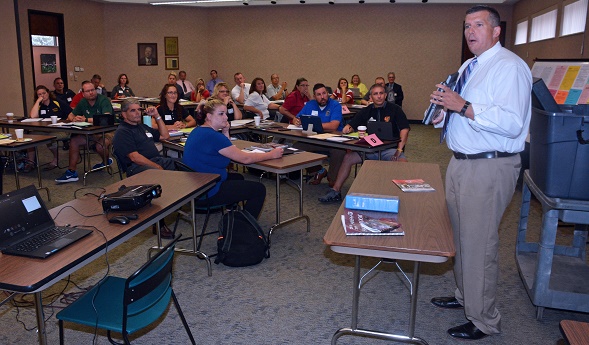
PHOTOS: (Top) MHSAA Executive Director Mark Uyl speaks during an in-service for new athletic directors this fall. (Middle) Jack Roberts stood this summer in front of the building that now bears his name. (Below) Al Bush, Charles Forsythe and Vern Norris.