

Tales of Teams, Trophies & Trinkets - Vol 2
By
Ron Pesch
MHSAA historian
February 9, 2017
A picture may be worth a thousand words – but often, we can learn as much from a traveling trophy, game ticket, and even an old megaphone.
Michigan’s high school sports history is more than a century old and filled with legends passed on of games, teams and athletes and the roles they played as our communities rolled forward toward present day. Following up last year’s “Tales of Teams, Trophies & Trinkets,” we present a second chapter highlighting artifacts that tell some of those stories.
|
1909 |
Saginaw vs. Saginaw Arthur Hill |
Football Trophy |
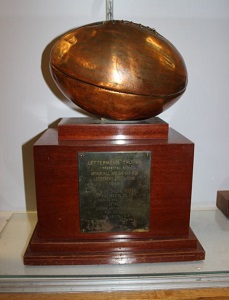 This bronzed football was the original used in the 1909 Thanksgiving Day contest played between Saginaw High and Saginaw Arthur Hill, and won by Saginaw, 5-0 at Burkart Park. In 1948, the ball was stylized into a trophy by the Letterman’s Associations of the rival schools, designed to travel between schools as the reward for winning the annual contest. When the Lumberjacks of Arthur Hill ripped off 24 straight victories beginning in 1971 (the teams played twice in 1974), ownership of the trophy was mostly forgotten. When talk of closing Saginaw High School mounted, the trophy was placed on display at Saginaw’s Castle Museum, then donated to the Saginaw County Sports Hall of Fame.
According to Jeffrey Cottrell, the multi-media specialist at the Historical Society of Saginaw County, when plans to close Saginaw High did not materialize, “it was decided amongst the Saginaw County Sports Hall of Fame and the Arthur Hill Letterwinners Association that it was time to put it back into use. This past fall, the Sports Hall of Fame awarded the trophy to Saginaw High when they beat Arthur Hill 40-0.”
Going forward, the Letterman's Trophy will continue to be presented to the winner of the football game between the Trojans and the Lumberjacks.
|
1921 |
Detroit Cass Tech vs. Flint Central |
Football Program |
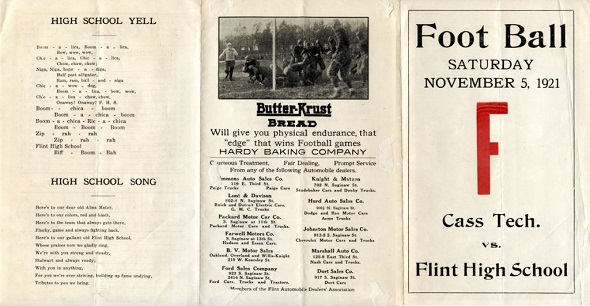
A crowd of 2,500 was on hand for this contest as Detroit Cass Tech downed Flint Central, 34-20, in an aerial battle between the squads. The Detroit Free Press arraigned for a special interurban run, with special railcars earmarked for Cass Tech students interested in attending the Saturday game at Flint. Between 200 to 300 made the trip to cheer their team to victory.
Flint Central completed 14 of 34 passes for 176 yards, but was intercepted on six occasions. Cass Tech arms were accurate on only 7 of 24 attempts for 160 yards, with four interceptions, but two completions went for touchdowns of 18 yards and 50 yards. A third pass of 35 yards helped set up the visitor’s first score. Bruno Murkobred, Cass Tech’s speedy quarterback, was the star of the contest, scoring three of his team’s five touchdowns.
|
1939 |
Kalamazoo Central vs. Battle Creek Central |
Basketball Program |
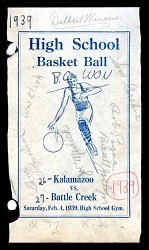 This tattered memento, from a scrapbook kept by historian Dick Kishpaugh, illustrates the modest design of a high school basketball program back in 1939. Likely created by the high school print shop, this single sheet, printed specifically for distribution at the game, features autographs gathered by its owner. Wes Clark, one of the names captured on the cover, led Battle Creek Central with 10 points, including a pair of buckets in the final minute to secure a 27-26 win by the Bearcats.
Newspaper reports from the time indicate that halftime of the contest would feature “a table tennis exhibition between Helen Van Dyke of Flint, four-time state champion, and Floyd Painter, Battle Creek champion.” Miss Van Dyke was a sophomore at Olivet College at the time.
|
1940 |
Lansing Eastern vs. Lansing Central |
Football Program |
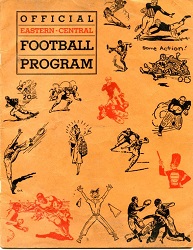 This is the program cover from the 13th annual Football Classic between the Quakers of Eastern and the Big Reds of Central. Fans were requested to “refrain from making unnecessary noise as they drive away from the stadium … due to the nearness of Sparrow Hospital.”
At the time of the 1940 contest, Lansing Central led the series with six wins against five defeats. The series featured a single tie, a 6-6 result in 1935.
Eastern’s 1940 squad, coached by Walter Graff, was able to knot the series at six wins apiece with a thrilling 7- 6 victory over the crosstown rivals, coached by Al Bovard.
The 16-page document was hand set and printed by the Eastern and Central High School Vocational Printing Classes, and included rosters, messages from the two school principals and athletic directors, as well as comments from each member of the coaching staffs, team captains, student council presidents and numerous team members from each school with their views on the game. Of course there is a photograph of each high school football team, but also photos of each band, their directors, and a list of the band members for both Eastern and Central. Finally, there are photos of the Eastern and Central Yell Leaders, nine for the Quakers and six for the Big Reds.
It is a true work of art.
|
1950 |
Central Michigan College Relays |
Track Medal |
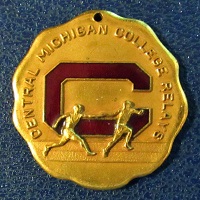 More than 2,300 athletes from 97 high schools descended upon Mt. Pleasant for the Tenth Annual Central Michigan Relays. Ecorse in Class B and Flint School for the Deaf in Class D earned team titles on Friday, May 5th while on Saturday, the 6th, Flint Northern and Milan won Class A and Class C, respectively. Six event records fell during the two-day event, three in the broad jump.
This medal, honoring a member of the winning Class C sprint relay team, was awarded at the event. The winning team, and therefore, the name of the individual awarded the medal, remain a mystery.
|
1962 |
Saginaw Sacred Heart |
Megaphone |
 As at the majority of schools across the state at the time, athletic competition against other schools was not an option for Gloria Groll and her female classmates during her days as a student at Saginaw Holy Rosary High School. So, from the fall of 1959 until her graduation with 27 other students in the spring of 1962, she was a cheerleader for the Greyhounds. This beautiful megaphone, donated by Groll to the Saginaw County Sports Hall of Fame, is a memento from those times.
Holy Rosary was one of nine Catholic high schools operating in the Saginaw area in the 1950s and 1960s. Population shifts from the cities to the suburbs over the coming years would impact enrollment figures at schools nationally. In Saginaw, the opening of the Buena Vista School District in 1956 directly impacted Holy Rosary. In 1970 the school closed. A year later only three schools – SS Peter and Paul, St. Mary and Saginaw St. Stephen – remained. In 1984, those schools were consolidated to form Saginaw Nouvel Catholic Central.
|
1963 & 1930 |
Grosse Pointe St. Paul |
League Trophies |
 On the left, we find the trophy awarded to Grosse Pointe St. Paul's after winning the 1963 city championship. Bob Martin, a 6-foot-6 junior who earned first division all-Catholic honors, scored 14 of his 22 points in the fourth quarter to lead the Lakers to a 55-46 upset-victory over Detroit Pershing. The game was played at University of Detroit Memorial before 6,979 spectators. It was the first time since 1958 that the Catholic League won the annual matchup with the champions of the Public School League.
To the right is the trophy awarded to St. Paul for winning the first golf tournament of the South Michigan Catholic High School League. The school's four golfers shot 710 over 36 holes on the day, 69 fewer strokes than second-place Detroit St. Rose. Played at Clinton Valley, the event saw Bill Beaupre win individual honors with a total of 158, including 76 in the morning. His cousin and teammate, Harold Beaupre, finished second with 169, while Peter Bononis of Detroit Holy Name was third with 171 strokes.
|
1965 |
Fennville vs. Kalamazoo Hackett |
Ticket Stub |
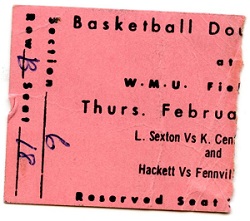 This ticket stub from a doubleheader hosted at Western Michigan University’s Read Fieldhouse on February 18, 1965 was the first chance for many to witness lightning in a bottle. A capacity-plus crowd of 9,100 fans slid through the gate to watch a rumor.
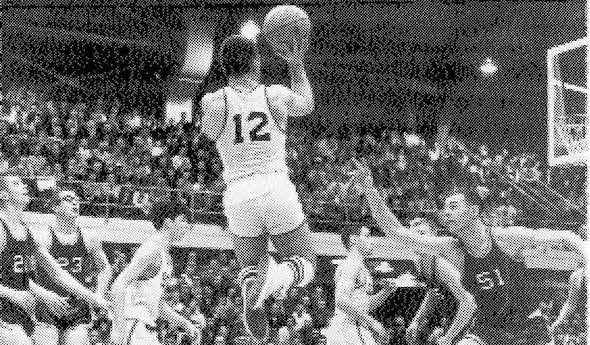
The antics of 5-foot-7½ guard Richie Jordan had been talked about around the Kalamazoo area, but few had actually seen him play. His skills were on full display on this Thursday night, as he netted a fieldhouse scoring record with 49 points in a come-from-behind 76-72 win over a much taller team from Kalamazoo Hackett. Jordan’s output during the evening’s second game eclipsed the 45 points Manny Newsome scored for Western Michigan University against Toledo, just over a year before.
The evening hadn’t started well. According to the Kalamazoo Gazette, “Jordan hit only six of his 13 field shots in the first half and threw the ball away eight times. Trailing Hackett by 17 points, 50-33, with two minutes to play in the third quarter, the Blackhawks were able to cut the deficit to 13, 60-47 as the teams entered the final frame.
Quickly, everyone in the fieldhouse knew who was getting the ball during the comeback attempt. Jordan grabbed control; with his drives for layups and “softly-arched” jump shots against intense pressure, he hit seven of nine field goals, wowing the crowd. With 2:36 to play, Jordan nailed a pair of free throws to tie the game at 72 all. Then, with 57 seconds left, the “Fennville Flash” nailed the go-ahead basket, followed by two insurance free throws to seal the win. For many, his 24 points in the fourth quarter sealed his journey from rumor to legend and, no doubt, inspired the single-sentence first paragraph of the next morning’s coverage in the Gazette.
“Yes, there is a Richie Jordan!”
(P.S. – Kalamazoo Central upset eighth-ranked Lansing Sexton, 67-57, in the evening’s opening contest).
 Ron Pesch has taken an active role in researching the history of MHSAA events since 1985 and began writing for MHSAA Finals programs in 1986, adding additional features and "flashbacks" in 1992. He inherited the title of MHSAA historian from the late Dick Kishpaugh following the 1993-94 school year, and resides in Muskegon. Contact him at [email protected] with ideas for historical articles.
PHOTO: Fennville's Richie Jordan pulls up for a jumper, showing off the form that's become iconic when recalling the high school phenom. (Photos of Letterman's Trophy and Megaphone were provided by Jeffery Cottrell, and photo of Grosse Pointe trophies was provided by Bill Roose.)
Michigan Boys Take the Swimming Plunge
November 30, 2018
By Ron Pesch
Special for Second Half
It was late March. Dressed in his black silk swimsuit adorned with an orange letter “J,” James Dingman stood 18 inches above the waterline, perched on a spring-less board. In 60 seconds it would be over.
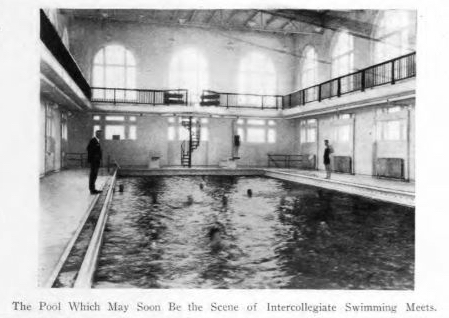
With his arms outstretched into an inverted “V,” he dove face first into the 90-foot swimming pool. The tank, 30 feet wide, and located on the campus of Michigan Agricultural College (now Michigan State University), was the largest of its kind in the Midwest and measured 15 feet longer than a standard competitive pool.
“The aim of all plungers should be to leap as high into the air as possible and as far out as an open jack-knife will carry,” wrote Tom J. Clemens in the 1919-20 edition of the Wilson Athletic Library Official Swimming Guide, the bible of instruction and rules for swimming, diving, water games and lifesaving. “Nearly all plungers dive too flatly,” added the coach of the Detroit Y.M.C.A. swimming team. “A plunge is only as good as the dive.”
How long Dingman remained under water or at what distance he surfaced is not recorded. According to Clemens, a dive might bring the body to within six inches of the bottom of the pool. The best plungers remain under water as long as possible, angling upward at 40 degrees just as the force of the dive is spent. Record holders would surface 40 to 50 feet out into the water.
Upon surfacing, as per the rules of the event, Dingman glided along the surface, without the aid of propulsion from his arms or legs, for a measured distance of 63 feet. The mark fell two feet short of his performance in the prelims. Still, it was the best of the day and earned him a first place finish at the 1925 team state swimming championships.
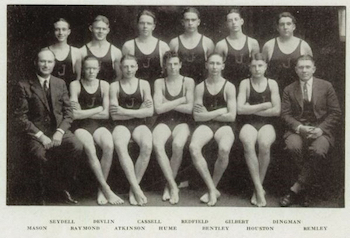 While its origins are unclear, the plunge for distance dates back to at least 1865. In 1904, it appeared as an Olympic diving event, and then disappeared from the games. By the 1920s, it was rapidly losing popularity. The plunge appeared only twice in the Michigan high school state title meets. The first time was in 1924 in what was Michigan’s first swimming and diving championships. Sanctioned by the Michigan Interscholastic Athletic Association (MIAA), the immediate predecessor to the modern-day Michigan High School Athletic Association (MHSAA), a total of nine teams – Northern, Northwestern and Southeastern, all of Detroit; Highland Park, Ann Arbor, Jackson, Lansing, Battle Creek Lakeview and Flint Central – took part in the event.
The 1925 championships was the first run by the MHSAA. Also staged at the M.A.C. pool, it featured a 10th team – Detroit Cass Tech. Dingman’s performance, combined with teammate Dick Seydell’s surprising first-place finish in the fancy diving competition and Jack Redfield’s second in the 100-yard freestyle, helped Jackson High School earn an unexpected runner-up finish in only its second year of competition.
Following the actions of the NCAA, the state association removed the plunge from the schedule of competition prior the 1926 championship meet.
Fancy diving and my plunge into uncharted waters
My ‘job” as MHSAA historian, (which is really just a fascination with prep sports history) has always been to fill in holes that surface when I, the various members of the MHSAA staff or the state’s television, radio or newspaper media, seek answers to a question. I’m a detail guy, who earned my living as a business analyst compiling, normalizing and studying data. I love diving deeper into information, completing lists and unearthing stories to tell.
From the first trophy awarded by the MHSAA in 1925, and then for the next 20 years, the state’s 35 team swimming championships never strayed beyond the borders of four Michigan counties: Wayne, Washtenaw, Calhoun and Jackson. Two of those counties, Washtenaw and Calhoun, accounted for 24 of those 35 titles.
Within those borders, only eight schools claimed titles during those two decades, with two schools combining for 18 of those awarded championships.
Detroit dominates
The Detroit area dominated statewide competition in the earliest days. The metro area boasted many of the state’s finest high schools, offering students, male and female, a wide array of athletic facilities and opportunities. During the 1920s, the schools dominated across a variety of sports, including swimming where Detroit Northwestern, Detroit Northern and Highland Park battled for annual city, state and, often, mid-west supremacy.
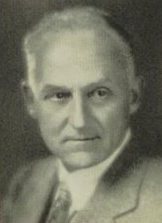 From 1925-1927, Detroit Northwestern, coached by Bert Maris, won the MHSAA’s Open Class swimming competitions, featuring all schools regardless of enrollment. A former coach at University of Michigan and Notre Dame, Maris accepted the position of athletic director at the newly-opened Northwestern High School in 1914, and stayed for 28 seasons before retiring in 1942. Like many mentors from the era, he coached multiple sports, winning state titles in basketball, track, and swimming. Over the years he worked with an amazing number of athletes, including football legend Knute Rockne and track stars Eddie Tolan and Willis Ward. Maris’ teams actually won four swimming titles in a row, as Northwestern topped Jackson in that 1924 MIAA prep championship. That meet featured eight events. Besides the plunge, and fancy diving, it included the 50, 100 and 220-yard freestyles, the 50-yard breaststroke, the 50-yard backstroke, and the 120-yard relay.
The 1925 meet, in which Dingman competed, included the same events and added the 300-yard medley relay, comprised of the 60-yard backstroke, 60-yard freestyle, 60-yard breaststroke and 120-yard free. While Northwestern repeated as team champion, Gurdon Guile of Flint Central “was the star of the meet, with a first in the 100-yard freestyle and a second in the 50-yard freestyle.”
OPEN CLASS
|
Year |
Champion (Coach) |
Runner-Up |
|
1925 |
Detroit Northwestern (Bert Maris) |
Jackson |
|
1926 |
Detroit Northwestern (Bert Maris) |
Highland Park |
|
1927 |
Detroit Northwestern (Bert Maris) |
Highland Park |
|
1928 |
Highland Park (Grant Withey) |
Detroit Northern |
The 1926 championships featured 10 Michigan high schools, including Belding, a newcomer to state swimming circles. Horace Craig, later a star swimmer at Michigan State, trimmed eight seconds from the 220 freestyle record in leading Northwestern to its third straight title in 1926. He again topped the mark in the preliminaries in 1927 as Northwestern posted 57 points, outdistancing runner-up Highland Park by 34.
In 1928, Highland Park jumped to the forefront, qualifying 10 of 26 swimmers in preliminary competition – more than twice the number of any other school – then unseated the four-time champions in the finals to win the competition. The Polar Bears topped six state meet records (including Craig’s 220 freestyle mark) along the way. Then, led by Louis Lemak and Bob Klintworth, future swimmers at the University of Michigan, Highland Park repeated as champion in 1929 when MHSAA competition was split into Class A for the state’s largest schools based on enrollment and Class B-C-D to handle all other schools with swim programs in the state. Roosevelt High, one of two high schools in Ypsilanti, grabbed the Class B-C-D crown, with East Grand Rapids finishing second.
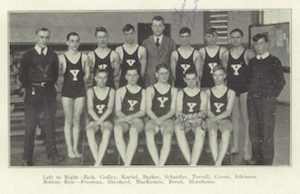 In the spring of 1930, Central High School in Ypsilanti eked past East Grand Rapids by a single point to top a field of seven schools competing for Class B-C-D honors. It was the first of four straight titles for Ypsilanti Central and their coach, James Schaffer, over a five-year span. (In 1932, the Indians finished runners-up to River Rouge. Rouge, in turn, finished second to Ypsilanti in 1931, 1933 and 1934).
Detroit Northwestern returned to the pedestal in 1930, earning another title against a field of 14, this time with Leo S. Maas as coach. It would be the last swimming title awarded to a Detroit Public League school.
With the arrival of the 1930-31 school year, Detroit public schools withdrew from state interscholastic competition, to focus only on intramural contests between other Detroit city schools. Vaughn S. Blanchard, who took charge as Director of Health and Physical Education for the Detroit Public Schools in 1929, cited in the decision his belief that there was an unhealthy overemphasis on competitive athletics. The voluntary exile would last for the next 30 years and recast competition within Michigan prep athletics.
Maas’ teams would continue to dominate Detroit swimming, winning 7 of 9 City League championships. In September of 1938, he joined the staff of Wayne University as swimming coach, leading the Tartars to national prominence in the 1940s. He spent 20 years at the school, renamed Wayne State University in 1956.
Battle Creek Takes Charge
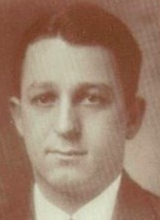
Charles McCaffree, Jr. was born in South Dakota and learned to love swimming at the YMCA pool in Sioux City. He followed his brother to the University of Michigan, earning three varsity letters under internationally-known swimming coach Matt Mann. Following college graduation in 1930, McCaffree was hired at Battle Creek Central as swimming coach in 1931. For the next six years, 1931-1936, his Bearcats teams won Michigan swimming titles. All were in Class A, with the exception of the 1935 tournament, when, because of the Great Depression, only a single title was awarded. A total of 139 swimmers from 14 teams competed in the state’s 12th annual meet, held at the intramural pool at the University of Michigan.
 The MHSAA returned to two class championships in the spring of 1936. Ypsilanti Roosevelt returned to the winners’ circle, besting Ypsilanti Central by two points, 38 to 36, while winning four first places in the eight-event meet.
In September 1936, McCaffree returned to U-M to take over the Wolverines program while Coach Mann attended to his seriously ill father in Leeds, England. McCaffree’s teams at Battle Creek had won 53 dual meets and lost only three. He helped build the district’s junior high swim program and turned out 14 prep All-Americans, (including Dobson “Dobbie” Burton, captain of Michigan’s 1941 NCAA championship swim team and later, a very successful swim coach at Evanston Township High School in Illinois). With Mann’s return to the helm at Michigan in February 1937, McCaffree accepted the head swimming coaching position at Iowa State, where his teams won four Big Eight Conference Championships.
In 1942, “Coach Mac” was hired by Michigan State athletic director Ralph Young to head the Spartans swim team. For the next 28 years, he guided the team as head coach, winning eight straight Central Collegiate Conference championships prior to State’s entry into the Big Ten. In 1957, he led MSU to its first Big Ten swimming title. Before retiring as coach in 1969, “his student-athletes earned All-American honors 322 times, won 34 Big Ten titles, and claimed 22 NCAA titles. Six individuals qualified for the Olympics.” In 1979, the university named the pools within the Intramural-West Building in his honor.
CLASS A
|
Year |
Champion (Coach) |
Runner-Up |
|
1929 |
Highland Park (Grant Withey) |
Detroit Northern |
|
1930 |
Detroit Northwestern (Leo. S. Maas) |
Detroit Northern |
|
1931 |
Battle Creek Central (Charles McCaffree) |
Lansing Central |
|
1932 |
Battle Creek Central (Charles McCaffree) |
Kalamazoo Central |
|
1933 |
Battle Creek Central (Charles McCaffree) |
Lansing Central |
|
1934 |
Battle Creek Central (Charles McCaffree) |
Lansing Central |
OPEN CLASS
|
Year |
Champion (Coach) |
Runner-Up |
|
1935 |
Battle Creek Central (Charles McCaffree) |
Dearborn Fordson |
CLASS B-C-D
|
Year |
Champion (Coach) |
Runner-Up |
|
1929 |
Ypsilanti Roosevelt (Howard Farnslow) |
East Grand Rapids |
|
1930 |
Ypsilanti (James Schaffer) |
East Grand Rapids |
|
1931 |
Ypsilanti (James Schaffer) |
River Rouge |
|
1932 |
River Rouge (Benny Goodell) |
Ypsilanti |
|
1933 |
Ypsilanti (James Schaffer) |
River Rouge |
|
1934 |
Ypsilanti (James Schaffer) |
River Rouge |
Ypsilanti, Jackson emerge
McCaffree’s replacement at Battle Creek, John Vydareny, led the Bearcats to a seventh consecutive title in 1937. The city of Ypsilanti retained control of the Class-B-C-D title, as Ypsilanti Central dethroned Roosevelt High 71-54. It was the first of three consecutive by Central High and coach James Schaffer.
“More than 200 high school swimming stars churned the Michigan State college pool today as they warmed up for trials in the 15th annual Michigan High School Athletic association championship swim,” noted The Associated Press in 1938 pre-event coverage.
 A broadcast, featuring a running account of the meet, was recorded in East Lansing that Saturday and brought to Battle Creek for an 11:00 p.m. broadcast on radio station WELL-AM. Designed to give listeners “the pool’s edge atmosphere of the meet,” the program was replayed on Sunday evening “to give those who did not attend, and those who retired too early to hear the Saturday night program.”
Jackson, which lost the Five-A league title to Battle Creek, emerged as the Class A winner. Both schools brought 22 to the event.
“Jackson dethroned the Bearcats…in the Michigan State college natatorium and the difference between an eighth successive crown and runner-up position … was disqualification of the Battle Creek Medley relay team in the preliminaries. The Bearcat medley trio finished a full half lap in front of the field … in record time … but it was ruled out …”
Jackson finished with 39 points, followed by Battle Creek with 32. The Vikings would repeat as Class A champions in both 1939 and 1940. Coach Elwood Watson’s swimmers would pick up a fourth title in 1942. Battle Creek Central added three additional titles to their total with wins in 1941, 1943 and 1944. Because of World War II restrictions, only 13 schools entered the Class A meet and five competed in Class B-C-D in 1943, while 14 schools participated in the Class A meet in 1944 at Michigan State, and six schools chased honors in the Class B-C-D competition at the University of Michigan.
With the absence of Detroit schools during the 14-year span, 1931 through 1944, a member of the 5-A League – comprised of Battle Creek, Jackson, Ann Arbor, Lansing Eastern and Lansing Central – controlled Michigan’s Class A swim title during that time. On nine occasions during that period, the 5-A also placed the state runner-up.
I n Class B-C-D, Ann Arbor University High emerged as a swimming power, finishing as runner-up to Ypsilanti Central in both 1938 and 1939. Guided by University of Michigan assistant swimming coach Harvey Muller, the Cubs ended the city of Ypsilanti’s grip on the smaller school title in 1940.
“University High’s crack free-style quartet of Bill Koch, Earl Bryant, Jim Gordy and Max Tobias nosed out Central in the final relay to overcome a 43-42 lead which Ypsilanti held prior to the event.”
With the win, “the Ann Arbor tankers scored 52 points, one more than Central … It was Central’s first defeat in the state meet in the last four years.”
Ypsilanti Central topped Roosevelt in the 1941 state meet, this time under the guidance of coach Christy Wilson. University High won the first of five straight titles, with Muller as coach in 1942 and the legendary Matt Mann guiding the team from 1943 to 1946. Among the winners in 1943 was Matt Mann, Jr., who clipped five seconds off the meet’s 200-yard freestyle record. He would later be named a four-time All-American at Michigan and compete on the university’s 1948 national championship swim team. Following graduation, Mann, Jr. coached swimming and diving at Lansing Sexton High School.
Times Change
Post World War II saw many changes to society, cities, and, within competitive swimming, new record setters and coaching legends emerged. In 1980, a separate boys tournament was added to the MHSAA menu for Michigan’s Upper Peninsula. The grouping of schools moved from classes to divisions in 2003, and in 2008, a third division was added.
Today, ownership of MHSAA boys swimming & diving titles has geographically traveled a bit farther, but still to only 12 of Michigan’s 68 Lower Peninsula counties.
Ron Pesch has taken an active role in researching the history of MHSAA events since 1985 and began writing for MHSAA Finals programs in 1986, adding additional features and "flashbacks" in 1992. He inherited the title of MHSAA historian from the late Dick Kishpaugh following the 1993-94 school year, and resides in Muskegon. Contact him at [email protected] with ideas for historical articles.
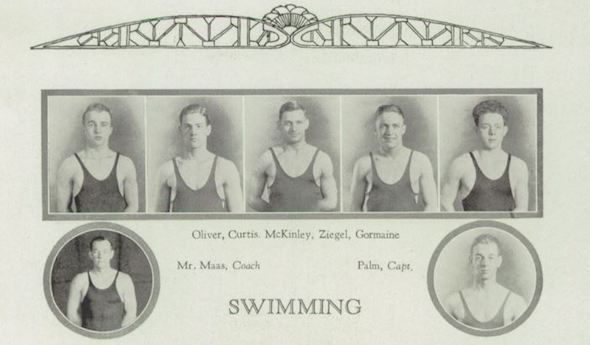
PHOTOS: (Top) The 1930 Detroit Northwestern team was among early state swimming powers. (2) Jackson's 1925 team also was an early force in the sport. (3) Bert Maris. (4) The 1930 Ypsilanti team. (5) Charles McCaffree, Jr. (6) The Michigan Agricultural College pool, in 1921. (7) The 1940 Jackson team. (Photos collected by Ron Pesch.)