

Tales of Teams, Trophies & Trinkets
By
Ron Pesch
MHSAA historian
March 30, 2016
High school athletics leaves behind an amazing array of treasures – although while buried in a keepsake box, or trophy case, the awards stand silent.
For many, their meaning and worth only continues to grow in value. Yet, in other cases, time can be cruel. For some trophies and trinkets, their worth diminishes as the stories contained within are lost behind retirements, neglect, administration decisions and death.
Following are a few tales that live on from more than a century of Michigan high school sports.
|
1909 |
Muskegon High School |
Track Trophy |
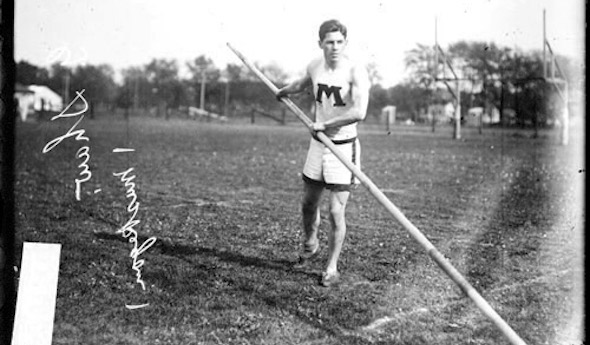
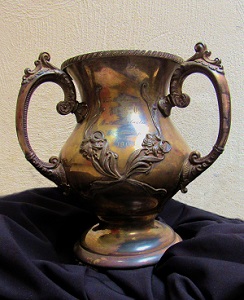 The search continues for the oldest state title trophy presented to a high school in the state of Michigan. This beauty, on display at Muskegon High School within the school’s storied trophy cases, currently leads the pack. In 1909, Muskegon coach Robert Zuppke’s team tallied 43½ points to win the fourth annual Michigan Agricultural College Interscholastic meet in Lansing. The total was the largest sum in the history of the meet, exceeding Detroit University School’s total of 27½ points and Detroit Central’s third-place total of 25 points.
Dominant in the field events, Muskegon was led by George Shaw, who set a new record in the pole vault at 11 feet, 2 inches, and by George Cowley, whose 4:47 time in the mile also set a new mark. Cowley’s time in the mile ranked among the top in the middle west.
Zuppke moved on a year later to coach at Oak Park, Ill., then to the University of Illinois where he became known as one of the great coaching minds in the history of college football. Shaw would school at Northwestern University while Cowley spent some time at the University of Chicago following graduation.
|
1923 |
Dollar Bay |
2nd U.P. Class B Tournament |
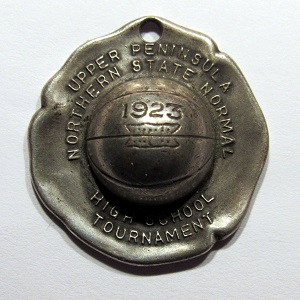 Someone within the Dollar Bay roster was once the proud owner of this silver basketball fob, given to team members by Northern Michigan Normal College for finishing second in the 6th annual Class B High School Basketball Tournament hosted at Northern State Normal College. According to documentation on the event, six sessions were held, and during presentation of the awards, only seven fobs were awarded to each of the top three teams. As was quite common at the time, only last names of players were mentioned in the game program and newspaper coverage. I guess back in the day, everyone who needed to know already knew the player’s first name.
Purchased on Etsy, perhaps this medal was owned by Stevens, who played one of the guard spots and served as team captain. He was responsible for all nine of the team’s points in the Class B championship game. Perhaps it belonged to Penphrase or Mattson, who each scored four points in the semifinal round, where Dollar Bay trounced Stambaugh 21-12. Munising defeated Newberry 15-10 in the semifinal, setting the stage for the title game. Munising won the Saturday evening contest, 17-9, and earned the right to play the Class A winner for the “supremacy of the Upper Peninsula." One week later at the Normal Gym, Munising topped Escanaba, winner of the Class A tournament, for the honor.
|
1927 |
J. Perry Austin |
Three Oaks |
4:57.3 |
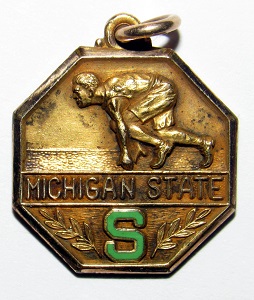 Along with his brother Phil, Joseph Perry Austin was one of 20 graduates in the class of 1927 at Three Oaks High School (Today known as Three Oaks River Valley). The most famous of the group was perhaps Joe Savoldi, who would star at Notre Dame.
The Austin boys moved to Three Oaks from Waukegan, Ill, when they reached high school age. There, Perry, as he was known among family and friends, would excel athletically and academically, winning the Class C MHSAA state championship in the mile and serving as valedictorian of his class. Phil was salutatorian. This medal, presented at Michigan State College of Agriculture and Applied Science (now Michigan State University) was found on Ebay.
Following graduation, Perry attended the University of Michigan, where he was crowned Big Ten Champion in the two mile in 1931. That same year, Austin was honored by the Big Ten with the conference’s prestigious Medal of Honor, awarded one per sport, for athletic and academic achievement in Track & Field. He would remain at Michigan, earning a doctorate in chemistry in 1935.
After graduation, he worked for Abbot Labs in Chicago. In the 1940s, Austin joined the seminary and became an Episcopalian priest, serving parishes in Wisconsin, Texas and Michigan. Ultimately, he returned to education, teaching high school chemistry in Toledo, Ohio. He passed away in 1991.
His brother Phil would ultimately become an internationally renowned watercolorist and a member of the exclusive American Water Color Society.
|
1940 |
Merrill Vandals scoreboard |
Castle Museum, Saginaw |
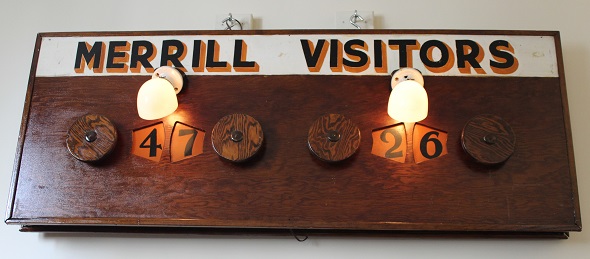 As the story goes, Merrill High School students built this scoreboard in shop class sometime during the late 1930s for use in their high school gymnasium. The board served the district for approximately the next 50 years. “It was always an honor to be selected as one of the kids to operate the scoreboard,” recalled Keith Clark, a former Merrill student who in later years served as a coach, then administrator in the district. “One kid would operate the home side and the other would operate the away side.”
When the new high school opened in 1956, the scoreboard remained in place at the building where it served junior high school teams until the 1980s. It was ultimately presented to Walt Krause, a longtime employee of the Merrill school district. Thanks to the efforts of Clark, and the kindness of the Krause family, the board eventually made its way to the Saginaw Sports Hall of Fame with a single stipulation – that the score displayed should always show Merrill leading.
|
1947 |
Brethren Dickson |
Basketball Team |
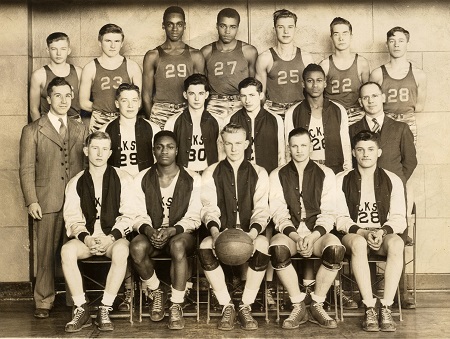 A scan of a photo cherished by the son of one of the team members, this team picture would likely go unnoticed mixed in with a stack of others. Yet, standing in the back row, wearing number 27, is an individual with a likeness, and most certainly a voice, that would be recognized by tens of millions. The Brethren Dickson basketball team of 1947 was eliminated early in the tournament. The 1932 team finished the year as runner-up to Portage for the Lower Peninsula’s Class D title. In 1963, Brethren lost in the state semifinals to eventual Class D state champion Britton.
Using his full given name, one can argue that James Earl Jones ranks with Earvin “Magic” Johnson as the state’s most famous basketball player, though his fame is for something entirely different than his ability to shoot a basketball.
|
1967 |
Ann Arbor University High School |
Track Trophy |
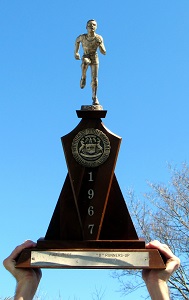 Found at a thrift store in Ann Arbor, it was purchased for $2.12, tax included. Showing its age, the trophy was earned by Ann Arbor University High’s track team that finished second to Detroit St. Charles.
Ann Arbor University High was a demonstration school operated by the University of Michigan’s School of Education. In 1922, the State of Michigan legislature approved $525,000 for the construction and furnishing of the building near the campus of the university. In the fall of 1924, the school was opened with 123 students in grades 7-12. In 1930, an elementary school was added. According to U-M’s Bentley Historical Library, “the school was used as a demonstration center for educators in the newer practices of educating children.”
University High’s athletic teams were nicknamed the Cubs, an obvious nod to the University of Michigan’s Wolverines. University High continued to operate into the 1960s, when a decision was made by U-M’s School of Education to close the school.
The 1967 team, led by Dave Shipman, finished second to Detroit St. Charles in point total, 64 to 47. Shipman, an individual winner in both the 100 and 220-yard events, also ran on University’s victorious 880 relay team. A year later, the final senior class graduated from the school.
|
1984 |
Brimley High School |
Volleyball |
 This medal dates to the days when champions were crowned in volleyball in both upper and lower peninsulas of Michigan. (In the year 2000, the tournament was unified.) This is another Ebay find.
Between 1980 and 1990 the U.P. staged a single open tournament for all schools north of the Mackinac Bridge. Despite competing against schools with much larger enrollment, the Brimley Bays captured seven titles during those 11 years of competition. Located just off I-75, coach Charles Compo’s team traveled extensively into the Lower Peninsula to gain experience. The time and travel paid dividends as the team captured five straight titles between 1981 and 1985. The 1984 title came with 15-3, 15-11 wins over Bessemer. That season, Compo was named U.P. Coach of the Year.
“Compo retired in 1990 with an amazing record of 408 victories and only 74 losses,” notes the Upper Peninsula Sports Hall of Fame, recognizing the achievements of those squads. “Seventeen of Compo's players would earn all-state honors, a total of 32 times.”
|
2009 |
Allison Pall |
East Grand Rapids |
1:50:09 |
 “When the boys on the football team got whiny about practice, their coach would bring them to one of our practices,” remembered Allison Pall, discussing the hours spent training before earning this medal as a member of the East Grand Rapids 200 medley relay team. Those practices were run by legendary swimming coach Milton “Butch” Briggs, Jr. Since taking on the task in fall of 1975, Briggs has led the girls to 19 MHSAA championships and the boys to 10 titles.
Pall, along with schoolmates Ally Bremer, Molly Lundquist, and Karly Surman won the 200 medley relay with an MHSAA Finals time of 1:50.09 at Eastern Michigan. A year later Pall, Bremer, Emily Lundquist and Katie Lachance again won the 200 medley relay, at 1:48.82 at Holland Aquatic Center. The girls clocked a 1:48:75 in the prelims the day prior, establishing a then-school record.
A late beginner in the sport, Pall took up competitive swimming in seventh grade. Following high school graduation, Pall headed to Ann Arbor to enroll at the University of Michigan, where she left behind her swimming career. Her height, an advantage in swimming, meant she was recruited to join the University Rowing team. She stayed for a season, deciding to dedicate herself to studies. Today, Allison is in pursuit of her Master’s degree in Public Health. Her medals will not be found for sale online. They still mean the world to her.
 Ron Pesch has taken an active role in researching the history of MHSAA events since 1985 and began writing for MHSAA Finals programs in 1986, adding additional features and "flashbacks" in 1992. He inherited the title of MHSAA historian from the late Dick Kishpaugh following the 1993-94 school year, and resides in Muskegon. Contact him at [email protected] with ideas for historical articles.
PHOTO: George Shaw prepares for the pole vault for Muskegon High in 1909. (Photos gathered by Ron Pesch.)
Marathon, Redemption Make Franklin's 1986 Softball Run Eternally Unforgettable
By
Ron Pesch
MHSAA historian
May 14, 2026
Tracy Lectka is celebrating a victory.
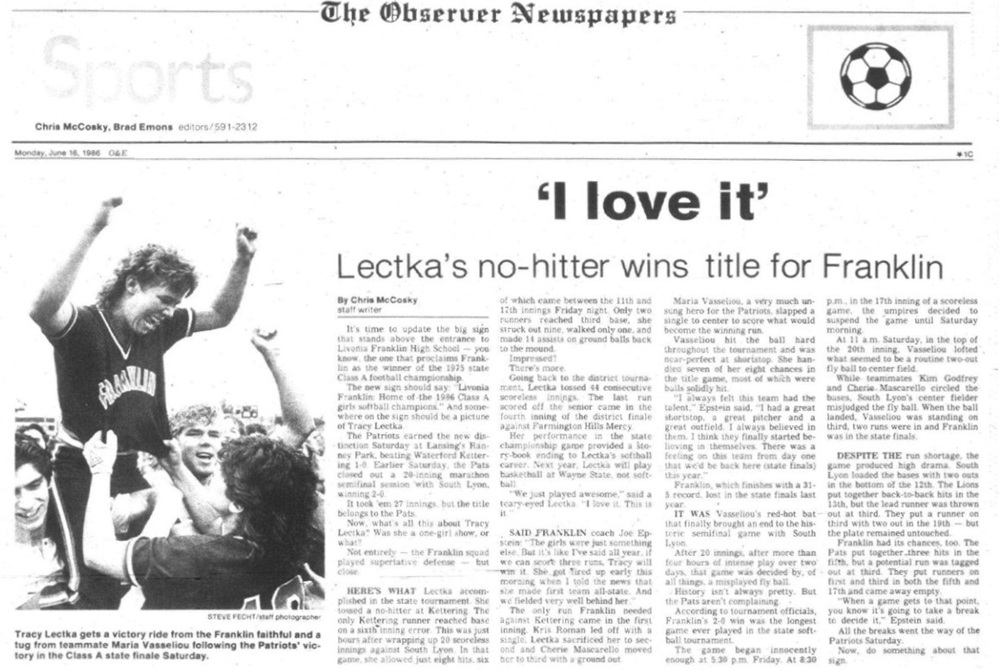
In Steve Fecht’s image found on the front page of the June 1986 Observer newspaper’s sports section, she is riding on the shoulders of ecstatic Livonia Franklin fans. Lectka’s arms are raised, and teammate Maria Vasseliou grabs at her jersey. The shot radiates the postgame celebration that came with the Patriots’ 1986 MHSAA Class A softball state championship – an honor that had slipped away a year previous.
Just as powerful is a photograph from the Observer’s Dan Dean from the 1985 run to the title game. Within, Lectka’s father Ron embraced his daughter, comforting the pain of what might have been.
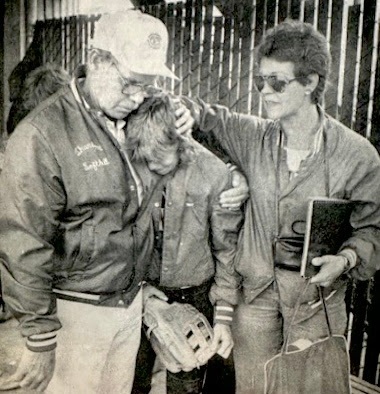 “My Dad was a huge part of my life and taught me everything I knew,” recalled Tracy. “He coached girls softball for Redford Thurston for years. … That was the most hits and runs I had given up all year. That picture speaks volumes to say the least.
“The woman next to me was our outfielder Cherie Mascarello’s mom. She was a huge supporter of the team. Never missed a game, like my mom.”
The Spring of 1985
In just his second year of coaching Livonia Franklin, Joe Epstein had built confidence among his players stressing focus and fundamentals. Lectka, a junior, emerged as an outstanding pitcher, and Epstein featured her constantly as she tossed more than 200 innings. Among Franklin’s victories were three over cross-town rival Livonia Stevenson and the state’s top pitcher, all-state senior Lisa Bokovoy. Franklin finished fourth in the Michigan High School Softball Coaches Association (MHSSCA) weekly Class A regular-season rankings.
During the tournament, Lectka tossed three consecutive four-hit shutouts, but, according to Observer staff writer Brad Emons, “was roughed up for 11 hits” in a 5-0 loss to Mount Clemens L’Anse Creuse North in the 1985 state title game. Played at Lansing’s Ranney Park, North’s star pitcher – right-hander Chris Harms (21-5) – twirled her sixth shutout of the tournament. During that Saturday lockdown, she had allowed seven hits but was “tough in pressure situations.” The Patriots had loaded the bases in the second and fifth innings but could not score.
“We just didn’t hit in the clutch,” Epstein told the Observer, “and they made it count when they had people on.”
North, 22-6 on the year, had opened the season among the state’s top-ranked teams. Harms earned second team all-state honors from MHSSCA, while Lectka was an honorable mention all-state selection. She finished the season with a 22-3 mark.
With an impressive 25-4 record, and one of the state’s top pitchers returning the following spring, Epstein vowed the team would be back.
A Shot at Redemption
With Lectka – one of three seniors – and top players Vasseliou, Cherie Mascarello, Rose Obey, Sue Ritz, Patty Wixson and Karen Schoeninger, the team was the MHSSCA’s Class A preseason favorite entering 1986. That quickly changed within the rankings when the Patriots lost their second game, 12-3, to Walled Lake Central, then dropped a double header to Garden City. A year earlier, Franklin had defeated the Cougars three times, including in a 21-inning pitching duel between Lectka and sophomore Shelly Malone, which Franklin won 1–0.
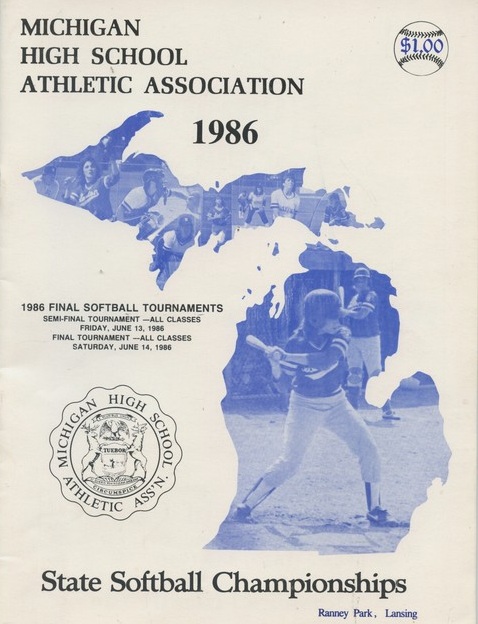 After some experimenting with the lineup, Epstein was able to right the ship. From there, things progressed with relative ease, as his team dropped just two more games against quality opponents, splitting a double header with Westland John Glenn, then dropping one of three games with a solid Plymouth Salem squad, a conference rival. The Patriots finished the regular season fifth in the final Class A rankings and eased their way through the District. They shut out both John Glenn and Belleville in the Regional to earn a trip back to Lansing for the final rounds.
Speaking just prior to their MHSAA Semifinal game with South Lyon, Coach Epstein was asked by the Observer about his squad’s chances.
The Lions, one of nine teams earning honorable mention in the MHSSCA’s rankings, were led by junior ace Andrea Nelson. They had trounced Salem, 19-4, beneath sweltering heat in their District Final. Following that win, Franklin upset fourth-ranked East Kentwood and then downed Lansing Eastern to continue the postseason run.
“I feel confident that if we beat South Lyon, we can go all the way,” said Epstein, “and I don’t go on a limb very often. … I understand there were a bunch of walks and errors (in Salem’s game with the Lions). I’ve seen some good teams have bad days.”
On the opposite side of the Class A bracket stood Waterford Kettering, a scrappy unranked squad Franklin had beat, “in an invitational tournament, 10-5,” and Grosse Pointe South, which, behind the pitching of University of Michigan-bound Lynn Vismara, had shocked both top-ranked Utica Ford and No. 2-ranked Fraser in Regional play.
“(We’re) a better hitting team than last year,” said Epstein, convinced strong pitching from other teams would not deter his crew from their quest. “And I’ve got some other kids who can swing the bat.”
Epstein’s belief would be severely tested.
The Marathon
“The game began innocently enough at 5:30 p.m.,” wrote the Observer’s Chris McCosky about Franklin’s battle with the Lions. “At 8:30 p.m. in the 17th inning, it was still scoreless. Despite the run shortage, the game (had) produced high drama. South Lyon loaded the bases with two outs in the bottom of the 12th. The Lions put together back-to-back hits in the 13th, but the lead runner was thrown out at third …
“Franklin had its chances, too,” continued McCosky. “The Pats put together three hits in the fifth, but a potential run was tagged out at third. They put runners on first and third in both the fifth and 17th and came away empty.”
 Drew Sharp, writing for the Detroit Free Press, covered what happened next.
“… Amid growing darkness at Michigan State, the umpires asked South Lyon coach Jeff Gale and Franklin coach Joe Epstein whether they wanted to continue playing at nearby Ranney Park, which (had) lights or wait until 10 a.m. Saturday.”
Epstein stated he had three players scheduled to take the ACT college entrance exam the next morning and requested the game be moved and continued. Gale wanted to wait. Because the coaches couldn’t come to a solution, the umpires were put on the spot. While the choice wasn’t an easy one, they decided play would resume at MSU in the morning.
Earlier in the day, Kettering sophomore Julie Vachon ripped a long line drive just beyond the reach of the left fielder for a game-winning grand slam, sealing a 4-3 comeback win over Grosse Pointe South.
Title Time
Come daylight, all three test-takers were ready, having skipped their scheduled appointment back home. With two outs in the top of the 20th inning, Vasseliou, the Patriots’ junior shortstop. tripled in a pair of runs to end the deadlock, sealing a 2-0 victory and sending Franklin back to the title game played later in the day at Ranney.
The Lansing State Journal’s Tom Gantert beautifully summarized the Patriots’ weekend in the paper’s Sunday edition. “Livonia Franklin High softball pitcher Tracy Lectka doesn’t ask much from her teammates. Just that they score …”
Kettering’s Vachon allowed two walks, struck out a pair, and gave up just three hits during the championship game. But Vasseliou, again facing two outs, drove in Kris Roman who had led off the first inning with a single. That gave the Patriots a 1-0 lead they would not increase or relinquish.
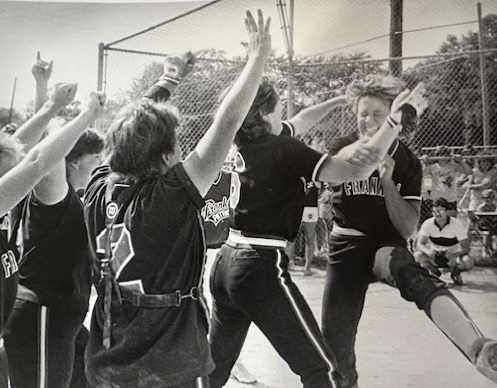
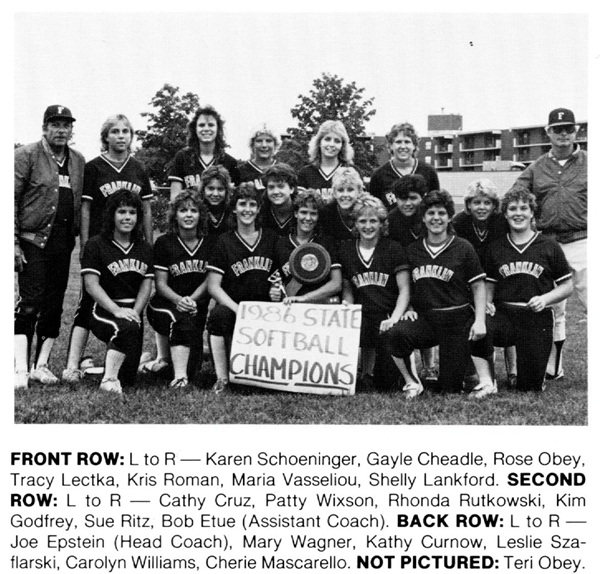 Lectka notched just a single strikeout, but, defensively, her teammates were nearly perfect. Outside a single error, her infield scooped up everything it faced from the Captains. Only three balls tossed by the senior left the infield during the title game. She finished the day with a no-hitter, extending her streak of scoreless innings allowed to 44. Franklin ended the season with a 31-5 record and the school’s second MHSAA state championship in any sport. Ten years previous, the Patriots had won the 1975 Class A football trophy.
“‘We played awesome. I love it,” a teary-eyed Lectka told the Observer. “This is it.” It was her final game on the diamond. A year earlier, she had accepted a college scholarship to play basketball – not softball – at Wayne State.
Soon after, Sports Illustrated visited the family to snap a photo of Tracy for publication in their weekly sidebar, “Faces in the Crowd.” Over 35 years later, in mid-September 2023, the softball squad, along with that football team, were inducted into Franklin’s inaugural Athletics Hall of Fame.
Epstein, who had passed away in 2012, was also honored individually that evening. He had taught in the Detroit Public Schools from 1957 to 1966 before moving to Franklin. A long-time physical education teacher, he also led Franklin’s softball team to a runner-up finish in 1990. His wife Linda joined three others to cut the honorary ribbon for the Hall.
The induction celebration brought back wonderful memories. But it was noted that a few of the team’s achievements during their runs to the Finals were missing from the MHSAA state record book.
Happily, that has now been corrected.
PHOTOS (Top) The Observer reported on Livonia Franklin’s 1986 Class A championship, including a memorable photo. (2) Ron Lectka, far left, comforts his daughter Tracy after her team’s 1985 title game loss. (3) The cover of the 1986 MHSAA Softball Finals program sets the scene for the weekend to come. (4) The Patriots celebrate. (5) Franklin poses for a team photo after the 1986 win. (Photos gathered by Ron Pesch from Observer archives and Tracy Lectka.)