

Unified Sports: Unified Goal, Unified Effort
By
Mark Uyl
MHSAA Executive Director
April 11, 2019
The following publisher's note and cover story were featured in this winter's edition of the MHSAA benchmarks magazine.
At its best, sport breaks down barriers and differences through promoting teamwork, inclusiveness and humility. At its worst, we’ve seen sport do the opposite.
Obviously those involved in school sports aim to create a culture within every school which fosters the best of what all of us can be. Those places that do this best have created a culture in every hallway, classroom, playing field and gymnasium filled with diverse students pulling for one another and working together regardless of the different backgrounds, races, religions, abilities, physical stature or academic acumen of each person. A culture of understanding and acceptance is what we strive for in each of our school communities.
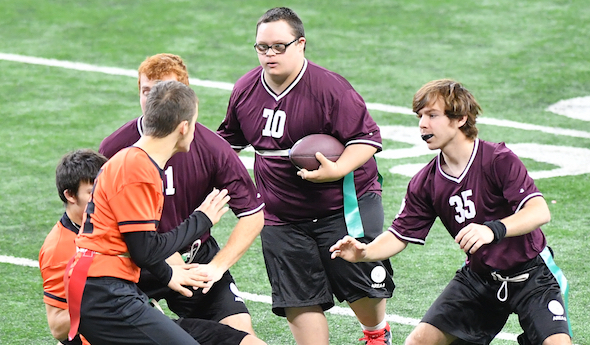
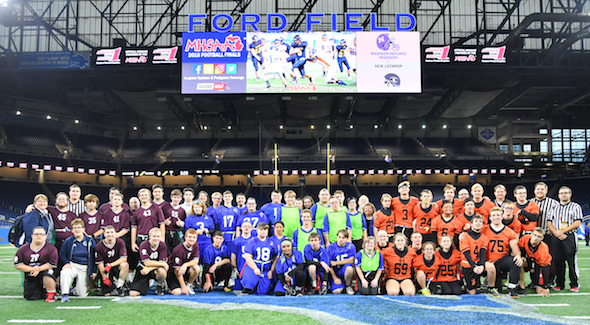
On Nov. 24, such a scene played out on the grand stage of the playing surface at Ford Field in Detroit. In what we hope will be the launching pad for many more such events, Unified Sports competitors from four MHSAA member schools competed simultaneously in two games prior to the MHSAA Division 7 Football Final.
Unified Sports is an inclusive sports program within Special Olympics which pairs students with and without intellectual disabilities as teammates for training and competition.
From the time competitors walked through the tunnel to perform in front of family, friends, and the appreciative crowds from New Lothrop and Madison Heights Madison awaiting kickoff for the 10 a.m. game, the enthusiasm was unmatched.
Following competition these Unified teams were given tours of the facility, including a visit to the Detroit Lions locker room. We intended to deliver a day filled with an experience and memory for a lifetime for our guests, and feedback suggests that was accomplished. But, make no mistake, the session left lasting impressions on the staff here at the MHSAA, as well.
Brighton, Holt, Mason and Sparta – schools represented at the 2018 Football Finals – are among the 300-plus schools statewide which are Special Olympics Unified Champion Schools®, and it is our hope that the number continues to grow around Michigan and throughout the country.
The MHSAA and Michigan Special Olympics have a wonderful relationship, and we will continue to plan with our valued partner for future events as opportunities present themselves.
There is no limit to the benefits of these games and such a partnership. And, no limit to the enthusiasm of its participants who are helping to redefine school cultures by helping us break down barriers and build inclusive school communities around this great state.
***
By Rob Kaminski
MHSAA benchmarks editor
The pass was lofted high, and floating toward the end zone nearest the tunnel where teams enter the playing surface at Ford Field.
As players from both teams converged, the intended receiver came away with the ball, clutching his prize and raising his arms in jubilant triumph.
It was arguably the best catch of the Thanksgiving weekend football feast in Detroit, and undoubtedly a memory this player will never forget. Moments later, the ear-to-ear grin remained as he high-fived spectators and family members on the way to the tunnel and up to the locker room.
And all of this happened before the second day of MHSAA 11-Player Football Finals kicked off Saturday, Nov. 24.
The play was one of many memorable moments to take place during the first-ever Unified Champion School event held in conjunction with the MHSAA Football Finals. If this year’s exhibition was any indication, it will be the first of many to come.
“The event far exceeded our expectations, and in discussions with the students, coaches and parents involved, I think it exceeded their expectations as well,” said MHSAA Executive Director Mark Uyl. “The feedback was positive, and the thanks and appreciation we received was overwhelming.”
Special Olympics Unified Champion Schools® (UCS) is an education-based project that uses sports and education programs to activate young people to develop school communities where all youth are agents of change – fostering respect, dignity and advocacy for people with intellectual disabilities.
Last summer, as Uyl was settling into his role as executive director at the MHSAA, Tim Hileman was acclimating himself to a similar role with Michigan Special Olympics. Both were replacing long-time leaders – Jack Roberts at the MHSAA and Lois Arnold at Special Olympics, who both had served their organizations for more than three decades.
The similarities brought Uyl and Hileman together, and they began to nurture seeds that had been planted by their predecessors.
“Mark reached out when the announcement was made that I was to become CEO of Michigan Special Olympics,” said Hileman. “We strongly believed in the benefits of a partnership between the two organizations. We talked about long-term plans and the goal of growing a culture of inclusion within our schools. A more immediate component was exploring existing opportunities to highlight a partnership, and what greater way to do that than at Ford Field during one of the most prominent weekends of the MHSAA sports season?”
The inaugural event included students from Brighton, Holt, Mason and Sparta school districts, each of which sponsor Unified teams.
Brighton, which has been in the game since 2016-17 and involves a combined 75 general education students and students with intellectual disabilities (I.D. students), recently earned national recognition for its Unified program.
“Andy Doupe, a faculty member who teaches special education here, brought the initiative to our district and it was a no-brainer that we needed to implement the program,” said John Thompson, athletic director at Brighton High School and a member of the MHSAA Representative Council. “It was a great opportunity to be supportive of all students in our community.”
Brighton Unified coach and faculty member Jody Renicker has helped take the lead.
“The foundation of Unified Sports is pretty simple,” Renicker said. “It's the idea that training and competing together is one of the fastest ways to friendship and understanding. The students discover that they are much more alike than they are different. This helps to dissolve the preconceptions and stereotypes often associated with people with disabilities.”
Just up the road in Holt, that community was gaining its own recognition, bringing home the Gold Medal from the USA Flag Football Championships in Seattle last summer. The lessons and experiences proved even more valuable.
“Athletes roomed with UCS partners,” said Val Suszko, a coach for the Holt/Mason program, which involves roughly 80 students with and without disabilities and is in its sixth year of existence. “The friendship that they developed over those 10 days was priceless. They are friends for life. They care for and protect each other. Without this experience, they wouldn’t have ever met.”
That’s the overriding goal of Unified athletics: to break down barriers within schools and communities while introducing young people to those with various challenges, offering opportunities to lead and assist.
 “The inclusion of special needs kids and how it makes them feel is a wonderful part of the school community and program,” Thompson said. “We have a young lady with a prosthetic leg who never wore shorts because she was embarrassed. Now, being part of our basketball team, she wears shorts all the time.
“Naturally there’s a huge upside for the special needs students, but the general ed kids are being provided an opportunity to grow and develop leadership skills. The experiences open some eyes and break down some divisions that exist to make for an improved culture throughout the school. The melding of kids with different backgrounds of any kind is always good for perspective.”
Unified programs offer increased participation opportunity for the general education population as well as the I.D. students. For students who may not make the cut for school teams, or prefer to focus on academics or part-time jobs, the Unified option provides just what they are seeking. Others are varsity athletes looking for competition outside their preferred sport seasons.
“We receive a lot of interest from those partners who might have wanted to play on freshman, JV, or varsity teams but couldn’t meet the eligibility requirements or physically do not make the cuts at those levels of team tryouts,” said Renne Wyman, Unified coach at Sparta High School. “So they wander into the gym and join us. What happens is, the level of play ratchets up a notch or two. These kids initially come here to play, not necessarily help the intellectually disabled kids.
“But, then they start giving shooting advice, or directing them where to move offensively or whom to cover defensively. Suddenly they are talking to each other, and no adult staged the mentoring. It carries on between quarters, at halftime, before games and practices. They start texting and offering a seat in the cafeteria at lunch. I’m talking about major culture change in our building.”
This type of interaction serves to reduce the number of negative incidents in the hallways.
“Statistics show that these programs have proven to reduce bullying of the intellectually disabled population,” said Suszko of Holt/Mason. “To have an organized sports team and school support team is invaluable. The students with intellectual disabilities gain so much. They train together, play together and develop friendships through sports with the general school population.”
With such important life lessons in the balance, and 300-plus schools around Michigan sponsoring school programs, the time was right to further shine a spotlight on the product. In the past, Unified basketball events have been showcased during MHSAA Hoopfest events in conjunction with the Boys Basketball Finals, and it was time to take the next step.
“A partnership between the MHSAA and Special Olympics is a natural fit, and our goal is to assist in promoting inclusiveness and leadership components of Unified Champion Schools as opportunities at our tournaments allow,” Uyl said. “These are such worthwhile endeavors, and the student-athletes involved truly symbolize the best in school sports.”
The Ford Field event provided a chance for some serious competition on the field, along with countless smiles – and some tears – from onlookers and support groups following the action.
“My favorite story from that day came as Mark (Uyl) was addressing the group in the Lions locker room and thanking them for being there,” Hileman said. “I looked into the corner of the room and there’s a man – pretty good sized, tough-looking – standing there with his wife, and they’ve got tears in their eyes. The dad came up and told me, ‘I never thought I’d see my son play any kind of sport, and here he is at Ford Field. I’ll never forget this, and never watch a Lions game without thinking of this.’
“So many of our athletes are told what they can't do. Special Olympics is about showing what they can do.”
 For Suszko, the highlights began earlier in the morning.
“The most memorable moment for me was watching the expressions on all of the athletes’ faces as they walked through the tunnel onto the field,” she said. “What a great opportunity. The hospitality that Mark Uyl, Nate Hampton, and the rest of the staff gave us was appreciated so much. The parents were excited. They loved seeing their athlete participating alongside the other high school football teams. Watching barriers being broken and teamwork being established is what inclusion is all about.”
There were plenty of emotions to go around, from the guests and the hosts.
“The kids and parents were over the moon when the invitation came. Ford Field, the MHSAA Finals, it really resonated with the kids, the school and families,” Thompson said. “Nate and Mark and all staff involved went out of their way to make it a wonderful and meaningful experience. They did more for the families and kids than anyone expected. We are very appreciative of the MHSAA continuing to work toward inclusion, and events like these help to spread the word.”
Spreading the word will help bolster an already strong movement both in Michigan and nationally. Hileman is excited for the future in partnering with the MHSAA for events like the one in November, which generate a high level of enthusiasm. In the near future, he has some more immediate goals.
“We are concentrating on expanding league play. That’s what sports are; athletes competing, and our athletes want to compete,” Hileman said. “We have league play in the O-K Conference, and in the Lansing area. Our goal and vision is to continue to build on the Unified conference experience; more competitions during the season.”
The Sparta program has been in place for four years, and numbers have increased from a handful to a total of 60 partners and Special Olympics athletes combined. Volunteers are a vital part of the initiative, and Wyman says hundreds of people donate their time at affiliated service projects held twice yearly. The school offers Unified flag football at the league/conference level each fall, Unified ski/snowboard on a smaller scale, Unified basketball at the league/conference level in the winter, and is looking to add Unified track & field at the league/conference level this spring.
Make no mistake; athletes of all kinds like to compete.
“My kids are learning the game like they never did before. The partners don’t dumb down the vocabulary or slow down what they teach. This occurs in real-time scrimmaging with a need to adjust quickly,” said Wyman. “So our Unified athletes are being coached and challenged to increase their skill and conditioning at a level I just can’t replicate in my Special Olympics Physical Education class where no partners are present.”
One also cannot replicate the related successes outside the gyms and away from the fields, where Wyman reports that I.D. students are now being offered rides to school for dances and athletic events, improving their grades to be eligible to participate in the program and becoming healthier through the activities, all while gaining confidence in themselves.
Renicker believes that seeing is believing, and encourages people to attend events in neighboring communities. The impression will likely spur action.
“My No. 1 suggestion would be to come and witness how special a Unified Game is,” Renicker said. “It will give you hope for our future and highlight some pretty amazing things that are going on in schools every day that don't make the front page of the newspaper. I feel so lucky to be part of a school community that values this program and the culture it has created.”
Hileman recently attended a national Special Olympics event and heard International Chairman of Special Olympics Dr. Timothy Shriver proclaim his dream: that just as every high school sponsors boys and girls athletic programs, he hopes that one day every high school in the country will become a Unified Champion School.
It is a big dream, but the slightest nudge can put things in motion, as Wyman has seen.
“It can start small. You only need one or two partners to commit and you can get something going,” Wyman said. “A lot of kids would love to help in supporting roles, whether it’s running sporting events, officiating, keeping stats, designing, or organizing. In the beginning, it is one person reaching out to one school seeing if they can get together and play the game.”
With that, the guidance of Special Olympics, and assistance from partners like the MHSAA, maybe the ball can keep rolling all the way around the state.
***
Inclusion is Primary Mission of Special Olympics UCS
Team sports bring people together. Special Olympics Unified Sports® teams do that, too, and much more.
About 1.4 million people worldwide take part in Unified Sports, breaking down stereotypes about people with intellectual disabilities in a really fun way. ESPN has served as the Global Presenting Sponsor of Special Olympics Unified Sports since 2013, supporting the growth and expansion of this program that empowers individuals with and without intellectual disabilities to engage through the power of sports.
Promoting Social Inclusion Through Sport
Special Olympics is dedicated to promoting social inclusion through shared sports training and competition experiences. Unified Sports joins people with and without intellectual disabilities on the same team. It was inspired by a simple principle: training together and playing together is a quick path to friendship and understanding. In Unified Sports, teams are made up of people of similar age and ability. That makes practices more fun and games more challenging and exciting for all. Having sport in common is just one more way that preconceptions and false ideas are swept away.
States Embracing Unified Sports
Young people with disabilities do not often get a chance to play on their school sports teams. More and more states are adopting the Unified Sports approach that Special Olympics pioneered.
Unified Sports is also an integral part of Special Olympics Unified Champion Schools, which was founded in 2008 and funded through the U.S. Office of Special Education Programs at the U.S. Department of Education to use Special Olympics as a way to build inclusion and tolerance in schools. Unified Sports are now in more than 4,500 elementary, middle and high schools in the United States. Seventy percent of Unified Champion Schools (Pre-K through Grade 12) are engaging in Unified Sports! Also 215 U.S. colleges and universities have Special Olympics College Clubs on campus, providing ongoing Unified and inclusionary activities for students and Special Olympics athletes. Seventy-three of the 215 U.S. colleges and universities activating Special Olympics College conduct ongoing Unified Sports on their campuses. Learn how to get involved at www.playunified.org.
Mission: Inclusion
As part of the Special Olympics-Lions Clubs International “Mission: Inclusion” partnership, the LCI youth network-Leos have become a strong global partner in expanding and implementing Unified Sports together with Special Olympics. The Leos have helped start and sustain Unified Sports in a number of nations worldwide, and serve as one of the movement’s strongest youth leadership networks in bringing inclusive programming to communities across the world. From Zimbabwe to Brazil and from California to India, the Leos continue to amplify the voice of athletes and embody the creed: Play Unified. Live Unified.
Major sports organization, league and event support to Play Unified
Many high-profile, professional sports organizations and events have also showcased Unified Sports as a vehicle to show the power of inclusive sports! This support includes:
• National Basketball Association (NBA)
• Major League Soccer (MLS)
• Union of European Football Associations (UEFA)
• National Collegiate Athletic Association, D-III
• ESPN's X Games Aspen
• National Federation of State High School Associations (NFHS)
• National Intramural-Recreational Sports Association (NIRSA)
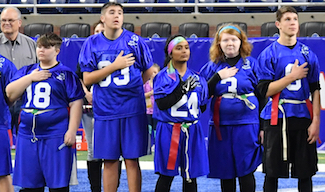
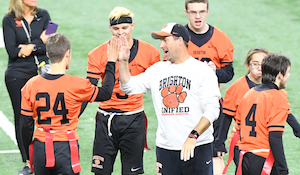
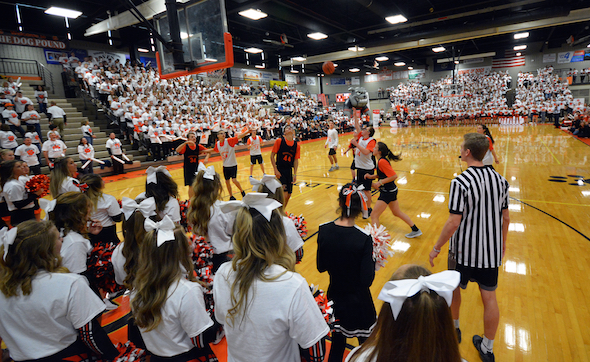
PHOTOS: (Top) Unified teams from Brighton and Mason/Holt play during the second day of the MHSAA 11-Player Football Finals at Ford Field. (Top middle) Participants from those three schools and Sparta took part in the morning's games. (Middle) Sparta athletes stand together for the national anthem. (Below middle) A Brighton coach and players exchange high fives. (Below) Brighton's Unified basketball team plays during a celebration for receiving national recognition last fall. (Photos by John Johnson.)
Dedication Continues to Make Difference as Pittman Elevates Game, Shores' Offense
By
Tom Kendra
Special for MHSAA.com
September 11, 2024
Jonathan Pittman lives by the acronym “PGF.”
 “My mom gave me that life motto; it stands for 'Put God First,'” explained Pittman, the senior quarterback for Muskegon Mona Shores, which is off to a 2-0 start.
“That is the core of who I am.”
Those aren’t just words for Pittman, who starts every day – Monday through Friday, from 6 a.m. to 7, when much of the world and most 17-year-olds are still sleeping – by going to church to study his Mormon faith at the Spring Lake Ward of the Church of Jesus Christ of Latter-day Saints.
He heads directly from there to school, where he either practices throwing the football or shooting the basketball (Pittman is also a standout on the Sailors’ hoops team). Then it’s off to the classroom – where, by the way, he is a straight-A student in honors classes.
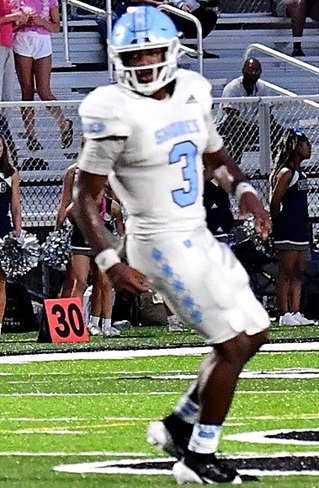
Only when all of that is completed does he switch his focus solely to football. The 6-foot-2, 205-pound senior is a three-year starter with a rocket arm and the power to run over linebackers like a fullback.
“Pitt is the hardest-working kid I have ever coached,” said 14th-year Mona Shores coach Matt Koziak, who has led the Sailors to four Division 2 championship games and won two, in 2019 and 2020.
“He is very critical of his own game. He identifies where he needs to get better, and he just keeps working at it.”
Koziak can track how much film his players are watching. One day, he checked and noticed that senior linebacker and film study devotee Solomon Robertson had logged two hours on that day. The only player with more was Pittman – with six hours.
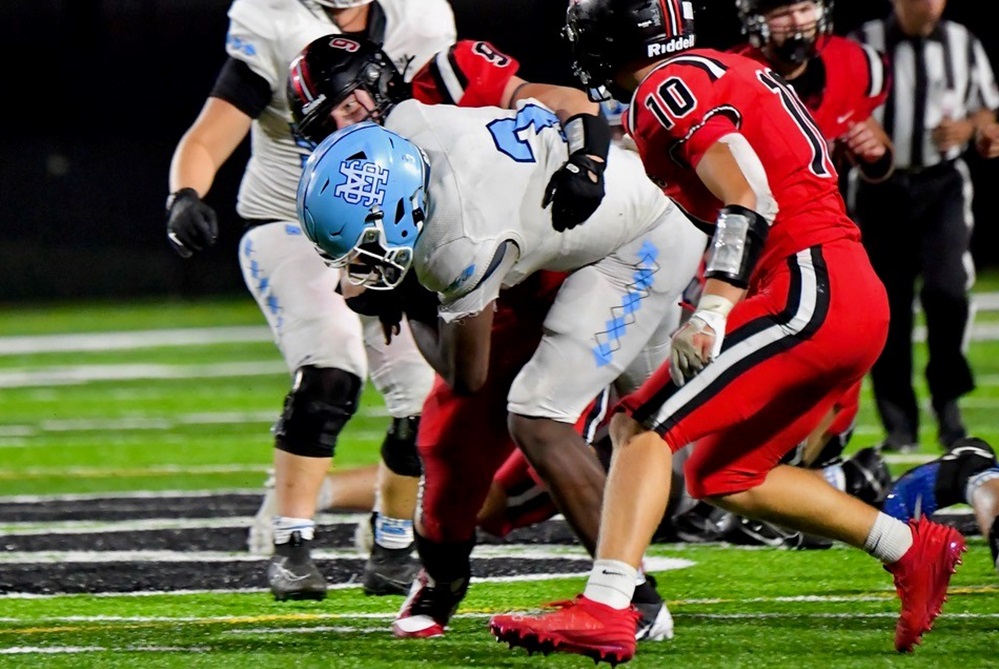
Pittman’s work ethic appears to be paying dividends, as he’s led the Sailors to impressive road wins over Grand Blanc (28-26) and River Rouge (21-6) to open the season and heading into yet another road game this week at undefeated Flint Hamady.
He did it with his feet against Grand Blanc, running 25 times for 192 yards and throwing for only 43. Against River Rouge, it was just the opposite – he completed 9-of-13 passes for 127 yards, while rushing for just 30.
Pittman comes from good pedigree. His father, also Jonathan Pittman, is a California native and former standout receiver at Brigham Young University who went on to play three years in the NFL for Buffalo, Tampa Bay and the New York Jets. His mother, Quintina, was a three-sport high school star whose college sports dreams were cut short by a knee injury.
 The Pittmans moved to Muskegon in 2014 when his father was hired as the general manager at The Lakes Mall, a position he held for five years. (The younger Pittman, who is the second oldest of four children, said his family is not related to any of the many Pittmans in the Muskegon area.)
Pittman has always had a big arm, which allowed him to earn the varsity starting role as a sophomore. Last fall, he completed 87-of-134 passes for 1,391 yards and 15 TDs. His main targets this fall are wideouts Jaeger Johnson and Micah Carafelle and tight end George Duggins.
Pittman is equally well-known for his power running, forming a tough-to-tackle 1-2 duo with junior running back Tomarion “Ike” Steward (5-11, 205).
The biggest improvement for Pittman so far this season has been his increased speed and agility, as he has slimmed down from 218 pounds to 205.
“I wasn’t as fast as I needed to be and couldn’t execute some of the things we like to run,” said Pittman. “I needed to work on that. Our offense is much more diverse this year. We have a ton of weapons, and we can hit teams from all angles.”
Koziak hopes his quicker quarterback will give his team the extra edge it needs in huge Ottawa-Kent Conference Green games at home against Byron Center (Sept. 20) and at Muskegon (Sept. 27) – both against likely Division 2 playoff opponents.
Shores made it to the Division 2 Final four times in eight years, losing to Warren De La Salle Collegiate in 2014 and 2018, then defeating Detroit Martin Luther King in 2019 and De La Salle in 2020. The Sailors have not advanced out of their District the past three years.
Right now, Shores is just waiting to play a game in West Michigan, and will have traveled 1,030 miles round-trip for their first three this season.
The most puzzling aspect of Pittman’s football career thus far is his surprisingly small number of college scholarship offers. Wayne State, Lawrence Tech and Siena Heights have made offers, while Eastern Michigan and Northern Illinois have made the trip to Muskegon to watch him throw.
Pittman, who plans to major in accounting, is not doing any lobbying – preferring to let his play on Friday nights speak for itself.
One thing is for certain: He has made a believer out of Koziak, who has been coaching football for more than 20 years, with prior stops as offensive coordinator at Muskegon Heights and head coach at Muskegon High in 2009.
“I will say this: Wherever he goes, by his junior year, he will be a team captain,” said Koziak. “You combine his athletic ability and his work ethic, and it’s magic. He’s a special kid; a generational kid.”
 Tom Kendra worked 23 years at The Muskegon Chronicle, including five as assistant sports editor and the final six as sports editor through 2011. E-mail him at [email protected] with story ideas for Muskegon, Oceana, Mason, Lake, Oceola, Mecosta and Newaygo counties.
PHOTOS (Top) Muskegon Mona Shores' Jonathan Pittman powers into the Grand Blanc defense during his team's season-opening win. (Middle) Pittman watches as a teammate carries the ball upfield. (Photos by Terry Lyons.)