

Unified Sports: Unified Goal, Unified Effort
By
Mark Uyl
MHSAA Executive Director
April 11, 2019
The following publisher's note and cover story were featured in this winter's edition of the MHSAA benchmarks magazine.
At its best, sport breaks down barriers and differences through promoting teamwork, inclusiveness and humility. At its worst, we’ve seen sport do the opposite.
Obviously those involved in school sports aim to create a culture within every school which fosters the best of what all of us can be. Those places that do this best have created a culture in every hallway, classroom, playing field and gymnasium filled with diverse students pulling for one another and working together regardless of the different backgrounds, races, religions, abilities, physical stature or academic acumen of each person. A culture of understanding and acceptance is what we strive for in each of our school communities.
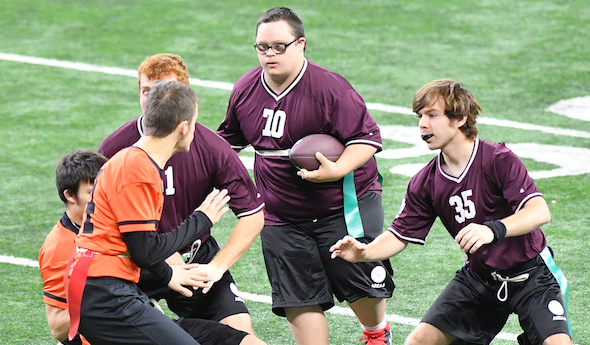
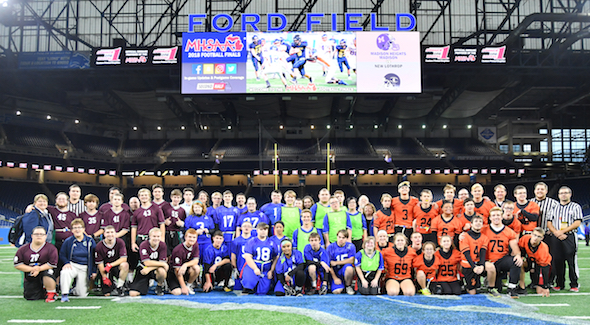
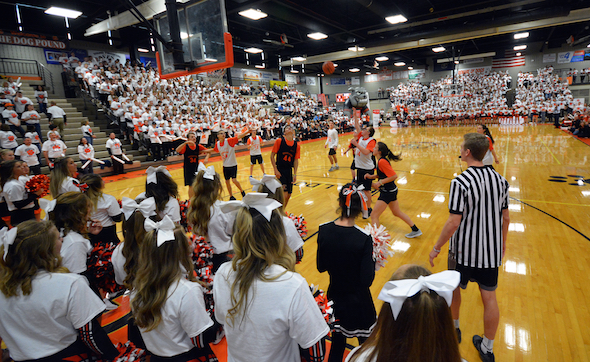
On Nov. 24, such a scene played out on the grand stage of the playing surface at Ford Field in Detroit. In what we hope will be the launching pad for many more such events, Unified Sports competitors from four MHSAA member schools competed simultaneously in two games prior to the MHSAA Division 7 Football Final.
Unified Sports is an inclusive sports program within Special Olympics which pairs students with and without intellectual disabilities as teammates for training and competition.
From the time competitors walked through the tunnel to perform in front of family, friends, and the appreciative crowds from New Lothrop and Madison Heights Madison awaiting kickoff for the 10 a.m. game, the enthusiasm was unmatched.
Following competition these Unified teams were given tours of the facility, including a visit to the Detroit Lions locker room. We intended to deliver a day filled with an experience and memory for a lifetime for our guests, and feedback suggests that was accomplished. But, make no mistake, the session left lasting impressions on the staff here at the MHSAA, as well.
Brighton, Holt, Mason and Sparta – schools represented at the 2018 Football Finals – are among the 300-plus schools statewide which are Special Olympics Unified Champion Schools®, and it is our hope that the number continues to grow around Michigan and throughout the country.
The MHSAA and Michigan Special Olympics have a wonderful relationship, and we will continue to plan with our valued partner for future events as opportunities present themselves.
There is no limit to the benefits of these games and such a partnership. And, no limit to the enthusiasm of its participants who are helping to redefine school cultures by helping us break down barriers and build inclusive school communities around this great state.
***
By Rob Kaminski
MHSAA benchmarks editor
The pass was lofted high, and floating toward the end zone nearest the tunnel where teams enter the playing surface at Ford Field.
As players from both teams converged, the intended receiver came away with the ball, clutching his prize and raising his arms in jubilant triumph.
It was arguably the best catch of the Thanksgiving weekend football feast in Detroit, and undoubtedly a memory this player will never forget. Moments later, the ear-to-ear grin remained as he high-fived spectators and family members on the way to the tunnel and up to the locker room.
And all of this happened before the second day of MHSAA 11-Player Football Finals kicked off Saturday, Nov. 24.
The play was one of many memorable moments to take place during the first-ever Unified Champion School event held in conjunction with the MHSAA Football Finals. If this year’s exhibition was any indication, it will be the first of many to come.
“The event far exceeded our expectations, and in discussions with the students, coaches and parents involved, I think it exceeded their expectations as well,” said MHSAA Executive Director Mark Uyl. “The feedback was positive, and the thanks and appreciation we received was overwhelming.”
Special Olympics Unified Champion Schools® (UCS) is an education-based project that uses sports and education programs to activate young people to develop school communities where all youth are agents of change – fostering respect, dignity and advocacy for people with intellectual disabilities.
Last summer, as Uyl was settling into his role as executive director at the MHSAA, Tim Hileman was acclimating himself to a similar role with Michigan Special Olympics. Both were replacing long-time leaders – Jack Roberts at the MHSAA and Lois Arnold at Special Olympics, who both had served their organizations for more than three decades.
The similarities brought Uyl and Hileman together, and they began to nurture seeds that had been planted by their predecessors.
“Mark reached out when the announcement was made that I was to become CEO of Michigan Special Olympics,” said Hileman. “We strongly believed in the benefits of a partnership between the two organizations. We talked about long-term plans and the goal of growing a culture of inclusion within our schools. A more immediate component was exploring existing opportunities to highlight a partnership, and what greater way to do that than at Ford Field during one of the most prominent weekends of the MHSAA sports season?”
The inaugural event included students from Brighton, Holt, Mason and Sparta school districts, each of which sponsor Unified teams.
Brighton, which has been in the game since 2016-17 and involves a combined 75 general education students and students with intellectual disabilities (I.D. students), recently earned national recognition for its Unified program.
“Andy Doupe, a faculty member who teaches special education here, brought the initiative to our district and it was a no-brainer that we needed to implement the program,” said John Thompson, athletic director at Brighton High School and a member of the MHSAA Representative Council. “It was a great opportunity to be supportive of all students in our community.”
Brighton Unified coach and faculty member Jody Renicker has helped take the lead.
“The foundation of Unified Sports is pretty simple,” Renicker said. “It's the idea that training and competing together is one of the fastest ways to friendship and understanding. The students discover that they are much more alike than they are different. This helps to dissolve the preconceptions and stereotypes often associated with people with disabilities.”
Just up the road in Holt, that community was gaining its own recognition, bringing home the Gold Medal from the USA Flag Football Championships in Seattle last summer. The lessons and experiences proved even more valuable.
“Athletes roomed with UCS partners,” said Val Suszko, a coach for the Holt/Mason program, which involves roughly 80 students with and without disabilities and is in its sixth year of existence. “The friendship that they developed over those 10 days was priceless. They are friends for life. They care for and protect each other. Without this experience, they wouldn’t have ever met.”
That’s the overriding goal of Unified athletics: to break down barriers within schools and communities while introducing young people to those with various challenges, offering opportunities to lead and assist.
 “The inclusion of special needs kids and how it makes them feel is a wonderful part of the school community and program,” Thompson said. “We have a young lady with a prosthetic leg who never wore shorts because she was embarrassed. Now, being part of our basketball team, she wears shorts all the time.
“Naturally there’s a huge upside for the special needs students, but the general ed kids are being provided an opportunity to grow and develop leadership skills. The experiences open some eyes and break down some divisions that exist to make for an improved culture throughout the school. The melding of kids with different backgrounds of any kind is always good for perspective.”
Unified programs offer increased participation opportunity for the general education population as well as the I.D. students. For students who may not make the cut for school teams, or prefer to focus on academics or part-time jobs, the Unified option provides just what they are seeking. Others are varsity athletes looking for competition outside their preferred sport seasons.
“We receive a lot of interest from those partners who might have wanted to play on freshman, JV, or varsity teams but couldn’t meet the eligibility requirements or physically do not make the cuts at those levels of team tryouts,” said Renne Wyman, Unified coach at Sparta High School. “So they wander into the gym and join us. What happens is, the level of play ratchets up a notch or two. These kids initially come here to play, not necessarily help the intellectually disabled kids.
“But, then they start giving shooting advice, or directing them where to move offensively or whom to cover defensively. Suddenly they are talking to each other, and no adult staged the mentoring. It carries on between quarters, at halftime, before games and practices. They start texting and offering a seat in the cafeteria at lunch. I’m talking about major culture change in our building.”
This type of interaction serves to reduce the number of negative incidents in the hallways.
“Statistics show that these programs have proven to reduce bullying of the intellectually disabled population,” said Suszko of Holt/Mason. “To have an organized sports team and school support team is invaluable. The students with intellectual disabilities gain so much. They train together, play together and develop friendships through sports with the general school population.”
With such important life lessons in the balance, and 300-plus schools around Michigan sponsoring school programs, the time was right to further shine a spotlight on the product. In the past, Unified basketball events have been showcased during MHSAA Hoopfest events in conjunction with the Boys Basketball Finals, and it was time to take the next step.
“A partnership between the MHSAA and Special Olympics is a natural fit, and our goal is to assist in promoting inclusiveness and leadership components of Unified Champion Schools as opportunities at our tournaments allow,” Uyl said. “These are such worthwhile endeavors, and the student-athletes involved truly symbolize the best in school sports.”
The Ford Field event provided a chance for some serious competition on the field, along with countless smiles – and some tears – from onlookers and support groups following the action.
“My favorite story from that day came as Mark (Uyl) was addressing the group in the Lions locker room and thanking them for being there,” Hileman said. “I looked into the corner of the room and there’s a man – pretty good sized, tough-looking – standing there with his wife, and they’ve got tears in their eyes. The dad came up and told me, ‘I never thought I’d see my son play any kind of sport, and here he is at Ford Field. I’ll never forget this, and never watch a Lions game without thinking of this.’
“So many of our athletes are told what they can't do. Special Olympics is about showing what they can do.”
 For Suszko, the highlights began earlier in the morning.
“The most memorable moment for me was watching the expressions on all of the athletes’ faces as they walked through the tunnel onto the field,” she said. “What a great opportunity. The hospitality that Mark Uyl, Nate Hampton, and the rest of the staff gave us was appreciated so much. The parents were excited. They loved seeing their athlete participating alongside the other high school football teams. Watching barriers being broken and teamwork being established is what inclusion is all about.”
There were plenty of emotions to go around, from the guests and the hosts.
“The kids and parents were over the moon when the invitation came. Ford Field, the MHSAA Finals, it really resonated with the kids, the school and families,” Thompson said. “Nate and Mark and all staff involved went out of their way to make it a wonderful and meaningful experience. They did more for the families and kids than anyone expected. We are very appreciative of the MHSAA continuing to work toward inclusion, and events like these help to spread the word.”
Spreading the word will help bolster an already strong movement both in Michigan and nationally. Hileman is excited for the future in partnering with the MHSAA for events like the one in November, which generate a high level of enthusiasm. In the near future, he has some more immediate goals.
“We are concentrating on expanding league play. That’s what sports are; athletes competing, and our athletes want to compete,” Hileman said. “We have league play in the O-K Conference, and in the Lansing area. Our goal and vision is to continue to build on the Unified conference experience; more competitions during the season.”
The Sparta program has been in place for four years, and numbers have increased from a handful to a total of 60 partners and Special Olympics athletes combined. Volunteers are a vital part of the initiative, and Wyman says hundreds of people donate their time at affiliated service projects held twice yearly. The school offers Unified flag football at the league/conference level each fall, Unified ski/snowboard on a smaller scale, Unified basketball at the league/conference level in the winter, and is looking to add Unified track & field at the league/conference level this spring.
Make no mistake; athletes of all kinds like to compete.
“My kids are learning the game like they never did before. The partners don’t dumb down the vocabulary or slow down what they teach. This occurs in real-time scrimmaging with a need to adjust quickly,” said Wyman. “So our Unified athletes are being coached and challenged to increase their skill and conditioning at a level I just can’t replicate in my Special Olympics Physical Education class where no partners are present.”
One also cannot replicate the related successes outside the gyms and away from the fields, where Wyman reports that I.D. students are now being offered rides to school for dances and athletic events, improving their grades to be eligible to participate in the program and becoming healthier through the activities, all while gaining confidence in themselves.
Renicker believes that seeing is believing, and encourages people to attend events in neighboring communities. The impression will likely spur action.
“My No. 1 suggestion would be to come and witness how special a Unified Game is,” Renicker said. “It will give you hope for our future and highlight some pretty amazing things that are going on in schools every day that don't make the front page of the newspaper. I feel so lucky to be part of a school community that values this program and the culture it has created.”
Hileman recently attended a national Special Olympics event and heard International Chairman of Special Olympics Dr. Timothy Shriver proclaim his dream: that just as every high school sponsors boys and girls athletic programs, he hopes that one day every high school in the country will become a Unified Champion School.
It is a big dream, but the slightest nudge can put things in motion, as Wyman has seen.
“It can start small. You only need one or two partners to commit and you can get something going,” Wyman said. “A lot of kids would love to help in supporting roles, whether it’s running sporting events, officiating, keeping stats, designing, or organizing. In the beginning, it is one person reaching out to one school seeing if they can get together and play the game.”
With that, the guidance of Special Olympics, and assistance from partners like the MHSAA, maybe the ball can keep rolling all the way around the state.
***
Inclusion is Primary Mission of Special Olympics UCS
Team sports bring people together. Special Olympics Unified Sports® teams do that, too, and much more.
About 1.4 million people worldwide take part in Unified Sports, breaking down stereotypes about people with intellectual disabilities in a really fun way. ESPN has served as the Global Presenting Sponsor of Special Olympics Unified Sports since 2013, supporting the growth and expansion of this program that empowers individuals with and without intellectual disabilities to engage through the power of sports.
Promoting Social Inclusion Through Sport
Special Olympics is dedicated to promoting social inclusion through shared sports training and competition experiences. Unified Sports joins people with and without intellectual disabilities on the same team. It was inspired by a simple principle: training together and playing together is a quick path to friendship and understanding. In Unified Sports, teams are made up of people of similar age and ability. That makes practices more fun and games more challenging and exciting for all. Having sport in common is just one more way that preconceptions and false ideas are swept away.
States Embracing Unified Sports
Young people with disabilities do not often get a chance to play on their school sports teams. More and more states are adopting the Unified Sports approach that Special Olympics pioneered.
Unified Sports is also an integral part of Special Olympics Unified Champion Schools, which was founded in 2008 and funded through the U.S. Office of Special Education Programs at the U.S. Department of Education to use Special Olympics as a way to build inclusion and tolerance in schools. Unified Sports are now in more than 4,500 elementary, middle and high schools in the United States. Seventy percent of Unified Champion Schools (Pre-K through Grade 12) are engaging in Unified Sports! Also 215 U.S. colleges and universities have Special Olympics College Clubs on campus, providing ongoing Unified and inclusionary activities for students and Special Olympics athletes. Seventy-three of the 215 U.S. colleges and universities activating Special Olympics College conduct ongoing Unified Sports on their campuses. Learn how to get involved at www.playunified.org.
Mission: Inclusion
As part of the Special Olympics-Lions Clubs International “Mission: Inclusion” partnership, the LCI youth network-Leos have become a strong global partner in expanding and implementing Unified Sports together with Special Olympics. The Leos have helped start and sustain Unified Sports in a number of nations worldwide, and serve as one of the movement’s strongest youth leadership networks in bringing inclusive programming to communities across the world. From Zimbabwe to Brazil and from California to India, the Leos continue to amplify the voice of athletes and embody the creed: Play Unified. Live Unified.
Major sports organization, league and event support to Play Unified
Many high-profile, professional sports organizations and events have also showcased Unified Sports as a vehicle to show the power of inclusive sports! This support includes:
• National Basketball Association (NBA)
• Major League Soccer (MLS)
• Union of European Football Associations (UEFA)
• National Collegiate Athletic Association, D-III
• ESPN's X Games Aspen
• National Federation of State High School Associations (NFHS)
• National Intramural-Recreational Sports Association (NIRSA)
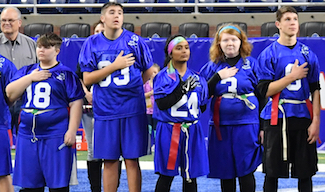
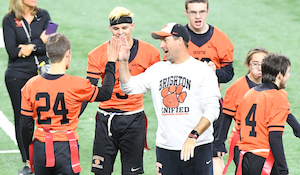
PHOTOS: (Top) Unified teams from Brighton and Mason/Holt play during the second day of the MHSAA 11-Player Football Finals at Ford Field. (Top middle) Participants from those three schools and Sparta took part in the morning's games. (Middle) Sparta athletes stand together for the national anthem. (Below middle) A Brighton coach and players exchange high fives. (Below) Brighton's Unified basketball team plays during a celebration for receiving national recognition last fall. (Photos by John Johnson.)
Dunn Ends with Memorable Finishes
By
Tom Markowski
Special for Second Half
June 1, 2019
JENISON – The Dunns are done.
Brad Dunn is the last of nine children, four of them boys, to go through Saugatuck High School – and he more than held his own on the last day of competition.
His father, Bill Dunn, is the football coach and athletic director at the school, and it’s been a successful ride for him and his family. Will and Nick are the two oldest boys, but it was Blake Dunn who caught the attention of fans statewide. Blake led Saugatuck to the MHSAA Division 7 Football Final before the team lost to Pewamo-Westphalia, 21-0. He set just about all the school records in football and is in the top 10 of a number of MHSAA all-time record lists including points scored in a season (323, good for third place), career points (827, good for second) and career touchdowns (113, food for fourth).
Brad is no slouch. His 43 touchdowns this past season places him in a tie for 10th and is one better than his brother had in 2016.
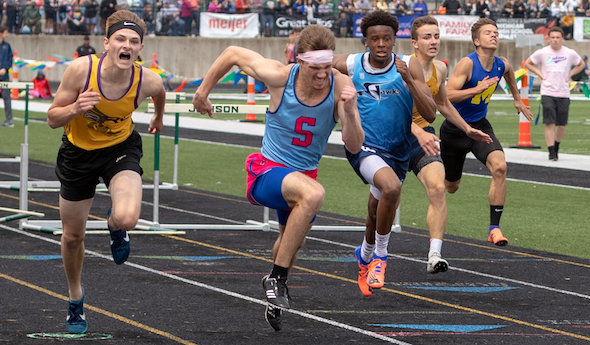
On Saturday at the Lower Peninsula Division 3 Track & Field Finals at Jenison High School, Brad Dunn placed first in two individual events to end his career on a high note.
He took first in the 100-meter hurdles with a time of 14.63 seconds and then later first in the 300 with a time of 40.06.
“It’s crazy being the youngest,” he said. “I usually got blamed for everything. (My older brothers) set the example for me. They told me what to do and what not to do.”
Blake is playing baseball at Western Michigan University and Brad, who played four sports in high school including also basketball and baseball, will attend Grand Rapids Community College and plans on being a pitcher for the baseball team. He’s a lefthander who possesses an 83-mph fastball and three other pitches.
“You know, I’ll miss all the sports I played,” Brad said. “I’ll miss the community. I looked up to Blake when I was growing up. He was awesome.”
Disappointment turns into a positive
Giovanni Weeks of Kent City thought he had won the 100 dash but was edged at the finish line by Aiden Harrison of New Lothrop. Harrison won with a time of 11.07 to 11.09 for Weeks.
No matter. Weeks placed first in the long jump (21 feet, 5¼ inches) and then won the 200 dash (21.93).
All of this took place as the Grand Rapids area was inundated with thunderstorm after thunderstorm. There were three weather delays during the meet with the shortest, taking place in the middle of the meet, lasting just 30 minutes but featuring dime-sized hail.
“It was pretty hectic,” Weeks said. “I had my jump just near the prelims of the 100 and I really just had one good jump. I didn’t have to think about it, and that probably helped. Winning was a thought but it just depends on the day. You can’t plan on this thunder and stuff.”
Northern exposure
Jeremy Kloss of Harbor Springs trailed Ransom Allen of Ithaca nearly the entire 1,600 run. Allen took the lead from the start and looked unbeatable until the last 100 meters.
“(Allen) ran an awesome race,” Kloss said. “He took the race by the horns.
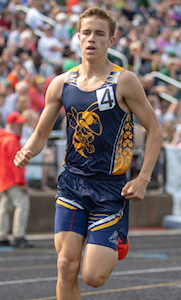 “I felt he was tiring a little with 300 to go. That momentum came to me in the last 110. I just went back to the drills, lifting my legs up. It was amazing. To have the lead all that way is crazy.”
Kloss nosed in front with about 50 meters left and won by four hundredths of a second. His time was 4:15.59. Allen was second at 4:15.63.
Kloss was runner-up last year, sixth in Division 4 as a freshman and won the title in Division 4 as a sophomore.
Allen gained some payback by taking first in the 3,200 run with a time of 9:19.70.
Ready after the delay
Sal Tranchida of Marine City showed patience throughout the day. With the rain causing a wet surface as he approached the bar in the high jump, he just waited for his opportunity.
“It was weird,” he said. “I was jumping 5-9, 6-1, then the long delay happened. Then after the (second) delay the track was better and I got to 6-3 and higher. I saw the other guys jumping 6-5 and it got me going.”
Tranchida won the high jump with a leap of 6 feet, 7 inches, two inches higher than second-place Sam Spaulding of Berrien Springs.
“I told my coach before the meet,” Tranchida said. “I knew I was ranked high, and I was going to try to win it.”
His jump also was a personal best.
Close call
In one of the more closely-contested Finals, Ithaca won the team title with 45 points, one more than runners-up Pewamo-Westphalia and Saugatuck. Harbor Springs placed fourth with 43 points and New Lothrop and Kent City each had 33 to finish in a tie for fifth.
Ithaca did not score any points in the meet’s final event, the 1,600 relay. Harbor Springs won that event to garner the 10 points and make a final move up the standings. Pewamo-Westphalia placed third in the 1,600 relay and missed an opportunity to win the team competition. Had the Pirates placed second, they would have earned eight points and won the title by one over Ithaca.
In addition to Allen’s fine finishes in the two distance races, Ithaca received valuable points in the field events. Alex VanDeWeghe won the shot put at 59 feet, 7 inches, and placed fifth in the discus. Ithaca’s Baylee Chaffin placed second in the discus with a throw of 161 feet, 1 inch.
Winners all
Detroit Edison senior Brian Taylor and Morley Stanwood junior Aiden McLaughlin earned championships in the 400 and 800, respectively. Harrison also anchored New Lothrop's winning 400 relay.
Warren Michigan Collegiate won the 800 relay, and Harbor Springs took the 1,600 and 3,200 relays with Kloss leading off the former and anchoring the latter.
Constantine junior Wyatt Alwine won the pole vault, and Pewamo-Westphalia junior Nathan Spitzley claimed the discus title.
PHOTOS: (Top) Saugatuck's Brad Dunn stretches across the finish line in winning the 110 hurdles Saturday at Jenison. (Middle) Ransom Allen scored big points to help Ithaca to the team title. (Photos by Annette Tipton. Click to see more from RunMichigan.com.)