

10 to Remember: 2013-14 Finals
July 10, 2014
By Geoff Kimmerly
Second Half editor
Every championship leaves a lasting impression with the athletes and coaches who achieved it and the communities that cheered them on.
That makes picking the 10 most notable finishes from this school year's MHSAA Finals a no-win scenario. But here's one person's carefully-considered opinion:
10. Unranked Eaton Rapids finishes No. 1 for the first time
The Greyhounds capped this year’s Girls Basketball Finals with a 51-38 win over Grand Rapids South Christian in the Class B title game that closed the weekend. But that statement alone barely scratches the surface of the story. The championship was the first for Eaton Rapids, which started five seniors and entered the tournament unranked but eliminated No. 6 Ypsilanti Arbor Prep, No. 8 Flint Powers Catholic and then the top-ranked Sailors during the season’s final week.
9. Western sweeps first Finals at Michigan State
The Baseball and Softball Finals moved to Michigan State University this spring, and the Bay City Western baseball and softball teams both took home championship trophies. The Warriors baseball team, after winning its first title in 2013, became the first in Class A or Division 1 to repeat in defeating Grosse Pointe South 6-2. The softball team won its first MHSAA championship by defeating Portage Central 4-2 after also making – and leading late – in the 2013 Final before losing by a run to Mattawan.
8. Sacred Heart overcomes, comes back for first title
Mount Pleasant Sacred Heart couldn’t have been favored by many in this season’s Class D Girls Basketball Final with one senior, making only its second championship game appearance and going up against Crystal Falls Forest Park and recently-crowned Miss Basketball Lexi Gussert. But the unranked Irish finished on a 14-3 run over the final three minutes to get past the top-ranked Trojans 56-53 and win their first MHSAA title.
7. Canton gymnastics finishes long championship journey
The Canton gymnastics team claimed its first MHSAA title by edging Grand Ledge by 2.4 points after finishing runner-up to the Comets each of the last three seasons. The Chiefs also had finished Finals runner-up in 1996 under coach John Cunningham, who took over the program in 1979 and has coached the sport since 1968. Grand Ledge had won 106 straight competitions including the last six MHSAA Finals.
6. Big Reds regain top spot in Class A hoops
With Mr. Basketball Deshaun Thrower and 2015 candidate Deyonta Davis setting the pace, Muskegon finished only the second perfect season in Class A in the last 24 seasons with a 91-67 Final win over Bloomfield Hills that earned the Big Reds their first MHSAA championship since 1937. Thrower had 21 points, and Davis had 26 and 13 rebounds.
5. Brother Rice sends Fracassa out as champion once more
The Warriors made coach Al Fracassa a back-to-back MHSAA football champion for the first time with a 38-21 victory over Muskegon in a rematch of the 2013 Division 2 Final. Brother Rice also finished 14-0 as Fracassa finished a career during which he built a 430-117-7 record dating to 1969. His wins rank first in MHSAA football history.
4. New Lothrop wrestlers end Hudson’s reign
The Hornets won their first MHSAA title since 2004 by edging Hudson 32-22 in the Division 4 Final at Kellogg Arena. New Lothrop’s title win also ended an MHSAA-record five-season championship run by the Tigers, who tied the Davison teams of 2002-06 for the longest string of consecutive titles.
3. Stars finish final title runs with 4
A pair of mid-Michigan athletes capped four-year varsity careers by joining the elite champions in their respective sports. Breckenridge runner Kirsten Olling became the fifth girl in MHSAA history to win four Lower Peninsula individual championships, claiming her latest and last in an LP Division 4 Final record 17:44.9. St. Johns senior Zac Hall became the third wrestler in three seasons and 18th in MHSAA history to finish with four individual championships. He defeated Greenville’s Alec Ward 12-2 in the Division 2 140-pound championship match to close this season 52-0 and his career 198-2.
2. St. Philip adds to all-time accolades
The Battle Creek St. Philip volleyball program ranks first in MHSAA Final appearances (27) and championships (19), but further cemented itself among the all-time elite by winning its eighth straight MHSAA title – good to tie Marysville’s 1997-2004 teams for the longest championship streak in MHSAA history. The Tigers did so this season by defeating Waterford Our Lady in three games in Class D, and despite graduating seven from its 2012 championship team.
1. Trenton wins one more for Turner
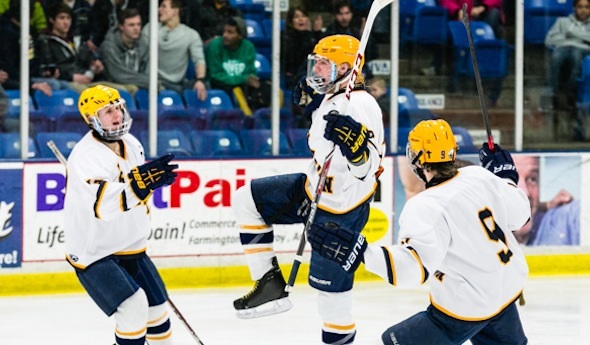
Trenton’s hockey team defeated Hartland 8-3 in the Division 2 Final to earn the program’s 14th MHSAA championship and first since 2010 – and send out coach Mike Turner with one more crowning achievement on the most notable career in MHSAA hockey history. Earlier this winter, Turner set the record for coaching wins. He finished 628-126-52 over 28 seasons stretching across two tenures.
PHOTO: Trenton hockey players celebrate during this season's Division 2 championship trophy.
Refusing to Settle for Less Than Best, Stoney Creek Shines to Complete 3-Peat
By
Tom Kendra
Special for MHSAA.com
March 6, 2026
MOUNT PLEASANT – It really hadn’t been Rochester Hills Stoney Creek’s year going into the MHSAA Finals.
The Cougars were the two-time reigning Division 1 champions, but they didn’t win their conference or their District or their Regional.
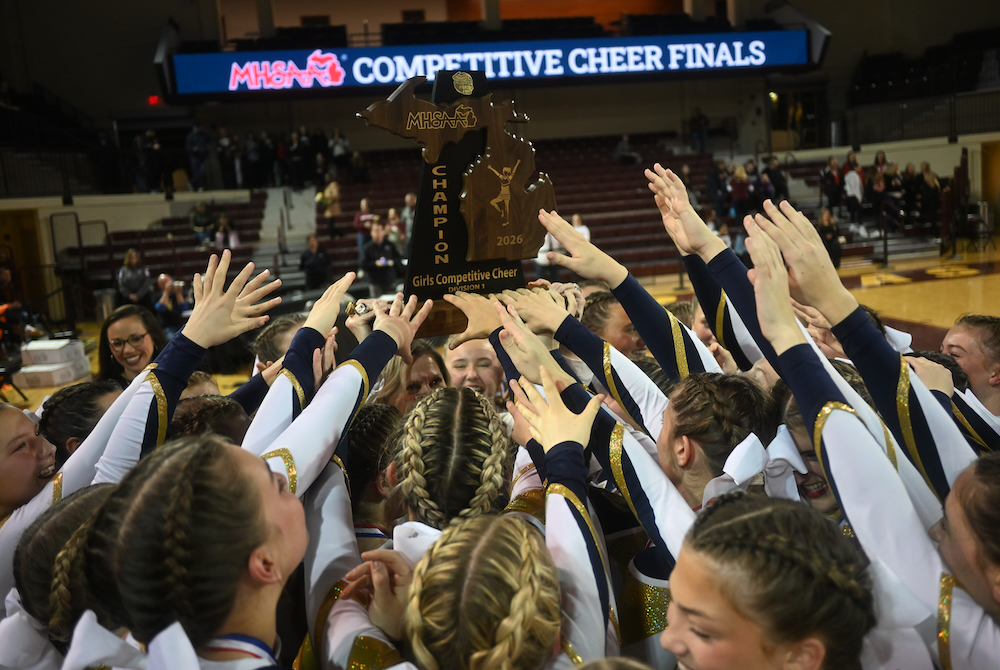
But on the biggest stage of all at Central Michigan University’s McGuirk Arena, the Cougars delivered once again.
Stoney Creek, which entered the postseason ranked No. 5, used another clutch performance in Round 3 to “three-peat” as Division 1 champion with 789.94 points – once again barely edging neighboring rivals Rochester (789.52) and Rochester Adams (789.16).
“Things haven’t been going our way this year, but these girls never stopped believing in themselves,” said 23rd-year Stoney Creek coach Tricia Williams, who won her fifth Finals championship.
“They peaked at the state finals, and I couldn’t be more proud of them.”
It looked for a while that the Division 1 title might go to a West Michigan school for the first time since 2015, as Grandville held the lead after Round 1 and Round 2 before struggling in the final round and finishing fifth (785.56).
Brighton was also right in the mix in third place heading into the final round, but backed up a spot to fourth (788.58).
It was in the “money round” of Round 3, as has so often been the case in past years, where the three Rochester schools pulled away with their complex and more difficult routines – much to the delight of the rabid fan bases from each school.
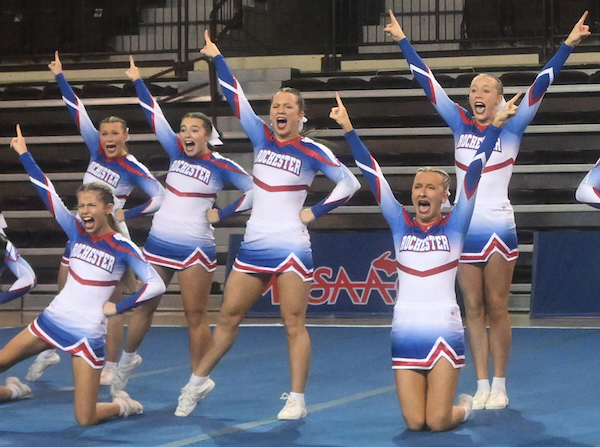 Rochester posted the best Round 3 score of 321.80 to jump from fifth place up to second. Adams turned in a 321.00 to move from fourth to third place.
That just left Stoney Creek, going last in the final round for the second consecutive year, to see if it could do enough to hold off its rivals. The Cougars posted the same score as Adams, 321.00, to win by 0.42 over Rochester.
“I think the reason that we won today is because we didn’t win at Districts and Regionals,” said Stoney Creek’s Audrey Harvath, one of 13 seniors on the 26-athlete roster.
“We knew we had to keep climbing. We looked at each of our rounds in slow motion and tried to find every little thing that we could possibly improve, and that made the difference.”
Harvath was one of three returning first-team all-staters for the Cougars, along with fellow seniors Mia Badalucco and Natalie Marco.
Seniors Taylor Brandimarte and Kendall Keller and sophomore Kate Kacy were second team all-state last season, while senior Cassidy Niester and Isabel Williams were honorable mention.
It was not only the third-straight championship for Stoney Creek, but the eighth straight for a Rochester school and the 10th in 11 years – with Stoney Creek winning four and Adams and Rochester three each. The only non-Rochester school to win the title in Division 1 during that stretch was Sterling Heights Stevenson in 2018.
“At the end of the day, we are grateful to be in each other’s backyards because it forces us to keep getting better,” said fourth-year Rochester coach Samantha Dean. “What can I say, it came down to tenths of a point again. We can say we had the best Round 3 in the state, which is certainly something to be proud of.”
The three schools have battled each other for the last three Saturdays, with each of them winning a title – Adams at Districts, Rochester at Regionals and Stoney Creek at the Finals.
It was truly a bittersweet moment as those 13 Stoney Creek seniors lingered on the McGuirk Arena floor long after most of the fans had filed out.
The Cougars became the 13th competitive cheer program in MHSAA history to win at least three Finals championships in a row.
“Going for back-to-back was hard enough, and we knew trying to get three in a row would be even harder against some powerhouse competition,” said Harvath. “It obviously took every last ounce of energy that we had.”