

10 to Remember: 2013-14 Finals
July 10, 2014
By Geoff Kimmerly
Second Half editor
Every championship leaves a lasting impression with the athletes and coaches who achieved it and the communities that cheered them on.
That makes picking the 10 most notable finishes from this school year's MHSAA Finals a no-win scenario. But here's one person's carefully-considered opinion:
10. Unranked Eaton Rapids finishes No. 1 for the first time
The Greyhounds capped this year’s Girls Basketball Finals with a 51-38 win over Grand Rapids South Christian in the Class B title game that closed the weekend. But that statement alone barely scratches the surface of the story. The championship was the first for Eaton Rapids, which started five seniors and entered the tournament unranked but eliminated No. 6 Ypsilanti Arbor Prep, No. 8 Flint Powers Catholic and then the top-ranked Sailors during the season’s final week.
9. Western sweeps first Finals at Michigan State
The Baseball and Softball Finals moved to Michigan State University this spring, and the Bay City Western baseball and softball teams both took home championship trophies. The Warriors baseball team, after winning its first title in 2013, became the first in Class A or Division 1 to repeat in defeating Grosse Pointe South 6-2. The softball team won its first MHSAA championship by defeating Portage Central 4-2 after also making – and leading late – in the 2013 Final before losing by a run to Mattawan.
8. Sacred Heart overcomes, comes back for first title
Mount Pleasant Sacred Heart couldn’t have been favored by many in this season’s Class D Girls Basketball Final with one senior, making only its second championship game appearance and going up against Crystal Falls Forest Park and recently-crowned Miss Basketball Lexi Gussert. But the unranked Irish finished on a 14-3 run over the final three minutes to get past the top-ranked Trojans 56-53 and win their first MHSAA title.
7. Canton gymnastics finishes long championship journey
The Canton gymnastics team claimed its first MHSAA title by edging Grand Ledge by 2.4 points after finishing runner-up to the Comets each of the last three seasons. The Chiefs also had finished Finals runner-up in 1996 under coach John Cunningham, who took over the program in 1979 and has coached the sport since 1968. Grand Ledge had won 106 straight competitions including the last six MHSAA Finals.
6. Big Reds regain top spot in Class A hoops
With Mr. Basketball Deshaun Thrower and 2015 candidate Deyonta Davis setting the pace, Muskegon finished only the second perfect season in Class A in the last 24 seasons with a 91-67 Final win over Bloomfield Hills that earned the Big Reds their first MHSAA championship since 1937. Thrower had 21 points, and Davis had 26 and 13 rebounds.
5. Brother Rice sends Fracassa out as champion once more
The Warriors made coach Al Fracassa a back-to-back MHSAA football champion for the first time with a 38-21 victory over Muskegon in a rematch of the 2013 Division 2 Final. Brother Rice also finished 14-0 as Fracassa finished a career during which he built a 430-117-7 record dating to 1969. His wins rank first in MHSAA football history.
4. New Lothrop wrestlers end Hudson’s reign
The Hornets won their first MHSAA title since 2004 by edging Hudson 32-22 in the Division 4 Final at Kellogg Arena. New Lothrop’s title win also ended an MHSAA-record five-season championship run by the Tigers, who tied the Davison teams of 2002-06 for the longest string of consecutive titles.
3. Stars finish final title runs with 4
A pair of mid-Michigan athletes capped four-year varsity careers by joining the elite champions in their respective sports. Breckenridge runner Kirsten Olling became the fifth girl in MHSAA history to win four Lower Peninsula individual championships, claiming her latest and last in an LP Division 4 Final record 17:44.9. St. Johns senior Zac Hall became the third wrestler in three seasons and 18th in MHSAA history to finish with four individual championships. He defeated Greenville’s Alec Ward 12-2 in the Division 2 140-pound championship match to close this season 52-0 and his career 198-2.
2. St. Philip adds to all-time accolades
The Battle Creek St. Philip volleyball program ranks first in MHSAA Final appearances (27) and championships (19), but further cemented itself among the all-time elite by winning its eighth straight MHSAA title – good to tie Marysville’s 1997-2004 teams for the longest championship streak in MHSAA history. The Tigers did so this season by defeating Waterford Our Lady in three games in Class D, and despite graduating seven from its 2012 championship team.
1. Trenton wins one more for Turner
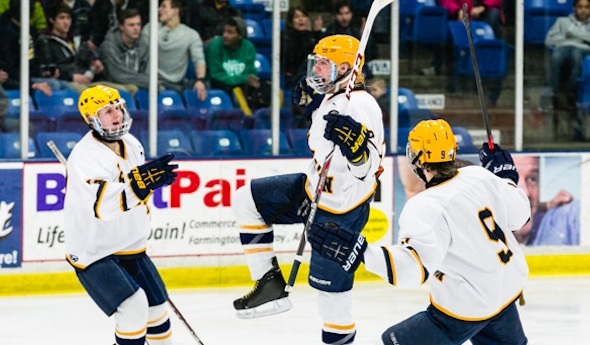
Trenton’s hockey team defeated Hartland 8-3 in the Division 2 Final to earn the program’s 14th MHSAA championship and first since 2010 – and send out coach Mike Turner with one more crowning achievement on the most notable career in MHSAA hockey history. Earlier this winter, Turner set the record for coaching wins. He finished 628-126-52 over 28 seasons stretching across two tenures.
PHOTO: Trenton hockey players celebrate during this season's Division 2 championship trophy.

Title IX Continues to Fuel Growth of Girls and Women’s Sports, Olympic Dominance
By
Karissa Niehoff
NFHS Executive Director
September 24, 2021
To say that American female athletes dominated the recent Olympics in Tokyo would be an understatement.
Among the 66 medals earned by American female Olympians – most by any country in the history of the Games – were gold-medal performances by the U.S. basketball, volleyball, water polo and beach volleyball teams. Eighteen medals were earned by the U.S. women swimmers, female track and field athletes claimed 15 medals, and the U.S. women’s softball and soccer teams won silver and bronze medals, respectively.
In the past 30 years of the Olympic Games, the United States has dominated the women’s team sports of basketball (nine golds), soccer (four golds, one silver, one bronze) and softball (three golds, two silvers) — not to mention the untold number of medals in track and field. And this past summer, the U.S. women’s volleyball team claimed its first gold medal.
These performances by some of our nation’s most skilled female athletes never would have been possible without the passage of Title IX and the offerings of these sports through our nation’s schools. With the chance to play afforded by the landmark Title IX legislation in 1972, girls participation in several high school sports skyrocketed in the years that followed.
When the NFHS conducted its first participation survey in 1971, basketball and outdoor track and field were the primary girls sports, comprising about two-thirds of the 294,000 total. However, with the opportunity to play additional sports, girls flocked to volleyball and softball first, along with cross country and eventually soccer.
Soccer, in fact, has had the most remarkable growth. In 1971, only 700 girls were playing high school soccer. Twenty-five years later, that number had climbed to almost 210,000; and as the 50th anniversary of Title IX approaches, there are now almost 400,000 girls playing high school soccer – a staggering 56,200 percentage increase in 50 years. Soccer now ranks fourth in popularity among girls high school sports – all because of that opportunity in 1972.
There are many other success stories, however. The pre-Title IX survey in 1971 indicated that 1,719 girls were participating in cross country. With increases every year until 2015, today, there are 219,345 girls competing in high school programs and the sport ranks sixth in popularity.
Although participation numbers have leveled a bit the past 10 years, fast-pitch softball is another sport that flourished after the passage of Title IX. With fewer than 10,000 participants in 1971, the numbers quickly rose to 220,000 by 1985 and 343,000 by 2000, and softball is currently fifth among girls sports with 362,038 participants.
Since track and field and basketball were the primary sports in the early days of girls sports programs, increases in those sports have not been as dramatic; however, they remain the first and third most-popular sports, respectively, today. Volleyball, however, much like soccer, continues its upward climb.
Without a doubt, volleyball has seen the steadiest increases among girls high school sports the past 50 years. After starting with 17,952 participants in 1971, the numbers jumped to 300,810 by 1990 and 409,332 by 2010 and 452,808 by 2018. During its climb, volleyball surpassed basketball as the No. 2 girls sport.
And among the top six girls sports from 2010 to 2018 (numbers are not available the past two years due to the pandemic), volleyball has gained the most participants (43,476), followed by soccer (32,549). And all of this has occurred thanks to legislation passed in 1972 that was not fundamentally meant to address opportunities for girls to participate in high school sports.
The NFHS is leading a yearlong celebration of the 50th anniversary of Title IX, which officially occurs on June 23, 2022. “Title IX at 50 – Celebrating and Growing Opportunities” is highlighting the law’s impact by celebrating the inspirational individuals and landmark moments in the history of Title IX, and continuing to grow the educational and competitive opportunities for the future.
More information, including a Title IX Timeline, Title IX Milestones, The History and Importance of Title IX, Title IX Fact Sheet, Title IX Frequently Asked Questions and several Title IX videos, can be accessed on the NFHS Website.
Dr. Karissa L. Niehoff is beginning her fourth year as executive director of the National Federation of State High School Associations (NFHS) in Indianapolis. She is the first female to head the national leadership organization for high school athletics and performing arts activities and the sixth full-time executive director of the NFHS. She previously was executive director of the Connecticut Association of Schools-Connecticut Interscholastic Athletic Conference for seven years.