

10 to Remember: 2013-14 Finals
July 10, 2014
By Geoff Kimmerly
Second Half editor
Every championship leaves a lasting impression with the athletes and coaches who achieved it and the communities that cheered them on.
That makes picking the 10 most notable finishes from this school year's MHSAA Finals a no-win scenario. But here's one person's carefully-considered opinion:
10. Unranked Eaton Rapids finishes No. 1 for the first time
The Greyhounds capped this year’s Girls Basketball Finals with a 51-38 win over Grand Rapids South Christian in the Class B title game that closed the weekend. But that statement alone barely scratches the surface of the story. The championship was the first for Eaton Rapids, which started five seniors and entered the tournament unranked but eliminated No. 6 Ypsilanti Arbor Prep, No. 8 Flint Powers Catholic and then the top-ranked Sailors during the season’s final week.
9. Western sweeps first Finals at Michigan State
The Baseball and Softball Finals moved to Michigan State University this spring, and the Bay City Western baseball and softball teams both took home championship trophies. The Warriors baseball team, after winning its first title in 2013, became the first in Class A or Division 1 to repeat in defeating Grosse Pointe South 6-2. The softball team won its first MHSAA championship by defeating Portage Central 4-2 after also making – and leading late – in the 2013 Final before losing by a run to Mattawan.
8. Sacred Heart overcomes, comes back for first title
Mount Pleasant Sacred Heart couldn’t have been favored by many in this season’s Class D Girls Basketball Final with one senior, making only its second championship game appearance and going up against Crystal Falls Forest Park and recently-crowned Miss Basketball Lexi Gussert. But the unranked Irish finished on a 14-3 run over the final three minutes to get past the top-ranked Trojans 56-53 and win their first MHSAA title.
7. Canton gymnastics finishes long championship journey
The Canton gymnastics team claimed its first MHSAA title by edging Grand Ledge by 2.4 points after finishing runner-up to the Comets each of the last three seasons. The Chiefs also had finished Finals runner-up in 1996 under coach John Cunningham, who took over the program in 1979 and has coached the sport since 1968. Grand Ledge had won 106 straight competitions including the last six MHSAA Finals.
6. Big Reds regain top spot in Class A hoops
With Mr. Basketball Deshaun Thrower and 2015 candidate Deyonta Davis setting the pace, Muskegon finished only the second perfect season in Class A in the last 24 seasons with a 91-67 Final win over Bloomfield Hills that earned the Big Reds their first MHSAA championship since 1937. Thrower had 21 points, and Davis had 26 and 13 rebounds.
5. Brother Rice sends Fracassa out as champion once more
The Warriors made coach Al Fracassa a back-to-back MHSAA football champion for the first time with a 38-21 victory over Muskegon in a rematch of the 2013 Division 2 Final. Brother Rice also finished 14-0 as Fracassa finished a career during which he built a 430-117-7 record dating to 1969. His wins rank first in MHSAA football history.
4. New Lothrop wrestlers end Hudson’s reign
The Hornets won their first MHSAA title since 2004 by edging Hudson 32-22 in the Division 4 Final at Kellogg Arena. New Lothrop’s title win also ended an MHSAA-record five-season championship run by the Tigers, who tied the Davison teams of 2002-06 for the longest string of consecutive titles.
3. Stars finish final title runs with 4
A pair of mid-Michigan athletes capped four-year varsity careers by joining the elite champions in their respective sports. Breckenridge runner Kirsten Olling became the fifth girl in MHSAA history to win four Lower Peninsula individual championships, claiming her latest and last in an LP Division 4 Final record 17:44.9. St. Johns senior Zac Hall became the third wrestler in three seasons and 18th in MHSAA history to finish with four individual championships. He defeated Greenville’s Alec Ward 12-2 in the Division 2 140-pound championship match to close this season 52-0 and his career 198-2.
2. St. Philip adds to all-time accolades
The Battle Creek St. Philip volleyball program ranks first in MHSAA Final appearances (27) and championships (19), but further cemented itself among the all-time elite by winning its eighth straight MHSAA title – good to tie Marysville’s 1997-2004 teams for the longest championship streak in MHSAA history. The Tigers did so this season by defeating Waterford Our Lady in three games in Class D, and despite graduating seven from its 2012 championship team.
1. Trenton wins one more for Turner
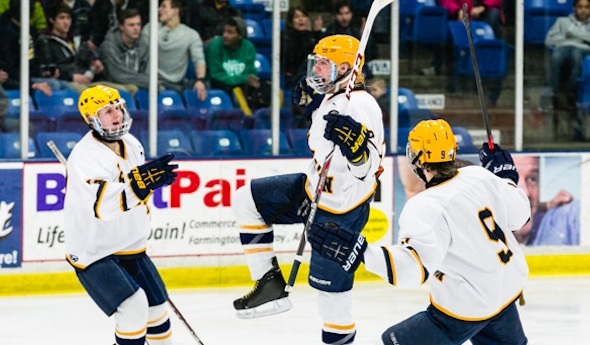
Trenton’s hockey team defeated Hartland 8-3 in the Division 2 Final to earn the program’s 14th MHSAA championship and first since 2010 – and send out coach Mike Turner with one more crowning achievement on the most notable career in MHSAA hockey history. Earlier this winter, Turner set the record for coaching wins. He finished 628-126-52 over 28 seasons stretching across two tenures.
PHOTO: Trenton hockey players celebrate during this season's Division 2 championship trophy.

NFHS Voice: Campaign Touts Benefits of High School Football
By
Karissa Niehoff
NFHS Executive Director
May 21, 2021
A full return to high school sports and performing arts programs – that’s the hope for this fall in schools across the country.
After a year of unprecedented challenges in keeping these programs going due to the pandemic, which included 11 states that conducted their primary football season this spring, there is great optimism as we look to a new school year.
Even in those states that were able to conduct activities last fall, attendance restrictions kept many fans out of stadiums and watching games online. However, with vaccine eligibility now at 12 years of age and older and with vaccinations continuing during the next three months, the likelihood of routines and traditions returning this fall grows stronger each day.
And there is no tradition more anticipated than the full-scale return of high school football. While there were 34 states there were fortunate enough to conduct football at some level last fall, the routines were anything but normal.
This fall, however, we anticipate a return to the energy and excitement of the 2019 season when 1,003,524 boys participated in 11-player football. That total marked a decline of only 2,489 from the previous year and was a good sign of a renewed confidence on the part of parents and student-athletes that concerns about the risk of injury were being addressed.
While boys participation in 11-player football has exceeded one million participants every year since 1999 and is overwhelmingly the most popular boys sport, there have been concerns about declines in past years.
Last fall, the NFHS and the National Football League announced a partnership to promote the growth, understanding and support for football at the high school level. The NFHS and NFL have been studying participation trends, developing educational tools and striving to restore confidence in students and parents that the sport is, in fact, more focused on risk minimization than ever before.
As a result, the springboard to the return of high school football next fall begins this week with the launch of the #ThisIsHSFootball campaign. Through this effort over the next few months, the NFHS will be reaching out to coaches, students, parents, officials, athletic directors and others with research information, participation trends and data on various risk mitigation efforts that, we believe, continues to make high school football safer than it has ever been.
As a part of this effort, the NFHS produced a video entitled “This is High School Football” designed to detail the benefits of participation in high school football.
As the video states, more so than at any other level of play, parents should feel good about their kids playing high school football.
>Here are some of the many educational and medical safeguards put in place the past 12 years to offer parents a comfort level about the safety standards that are a part of high school football.
► Concussion research and education. All NFHS high school playing rules require a student who is exhibiting signs of a concussion to be removed from the game and not allowed to return until the student has been cleared by a medical professional. Thanks to education and training on the part of students, coaches, trainers, parents and others, research data has shown positive trends in concussion rates. In a recent five-year period, concussion rates during practices dropped from 5.47 to 4.44 concussions per 10,000 athletic exposures.
► Concussion in Sport Course. This free online education course has been available through the NFHS Learning Center since 2010, and millions of individuals have taken the course for a deeper understanding about concussions.
► Concussion Laws. By 2014, every state had adopted state concussion laws that established mandatory protocols, and every state high school association has adopted policies that limit contact during preseason drills and in practices during the season.
► Football equipment. Manufacturers continue to produce higher quality equipment every year, and high school coaches are doing a much better job at teaching and coaching the rules of the game and making attempts to minimize risk of injury for players.
► Emergency Action Plans. Thanks to the NFHS Foundation, a copy of the “Anyone Can Save a Life” emergency action plan originally developed by the Minnesota State High School League was sent to all state high school associations and their high schools, and all schools have access to an AED to help save lives.
► Playing Rules. Risk minimization is a major focus of every NFHS sports rules committee. In football, helmet-to-helmet hits are not allowed.
High school football has been a significant part of schools, towns and communities across America for almost 100 years. The NFHS is committed to making the sport as safe as possible for the millions of kids who will play the sport in the years to come.
Dr. Karissa L. Niehoff is in her third year as executive director of the National Federation of State High School Associations (NFHS) in Indianapolis, Indiana. She is the first female to head the national leadership organization for high school athletics and performing arts activities and the sixth full-time executive director of the NFHS, which celebrated its 100th year of service during the 2018-19 school year. She previously was executive director of the Connecticut Association of Schools-Connecticut Interscholastic Athletic Conference for seven years.