

10 to Remember: 2013-14 Finals
July 10, 2014
By Geoff Kimmerly
Second Half editor
Every championship leaves a lasting impression with the athletes and coaches who achieved it and the communities that cheered them on.
That makes picking the 10 most notable finishes from this school year's MHSAA Finals a no-win scenario. But here's one person's carefully-considered opinion:
10. Unranked Eaton Rapids finishes No. 1 for the first time
The Greyhounds capped this year’s Girls Basketball Finals with a 51-38 win over Grand Rapids South Christian in the Class B title game that closed the weekend. But that statement alone barely scratches the surface of the story. The championship was the first for Eaton Rapids, which started five seniors and entered the tournament unranked but eliminated No. 6 Ypsilanti Arbor Prep, No. 8 Flint Powers Catholic and then the top-ranked Sailors during the season’s final week.
9. Western sweeps first Finals at Michigan State
The Baseball and Softball Finals moved to Michigan State University this spring, and the Bay City Western baseball and softball teams both took home championship trophies. The Warriors baseball team, after winning its first title in 2013, became the first in Class A or Division 1 to repeat in defeating Grosse Pointe South 6-2. The softball team won its first MHSAA championship by defeating Portage Central 4-2 after also making – and leading late – in the 2013 Final before losing by a run to Mattawan.
8. Sacred Heart overcomes, comes back for first title
Mount Pleasant Sacred Heart couldn’t have been favored by many in this season’s Class D Girls Basketball Final with one senior, making only its second championship game appearance and going up against Crystal Falls Forest Park and recently-crowned Miss Basketball Lexi Gussert. But the unranked Irish finished on a 14-3 run over the final three minutes to get past the top-ranked Trojans 56-53 and win their first MHSAA title.
7. Canton gymnastics finishes long championship journey
The Canton gymnastics team claimed its first MHSAA title by edging Grand Ledge by 2.4 points after finishing runner-up to the Comets each of the last three seasons. The Chiefs also had finished Finals runner-up in 1996 under coach John Cunningham, who took over the program in 1979 and has coached the sport since 1968. Grand Ledge had won 106 straight competitions including the last six MHSAA Finals.
6. Big Reds regain top spot in Class A hoops
With Mr. Basketball Deshaun Thrower and 2015 candidate Deyonta Davis setting the pace, Muskegon finished only the second perfect season in Class A in the last 24 seasons with a 91-67 Final win over Bloomfield Hills that earned the Big Reds their first MHSAA championship since 1937. Thrower had 21 points, and Davis had 26 and 13 rebounds.
5. Brother Rice sends Fracassa out as champion once more
The Warriors made coach Al Fracassa a back-to-back MHSAA football champion for the first time with a 38-21 victory over Muskegon in a rematch of the 2013 Division 2 Final. Brother Rice also finished 14-0 as Fracassa finished a career during which he built a 430-117-7 record dating to 1969. His wins rank first in MHSAA football history.
4. New Lothrop wrestlers end Hudson’s reign
The Hornets won their first MHSAA title since 2004 by edging Hudson 32-22 in the Division 4 Final at Kellogg Arena. New Lothrop’s title win also ended an MHSAA-record five-season championship run by the Tigers, who tied the Davison teams of 2002-06 for the longest string of consecutive titles.
3. Stars finish final title runs with 4
A pair of mid-Michigan athletes capped four-year varsity careers by joining the elite champions in their respective sports. Breckenridge runner Kirsten Olling became the fifth girl in MHSAA history to win four Lower Peninsula individual championships, claiming her latest and last in an LP Division 4 Final record 17:44.9. St. Johns senior Zac Hall became the third wrestler in three seasons and 18th in MHSAA history to finish with four individual championships. He defeated Greenville’s Alec Ward 12-2 in the Division 2 140-pound championship match to close this season 52-0 and his career 198-2.
2. St. Philip adds to all-time accolades
The Battle Creek St. Philip volleyball program ranks first in MHSAA Final appearances (27) and championships (19), but further cemented itself among the all-time elite by winning its eighth straight MHSAA title – good to tie Marysville’s 1997-2004 teams for the longest championship streak in MHSAA history. The Tigers did so this season by defeating Waterford Our Lady in three games in Class D, and despite graduating seven from its 2012 championship team.
1. Trenton wins one more for Turner
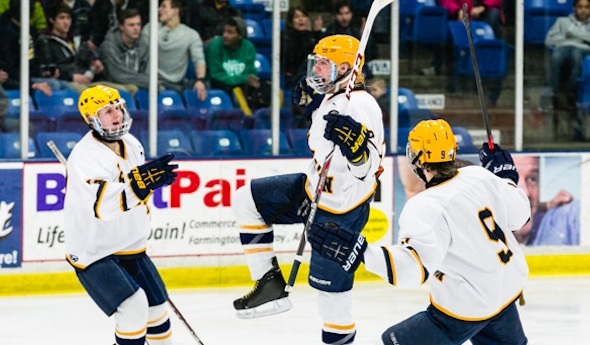
Trenton’s hockey team defeated Hartland 8-3 in the Division 2 Final to earn the program’s 14th MHSAA championship and first since 2010 – and send out coach Mike Turner with one more crowning achievement on the most notable career in MHSAA hockey history. Earlier this winter, Turner set the record for coaching wins. He finished 628-126-52 over 28 seasons stretching across two tenures.
PHOTO: Trenton hockey players celebrate during this season's Division 2 championship trophy.
Workout Basics: Warm-Ups & Cool-Downs
February 3, 2021

By Nick Parkinson, M.Ed., AT, ATC, TSAC-F
Henry Ford Health Systems
You may know a good warm-up — and cool-down — are essential to getting a good workout. You may also know that warming up your muscles and stretching them out after exercise can help prevent injury and keep you at the top of your game.
They’re the two bookends that help maximize a workout. Unfortunately, a lot of exercise enthusiasts don’t know how to warm up and cool down correctly.
Warm-Up Basics
A warm-up is exactly what it sounds like: The goal is to warm up your muscles and prepare your body for whatever you’re asking it to do. Warming up increases your body temperature and helps blood flow to the muscles that you’re using.
So if you’re going to play soccer, your warm-up should touch all of the muscles in your legs and core. Shooting hoops? You’ll need to add shoulders and arms to your routine. Circuit training at the gym? Choose a warm-up that flexes all of the muscles you’re about to use.
The thing that all warm-ups have in common is that they require dynamic (or constantly moving) motion, not static stretching (holding poses for a certain amount of time). In fact, static stretching prior to a workout can inhibit power and strength, especially if you’re doing something like weightlifting.
The anatomy of a solid warm-up:
• Before any activity, do about 10 minutes of light cardiovascular activity, whether walking, biking or jogging.
• Dynamic stretches. After you get your muscles moving, do a series of lunges, jumping jacks or toe touches to stretch a bit.
• Dive in. When you start your workout, begin slowly and gradually increase power and speed.
Cool-Down Basics
After you’ve put your body through a challenge, a good cool-down is essential. It helps slow down your heart rate gradually, relax your muscles and stretch them out.
Cool-down routines should always include some type of motion before you get to static stretching, especially if you’ve just finished a high-intensity workout. Static stretching improves flexibility and performance and it can also help stave off future injury.
As with warm-ups, the right cool-down exercises depend on the activity you engaged in. If you biked for 20 miles, you might coast on your cycle for a while before coming to a stop. If you ran, you might jog or walk before you begin stretching. As with your warm-up, the key is addressing every muscle group you worked during your workout.
The anatomy of a solid cool-down:
• At the end of your workout, slow the pace and intensity of whatever activity you’re doing. So, if you’re running, slow to a jog and then a walk for 5 to 10 minutes before stopping.
• Stretch out the muscles you work, but don’t push past the point where you feel tight. Then, hold the position for at least 30 seconds. That’s how long it takes for the body to overcome its stretch reflex.
• Breathe through your stretches and make sure to finish your cool-down with deep, belly breaths.
Running short on time? Target muscle groups you may have injured in the past or that tend to get sore after activity. Cooling down will preserve your athleticism — and your ability to participate in daily activities — over the long term.
Be Good to Your Body
While there’s some controversy about whether warming up and cooling down can help prevent injury, there’s little dispute that they can help you ease in and out of activity.
The key is to find something that works for you. Your warm-up could be as simple as walking to the gym and doing a set of jumping jacks when you arrive. Your cool-down might just involve ending your workout 10 minutes early so you can slow down.
It doesn’t have to be complicated. It just has to give your heart and blood vessels a chance to breathe before and after activity.
Nick Parkinson, M.Ed., AT, ATC, TSAC-F, is the Supervisor of Athletic Training with Henry Ford Sports Medicine and also leads Sports Performance training at the William Clay Ford Center for Athletic Medicine. Learn more about Nick.
Want to learn more? Henry Ford Health System sports medicine experts are treating the whole athlete, in a whole new way. From nutrition to neurology, and from injury prevention to treatment of sports-related conditions, they can give your athlete a unique game plan.
Visit henryford.com/sports or call (313) 972-4216.