

10 to Remember: 2013-14 Finals
July 10, 2014
By Geoff Kimmerly
Second Half editor
Every championship leaves a lasting impression with the athletes and coaches who achieved it and the communities that cheered them on.
That makes picking the 10 most notable finishes from this school year's MHSAA Finals a no-win scenario. But here's one person's carefully-considered opinion:
10. Unranked Eaton Rapids finishes No. 1 for the first time
The Greyhounds capped this year’s Girls Basketball Finals with a 51-38 win over Grand Rapids South Christian in the Class B title game that closed the weekend. But that statement alone barely scratches the surface of the story. The championship was the first for Eaton Rapids, which started five seniors and entered the tournament unranked but eliminated No. 6 Ypsilanti Arbor Prep, No. 8 Flint Powers Catholic and then the top-ranked Sailors during the season’s final week.
9. Western sweeps first Finals at Michigan State
The Baseball and Softball Finals moved to Michigan State University this spring, and the Bay City Western baseball and softball teams both took home championship trophies. The Warriors baseball team, after winning its first title in 2013, became the first in Class A or Division 1 to repeat in defeating Grosse Pointe South 6-2. The softball team won its first MHSAA championship by defeating Portage Central 4-2 after also making – and leading late – in the 2013 Final before losing by a run to Mattawan.
8. Sacred Heart overcomes, comes back for first title
Mount Pleasant Sacred Heart couldn’t have been favored by many in this season’s Class D Girls Basketball Final with one senior, making only its second championship game appearance and going up against Crystal Falls Forest Park and recently-crowned Miss Basketball Lexi Gussert. But the unranked Irish finished on a 14-3 run over the final three minutes to get past the top-ranked Trojans 56-53 and win their first MHSAA title.
7. Canton gymnastics finishes long championship journey
The Canton gymnastics team claimed its first MHSAA title by edging Grand Ledge by 2.4 points after finishing runner-up to the Comets each of the last three seasons. The Chiefs also had finished Finals runner-up in 1996 under coach John Cunningham, who took over the program in 1979 and has coached the sport since 1968. Grand Ledge had won 106 straight competitions including the last six MHSAA Finals.
6. Big Reds regain top spot in Class A hoops
With Mr. Basketball Deshaun Thrower and 2015 candidate Deyonta Davis setting the pace, Muskegon finished only the second perfect season in Class A in the last 24 seasons with a 91-67 Final win over Bloomfield Hills that earned the Big Reds their first MHSAA championship since 1937. Thrower had 21 points, and Davis had 26 and 13 rebounds.
5. Brother Rice sends Fracassa out as champion once more
The Warriors made coach Al Fracassa a back-to-back MHSAA football champion for the first time with a 38-21 victory over Muskegon in a rematch of the 2013 Division 2 Final. Brother Rice also finished 14-0 as Fracassa finished a career during which he built a 430-117-7 record dating to 1969. His wins rank first in MHSAA football history.
4. New Lothrop wrestlers end Hudson’s reign
The Hornets won their first MHSAA title since 2004 by edging Hudson 32-22 in the Division 4 Final at Kellogg Arena. New Lothrop’s title win also ended an MHSAA-record five-season championship run by the Tigers, who tied the Davison teams of 2002-06 for the longest string of consecutive titles.
3. Stars finish final title runs with 4
A pair of mid-Michigan athletes capped four-year varsity careers by joining the elite champions in their respective sports. Breckenridge runner Kirsten Olling became the fifth girl in MHSAA history to win four Lower Peninsula individual championships, claiming her latest and last in an LP Division 4 Final record 17:44.9. St. Johns senior Zac Hall became the third wrestler in three seasons and 18th in MHSAA history to finish with four individual championships. He defeated Greenville’s Alec Ward 12-2 in the Division 2 140-pound championship match to close this season 52-0 and his career 198-2.
2. St. Philip adds to all-time accolades
The Battle Creek St. Philip volleyball program ranks first in MHSAA Final appearances (27) and championships (19), but further cemented itself among the all-time elite by winning its eighth straight MHSAA title – good to tie Marysville’s 1997-2004 teams for the longest championship streak in MHSAA history. The Tigers did so this season by defeating Waterford Our Lady in three games in Class D, and despite graduating seven from its 2012 championship team.
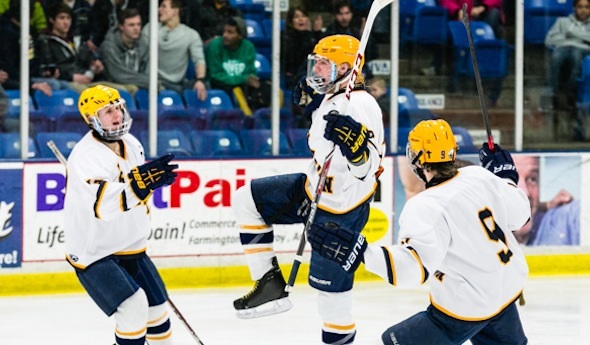
1. Trenton wins one more for Turner
Trenton’s hockey team defeated Hartland 8-3 in the Division 2 Final to earn the program’s 14th MHSAA championship and first since 2010 – and send out coach Mike Turner with one more crowning achievement on the most notable career in MHSAA hockey history. Earlier this winter, Turner set the record for coaching wins. He finished 628-126-52 over 28 seasons stretching across two tenures.
PHOTO: Trenton hockey players celebrate during this season's Division 2 championship trophy.
Fure Completes Comeback, Rudyard Sweeps & L'Anse Claims 1st Finals Win
By
John Vrancic
Special for MHSAA.com
October 18, 2025
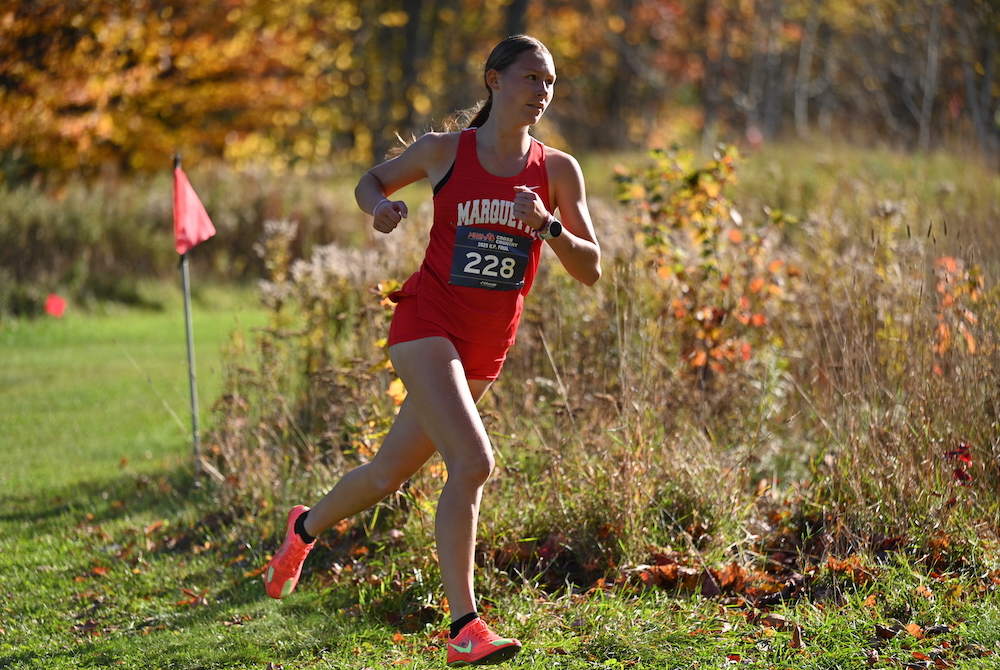
MUNISING — A few months ago, Ella Fure wasn’t sure she’d be able to run cross country this fall.
The Marquette High School senior had mononucleosis this summer and missed a lot of time from training and a few early-season meets.
She made up for lost time and regained her Upper Peninsula Division 1 title here Saturday by covering the 3.1 miles on the Pictured Rocks Golf Course in 18:53.3 – the fourth-fastest time in UP Division 1 Finals history.
“That was my goal,” she said. “I ran in God’s name more than in my own, and that’s why I think I was successful. It was also my goal to run as hard as I can. This was my last high school cross country meet. I just left it all on the course.”
This marked the fourth straight team title for Marquette, which scored 39 points. The Sentinels were followed by Sault Ste. Marie with 53 and Houghton with 63.
“I’m really excited,” Fure said. “I’m going to the MITCA meet in Mount Pleasant in two weeks and will be going downstate for indoor meets. I’m proud of all the girls. They really showed up today. I’m really proud of Emma (Ziegler), who’s a freshman. We worked so hard for this.”
Kingsford sophomore Maria Murvich placed second (20:25.5), followed by Negaunee junior Keira Waterman (20:33) and Houghton sophomores Holly Cooke (20:39.4) and Sela Niska (20:41.1).
“I tried to keep Ella within my sight,” Murvich said. “I’m so proud of her. She has come a long way.
“I’m very happy with my season. I have something to build on. It was a little warm out there, but a good day for a run. This is awesome.”
Houghton senior Tessa Rautiola, who was crowned champion two of the past three years, ran for the first time in six weeks due to a stress fracture. She placed 18th this time in 22:05.8
Division 2
Rudyard edged four-time reigning champion Hancock 28-32 for its first title in 14 years. Third-place Ironwood scored 67 points.
“The girls worked their tails off all year,” Rudyard coach Mike Kirschner said. “We have a group of girls who worked all summer long. They (Hancock) were injury-riddled this season, but really poured it on toward the end.
“We have a young group. I’m just so proud of the way they performed. We should be stronger next year.”
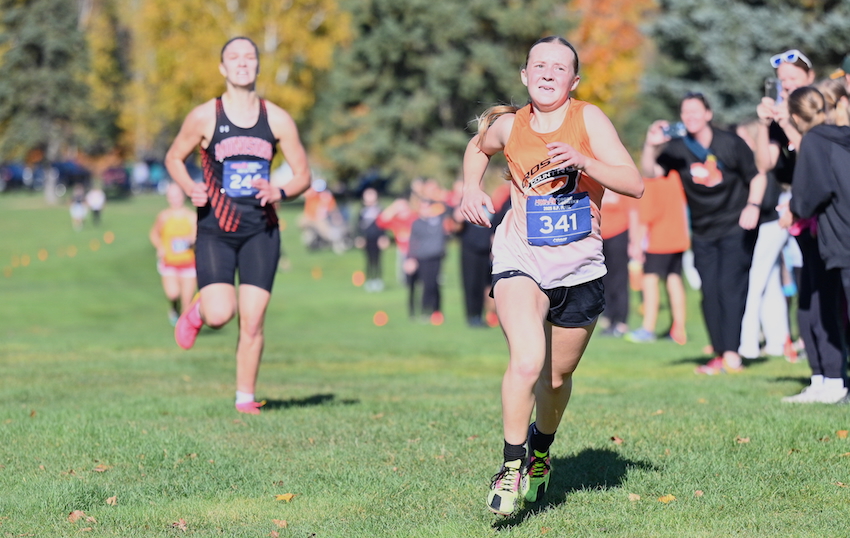
Rudyard freshman Melissa Kirschner won in 21:56.6. She was followed by Munising sophomore Addie Bowerman at 21:58.4, Hancock senior Jill Berg (22:05.1), Painesdale Jeffers sophomore Remi Coponen (22:37.7) and Hancock senior Lydia Pelli (22:49.3).
“I just wanted to get out there and run my race and have a big kick,” Kirschner said. “It really helps having everyone on different parts of the course and cheering me on. It was nice having somebody at the mile mark calling out my time. This is a big motivator to keep me running and pushing hard.”
Division 3
This marked what is believed to be the first U.P. Finals team title for L’Anse, which scored 51 points. The Purple Hornets were followed by last year’s champion Ewen-Trout Creek with 99 and Stephenson at 112.
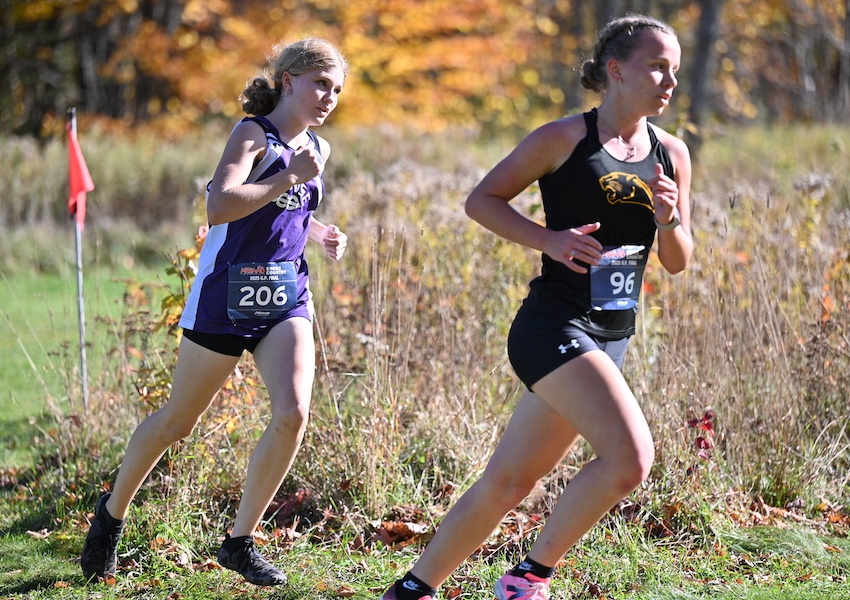
Pickford senior Talya Schreiber claimed the Division 3 individual race at 18:31.6, followed by Newberry senior Samantha Taylor (18:48.7), junior Abby Taylor (20:29.3) and freshman Molly McNamara (20:52.5), and L’Anse sophomore Lily Froese (21:02.1).
Schreiber had broken 18 minutes twice this season. She ran a 17:46 at Shepherd on Sept. 27 and 17:54 in the final leg of the Eastern U.P. Conference jamborees at her home course Monday.
“I felt really good (Monday),” she said. “That may have taken a little out of me for today, but it’s pretty amazing. I will probably run in some indoor meets this winter. I’m hoping track season will be pretty good.”
PHOTOS (Top) Marquette's Ella Fure leads and eventually wins the Upper Peninsula Division 1 Girls Final at Picture Rocks Golf Course in Munising. (Middle) As Rudyard's Melissa Kirschner approaches the finish line, Munising's Addie Bowernman challenges. (Below) L'Anse's Lily Froese is close behind Ewen-Trout Creek's Bree Besonen. (Photos by Cara Kamps.)