


10 to Remember: Fall 2014
December 12, 2014
By Geoff Kimmerly
Second Half editor
This fall saw the start of numerous championship legacies all over the Michigan, the continuation of a few more and the end of one that likely will be recalled for decades to come.
All championship runs are memorable for those fortunate enough to achieve them. But because of historical reference, dramatic impact or in rare cases national significance, some stay in our discussions a little bit longer.
Below is one person’s thoughts on the most memorable finishes from this fall’s MHSAA Finals.
10. Novi, East Kentwood Rise to the Top
Among a number of first-time champions this fall, the Novi boys tennis team and East Kentwood girls golf team celebrated taking final steps after some recent close misses. Novi had finished second at the 2013 Lower Peninsula Division 1 Final, by a point, as Ann Arbor Huron won its third straight title. The Wildcats clinched their first ever this season, by eight points, while the East Kentwood golfers finished 22 strokes better than their LP Division 1 field after finishing 10th and sixth the last two seasons, respectively. Senior Emily White capped her high school career with a 51-foot putt to win the individual title.
9. Saline Clinches on Final Swim
The Saline girls swimming and diving team trailed reigning champion Farmington Hills Mercy by a half-point entering the final event of the LP Division 1 Final. But the Hornets outpaced Mercy by three seconds in the 400-yard freestyle relay to move ahead and claim the team championship by 5.5 points. Saline had finished runner-up to Mercy by 20 points in 2013.
8. St. Mary’s Football Keeps Promise
From an incredible story point of view, Orchard Lake St. Mary’s 7-0 win over Muskegon in the Division 3 Football Final was easily the most memorable of the fall. Showing immense courage, Eaglets running back Brandon Adams took the field only two days after his mother died after fighting cancer. He scored the game’s lone points midway through the first quarter.
7. Kestrels Give Coach Best Retirement Gift
Monroe St. Mary Catholic Central’s Diane Tuller coached teams to 595 wins over 17 seasons – and in her final match took the Kestrels to their fifth MHSAA championship. St. Mary downed Schoolcraft in four sets despite dropping the first to claim its third Class C title in five seasons. The Kestrels became the eighth team to win at least five MHSAA titles, claiming all five under Tuller’s guidance.
6. Concord’s Hersha Joins Elite Company
Only 14 runners in MHSAA boys cross country history have won at least three individual championships. Concord’s Jason Hersha became the latest, claiming the LP Division 4 title in 15:23.0, the second-fastest time in LP Division 4 Finals history. He became only the third to win three boys titles since team and individual qualifiers began running the same race in 1996; he also finished first as a sophomore and junior.
5. Canton Never Loses on Division 1 March
Just one on-target kick can change a soccer game. That makes Canton’s undefeated run to this season’s Division 1 boys championship even more impressive. Finishing without a loss in any sport is something – but the Chiefs defeated Rochester Adams 1-0 in the Final to end 24-0-3 and as the 13th undefeated champion in MHSAA boys soccer history. Canton posted 16 shutouts this fall.
4. Spring Lake Surges to First Championship
Despite trailing annual power Bloomfield Hills Cranbrook-Kingswood by six strokes after the first round, Spring Lake rolled through the second at the LP Division 3 Girls Golf Final to best the field by a final margin of 18 strokes and claim the school’s first MHSAA golf championship. The achievement was a crowning one for the program started by George Bitner, who has coached at the school since 1968 and fielded his first girls team in 1980.
3. Fisher Finishes Among Fastest in MHSAA History
Grand Blanc senior Grant Fisher finished his high school career with a second straight Lower Peninsula Division 1 championship – and the third-fastest time since the Finals moved to Michigan International Speedway 19 seasons ago. Fisher finished in 14:52.5, 1.5 seconds off the second-fastest time in MHSAA Finals history since 5K (3.1 miles) became the distance in 1980. The only runners who have come in faster than Fisher went on to the Olympics (Dathan Ritzenhein) and top American finishes (twice) at the Boston Marathon (Jason Hartmann).
2. St. Philip Stands Alone with 9 Straight Titles
Battle Creek St. Philip continued its near-decade dominance of Class D, but this time with another historical twist. The Tigers downed Leland in four sets in this season’s Final to win their ninth straight MHSAA championship – setting a record for consecutive titles after formerly being tied with the Marysville teams from 1997-2004. St. Philip entered the postseason ranked No. 3 in D but defeated both No. 2 Mendon and the top-ranked Comets during the final week.
1. Monroe St. Mary Ends Ithaca’s Record Run
Much of the credit for this topping the list goes to Ithaca, which brought a 69-game winning streak into the Division 6 Football Final. The streak was the longest active streak nationally among 11-player football teams, and a win would've allowed the Yellowjackets next fall an opportunity to break the MHSAA winning streak record of 72. But St. Mary controlled the clock with a workmanlike running game and held an Ithaca offense averaging 43 points to nearly a quarter of that in winning 22-12.
PHOTO: The East Kentwood girls golf team raised its first MHSAA Finals championship trophy this October. (Click for more from HighSchoolSportsScene.com.)
Hastings' Life-Saving Response Reinforces Vital Importance of Being Prepared
By
Geoff Kimmerly
MHSAA.com senior editor
August 23, 2022
HASTINGS – Preseason silence, mixed with anticipation, made Hastings High School’s gym feel especially pristine last week.
 The raucousness is returning soon as the school’s volleyball teams are into their first matches of a new season, with winter sports bringing everyone inside in a few months. This is a place where big-game memories are made – but one from a scrimmage June 14 certainly will stick with many who were at Hastings High that day.
That evening, Potterville junior Da’Marion Hicks was playing in a basketball scrimmage when he suffered a heart attack due to a valve that later required open-heart surgery.
During a period of just a few minutes that could have meant his life, Hastings staff, students and a doctor who fortunately happened to be watching his son’s team from the stands, responded to assist Hicks before it was too late. In fact, he’s expected to be cleared to return this upcoming basketball season.
It’s a situation everyone hopes will never happen, but very occasionally it does. And when it did this time, Hastings – with crucial assistance coming out of the bleachers – showed what can be done to assure a best-possible result.
“We debriefed after this whole thing, and we actually had six people from our school (there) trained in CPR and AED use. Enough people felt comfortable enough to take some action to cause it to have a good outcome,” Hastings athletic director Mike Goggins said. “I think more times than not in a situation like this, bad results don’t come from people trying to help. Bad results come from people being afraid to help. What was great about this situation was … lots of people took the initiative to jump in.”
As another school year begins, Hastings’ ready response should continue to reinforce the importance of being prepared for the scariest of situations. (The Grand Rapids Press spoke with Hicks as he was beginning his recovery; click here to read.)
Emergency planning for sports venues has emerged as an important topic especially over the last decade, and the National Federation of State High School Associations (NFHS) and National Athletic Trainers’ Association (NATA) detail how these should work, with the “Anyone Can Save A Life” plan provided to all member schools by the MHSAA at the start of the 2015-16 school year.
Goggins said that while Hastings doesn’t necessarily have a “formal” plan like those linked above, what his department does is “saturate” his teams’ coaches and athletes with knowledge of where to find AEDs – and Hastings also has created a setup whereby a person is never more than one minute from an AED while on school property.
That evening, four boys basketball teams were playing on adjacent courts – including Potterville against Wyoming Tri-unity Christian. Goggins himself wasn’t at the school at the time (although he quickly arrived after being notified of the situation), but the following is the collection of information he has gathered over the last two months.
- Hicks had felt especially fatigued that evening and actually had mentioned to a few Hastings players during their scrimmage earlier that night that he was having a hard time catching his breath – definitely rare for a three-sport athlete who had run the 400 meters at an MHSAA Track & Field Finals a few weeks earlier.
- Hicks went to his bench for a break during the Tri-unity scrimmage, and laid down. Goggins said Potterville teammates thought Hicks was just gassed, but then noticed his eyes rolling back into his head. They started yelling for help.
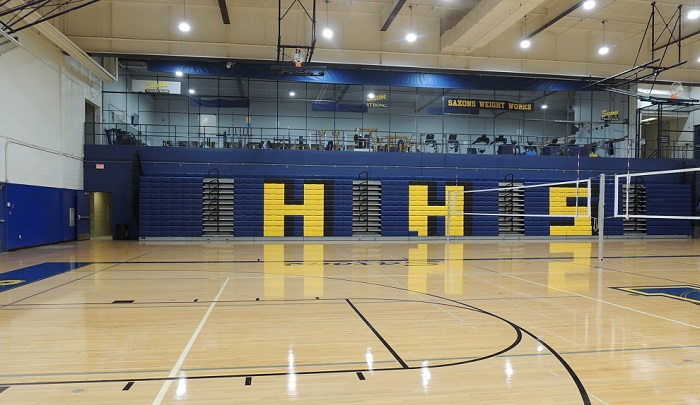
- Hastings boys basketball coach Rich Long sprang into action, running over to the Potterville bench and then calling into the crowd to see if anyone with medical expertise could help a student in distress. Meanwhile, Long was joined by Hastings’ strength coach (and U.S. Marine) James Avery – who was training athletes in the weight room in the balcony overlooking the gym – and Dr. Luke Van Klompenberg, an emergency medicine physician at Holland Hospital who was there watching his son play for Tri-unity.
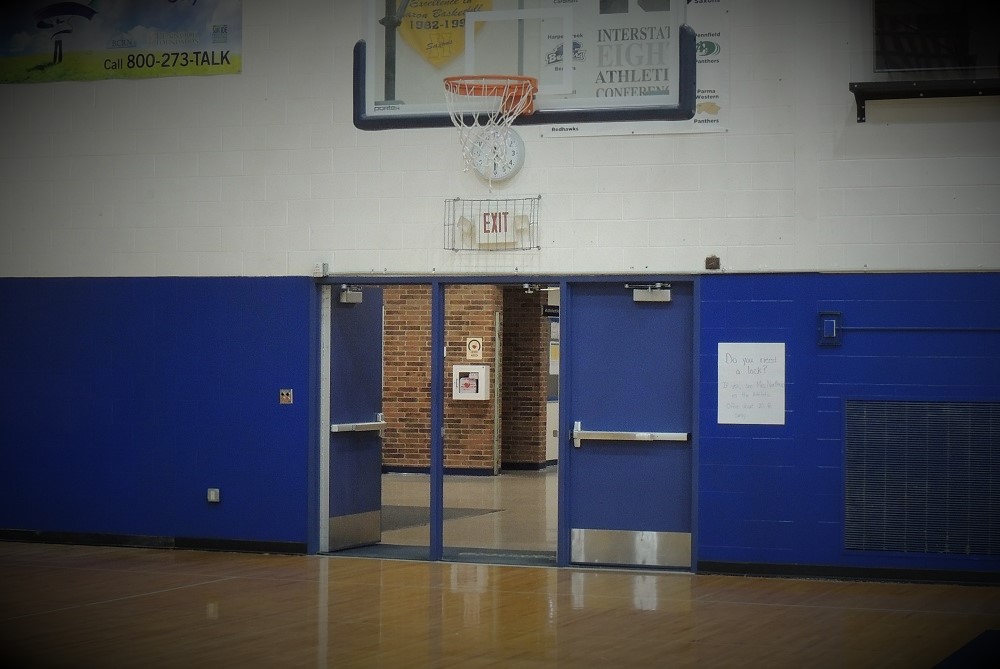
- Long sent an athlete to retrieve the closest AED, located on the wall just outside the gym doors. He also sent a parent to call 9-1-1, and Saxons boys track & field coach Lin Nickels sent multiple athletes to set up a relay near the school’s doors to direct paramedics when they arrived.
- Van Klompenberg, meanwhile, couldn’t find Hicks’ pulse, and the athlete’s breathing was shallow. Avery had begun chest compressions, the AED was used, and as the ambulance arrived Hicks was beginning to regain some consciousness. He was transported to the local Spectrum Health Pennock hospital, then to Helen DeVos Children's Hospital in Grand Rapids.
“It was one of those things where it just worked,” Goggins said. “My message, if nothing else, is we all practice it for a time that may never come – but the more you can saturate your people with the idea of A, being prepared, and B, don’t be afraid to take action … that’s really I think the key.”
 Beginning this year, the MHSAA is requiring all head coaches at the varsity, junior varsity and freshman levels to have CPR certification. That training almost always includes direction in the use of an AED.
Hastings has been on this track for a while. The MHSAA’s first CPR requirement for coaches was added for the 2015-16 school year, just for varsity head coaches – but Goggins made it a requirement for all of his coaches at all levels at that time.
Hastings also has taken AED prep to another level. There are 16 throughout the district – one each at the four elementary schools, two at the middle school and 10 at the high school – and they represent an even bigger investment in the life-saving technology as the district’s school board purchased those 16 a year ago to replace 12 that were nearing their expirations.
Goggins said doctors have told him that if Hicks had not received care for even 4-5 more minutes, he would not have survived because of the damage done to his heart and brain. Potterville athletic director and boys basketball coach Jake Briney said surgeons have broken things down to a 45-second window that made the difference between a good result and a sad one.
Coincidentally, Briney had scheduled a game this upcoming season against Wyoming Tri-unity Christian; Potterville should be tough, and Tri-unity is last season’s Division 4 runner-up. But the events of June 14 will make the events of this upcoming Jan. 14 much more meaningful.
Briney said Potterville also has formed a close relationship with Hastings. Multiple Saxons administrators have checked in, including Goggins almost daily during the first weeks after the incident.
Briney is filled with nothing but praise for Hastings’ preparation. And both athletic directors noted a similar effect at their schools as another school year begins.
“It really, really made the training, made you look at it through a different lens,” Briney said.
“Our fall coaches are now like, ‘You know, if Heather (Coipel, Hastings’ trainer) wanted to stop by and run through the AED procedure again, that would be great,’” Goggins said. “(Or) ‘Where is the AED? We have one at the fieldhouse, right? Where’s the closest one for me again?’ They’re just doublechecking.”
 Geoff Kimmerly joined the MHSAA in Sept. 2011 after 12 years as Prep Sports Editor of the Lansing State Journal. He is a senior editor of MHSAA.com's editorial content and has served as MHSAA Communications Director since January 2021. Contact him at [email protected] with story ideas for the Barry, Eaton, Ingham, Livingston, Ionia, Clinton, Shiawassee, Gratiot, Isabella, Clare and Montcalm counties.
PHOTOS (Top) An AED, located just outside the doors to Hastings’ gymnasium, was used to save Da’Marion Hicks’ life June 14. (Middle) Strength coach James Avery emerged from the balcony weight room to assist in Hicks’ care that evening. (Photos by Geoff Kimmerly.)