

10 to Remember: Fall 2014
December 12, 2014
By Geoff Kimmerly
Second Half editor
This fall saw the start of numerous championship legacies all over the Michigan, the continuation of a few more and the end of one that likely will be recalled for decades to come.
All championship runs are memorable for those fortunate enough to achieve them. But because of historical reference, dramatic impact or in rare cases national significance, some stay in our discussions a little bit longer.
Below is one person’s thoughts on the most memorable finishes from this fall’s MHSAA Finals.
10. Novi, East Kentwood Rise to the Top
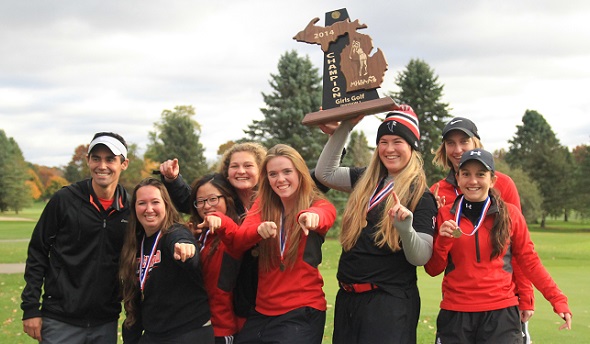
Among a number of first-time champions this fall, the Novi boys tennis team and East Kentwood girls golf team celebrated taking final steps after some recent close misses. Novi had finished second at the 2013 Lower Peninsula Division 1 Final, by a point, as Ann Arbor Huron won its third straight title. The Wildcats clinched their first ever this season, by eight points, while the East Kentwood golfers finished 22 strokes better than their LP Division 1 field after finishing 10th and sixth the last two seasons, respectively. Senior Emily White capped her high school career with a 51-foot putt to win the individual title.
9. Saline Clinches on Final Swim
The Saline girls swimming and diving team trailed reigning champion Farmington Hills Mercy by a half-point entering the final event of the LP Division 1 Final. But the Hornets outpaced Mercy by three seconds in the 400-yard freestyle relay to move ahead and claim the team championship by 5.5 points. Saline had finished runner-up to Mercy by 20 points in 2013.
8. St. Mary’s Football Keeps Promise
From an incredible story point of view, Orchard Lake St. Mary’s 7-0 win over Muskegon in the Division 3 Football Final was easily the most memorable of the fall. Showing immense courage, Eaglets running back Brandon Adams took the field only two days after his mother died after fighting cancer. He scored the game’s lone points midway through the first quarter.
7. Kestrels Give Coach Best Retirement Gift
Monroe St. Mary Catholic Central’s Diane Tuller coached teams to 595 wins over 17 seasons – and in her final match took the Kestrels to their fifth MHSAA championship. St. Mary downed Schoolcraft in four sets despite dropping the first to claim its third Class C title in five seasons. The Kestrels became the eighth team to win at least five MHSAA titles, claiming all five under Tuller’s guidance.
6. Concord’s Hersha Joins Elite Company
Only 14 runners in MHSAA boys cross country history have won at least three individual championships. Concord’s Jason Hersha became the latest, claiming the LP Division 4 title in 15:23.0, the second-fastest time in LP Division 4 Finals history. He became only the third to win three boys titles since team and individual qualifiers began running the same race in 1996; he also finished first as a sophomore and junior.
5. Canton Never Loses on Division 1 March
Just one on-target kick can change a soccer game. That makes Canton’s undefeated run to this season’s Division 1 boys championship even more impressive. Finishing without a loss in any sport is something – but the Chiefs defeated Rochester Adams 1-0 in the Final to end 24-0-3 and as the 13th undefeated champion in MHSAA boys soccer history. Canton posted 16 shutouts this fall.
4. Spring Lake Surges to First Championship
Despite trailing annual power Bloomfield Hills Cranbrook-Kingswood by six strokes after the first round, Spring Lake rolled through the second at the LP Division 3 Girls Golf Final to best the field by a final margin of 18 strokes and claim the school’s first MHSAA golf championship. The achievement was a crowning one for the program started by George Bitner, who has coached at the school since 1968 and fielded his first girls team in 1980.
3. Fisher Finishes Among Fastest in MHSAA History
Grand Blanc senior Grant Fisher finished his high school career with a second straight Lower Peninsula Division 1 championship – and the third-fastest time since the Finals moved to Michigan International Speedway 19 seasons ago. Fisher finished in 14:52.5, 1.5 seconds off the second-fastest time in MHSAA Finals history since 5K (3.1 miles) became the distance in 1980. The only runners who have come in faster than Fisher went on to the Olympics (Dathan Ritzenhein) and top American finishes (twice) at the Boston Marathon (Jason Hartmann).
2. St. Philip Stands Alone with 9 Straight Titles
Battle Creek St. Philip continued its near-decade dominance of Class D, but this time with another historical twist. The Tigers downed Leland in four sets in this season’s Final to win their ninth straight MHSAA championship – setting a record for consecutive titles after formerly being tied with the Marysville teams from 1997-2004. St. Philip entered the postseason ranked No. 3 in D but defeated both No. 2 Mendon and the top-ranked Comets during the final week.
1. Monroe St. Mary Ends Ithaca’s Record Run
Much of the credit for this topping the list goes to Ithaca, which brought a 69-game winning streak into the Division 6 Football Final. The streak was the longest active streak nationally among 11-player football teams, and a win would've allowed the Yellowjackets next fall an opportunity to break the MHSAA winning streak record of 72. But St. Mary controlled the clock with a workmanlike running game and held an Ithaca offense averaging 43 points to nearly a quarter of that in winning 22-12.
PHOTO: The East Kentwood girls golf team raised its first MHSAA Finals championship trophy this October. (Click for more from HighSchoolSportsScene.com.)
Rep Council Wrap-up: Spring 2020
May 8, 2020
By Geoff Kimmerly
Second Half editor
The addition of seeding at the Regional level in ice hockey and adjustments to provide byes for top-seeded teams in basketball and soccer were among the most notable actions taken by the Representative Council of the Michigan High School Athletic Association during its annual Spring Meeting on May 4.
The Spring Meeting of the 19-member legislative body of the Association’s more than 1,500 member schools is generally the busiest of its three sessions each year. The Council considered 32 committee proposals and dealt with a variety of eligibility rule, postseason tournament and operational issues. As with the Council’s Winter Meeting in March, the Spring Meeting was conducted remotely to keep with social distancing required by the COVID-19 pandemic.
Beginning with the 2020-21 school year, ice hockey will employ a seeding process to place the top two teams in every Regional on opposite sides of that bracket, guaranteeing those two teams could not play each other before the Regional championship game. The two teams are to be seeded in each Regional using the Michigan Power Rating computer formula based on regular-season results against other MHSAA Tournament-eligible teams and opponents’ strength of schedule, the same system used in basketball and soccer and as one of multiple methods to seed in boys lacrosse. (Games against out-of-state or non-MHSAA opponents do not count in the MPR formula.) The MHSAA will draw all ice hockey brackets 15 days before the start of Regional play. The addition of hockey seeding was proposed by the MHSAA Hockey Committee.
The Council also adopted a change to seeding to take affect for hockey, basketball and soccer to provide any existing byes to the #1, and then #2 seed, in that order, if multiple byes are part of a bracket. The draw process then will continue to place the remaining teams on the bracket based on a randomly-selected order determined earlier in the season.
Similar rules changes in football and basketball approved by the Council and recommended by the MHSAA committees for those respective sports aim to create more opportunities, especially for programs struggling to field teams at multiple levels. In football, while an athlete may still play only four quarters in one day, that athlete may play in up to five quarters per week. In basketball, an athlete may compete in up to five quarters per day, during no more than three dates per week and 20 dates per team or individual. Both changes will allow athletes to contribute to both varsity and subvarsity teams simultaneously, potentially bolstering numbers and opportunities to retain those squads.
The Council also took action on a number of MHSAA Handbook regulations requiring adjustment because of the COVID-19 pandemic and disruption it has caused to Michigan high school athletics. Notably, the Council voted to waive the 2020-21 pre-participation physical exam requirement for athletes who received one during the 2019-20 school year, although they are still required to fill out and sign the MHSAA Annual Sports Health Questionnaire. The Council also authorized schools to make decisions on multiple summer matters, including an opportunity for athletic directors to request a waiver from the MHSAA to wear school competition uniforms during events that are school-sponsored and designed to recognize graduating 12th-graders. Additionally, the Council voted to give schools the opportunity to waive the annually-required week-long period of no summer activity, if they choose to do so.
Here is a summary of other notable actions taken by the Representative Council at the Spring Meeting, which will take effect during the 2020-21 school year unless noted. Additionally, three sport changes were approved by the Council during its Winter meeting in March and not yet publicized; those too are noted below.
Regulations
• The Council approved a change allowing teams in sports governed by MHSAA summer competition limits – basketball, football, ice hockey, lacrosse, soccer and girls volleyball – to participate against all opponents present at out-of-state summer events. MHSAA member schools must continue to abide by the MHSAA travel limit – traveling only to events that are hosted either in bordering states/provinces (Illinois, Indiana, Ohio, Ontario and Wisconsin) or within 300 miles one way. MHSAA member schools now may participate at those events against out-of-state teams that exceed the travel limit by traveling more than 300 miles to the event site.
Sport Matters
• In baseball, the Council approved a Baseball Committee recommendation to adopt a suspended-game policy stating that any game called before it reaches regulation, or when the score is tied, is suspended with play to pick up at a later time from that point. However, if both schools agree, a game called prior to regulation may be replayed in its entirety.
• Also in baseball, during its Winter meeting, the Council approved a Baseball Committee recommendation renaming the “Super Regional” level of the MHSAA Tournament as the “Quarterfinal” level – with trophies and medals to be presented to both Regional champions after the day’s Regional Finals are completed and before the day’s Quarterfinal matching up those two teams. The Council also adopted at the Winter meeting a tournament schedule that during even-numbered years will see Semifinals for Divisions 2 and 4 played on Thursday and Divisions 1 and 3 on Friday. The Semifinal schedule will flip during odd-numbered years.
• The Council approved a series of Girls Competitive Cheer Committee recommendations. High school athletes now are allowed to transition to stunts or loads from the flatback position. Also at the high school level, bases will be allowed to rotate or move while a flyer is in the inverted position (in a static inversion), and to provide for the allowance of additional flairs at the point of static inversion.
• Also in cheer, the Council approved a Committee recommendation requiring three safety judges (instead of two) and five panel judges at MHSAA Regional events.
• In football, the Council approved a Football Committee recommendation extending the running clock when a team leads its opponent by 50 points to both the first and second halves of a game; the 50-point running clock stops only for player injuries and previously was employed only during the second half. The 35-point running clock employed during the second half, with stoppages also for penalty enforcement, scoring plays and called timeouts, will remain in effect if the differential dips below 50 and until it reaches 50 points again.
• Also in football, the Council approved a Committee recommendation allowing schools 15 summer dates of non-mandatory contact with an unlimited number of players (wearing helmets only). Schools may use these dates as they see fit, but of these 15 only seven dates may be used for 7-on-7 competition against other teams. This also eliminates the previous allowance for a camp.
• The Council approved another change in hockey to improve safety, adopting a Hockey Committee recommendation requiring all members of a coaching staff to wear HECC-certified helmets while on the ice for practices or games.
• In alpine skiing, the Council approved a Ski Committee recommendation that will allow athletes who qualify for an MHSAA Final in one discipline (giant slalom or slalom) during Regional racing to compete in both disciplines at the Finals level.
• In soccer, the Council approved a recommendation from the Soccer Committee to allow girls soccer athletes to compete in scrimmages at a maximum of two college ID camps during the spring girls soccer season, when these ID events generally take place.
• A pair of changes were adopted for swimming & diving, one affecting each group of athletes. The Council approved a Swimming & Diving Committee recommendation allowing swimmers to wear caps reading “State Team” during both regular-season and postseason competition. For diving, the Council approved a Committee recommendation to designate the number of qualifiers from each Lower Peninsula Regional to be in proportion to the number of entries at those respective Regionals in each division. This will allow Regionals with larger numbers of participants to contribute more Finals qualifiers, while eliminating the possibility that a Regional could send all entrants to the Finals regardless of performance because only 12 participate at that site. Each division will continue to advance 36 divers total to the MHSAA Finals.
• In tennis, the Council approved a Tennis Committee recommendation to play the MHSAA Final two-day tournament on Friday and Saturday unless there is a conflict with the host facility. In that case, that specific Final would be scheduled for Thursday and Friday.
• During its Winter meeting, the Council approved a Classification Committee recommendation that adds girls and boys tennis to the group of sports that schools may play as cooperative programs – with Executive Committee approval – if their combined enrollments do not exceed 3,500 students. The Council will reexamine this allowance after its first two years.
Junior High/Middle Schools
• The Council approved a Junior High/Middle School Committee recommendation to conduct MHSAA-sponsored cross country Regional meets for junior high/middle school athletes at eight sites across the state, based on “zones” currently designated by the MHSAA. These Regional meets will begin with the 2021-22 school year.
• The Council also approved a Girls Competitive Cheer Committee recommendation to allow junior high/middle school teams to participate in three competitions per week (instead of two) as long as one of the three is conducted on a non-school day or a day not followed by school.
Officials
• The Council approved a series of recommendations from the Officials Review Committee. Of particular note, coaches and athletes ejected from competition now are required to complete an online sportsmanship course from the National Federation of State High School Associations (NFHS) before returning to competition.
The Council also discussed various other topics, including possibilities for presentation during this fall’s Update Meeting statewide tour, and took action to clarify Handbook language regarding a few eligibility scenarios. The Association’s $11.5 million budget for the 2020-21 school year also was approved.
The Representative Council is the 19-member legislative body of the MHSAA. All but five are elected by member schools. Four members are appointed by the Council to facilitate representation of females and minorities, and the 19th position is occupied by the Superintendent of Public Instruction or designee.
The MHSAA is a private, not-for-profit corporation of voluntary membership by more than 1,500 public and private senior high schools and junior high/middle schools which exists to develop common rules for athletic eligibility and competition. No government funds or tax dollars support the MHSAA, which was the first such association nationally to not accept membership dues or tournament entry fees from schools. Member schools which enforce these rules are permitted to participate in MHSAA tournaments, which attract more than 1.4 million spectators each year.