

10 to Remember: Fall 2014
December 12, 2014
By Geoff Kimmerly
Second Half editor
This fall saw the start of numerous championship legacies all over the Michigan, the continuation of a few more and the end of one that likely will be recalled for decades to come.
All championship runs are memorable for those fortunate enough to achieve them. But because of historical reference, dramatic impact or in rare cases national significance, some stay in our discussions a little bit longer.
Below is one person’s thoughts on the most memorable finishes from this fall’s MHSAA Finals.
10. Novi, East Kentwood Rise to the Top
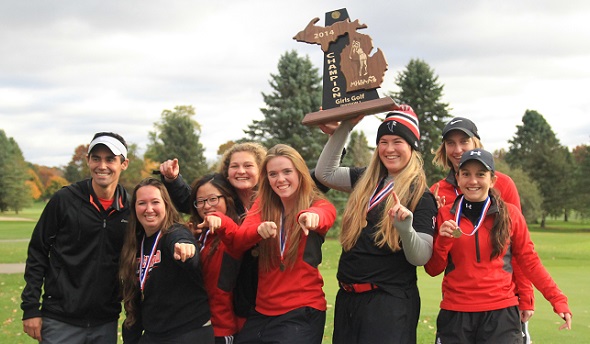
Among a number of first-time champions this fall, the Novi boys tennis team and East Kentwood girls golf team celebrated taking final steps after some recent close misses. Novi had finished second at the 2013 Lower Peninsula Division 1 Final, by a point, as Ann Arbor Huron won its third straight title. The Wildcats clinched their first ever this season, by eight points, while the East Kentwood golfers finished 22 strokes better than their LP Division 1 field after finishing 10th and sixth the last two seasons, respectively. Senior Emily White capped her high school career with a 51-foot putt to win the individual title.
9. Saline Clinches on Final Swim
The Saline girls swimming and diving team trailed reigning champion Farmington Hills Mercy by a half-point entering the final event of the LP Division 1 Final. But the Hornets outpaced Mercy by three seconds in the 400-yard freestyle relay to move ahead and claim the team championship by 5.5 points. Saline had finished runner-up to Mercy by 20 points in 2013.
8. St. Mary’s Football Keeps Promise
From an incredible story point of view, Orchard Lake St. Mary’s 7-0 win over Muskegon in the Division 3 Football Final was easily the most memorable of the fall. Showing immense courage, Eaglets running back Brandon Adams took the field only two days after his mother died after fighting cancer. He scored the game’s lone points midway through the first quarter.
7. Kestrels Give Coach Best Retirement Gift
Monroe St. Mary Catholic Central’s Diane Tuller coached teams to 595 wins over 17 seasons – and in her final match took the Kestrels to their fifth MHSAA championship. St. Mary downed Schoolcraft in four sets despite dropping the first to claim its third Class C title in five seasons. The Kestrels became the eighth team to win at least five MHSAA titles, claiming all five under Tuller’s guidance.
6. Concord’s Hersha Joins Elite Company
Only 14 runners in MHSAA boys cross country history have won at least three individual championships. Concord’s Jason Hersha became the latest, claiming the LP Division 4 title in 15:23.0, the second-fastest time in LP Division 4 Finals history. He became only the third to win three boys titles since team and individual qualifiers began running the same race in 1996; he also finished first as a sophomore and junior.
5. Canton Never Loses on Division 1 March
Just one on-target kick can change a soccer game. That makes Canton’s undefeated run to this season’s Division 1 boys championship even more impressive. Finishing without a loss in any sport is something – but the Chiefs defeated Rochester Adams 1-0 in the Final to end 24-0-3 and as the 13th undefeated champion in MHSAA boys soccer history. Canton posted 16 shutouts this fall.
4. Spring Lake Surges to First Championship
Despite trailing annual power Bloomfield Hills Cranbrook-Kingswood by six strokes after the first round, Spring Lake rolled through the second at the LP Division 3 Girls Golf Final to best the field by a final margin of 18 strokes and claim the school’s first MHSAA golf championship. The achievement was a crowning one for the program started by George Bitner, who has coached at the school since 1968 and fielded his first girls team in 1980.
3. Fisher Finishes Among Fastest in MHSAA History
Grand Blanc senior Grant Fisher finished his high school career with a second straight Lower Peninsula Division 1 championship – and the third-fastest time since the Finals moved to Michigan International Speedway 19 seasons ago. Fisher finished in 14:52.5, 1.5 seconds off the second-fastest time in MHSAA Finals history since 5K (3.1 miles) became the distance in 1980. The only runners who have come in faster than Fisher went on to the Olympics (Dathan Ritzenhein) and top American finishes (twice) at the Boston Marathon (Jason Hartmann).
2. St. Philip Stands Alone with 9 Straight Titles
Battle Creek St. Philip continued its near-decade dominance of Class D, but this time with another historical twist. The Tigers downed Leland in four sets in this season’s Final to win their ninth straight MHSAA championship – setting a record for consecutive titles after formerly being tied with the Marysville teams from 1997-2004. St. Philip entered the postseason ranked No. 3 in D but defeated both No. 2 Mendon and the top-ranked Comets during the final week.
1. Monroe St. Mary Ends Ithaca’s Record Run
Much of the credit for this topping the list goes to Ithaca, which brought a 69-game winning streak into the Division 6 Football Final. The streak was the longest active streak nationally among 11-player football teams, and a win would've allowed the Yellowjackets next fall an opportunity to break the MHSAA winning streak record of 72. But St. Mary controlled the clock with a workmanlike running game and held an Ithaca offense averaging 43 points to nearly a quarter of that in winning 22-12.
PHOTO: The East Kentwood girls golf team raised its first MHSAA Finals championship trophy this October. (Click for more from HighSchoolSportsScene.com.)
Put a Stop to Recurring Injuries
May 5, 2020
 By Nick Parkinson, M.Ed., AT, ATC, TSAC-F
Henry Ford Health System
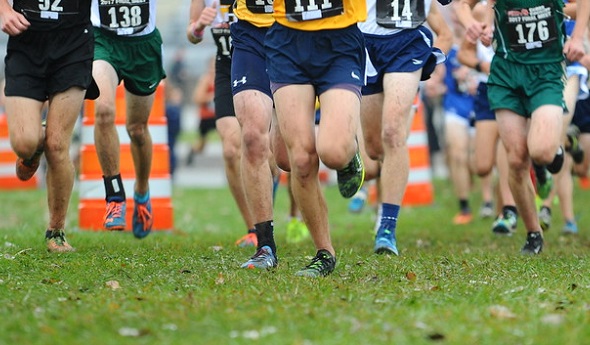
Recurring injuries happen — and they're especially common among single-sport athletes or people who focus on one type of exercise, like runners. The reason: You're working the same muscles repeatedly. The end result: Your joints, muscles and tissues get worn out.
Breaking Down Recurring Injuries
Overuse injuries are a big deal. Continuing to re-injure the same muscle groups can take you out of the game entirely and limit your ability to participate in other activities. Here's what you need to know about these all-to-common ailments:
What are Recurring Injuries?
Recurring injuries, also called repetitive and overuse injuries, are injuries that happen repeatedly in the same location. Think along the lines of tendinitis, stress fractures, shin splints and even carpal tunnel syndrome. Common sites include ankles, knees, hips and shoulders.
Who is at Risk for Repetitive Injuries?
Overuse injuries can happen to anyone, but they're more likely to occur among workers who do repetitive motions and single-sport athletes. The risk of these injuries also increases with age. They're more likely to occur if you don't recognize the impact aging can have on your muscles, joints and tissues and modify your activities accordingly.
Why Do Recurring Injuries Happen?
Recurring injuries happen when you overuse the same muscles without sufficient recovery. It's simple body mechanics: If you continue using compromised muscles, you're more likely to get reinjured. And once you get stuck in that same biomechanic loop, it's nearly impossible to recover without changing your routine and learning new techniques.
How Can You Prevent Recurring Injuries?
All sports have a risk of injury. The key is paying attention to your body and taking the appropriate steps to minimize your risk. Here's how:
• Use appropriate gear. Make sure you're wearing appropriate protective gear for the activity you're participating in and choose the right footwear.
• Alternate muscle groups. Instead of focusing on one type of exercise, switch things up. Incorporate low-impact activities, such as swimming, biking and water sports, and make sure you're not overloading any particular muscle group.
• Take rest days. It's important to give your muscles, joints and tissues time to recover. Two days of rest each week is best. If you play a sport, plan to have at least one off day per week and at least one month off per year.
• Strengthen muscles. Conditioning exercises can help strengthen the muscles you need to perform various activities.
• Use proper form. Overuse injuries are sometimes related to improper form during activity. Work with a professional to ensure you're using proper body mechanics and get back to your usual activities gradually.
Play it Safe
The best way to avoid recurrent injuries is to not get injured in the first place. Recover during the season — even if it means missing out on some play. It's better to show up to a game healthy but undertrained than to power through an injury and risk reinjury.
Talk to your doctor before starting a new activity or ramping up your current routine. If you're at risk of developing a recurrent injury, a professional can provide you with a workout regimen that can help prevent injury.
Most important: Don't let an overuse injury prevent you from being physically active. Instead, listen to your body, consult a professional and pace yourself. Treatment may involve avoiding a specific activity for a period of time, along with hot and cold therapy, massage and focused rehabilitation.
Nick Parkinson, M.Ed., AT, ATC, TSAC-F, is the Supervisor of Athletic Training with Henry Ford Sports Medicine and also leads Sports Performance training at the William Clay Ford Center for Athletic Medicine. Learn more about Nick.
Want to learn more? Henry Ford Health System sports medicine experts are treating the whole athlete, in a whole new way. From nutrition to neurology, and from injury prevention to treatment of sports-related conditions, they can give your athlete a unique game plan.
Visit henryford.com/sports or call (313) 972-4216 for an appointment within 24 business hours.