

10 to Remember: Fall 2014
December 12, 2014
By Geoff Kimmerly
Second Half editor
This fall saw the start of numerous championship legacies all over the Michigan, the continuation of a few more and the end of one that likely will be recalled for decades to come.
All championship runs are memorable for those fortunate enough to achieve them. But because of historical reference, dramatic impact or in rare cases national significance, some stay in our discussions a little bit longer.
Below is one person’s thoughts on the most memorable finishes from this fall’s MHSAA Finals.
10. Novi, East Kentwood Rise to the Top
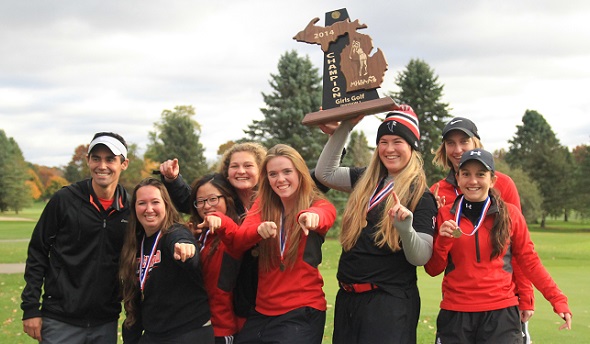
Among a number of first-time champions this fall, the Novi boys tennis team and East Kentwood girls golf team celebrated taking final steps after some recent close misses. Novi had finished second at the 2013 Lower Peninsula Division 1 Final, by a point, as Ann Arbor Huron won its third straight title. The Wildcats clinched their first ever this season, by eight points, while the East Kentwood golfers finished 22 strokes better than their LP Division 1 field after finishing 10th and sixth the last two seasons, respectively. Senior Emily White capped her high school career with a 51-foot putt to win the individual title.
9. Saline Clinches on Final Swim
The Saline girls swimming and diving team trailed reigning champion Farmington Hills Mercy by a half-point entering the final event of the LP Division 1 Final. But the Hornets outpaced Mercy by three seconds in the 400-yard freestyle relay to move ahead and claim the team championship by 5.5 points. Saline had finished runner-up to Mercy by 20 points in 2013.
8. St. Mary’s Football Keeps Promise
From an incredible story point of view, Orchard Lake St. Mary’s 7-0 win over Muskegon in the Division 3 Football Final was easily the most memorable of the fall. Showing immense courage, Eaglets running back Brandon Adams took the field only two days after his mother died after fighting cancer. He scored the game’s lone points midway through the first quarter.
7. Kestrels Give Coach Best Retirement Gift
Monroe St. Mary Catholic Central’s Diane Tuller coached teams to 595 wins over 17 seasons – and in her final match took the Kestrels to their fifth MHSAA championship. St. Mary downed Schoolcraft in four sets despite dropping the first to claim its third Class C title in five seasons. The Kestrels became the eighth team to win at least five MHSAA titles, claiming all five under Tuller’s guidance.
6. Concord’s Hersha Joins Elite Company
Only 14 runners in MHSAA boys cross country history have won at least three individual championships. Concord’s Jason Hersha became the latest, claiming the LP Division 4 title in 15:23.0, the second-fastest time in LP Division 4 Finals history. He became only the third to win three boys titles since team and individual qualifiers began running the same race in 1996; he also finished first as a sophomore and junior.
5. Canton Never Loses on Division 1 March
Just one on-target kick can change a soccer game. That makes Canton’s undefeated run to this season’s Division 1 boys championship even more impressive. Finishing without a loss in any sport is something – but the Chiefs defeated Rochester Adams 1-0 in the Final to end 24-0-3 and as the 13th undefeated champion in MHSAA boys soccer history. Canton posted 16 shutouts this fall.
4. Spring Lake Surges to First Championship
Despite trailing annual power Bloomfield Hills Cranbrook-Kingswood by six strokes after the first round, Spring Lake rolled through the second at the LP Division 3 Girls Golf Final to best the field by a final margin of 18 strokes and claim the school’s first MHSAA golf championship. The achievement was a crowning one for the program started by George Bitner, who has coached at the school since 1968 and fielded his first girls team in 1980.
3. Fisher Finishes Among Fastest in MHSAA History
Grand Blanc senior Grant Fisher finished his high school career with a second straight Lower Peninsula Division 1 championship – and the third-fastest time since the Finals moved to Michigan International Speedway 19 seasons ago. Fisher finished in 14:52.5, 1.5 seconds off the second-fastest time in MHSAA Finals history since 5K (3.1 miles) became the distance in 1980. The only runners who have come in faster than Fisher went on to the Olympics (Dathan Ritzenhein) and top American finishes (twice) at the Boston Marathon (Jason Hartmann).
2. St. Philip Stands Alone with 9 Straight Titles
Battle Creek St. Philip continued its near-decade dominance of Class D, but this time with another historical twist. The Tigers downed Leland in four sets in this season’s Final to win their ninth straight MHSAA championship – setting a record for consecutive titles after formerly being tied with the Marysville teams from 1997-2004. St. Philip entered the postseason ranked No. 3 in D but defeated both No. 2 Mendon and the top-ranked Comets during the final week.
1. Monroe St. Mary Ends Ithaca’s Record Run
Much of the credit for this topping the list goes to Ithaca, which brought a 69-game winning streak into the Division 6 Football Final. The streak was the longest active streak nationally among 11-player football teams, and a win would've allowed the Yellowjackets next fall an opportunity to break the MHSAA winning streak record of 72. But St. Mary controlled the clock with a workmanlike running game and held an Ithaca offense averaging 43 points to nearly a quarter of that in winning 22-12.
PHOTO: The East Kentwood girls golf team raised its first MHSAA Finals championship trophy this October. (Click for more from HighSchoolSportsScene.com.)
Speakers Bureau Helps Generate Conversation
December 30, 2019
By Rob Kaminski
MHSAA benchmarks editor
As student mental health climbs the list of health and safety concerns, the MHSAA and state associations across the country are taking measures to provide resources and guidance aimed to keep school sports an enjoyable and valuable experience.
In sports, coaches and athletes learn to expect the unexpected. It’s the nature of competition; constructing gameplans tailored to utilize team strengths and expose opponents’ weaknesses. Often times this entails doing things that opponents won’t expect. Participants then learn and prepare for the next time; it’s one of the ways athletics prepares participants for life, as educational leaders often preach.
Today’s ever-changing culture recently threw such a curveball at the young people who populate our hallways and playing surfaces, calling for statewide associations and organizations to shift focuses and prepare for a new opponent while attempting to keep school sports one of the best means to a healthy adolescent lifestyle.
“I was at the NCAA summer meeting in 2017, discussing health and safety issues and the topic of concussions came up, as it often does. I assumed that concussions was the No. 1 health and safety issue,” said MHSAA Executive Director Mark Uyl. “I was quickly corrected that it’s student mental health; that knocked me back.”
It would not be an uncommon reaction, given the amount of information, media coverage and programs designed to recognize and reduce concussion incidents in recent years.
All the while, anxiety, depression and stress had been creeping into the picture beneath the surface. Such disorders are much more difficult to detect, as there are few visible symptoms when compared to sprains, fatigue, head injuries and other physical ailments.
“I became interested and began to research the topic. The more I read, the more concerned I became,” Uyl said. “The MHSAA, with a great deal of help and cooperation from our school leaders, has done a tremendous job educating and providing resources for health-related issues such as heat management, concussion reporting and practice policies, and now we have a new challenge.”
Fortunately, as has often been the case, there are knowledgeable and qualified people throughout Michigan’s roster of educational leaders who are willing to assist.
As word spread regarding the student mental health initiative, the MHSAA was able to establish a Mental Health Speakers Bureau composed of several experienced individuals willing to assist (see below).
“Our speakers bureau really grew by word of mouth,” Uyl said. “A school would bring in a speaker, or a league would invite a speaker, and once we were connected with them, then those people would share names and it grew from there.”
The resources range from former professional athletes, to behavioral specialists, to current MHSAA coaches.
Dave Ingles, basketball coach at Kent City, is one such individual. His credibility comes from first-hand experience.
“I privately struggled with deep depression for six years,” Ingles said. “Be alert. Talk to your athletes and students and actually listen to what they are saying. I always used the phrase, ‘I’m fine;’ that is not an acceptable answer to me anymore when I hear it.”
The National Institute of Mental Health reveals that most mental health conditions begin around the time children are transitioning from middle school to high school. The more people trained to identify symptoms and behavior, the better the chance to reduce or reverse some of the following numbers:
• 50% of all lifetime cases of mental illness begin by age 14
• 37% of students with a mental health condition age 14 or older drop out of school
• 20% of students ages 13-18 live with a mental health condition
• 11% of youth have a mood disorder and 8% have an anxiety disorder
• Suicide is the third leading cause of death for ages 10-24
Non-visible ailments always have been most difficult to detect, and today’s proliferation of technology – from streaming to social media – can serve to further mask symptoms.
“The more kids spend time with their devices, staring at their screens, isolation can be quick to take hold,” Uyl said. “Everything is instant. It used to be if our friends didn’t invite us somewhere, we didn’t worry about it; we probably wouldn’t find out for a couple days and had already moved on. Today, in about 10 minutes, there’s a picture on Instagram or Snapchat and kids instantly know, ‘I’m not included.’ Isolation leads to depression and anxiety, and in the worst cases can even lead to suicide.”
That message might sound familiar. Segments of the 2019-20 MHSAA online rules meetings include Uyl emphasizing student mental health and a video clip produced by benice.org promoting a mental health action plan endorsed by four of the state’s most recognized collegiate coaches.
It’s all part of the plan to promote awareness and generate conversation surrounding this serious health and safety issue during 2019-20 and beyond.
“We’re not going to try to do this all by ourselves,” Uyl said. “There are plenty of experts in the field, and we’re going to utilize their knowledge. We’ll build relationships and align ourselves with these people to provide a foundation. We need to become a resource center for our membership.”
In addition to the rules meetings messages, the MHSAA also partnered with the Michigan Association of Secondary School Principals Student Mental Health Summit on Oct. 8 in Lansing. This event – sold out within weeks of posting – invited principals, counselors, student leadership advisers and student leaders to come together to discuss and seek solutions for student mental health concerns impacting schools. The MHSAA lined up Eric Hipple, one of its speaker bureau members, who delivered a keynote, “Depression and Suicidal Awareness.”
Student mental health was among topics during the MHSAA Update and AD In-Service tour around the state this fall as well. The meeting at Comstock Park on Sept. 30 included a presentation from the Mental Health Foundation of West Michigan to introduce the be nice® action plan and encourage schools to take advantage of that and other resources the group has to offer.
The rise of mental health as one of the more prominent medical concerns nationally has occurred, as Ingles sees it, “because more people are talking about it now.”
Leaders like Ingles and those in numerous organizations have begun to assist the MHSAA in identifying and treating cases in our schools.
MHSAA Mental Health Speakers Bureau
Below is a list of individuals and organizations partnering with the MHSAA to assist in promoting mental well-being for students around the state. The MHSAA encourages school personnel to reach out to any of these experienced leaders in the field for programming in your buildings and districts.
• Christy Buck, Executive Director – Mental Health Foundation of West Michigan - be nice.® [email protected]
• Brooke Buys, Mental & Behavioral Health Specialist – BLND Health [email protected]
• Eric Hipple, former Detroit Lions quarterback [email protected]
• Dave Ingles, Basketball Coach & Speaker – Kent City High School [email protected]
• Cat Lanting, Program Coordinator – Mental Health Foundation of West Michigan - be nice.® [email protected]
• Halle Wangler, former University of Michigan basketball player [email protected]
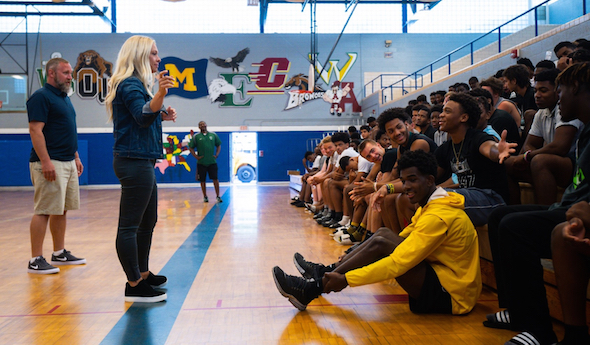
PHOTO: Brooke Buys, a mental and behavioral health specialist and founder of BLND Health, speaks with students. (Photo courtesy of BLND Health.)