

10 to Remember: Fall 2014
December 12, 2014
By Geoff Kimmerly
Second Half editor
This fall saw the start of numerous championship legacies all over the Michigan, the continuation of a few more and the end of one that likely will be recalled for decades to come.
All championship runs are memorable for those fortunate enough to achieve them. But because of historical reference, dramatic impact or in rare cases national significance, some stay in our discussions a little bit longer.
Below is one person’s thoughts on the most memorable finishes from this fall’s MHSAA Finals.
10. Novi, East Kentwood Rise to the Top
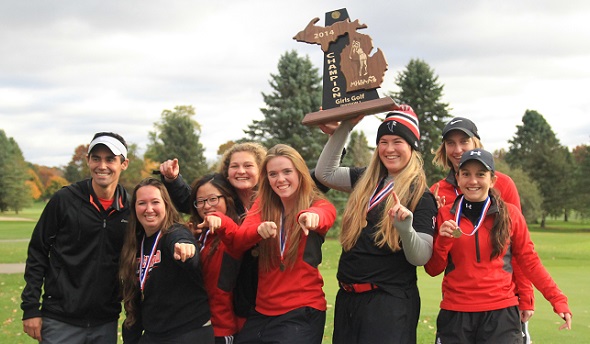
Among a number of first-time champions this fall, the Novi boys tennis team and East Kentwood girls golf team celebrated taking final steps after some recent close misses. Novi had finished second at the 2013 Lower Peninsula Division 1 Final, by a point, as Ann Arbor Huron won its third straight title. The Wildcats clinched their first ever this season, by eight points, while the East Kentwood golfers finished 22 strokes better than their LP Division 1 field after finishing 10th and sixth the last two seasons, respectively. Senior Emily White capped her high school career with a 51-foot putt to win the individual title.
9. Saline Clinches on Final Swim
The Saline girls swimming and diving team trailed reigning champion Farmington Hills Mercy by a half-point entering the final event of the LP Division 1 Final. But the Hornets outpaced Mercy by three seconds in the 400-yard freestyle relay to move ahead and claim the team championship by 5.5 points. Saline had finished runner-up to Mercy by 20 points in 2013.
8. St. Mary’s Football Keeps Promise
From an incredible story point of view, Orchard Lake St. Mary’s 7-0 win over Muskegon in the Division 3 Football Final was easily the most memorable of the fall. Showing immense courage, Eaglets running back Brandon Adams took the field only two days after his mother died after fighting cancer. He scored the game’s lone points midway through the first quarter.
7. Kestrels Give Coach Best Retirement Gift
Monroe St. Mary Catholic Central’s Diane Tuller coached teams to 595 wins over 17 seasons – and in her final match took the Kestrels to their fifth MHSAA championship. St. Mary downed Schoolcraft in four sets despite dropping the first to claim its third Class C title in five seasons. The Kestrels became the eighth team to win at least five MHSAA titles, claiming all five under Tuller’s guidance.
6. Concord’s Hersha Joins Elite Company
Only 14 runners in MHSAA boys cross country history have won at least three individual championships. Concord’s Jason Hersha became the latest, claiming the LP Division 4 title in 15:23.0, the second-fastest time in LP Division 4 Finals history. He became only the third to win three boys titles since team and individual qualifiers began running the same race in 1996; he also finished first as a sophomore and junior.
5. Canton Never Loses on Division 1 March
Just one on-target kick can change a soccer game. That makes Canton’s undefeated run to this season’s Division 1 boys championship even more impressive. Finishing without a loss in any sport is something – but the Chiefs defeated Rochester Adams 1-0 in the Final to end 24-0-3 and as the 13th undefeated champion in MHSAA boys soccer history. Canton posted 16 shutouts this fall.
4. Spring Lake Surges to First Championship
Despite trailing annual power Bloomfield Hills Cranbrook-Kingswood by six strokes after the first round, Spring Lake rolled through the second at the LP Division 3 Girls Golf Final to best the field by a final margin of 18 strokes and claim the school’s first MHSAA golf championship. The achievement was a crowning one for the program started by George Bitner, who has coached at the school since 1968 and fielded his first girls team in 1980.
3. Fisher Finishes Among Fastest in MHSAA History
Grand Blanc senior Grant Fisher finished his high school career with a second straight Lower Peninsula Division 1 championship – and the third-fastest time since the Finals moved to Michigan International Speedway 19 seasons ago. Fisher finished in 14:52.5, 1.5 seconds off the second-fastest time in MHSAA Finals history since 5K (3.1 miles) became the distance in 1980. The only runners who have come in faster than Fisher went on to the Olympics (Dathan Ritzenhein) and top American finishes (twice) at the Boston Marathon (Jason Hartmann).
2. St. Philip Stands Alone with 9 Straight Titles
Battle Creek St. Philip continued its near-decade dominance of Class D, but this time with another historical twist. The Tigers downed Leland in four sets in this season’s Final to win their ninth straight MHSAA championship – setting a record for consecutive titles after formerly being tied with the Marysville teams from 1997-2004. St. Philip entered the postseason ranked No. 3 in D but defeated both No. 2 Mendon and the top-ranked Comets during the final week.
1. Monroe St. Mary Ends Ithaca’s Record Run
Much of the credit for this topping the list goes to Ithaca, which brought a 69-game winning streak into the Division 6 Football Final. The streak was the longest active streak nationally among 11-player football teams, and a win would've allowed the Yellowjackets next fall an opportunity to break the MHSAA winning streak record of 72. But St. Mary controlled the clock with a workmanlike running game and held an Ithaca offense averaging 43 points to nearly a quarter of that in winning 22-12.
PHOTO: The East Kentwood girls golf team raised its first MHSAA Finals championship trophy this October. (Click for more from HighSchoolSportsScene.com.)

NFHS Voice: Source of HS Playing Rules
November 12, 2019
By Karissa Niehoff
NFHS Executive Director
When it comes to writing playing rules for major sports in the United States, it’s all in the acronyms. In football, you have the NFL, NCAA and NFHS. In basketball, it’s the NBA, NCAA and NFHS. In baseball, the rules-makers are MLB, NCAA and NFHS.
While the NFL, NBA, MLB and NCAA can be used on first reference without explanation, many people are unfamiliar with the NFHS. And yet the NFHS has been around as long – or longer – than the other four major sports organizations.
In many cases, references to NFHS rules – not only in these three major sports but the other 14 sports for which the organization writes rules – are simply noted as “high school rules.” The reality, however, is that the NFHS – the National Federation of State High School Associations – has been the national organization most directly focused on sports playing rules in the past 90 years since it published its first Football Rules Book in 1932.
With almost eight million participants in high school sports, NFHS rules are written for more individuals than all other levels of sports combined. As a result, risk minimization and the fundamentals of good sportsmanship are paramount to the rules-writing process for the NFHS and often are the distinguishing factors from rules at the higher levels of the sport.
Perhaps football is the best example of the commitment to risk minimization. In the mid-1970s, the NFHS was at the forefront of change when it outlawed spearing in high school football. The 1976 rule revision changed the landscape of high school football from an injury standpoint – from a high of 36 direct fatalities in 1968 to an average of about two per year by 2018.
Some people have questioned why there are multiple rules codes for a sport. Very simply, NFHS rules for high school play must be different than at the college and professional levels.
As an example, while professional baseball is concerned with how fast a baseball exits the batter’s box (Velocity Exit Speed) and how far the ball travels on a home run, the NFHS has enacted bat standards during the past 20 years to reduce the speed of balls coming off aluminum bats. In wrestling, the NFHS has enacted strict weight-management plans to reduce the risk of health issues. In ice hockey, while fighting is an accepted part of the sport at the professional level, NFHS rules have strict rules prohibiting all forms of unsportsmanlike conduct. In football, NFHS rules do not permit the excessive celebration displays following touchdowns that occur during NFL games.
In addition to risk minimization and sportsmanship, the NFHS must also weigh financial implications for schools when considering equipment and uniform changes. With schools ranging in size from less than 100 to more than 5,000 students, decisions must be made for the masses and cannot put undue financial hardships on schools.
NFHS rules are also written with the understanding that appropriate behavior begins with the coach, who is responsible for ensuring that his or her team exhibits good sporting behavior. Many penalties for unsportsmanlike conduct on the team are first directed against the coach.
While the NFHS and its member state associations govern the high school place in various sports – not only with playing rules but other issues as well – we maintain relationships with the National Governing Bodies (NGBs) in these sports to assist in meeting the needs of all participants.
Last week, the NFHS hosted a summit of various leaders of NGBs in Indianapolis. Leaders from about 15 NGBs were set to meet with NFHS staff to discuss various initiatives and opportunities for collaborative programs. We hope this is the first of many such meetings as it is crucial that all levels of sport work together to ensure ongoing opportunities for all sports participants.
Dr. Karissa L. Niehoff is in her second year as executive director of the National Federation of State High School Associations (NFHS) in Indianapolis, Indiana. She is the first female to head the national leadership organization for high school athletics and performing arts activities and the sixth full-time executive director of the NFHS, which celebrated its 100th year of service during the 2018-19 school year. She previously was executive director of the Connecticut Association of Schools-Connecticut Interscholastic Athletic Conference for seven years.