


10 to Remember: Spring 2013
June 25, 2013
By Geoff Kimmerly
Second Half editor
Nine teams won their first MHSAA championships this spring. Birmingham Brother Rice's boys lacrosse team won its ninth in a row.
And those are only among the toppers of the long list that made memorable moments during this season's Finals, which finished up the school year two weekends ago.
Locking down the 10 most significant performances is impossible. But endeavoring to do so, here are one person's guess at those that will continue to be discussed most in the years to come.
Among those that just missed this list: Brother Rice boys lacrosse, St. Ignace's girls track and field team after winning its fourth straight team title, Grosse Pointe Woods University Liggett's baseball team after its extra-innings Final win over Beal City, Grandville Calvin Christian's girls soccer team after winning a rematch of last season's Division 4 Final and Port Huron Northern's girls tennis team after it emerged from a loaded field to win the Lower Peninsula Division 1 title.
Sami Michell Shines Once More
In her final high school meet, Reed City senior Sami Michell won four more MHSAA Finals individual titles to finish her career with 12 – two more than the previous Lower Peninsula record. A year after becoming the second female to win four events at one Finals meet, she did so again by finishing first in the 100 and 300-meter hurdles, the 200 dash and the long jump. She scored 40 points to claim the team runner-up trophy for her school. Click to read more.
Best Class of All-Time?
That could be the argument for this season’s girls track and field seniors, as twins Hannah and Haley Meier and Erin Finn joined Sami Michell, Detroit Country Day's Kendall Baisden and a host of others in finishing their careers. The Meiers already are members of a national record-holding relay (which set its milestone in 2012), and Hannah won two more Division 1 individual titles (setting all-Finals records) while Haley placed in the same two races and joined her sister on two winning relays. West Bloomfield’s Finn, considered as well one of the nation’s top high school distance runners, finished third to the Meiers in the Division 1 1,600 before cutting nine seconds off her 2012 time in setting an all-Finals record in the 3,200. Click to read more.
Warriors Earn First Title for Winning Coach
Bay City Western’s baseball team strung together two 1-0 shutouts by pitchers Brett Adcock and then Connor Foley to claim its first MHSAA baseball championship – and the first to go with coach Tim McDonald’s other 563 wins over the last 21 seasons. The 1-0 championship game victory over Brother Rice was Western's 35th straight of the season; Western finished 42-2. Click to read more.
Gull Lake Soccer Makes Mark
Richland Gull Lake hadn’t played in a girls soccer Final since 1999, but survived two overtimes against reigning champion Bloomfield Hills Marian to win the Division 2 championship game 1-0. The title was Gull Lake’s first since 1992 and came against a program that not only won in 2012, but three of the last five Division 2 championships. Click to read more.
Upper Peninsula Ace Shoots Record Round
Snow and rain put a damper on a good portion of the girls golf season in the Upper Peninsula this spring. But no U.P. female golfer has ever finished as strongly as Marquette’s Avery Rochester. She claimed her second straight individual Finals championship with a U.P. Finals-record 69, which was three under par at Portage Lake Golf Course in Houghton. Her score also was just one more stroke than the all-Finals record of 68 shot by Grandville’s Stacy Snider in 1998. Click to read more.
7 ... 2 ... 1 ... Champion Tecumseh
Tecumseh entered the MHSAA Tournament after finishing the regular season an honorable mention in the Division 2 softball coaches poll. But the Indians defeated No. 1 Stevensville Lakeshore in the Quarterfinal, reigning champion and No. 2 Livonia Ladywood in the Semifinal and No. 7 Saginaw Swan Valley in the Final to claim their first championship since 2008. Click to read more.
Bishop Foley Sets Baseball Bar
Madison Heights Bishop Foley claimed its third straight Division 3 baseball championship to become the first in MHSAA baseball history to win that many consecutive titles. Bishop Foley is 112-8-1 over the last three seasons and finished 35-2-1 this spring. The Ventures outscored their Bailey Park competition by a combined 18-5 over Finals weekend – getting junior Garrett Schilling to 15-0 for this season and 31-0 for his career with a 6-0 Semifinal win. Click to read more.
Done Deal for Dundee
The Dundee softball team eliminated two-time reigning champion Clinton on the way to Bailey Park this spring, and then beat three-time champion Unionville-Sebewaing in the Division 3 Final to claim its first MHSAA championship in the sport. In the process, Dundee finished 45-1 – setting an MHSAA record for wins in a softball season. Click to read more.
Troy Moves Up to No. 1
After two-straight Division 1 runner-up finishes, Troy earned its first girls soccer championship since 2003 with a 2-1 Final win over Grandville. The Colts had been outscored a combined 3-0 in the last two MHSAA Division 1 Finals, and began this season 3-6-2 before rattling off 15 wins and a tie on the way to claiming the championship. Click to read more.
Tie-Breaker After Heart-Breaker
The Battle Creek Lakeview boys golf team had finished one stroke behind Birmingham Brother Rice at the 2012 Lower Peninsula Division 1 Final, and found itself tied with Plymouth this month after the final round was complete. But thanks to a fifth-player tie-breaker, Lakeview claimed its first MHSAA championship since 2008. Click to read more.
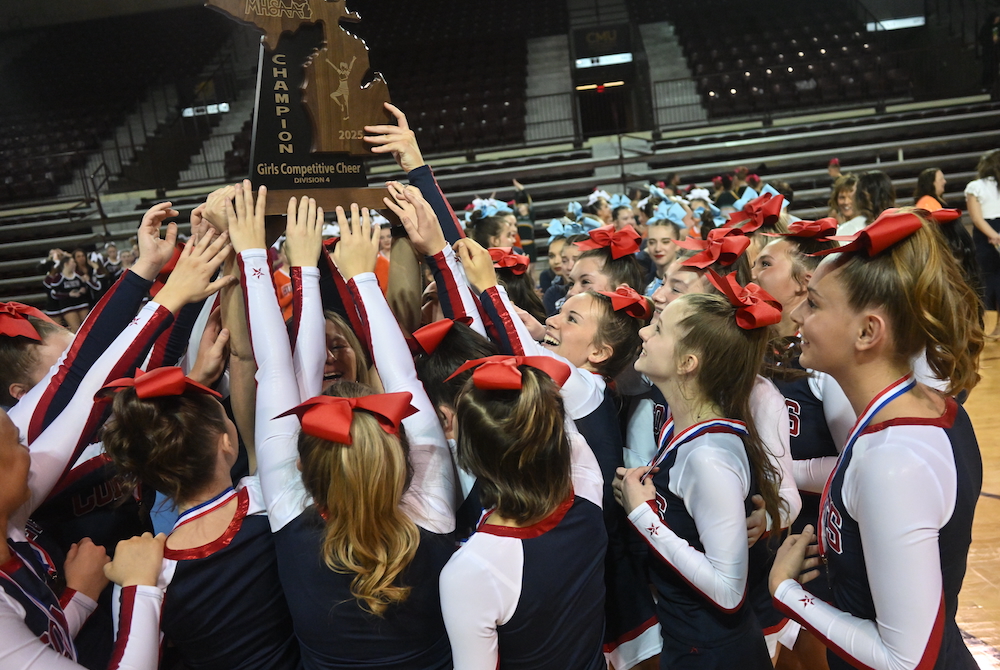
Hanover-Horton Caps Rapid Rise with Season-Best Score to Clinch 1st Title
By
Tom Kendra
Special for MHSAA.com
February 28, 2025
MOUNT PLEASANT – Alexyn DuBois started preparing to be a competitive cheer state champion before she was born.
“My mom has been a coach for 25 years, so in the womb I was literally cheering,” said DuBois, a senior all-stater for Hanover-Horton.
“It’s been a part of my whole life, so to go out as a state champion, with my mom as my coach, is a dream come true.”
The DuBois mother-daughter combination was a key part of a truly amazing turnaround story, as Hanover-Horton – which never made it to the Competitive Cheer Finals before last season (when it finished sixth) – broke through with a decisive victory in the Division 4 Final on Friday at Central Michigan University’s McGuirk Arena.
Hanover-Horton, which finished second behind Pewamo-Westphalia at their Regional, flipped the script, taking the lead after Round 1 and continuing to build the lead over the next two rounds.
The Comets posted a season-best score of 772.68 – 4.28 points better than their previous-best score – to hold off P-W (765.62).
Sanford Meridian (757.96) took third, and Hudson (752.66) placed fourth – ending the Tigers’ streak of five consecutive D4 titles.
“We needed to set the tone early, and we did that,” said Hanover-Horton coach Sarah DuBois, who is in her fourth year as the Comets’ coach after a successful 21-year run at nearby Vandercook Lake. “Starting strong gave our girls the feeling that this could be our day.”
Hanover-Horton, which had eight seniors on its 21-athlete roster, held a one-tenth of a point lead over P-W after Round 1, but Coach DuBois said it was the team’s emphasis all last week on Round 2 which proved to be the difference.
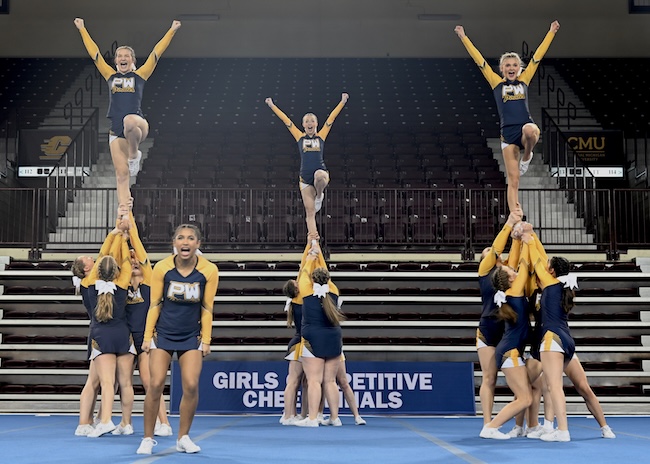 The Comets extended the lead to more than five full points with a powerhouse Round 2 performance.
“Round 2 was what cost us last week at Regionals, so we had to pull that up,” said DuBois, who brought in some of her former athletes from her days at Vandercook Lake last week to work with the team. “We really fine-tuned Round 2, and that was huge.”
Alexyn DuBois, also a standout pitcher on the Comets’ softball team who has committed to pitch at Spring Arbor next year, is the team’s leader and only returning first-team all-stater. Senior Maddy Sauber was second-team all-state, and senior Reyna Collins was honorable mention in 2024.
DuBois was a team captain, along with fellow seniors Delainey Cottrell and Sophie Schuette.
The seniors really helped the Comets elevate their game to a championship level this winter. After posting a top score of 739.86 last year, they finished this season topping 760 points in all of their final four competitions, including going over the 770 plateau on Friday.
“We knew we had to come out today and breathe fire,” explained Cottrell. “That’s what our team motto was. That’s what we needed to do to beat all of these other good teams.”
Other seniors for Hanover-Horton were Lexi VanGelder, Trinity Jones and Madison Gillett.
Pewamo-Westphalia, which came in as the favorite after a dominating victory at Regionals, couldn’t produce the same magic at CMU.
The Pirates placed second for the fourth time over the past six years, since their last title won in 2019.
“The girls are disappointed, but they put in three amazing rounds, so I’m not disappointed at all,” said P-W coach Staci Myers.
The other storyline coming into Friday was Hudson’s attempt to tie a state record with six consecutive Finals titles. The Tigers couldn’t overcome a slow start, ensuring Gibraltar Carlson’s place atop the MHSAA record book with six consecutive titles won from 2011 to 2016.
On this day, in a sport which is traditionally dominated by powerhouse programs, it was time for Cascades Conference champion Hanover-Horton to rule the state as well and join that elite group.
“Taking second at Regionals was a driving force for us to get better,” explained Alexyn DuBois. “During our cheer, we say ‘etched in stone.’ Today it was our turn to etch our school’s name in stone.”
PHOTOS (Top) Hanover-Horton raises its championship trophy Saturday at McGuirk Arena. (Middle) Pewamo-Westphalia competes during the Division 4 Final.