

10 to Remember: Spring 2013
June 25, 2013
By Geoff Kimmerly
Second Half editor
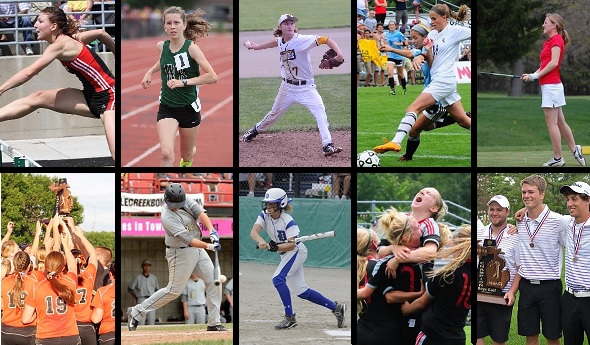
Nine teams won their first MHSAA championships this spring. Birmingham Brother Rice's boys lacrosse team won its ninth in a row.
And those are only among the toppers of the long list that made memorable moments during this season's Finals, which finished up the school year two weekends ago.
Locking down the 10 most significant performances is impossible. But endeavoring to do so, here are one person's guess at those that will continue to be discussed most in the years to come.
Among those that just missed this list: Brother Rice boys lacrosse, St. Ignace's girls track and field team after winning its fourth straight team title, Grosse Pointe Woods University Liggett's baseball team after its extra-innings Final win over Beal City, Grandville Calvin Christian's girls soccer team after winning a rematch of last season's Division 4 Final and Port Huron Northern's girls tennis team after it emerged from a loaded field to win the Lower Peninsula Division 1 title.
Sami Michell Shines Once More
In her final high school meet, Reed City senior Sami Michell won four more MHSAA Finals individual titles to finish her career with 12 – two more than the previous Lower Peninsula record. A year after becoming the second female to win four events at one Finals meet, she did so again by finishing first in the 100 and 300-meter hurdles, the 200 dash and the long jump. She scored 40 points to claim the team runner-up trophy for her school. Click to read more.
Best Class of All-Time?
That could be the argument for this season’s girls track and field seniors, as twins Hannah and Haley Meier and Erin Finn joined Sami Michell, Detroit Country Day's Kendall Baisden and a host of others in finishing their careers. The Meiers already are members of a national record-holding relay (which set its milestone in 2012), and Hannah won two more Division 1 individual titles (setting all-Finals records) while Haley placed in the same two races and joined her sister on two winning relays. West Bloomfield’s Finn, considered as well one of the nation’s top high school distance runners, finished third to the Meiers in the Division 1 1,600 before cutting nine seconds off her 2012 time in setting an all-Finals record in the 3,200. Click to read more.
Warriors Earn First Title for Winning Coach
Bay City Western’s baseball team strung together two 1-0 shutouts by pitchers Brett Adcock and then Connor Foley to claim its first MHSAA baseball championship – and the first to go with coach Tim McDonald’s other 563 wins over the last 21 seasons. The 1-0 championship game victory over Brother Rice was Western's 35th straight of the season; Western finished 42-2. Click to read more.
Gull Lake Soccer Makes Mark
Richland Gull Lake hadn’t played in a girls soccer Final since 1999, but survived two overtimes against reigning champion Bloomfield Hills Marian to win the Division 2 championship game 1-0. The title was Gull Lake’s first since 1992 and came against a program that not only won in 2012, but three of the last five Division 2 championships. Click to read more.
Upper Peninsula Ace Shoots Record Round
Snow and rain put a damper on a good portion of the girls golf season in the Upper Peninsula this spring. But no U.P. female golfer has ever finished as strongly as Marquette’s Avery Rochester. She claimed her second straight individual Finals championship with a U.P. Finals-record 69, which was three under par at Portage Lake Golf Course in Houghton. Her score also was just one more stroke than the all-Finals record of 68 shot by Grandville’s Stacy Snider in 1998. Click to read more.
7 ... 2 ... 1 ... Champion Tecumseh
Tecumseh entered the MHSAA Tournament after finishing the regular season an honorable mention in the Division 2 softball coaches poll. But the Indians defeated No. 1 Stevensville Lakeshore in the Quarterfinal, reigning champion and No. 2 Livonia Ladywood in the Semifinal and No. 7 Saginaw Swan Valley in the Final to claim their first championship since 2008. Click to read more.
Bishop Foley Sets Baseball Bar
Madison Heights Bishop Foley claimed its third straight Division 3 baseball championship to become the first in MHSAA baseball history to win that many consecutive titles. Bishop Foley is 112-8-1 over the last three seasons and finished 35-2-1 this spring. The Ventures outscored their Bailey Park competition by a combined 18-5 over Finals weekend – getting junior Garrett Schilling to 15-0 for this season and 31-0 for his career with a 6-0 Semifinal win. Click to read more.
Done Deal for Dundee
The Dundee softball team eliminated two-time reigning champion Clinton on the way to Bailey Park this spring, and then beat three-time champion Unionville-Sebewaing in the Division 3 Final to claim its first MHSAA championship in the sport. In the process, Dundee finished 45-1 – setting an MHSAA record for wins in a softball season. Click to read more.
Troy Moves Up to No. 1
After two-straight Division 1 runner-up finishes, Troy earned its first girls soccer championship since 2003 with a 2-1 Final win over Grandville. The Colts had been outscored a combined 3-0 in the last two MHSAA Division 1 Finals, and began this season 3-6-2 before rattling off 15 wins and a tie on the way to claiming the championship. Click to read more.
Tie-Breaker After Heart-Breaker
The Battle Creek Lakeview boys golf team had finished one stroke behind Birmingham Brother Rice at the 2012 Lower Peninsula Division 1 Final, and found itself tied with Plymouth this month after the final round was complete. But thanks to a fifth-player tie-breaker, Lakeview claimed its first MHSAA championship since 2008. Click to read more.
Old 5-A League Fueled Wrestling's Rise
June 29, 2020
By Ron Pesch
Special for Second Half
This latest quest into wrestling began with an inquiry, as these projects often do.
My work with the MHSAA – which includes the title ‘historian’ – is mostly a hobby that began many years ago. The diversion often gets me into press boxes and places the average sports fan doesn’t usually get to venture. Now and then, I get to talk into a microphone. But mostly, it is hours of digging; pouring through scrapbooks, yearbooks and newspapers, old and new, as I search for names, details and stories lost in time. The pursuit sometimes leads to awkward phone calls, e-mails and messages where I try to describe who I am and why I’m chasing a phone number for someone, a person’s mother or father, grandmother or grandfather.
I adore the chase and resolving mysteries. I love visiting libraries and schools and delight in connecting with people. I love filling in holes and connecting dots. I’m a computer guy by trade, focused on analyzing and aligning data. I equate sports searches to detective work, and for fans of old television, I’m like Columbo without the trench coat or cigar, always asking, “Just one more thing …”
Wrestling
My first visit to the sport was in junior high gym class. That’s when Coach Murphy paired me up against another undersized classmate. With the shrill of a whistle, we battled it out on a deep red colored mat – representative of one half of the red and grey school colors of Nelson Junior High. The struggle lasted for no more than a matter of seconds. With a slap of a mat, or perhaps another whistle, it was over. I lost by ‘fall’ – the gentler way of saying I was pinned.
 My second visit to the sport came in high school. That’s when the wrestling coach stopped me in the hall one day to suggest I join the wrestling team. Apparently, word of the skills I demonstrated at Nelson hadn’t travelled the half mile east from the junior high to the high school. Quickly recognizing this fact, I told him it might be counter-productive, as I wasn’t much of a wrestler. He was undeterred. Because I was still undersized, he said, I would likely win a fair number of matches. Many schools, it seemed, struggled to find someone to wrestle in the lower classes, and hence, would have to forfeit. I still turned him down.
I give credit to the Coach Erickson. He was trying to involve a kid in athletics that wasn’t going to make the football, basketball or track team. But that bit of wisdom didn’t hit me until long after high school.
As the above may demonstrate, an extensive understanding of the intricate particulars of wrestling isn’t my strong suit. I’ve attended only one MHSAA Wrestling Final. That visit still remains among my favorite sports sights. The pageantry of the Grand March staged before the orchestrated pandemonium of the MHSAA wrestling championship combined with huge crowds and inspiring athleticism creates a spectacular event.
The Latest Project
Recently, a question, relating to past individual champions from the earliest days of the championships, arrived at the MHSAA office. The Association has awarded wrestling titles since 1948, and a list of team champions and runners-up from the beginning to the present appear on the MHSAA Website. Missing, however, are the names of the individuals who won championships between 1948 and 1960.
To find an answer, that meant a deep dive into newspapers, yearbooks and old wrestling guides to exhume the particulars from articles and agate, cross-referencing results, matching last names to first names, correcting spellings and occasionally schools when obvious errors have been made.
Technology has helped carve away some time and travel when embarking on such a project. Once, the only way to dig out such information was to travel to microfilm, and then spend hours scrolling past print. Today, thanks to some online archives, even during a global pandemic, we can visit a handful of Michigan newspapers via the internet. Tack on the ability to search the online cloud of information, intriguing elements intermittently bubble to the surface, transforming a standing list of names and schools to an account that brings at least some names to life.
The Beginnings
An initial look at the existing team championship listings revealed the first fact. For all intents and purposes, the earliest days of the MHSAA wrestling state championships served as a glorified meet for the members of the 5-A Conference. The league, comprised of Ann Arbor, Battle Creek Central, Jackson, Lansing Eastern and Lansing Sexton high schools, was where wrestling as a prep sport first gained traction in Michigan. Almost immediately, Greater Lansing established a stronghold on the sport that would last those first 13 years.
From 1948 to 1960, there was only one classification in which all schools, regardless of size, competed. In 10 of those 13 years, one of two Lansing high schools – Eastern or Sexton – won the state’s mat championship. In the three years when a Lansing team didn’t win, they finished as runner-up. Those three were part seven total of that baker’s dozen when either Eastern or Sexton finished second.
Growth in Michigan
The first championship tournament in 1948 involved around a dozen schools. While expansion into other schools commenced slowly, by 1957, wrestling had progressed into the fastest growing sport in Michigan.
“The sport blossoms into many new schools every year,” stated George Maskin in a January issue of the Detroit Times in 1957. “Best estimates are that at least 60 varsity prep teams now are in competition. The figure should come close to the 100 mark within a year or two. Prep wrestling has grown with such swiftness it now is necessary to hold regionals to determine qualifiers for the state meet.
“It is not the kind of wrestling one has watched on television or in some of the professional arenas around the state,” he added, trying to educate the public about the difference between the prep sport and the form of broadcast entertainment then popular. “Groans and grunts have no part in high school wrestling … nor does hair pulling or stamping the feet … or pointing a finger into the referee’s eye.”
 Coaches of wrestling noted that it was one of the few sports offered that gave equal opportunity to students regardless of their physical build. Separated into 12 weight classifications, running from 95 pounds and under up to the unlimited, or heavyweight division, there was a place for all.
“Take the kid who weighs 95 pounds,” Ignatius ‘Iggy’ Konrad, a former wrestler at Michigan State and the coach at Lansing Sexton, told Maskin. “He’ll participate against a boy of similar weight. Thus a kid whose athletic possibilities might appear hopeless (in other sports) finds a place for himself in wrestling.”
As the sport continued to expand, coaches were still trying to explain the worth.
“Parents should try to understand the difference between television wrestling and high school and college wrestling,” Grandville coach Kay Hutsell told a Grand Rapids Press reporter in December 1960. “There is no comparison. TV is 100 percent acting.”
A state champion wrestler as a high school student in Illinois, where spectator interest and participation was far greater than in those early days of wrestling in Michigan, Hutsell twice lettered in the sport at Indiana University.
“Wrestling is a conditioner and perhaps develops the body better than any other sport. About the only way wrestling can educate the adults (in the western Michigan area about the sport) is through newspapers.” He felt people should come to “see for themselves.”
The Tournament
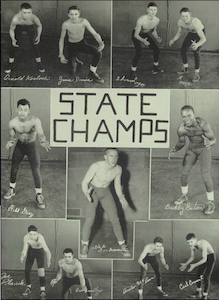
Lansing Sexton won the state’s inaugural team wrestling title, 54-43 over the Ann Arbor Pioneers, with the event run off on the mats of the University of Michigan in 1948. Both Floyd Eaton at 127 pounds and Carl Covert at 133 ended the year undefeated for the Big Reds. Five wrestlers from each school earned individual titles that first year. Jackson’s heavyweight, Norm Blank, scored a pin over Sexton’s Dick Buckmaster. The pair had split their two previous matches during league competition.
 Ann Arbor grabbed the next two MHSAA team titles, both by a mere four points, first 60-56 over Sexton, then topping the Quakers of Lansing Eastern, 56-52, in 1950.
Eight wrestlers qualified for the final round for both Ann Arbor and Sexton in 1949, with five each earning championships. Both schools had three wrestlers finish in third and fourth place; hence the team title was awarded based on Ann Arbor tallying more pins. A total of 96 wrestlers from 11 schools participated in the tournament. Ted Lennox, wrestling at 95 pounds, became the first athlete from the Michigan School for the Blind to compete for an individual title but was defeated by Sexton’s Leo Kosloski. Lennox would later wrestle for Michigan State.
In 1950, nine Ann Arbor wrestlers advanced to the final round with six seizing championship medals, but only Sam Holloway repeated as champion from the previous year. Teammate Jack Townsley, who had won in 1949 at 112 pounds, finished second at 120.
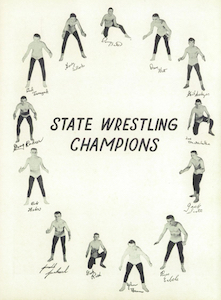 Eastern and coach Don Johnson grabbed the first of two consecutive titles in 1951, topping Ann Arbor, 56-52, with East Lansing finishing a distant third with 26 points. Pete Christ of Battle Creek Central became the first Bearcat (and only the second athlete from a school other than Eastern, Sexton or Ann Arbor) to bring home an individual wrestling title, with a decision over Lansing Eastern’s Vince Malcongi in the 140 classification. “The Bearcat matmen took fourth in the State,” according to the Battle Creek yearbook. “Mr. Donald Cooper took over the coaching duties when Mr. Allen Bush was called to the Marines.” (Bush would later serve as executive director of the MHSAA).
Johnson’s squad absolutely dominated the field in 1952, topping Sexton the next year, 68-43. Ann Arbor followed with 39 points. Seven Quakers – George Smith (95), Herb Austin (103), Jim Sinadinos (127) Bob Ovenhouse (133), Bob Ballard (138), Ed Cary (145) and Norm Thomas (175) – all won their final matches. Both Austin and Sinadinos were repeat champions.
Sexton flipped the table in 1953 with a 67-46 win over Eastern. Ten Big Reds competed for individual state championships among the 12 classifications, with five taking home titles. The Big Reds’ Ken Maidlow, jumping from 165 pounds to 175, and Eastern’s Ed Cary, who moved up to 154, both repeated as medal winners. In the heavyweight class, Sexton’s Ray Reglin downed Steve Zervas from Hazel Park. (Zervas, a two-time runner-up, later wrestled at the University of Michigan, then coached wrestling at Warren Fitzgerald for 34 seasons and served as mayor of Hazel Park from 1974 to 1986).
In 1954, Ossie Elliott of Ypsilanti and Henry Henson of Berkley became the first wrestlers from non 5-A schools to win individual state wrestling titles. Elliott, who had finished as state runner-up in 1953 at 133 pounds, downed Lansing Sexton’s Tom Holden in the same classification. Henson earned a decision over Lansing Eastern’s Ken Bliesener at 154 pounds. Eastern again returned to the winner’s circle, outdistancing Sexton, 60-44. Ypsilanti finished third with 34 points.
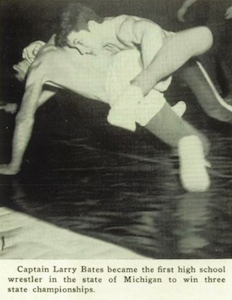
By 1955, athletes from 28 high school teams were battling for state team and individual honors on the mats at MSC’s Jenison Field House. As a senior captain, Lansing Eastern’s Larry Bates pinned four out of five opponents in the 112-pound class to become Michigan’s first wrestler to earn three state crowns. Bates grabbed his first title in 1953, competing at 95 pounds, followed by his second in 1954 at 103. Eastern picked up its second-straight team trophy, racking up 102 points on the way to a fourth crown in the eighth year of championships. For the first time, a non-5-A school finished second, as the Ypsilanti Braves grabbed runner-up honors with 84 points.
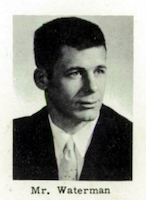 Coach Bert Waterman led Ypsilanti to the first of four championships during a 10-year span in 1956. Two Braves, Ambi Wilbanks and Walt Pipps, earned titles while three others finished second in their classifications. Ypsi had lost one dual meet during the regular season, to Lansing Eastern, by a slim three-point margin. With the 1967-68 school year, Waterman would embark on a 24-year career as coach at Yale University after posting a 192-35-4 mark in 16 seasons at Ypsilanti. A 1950 graduate of Michigan State, the former Spartans wrestler would join Eastern’s Don Johnson, Sexton’s Iggy Konrad, Fran Hetherington from the School for the Blind and two other high school coaches as a charter member of the Michigan Wrestling Hall of Fame in November 1978.
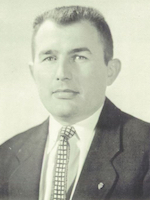 Runner-up in 1956, Eastern grabbed another title in 1957 topping Battle Creek Central, 93-89, in the tournament standings. It was a surprise “going away present” for Coach Don Johnson, who was stepping away after 10 seasons of coaching the Quakers to accept the assistant principal position at Eastern. Battle Creek had five wrestlers advance, and held a 56-48 lead over Eastern as the teams entered the final round. The Quakers’ Ted Hartman opened the day with a victory in the 98-pound weight class, helping Eastern post a 3-1 record in championship round matches. Sexton assisted with the Eastern victory when Norm Young defeated Battle Creek’s Bob McClenney in the 120 weight class. The Bearcats, who had five wrestlers in the finals, ended with two individual champs on the day and their highest finish in their 10 seasons of wrestling.
An All-American wrestler at Michigan State, Johnson would remain at Eastern throughout his education career, retiring as principal in 1983. The fieldhouse at Eastern was named after him in December 1984, fittingly just prior to the championship round of the annual Eastern High Wrestling Invitational.
Eastern again went back-to-back, topping Sexton, 88-57, with Ypsilanti third in the 1958 championship standings. The meet, culminating with 16 boys competing in each weight division – four each from regionals hosted at Battle Creek, Lansing, Ypsilanti and Berkley – was held at the Intramural Building at the University of Michigan. Both Eastern and Sexton advanced four wrestlers to the final round, with Eastern’s Gary Gogarn (95), Ron Parkinson (145) and Alex Valcanoff (154) earning titles. For Sexton, Fritz Kellerman (133) and Wilkie Hopkins (138) finished on top.
The 1959 championships, hosted at the new intramural building at MSU, found boys from 47 schools chasing medal honors.
“Points toward the team title are awarded one for each bout won, with an extra point for a fall,” noted the Lansing State Journal, explaining the mechanics of the tournament. “The big scoring chance comes (in the final round) with a first place netting 10 points, second 7, third 4 and fourth 2.”
Jackson and Sexton had tied for the 6-A Conference crown (the league renamed with the addition of Kalamazoo Central to the mix) and the race to the MHSAA title was expected to be a tight one. Jackson qualified seven for the semifinal round, with four advancing to the championships. The Big Reds sent five wrestlers to the last round. Vikings Ron Shavers (95), Nate Haehnle (145) and Don Mains (165) had each won matches, while Sexton’s qualifiers Tom Mulder (127) and Emerson Boles (175) had earned titles.
With one match remaining, Jackson trailed Iggy Konrad’s Big Reds by four, 67-63, as the Vikings’ Ed Youngs – the state’s reigning heavyweight champion – squared off with Sexton’s Mickey Devoe. Youngs grabbed a 3-1 decision to repeat, but the Vikings needed a fall in the match for a tie. Hence, the Big Reds eked out a single-point victory, 74-73, to escape with their third state mat title.
The results of the title round of the 1960 tournament, also won by Sexton, telegraphed how far the sport had come. Wrestlers from a dozen high schools squared off for honors in the title matches, with winners representing 10 cities. The Big Reds topped Ypsilanti 70-64, followed by Kalamazoo Central with 56 points. Eight other schools had scored at least 20 points in the tournament; 31 teams had scored at least a point. Tom Mulder of Sexton was the lone repeat champion.
With 112 schools now offering wrestling on their sports menu, the MHSAA split the event into two parts for the 1959-60 school year, with Class A set for the University of Michigan and Class B hosted by Michigan State University. The sport was now in full bloom.
 Ron Pesch has taken an active role in researching the history of MHSAA events since 1985 and began writing for MHSAA Finals programs in 1986, adding additional features and "flashbacks" in 1992. He inherited the title of MHSAA historian from the late Dick Kishpaugh following the 1993-94 school year, and resides in Muskegon. Contact him at [email protected] with ideas for historical articles.
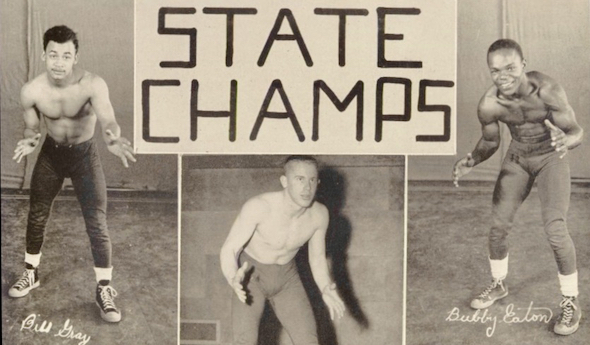
PHOTOS: (Top and 4) Lansing Sexton won the first MHSAA Finals in wrestling in 1948. (2) Eastern’s Larry Bates became the first three-time individual champion in MHSAA history in 1955. (3) The Big Reds were led by coach Ignatius Konrad. (5) Lansing Eastern kept the championship in the capital city in 1949. (6) Bert Waterman built one of the state’s top programs at Ypsilanti. (7) Don Johnson was the architect of Eastern’s program.(Photos gathered by Ron Pesch.)