


10 to Remember: Spring 2013
June 25, 2013
By Geoff Kimmerly
Second Half editor
Nine teams won their first MHSAA championships this spring. Birmingham Brother Rice's boys lacrosse team won its ninth in a row.
And those are only among the toppers of the long list that made memorable moments during this season's Finals, which finished up the school year two weekends ago.
Locking down the 10 most significant performances is impossible. But endeavoring to do so, here are one person's guess at those that will continue to be discussed most in the years to come.
Among those that just missed this list: Brother Rice boys lacrosse, St. Ignace's girls track and field team after winning its fourth straight team title, Grosse Pointe Woods University Liggett's baseball team after its extra-innings Final win over Beal City, Grandville Calvin Christian's girls soccer team after winning a rematch of last season's Division 4 Final and Port Huron Northern's girls tennis team after it emerged from a loaded field to win the Lower Peninsula Division 1 title.
Sami Michell Shines Once More
In her final high school meet, Reed City senior Sami Michell won four more MHSAA Finals individual titles to finish her career with 12 – two more than the previous Lower Peninsula record. A year after becoming the second female to win four events at one Finals meet, she did so again by finishing first in the 100 and 300-meter hurdles, the 200 dash and the long jump. She scored 40 points to claim the team runner-up trophy for her school. Click to read more.
Best Class of All-Time?
That could be the argument for this season’s girls track and field seniors, as twins Hannah and Haley Meier and Erin Finn joined Sami Michell, Detroit Country Day's Kendall Baisden and a host of others in finishing their careers. The Meiers already are members of a national record-holding relay (which set its milestone in 2012), and Hannah won two more Division 1 individual titles (setting all-Finals records) while Haley placed in the same two races and joined her sister on two winning relays. West Bloomfield’s Finn, considered as well one of the nation’s top high school distance runners, finished third to the Meiers in the Division 1 1,600 before cutting nine seconds off her 2012 time in setting an all-Finals record in the 3,200. Click to read more.
Warriors Earn First Title for Winning Coach
Bay City Western’s baseball team strung together two 1-0 shutouts by pitchers Brett Adcock and then Connor Foley to claim its first MHSAA baseball championship – and the first to go with coach Tim McDonald’s other 563 wins over the last 21 seasons. The 1-0 championship game victory over Brother Rice was Western's 35th straight of the season; Western finished 42-2. Click to read more.
Gull Lake Soccer Makes Mark
Richland Gull Lake hadn’t played in a girls soccer Final since 1999, but survived two overtimes against reigning champion Bloomfield Hills Marian to win the Division 2 championship game 1-0. The title was Gull Lake’s first since 1992 and came against a program that not only won in 2012, but three of the last five Division 2 championships. Click to read more.
Upper Peninsula Ace Shoots Record Round
Snow and rain put a damper on a good portion of the girls golf season in the Upper Peninsula this spring. But no U.P. female golfer has ever finished as strongly as Marquette’s Avery Rochester. She claimed her second straight individual Finals championship with a U.P. Finals-record 69, which was three under par at Portage Lake Golf Course in Houghton. Her score also was just one more stroke than the all-Finals record of 68 shot by Grandville’s Stacy Snider in 1998. Click to read more.
7 ... 2 ... 1 ... Champion Tecumseh
Tecumseh entered the MHSAA Tournament after finishing the regular season an honorable mention in the Division 2 softball coaches poll. But the Indians defeated No. 1 Stevensville Lakeshore in the Quarterfinal, reigning champion and No. 2 Livonia Ladywood in the Semifinal and No. 7 Saginaw Swan Valley in the Final to claim their first championship since 2008. Click to read more.
Bishop Foley Sets Baseball Bar
Madison Heights Bishop Foley claimed its third straight Division 3 baseball championship to become the first in MHSAA baseball history to win that many consecutive titles. Bishop Foley is 112-8-1 over the last three seasons and finished 35-2-1 this spring. The Ventures outscored their Bailey Park competition by a combined 18-5 over Finals weekend – getting junior Garrett Schilling to 15-0 for this season and 31-0 for his career with a 6-0 Semifinal win. Click to read more.
Done Deal for Dundee
The Dundee softball team eliminated two-time reigning champion Clinton on the way to Bailey Park this spring, and then beat three-time champion Unionville-Sebewaing in the Division 3 Final to claim its first MHSAA championship in the sport. In the process, Dundee finished 45-1 – setting an MHSAA record for wins in a softball season. Click to read more.
Troy Moves Up to No. 1
After two-straight Division 1 runner-up finishes, Troy earned its first girls soccer championship since 2003 with a 2-1 Final win over Grandville. The Colts had been outscored a combined 3-0 in the last two MHSAA Division 1 Finals, and began this season 3-6-2 before rattling off 15 wins and a tie on the way to claiming the championship. Click to read more.
Tie-Breaker After Heart-Breaker
The Battle Creek Lakeview boys golf team had finished one stroke behind Birmingham Brother Rice at the 2012 Lower Peninsula Division 1 Final, and found itself tied with Plymouth this month after the final round was complete. But thanks to a fifth-player tie-breaker, Lakeview claimed its first MHSAA championship since 2008. Click to read more.
The Last Time MHSAA Finals were Canceled
By
Ron Pesch
MHSAA historian
April 27, 2020
Historians trace the start of World War II to German dictator Adolph Hitler’s decision to invade Poland on September 1, 1939. The Empire of Japan’s involvement in the war became effective in September 1940 with the signing of the Tripartite Pact.
Until December 7, 1941, the United States avoided official involvement, declaring themselves “a neutral nation.” Then came Imperial Japan’s bombing of Pearl Harbor.
A labor shortage caused by World War I had taken out spring high school sports in Michigan in 1917. As noted in the Second Half article, “1918 Pandemic, WWI Threatened High School Sports,” the global spread of a devastating strain of influenza interrupted the football season in Michigan. Prep athletics would roar through the 1920s and survive the Great Depression before seeing another interruption.
That next disturbance had nothing to do with war’s insatiable desire for manpower. Rather, it was because of tires.
“When the Japanese bombed Pearl Harbor, rubber instantly became the most critical strategic material for making war,” wrote Stephen W. Sears in the October/November issue of American Heritage magazine in 1979. “Nine-tenths of the nation’s rubber came from the Far East, and it was painfully evident that nothing would now stop Japan from cutting off that source.”
Americans consumed nearly two-thirds of the world’s production of rubber. With only about a year’s worth of material on hand, “Just four days after Pearl Harbor a freeze was put on the sale of new passenger-car tires,” stated Sears, “and on December 27 tire rationing was authorized, to go into effect early in January, 1942. Sales of new cars also were halted.”
The MHSAA
The Michigan High School Athletic Association arrived in December 1924. It replaced the old Michigan Interscholastic Athletic Association which had served Michigan for 15 years.
The organization’s primary purpose was to standardize, interpret and administer rules, educate and guide officials, and regulate student eligibility within prep sports in Michigan. By the 1940s, it had evolved into an association that also managed postseason tournaments, designed to identify state champions in specific sports: swimming, cross country, golf, tennis, track, and the sport sponsored by the most high schools in the state, basketball.
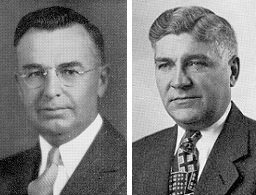 “The old MIAA had taken over the regulation of basketball tournaments in 1920. This had been done as a service to the schools and especially as a means of eliminating evils inherent in the invitational tournaments (that were hosted by various colleges around the state and the midwest),” wrote Lewis L. Forsythe in his book, Athletics in Michigan High Schools, recalling the first 100 years of prep sports in the state.
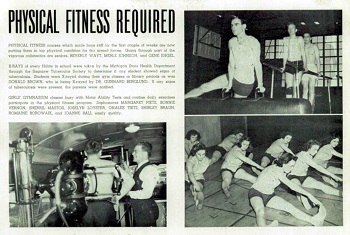
“In the last days of February 1942,” multiple Michigan schoolmen were in San Francisco to attend the annual meetings of Secondary School Principals, Superintendents and the National Federation of State High School Associations. “We were well aware that many of our boys in school would have to offer themselves in the service of their country,” noted Forsythe in his publication. “We fully realized that the quality of that service and, indeed, their own survival might well depend quite as much on their physical fitness as on their intellectual and spiritual resources. It was under those circumstances that we determined so to modify the emphasis of our athletic program as to make the largest possible contribution to the war effort. We recognized that the need in Michigan could not be met by our organization alone, and we therefore determined to encourage a general enrollment of all school groups in a united effort for promotion of physical fitness.”
Because of the “scarcity of tires and automobiles,” in April 1942 the MHSAA announced plans to curtail their upcoming annual golf and tennis events, eliminating a state championship round. Instead, the seasons were concluded with separate eastern and western sectional tournaments, hosted in Ann Arbor and Grand Rapids.
Early in May of 1942, MHSAA executive director Charlie Forsythe, nephew of Louis Forsythe, announced that the Association was “working on plans designed to make body-building exercises available to more young men and to spread recognition of sports achievements. He predicted substantial growth of intramural sports to include youngsters whose limited prowess might keep them from such interscholastic sports as football, baseball or basketball.”
Wire articles had told the story of how the running Battle of the Atlantic had impacted U.S. ocean transportation along the eastern seaboard. A Germany-mounted “campaign against American coastal shipping” by U-boats (submarines) was devastating “a section of America almost exclusively dependent upon ocean-point tankers for its petroleum products.” Without a viable alternative means to transport the products, on May 15, 1942, gasoline rationing began in 17 seaside states and the District of Columbia. It was hinted that gas rationing – specifically designed to save rubber – could roll out nationally. (Crude oil is the main ingredient in man-made rubber.)
The chances for restrictions in Michigan were a distinct possibility. According to P.J. Hoffmaster, the state’s supervisor of wells, the state consumed approximately 140,000 barrels of oil per day, but produced only 64,054 barrels. “This state has a shortage of at least 100,000 barrels on the basis of a regional demand,” he said, noting Michigan oil also supported needs outside the state. “When people say there can’t be rationing in Michigan because we have plenty of our own oil, they don’t have the true picture.”
Reverberations begin
When quizzed on the subject before the annual Lower Peninsula Track and Field championships, hosted at Michigan State College in May 1942, (Charlie) Forsythe, told The Associated Press he was unsure how rationing might affect the Association’s annual playoffs.
 “It is too early as yet to say exactly. … We are making every effort to maintain an adequate athletic program. Certainly where common carriers (busses and trains) will make it possible to get a team to a game, that means should be used,” Forsythe said. He added that the Association was “surprised to find the number of schools competing in this year’s tournaments practically equaled last year’s entries.”
A total of 162 schools had qualified individual contestants in the track championships, about 10 percent fewer than in 1941. However, L.L. Frimodig – the assistant director of college athletics at M.S.C. and acting director of the state track meet – felt “the actual field in the four-class carnival would be much smaller than the number eligible to compete,” considering the circumstances of travel. “Many coaches,” he said, “would think in terms of tires rather than trophies before embarking on any sizable journey to the meet.”
The threat of rationing was almost immediately seen within Michigan’s resorts and travel industry.
“July and August have been moved up into June,” wrote the Detroit Free Press. “This is the word that comes from various parts of the state. Evidently, determination to get the vacation over before gas rationing may be decreed is one of the factors that has stepped up the season. … Reports of heavy patronage at nearby resorts over Memorial Day week-end can be taken as an indication of the trend, or necessity in 1942 of holidays enjoyed close to home base.”
Come September, Joseph B. Eastman, national director of the office of war transportation, called for help in reducing consumption of natural resources: “We intend to solicit the help of colleges and universities in making arrangements for transfer of scheduled games to centers of population where as many people as possible will have an opportunity to attend football games without traveling.”
At the college level, the freshman eligibility rule was waived due to the loss of manpower tied to military enlistment and the enactment of the Selective Training and Service Act of 1940. Its passage required all men between ages 21 and 45 to register for the first peacetime draft in U.S. history. With entry into the war, in December 1941, it was amended to require all 18 to 64-year-olds to register, with starting age for likely draft lowered to 20.
“The seasons of 1942-45 turned the (college) game upside down, creating new juggernauts and decimating some old ones,” wrote Sports Illustrated in its 1971 article, “When Football Went to War.”
 “Michigan’s 85 high school athletic leagues are speculating on the effects of the office of defense transportation plan to whittle sports travel drastically,” stated an Associated Press (AP) article soon after Eastman’s announcement. The Southwestern Conference, comprised of Kalamazoo Central, Benton Harbor, Muskegon, Holland, Grand Haven and Muskegon Heights and one of the most widely spread major prep circuits in the state, was told by its regular bus company that its busses were not available for charter.
On Sept. 25, according to AP, “the state department of public instruction warned today that a threat of ‘no new tires’ will be held over rural schools which use their school busses to transport football players to and from games.”
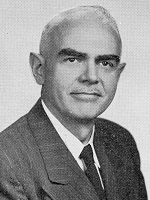
Julian W. Smith, named the interim director of the MHSAA when Charlie Forsythe went into military service, didn’t think the directive would have much impact on football schedules. “However, I believe the order will have a serious effect on basketball schedules this winter and on next year’s football schedule.”
“Four Gallons a Week for Most Drivers”
Two days later it was announced that nationwide gas rationing would go into effect at the beginning of December 1942. More immediately, compulsory tire inspections every 60 days and a “Victory Speed Limit” of 35 miles per hour, effective Oct. 1, were also enacted. “This is not a gasoline rationing program, but a rubber conservation program,” said William M. Jeffers, president of the Union Pacific Railroad, which had been placed in charge of the government’s struggle to alleviate the rubber shortage.
“The object is not to take cars off the road, but to keep them on the road. … The safe life of a tire at 50 miles per hour is only half as great as it is at 30 m.p.h.”
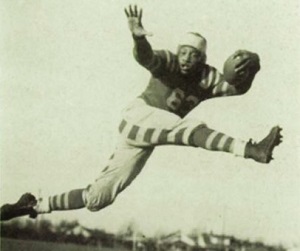 After initial announcements of game cancellations, the impact on high school football in Michigan in 1942 appears to have been minimal. Solutions were found to most challenges. In Bessemer, the high school superintendent announced that “enough persons have volunteered their automobiles to take the Speed Boy players to Calumet” for the game, scheduled for Saturday, Oct. 3. At season’s end, Flint Northern, Detroit Catholic Central, Muskegon, and Wyandotte each lay claim to a share of Michigan’s mythical football title.
But a hint of what was to follow came with an announcement concerning the annual Cross Country Finals. The state meet was cancelled to reduce travel, with honors instead awarded during October meets to which schools were assigned based on geography.
In its October 1942 bulletin, the MHSAA endorsed a commando-type “training plan drafted by the Minnesota branch of the office of civilian defense” to “step up scholastic physical fitness programs.” When plotted on a football field, the course bordered the playing area with 11 obstacles spaced 20 yards apart. The course required participants to jump a 4-foot fence, crawl under a 2-foot-high rope, then run between a maze of stakes and, later in the course, high-step through a series of open boxes. Students would scale a 7½-foot wall, walk on a 12-foot balance beam, swing across a broad jump pit from a rope that hung from above, then climb another rope hung from the crossbar of the goal posts. Once accomplished, the participant was to move, hand-over-hand, across the span of the crossbar before dropping to the ground.
At the end of October, the MHSAA’s Representative Council acknowledged the direct contribution that interscholastic sports had on the “lives of students and citizens of the communities in which they are offered” while recommending that they be “retained insofar as possible.”
The committee, however, also emphasized its belief “that physical fitness programs for all students, and intramural sports to offer opportunity for competition to all, should be stressed in the schools’ athletics program.
“In all probability,” it continued, “it will be necessary to modify the general plans of conducting tournaments.” The mechanics of modification would be hammered out at the next Council meeting to be held in December in Lansing.
Financial concerns also were expressed, as much of the Association’s operating budget came from a share of gate receipts of tournaments.
The Impact
“All over the state, athletic directors and coaches are tackling transportation problems. Instead of piling the athletes into privately owned automobiles or school busses, coaches have diligently studied timetables of regular train and bus lines with many satisfactory results,” stated the AP on Dec. 4.
That same day, the MHSAA announced that the upcoming basketball postseason would be altered due to rationing. The story was picked up by various newspapers across the Midwest.
“The association’s Representative Council last night stressed need for following a ‘principle of minimum travel’ in basketball play this winter and voted to dispense with the annual Lower Peninsula finals,” instead opting for a modified layout. Initial conversation related to a plan calling for sectional meets with the possibility of naming titles in the northern half of the Lower Peninsula, and in both the southern and eastern areas. An appointed basketball committee was also to consider combining enrollment classifications wherever necessary to localize tournament play.
From 1932-1947, inclusive, separate Lower and Upper Peninsula basketball champions were determined. The Upper Peninsula Athletic Committee announced a similar plan at its meeting in January of 1943. The committee expected to present winners of the U.P. events with certificates instead of the customary trophies due to shortage of materials prompted by the war.
According to a survey of its 40 member state associations by the National Federation of State High School Associations, Michigan was one of only four states, including Maine, Montana and Nevada, to eliminate naming basketball state champions come the winter of 1943, “since the distances within those states are too vast or transportation facilities are too limited. The same will prevail in track contests.”
 By mid-January, the MHSAA had polled its membership, and approximately 95 percent of the state’s high schools indicated a desire to participate in the replacement tournaments pitched by the Association. After examining the logistics, the plan previously discussed was modified. The Association then identified 51 Lower and 11 Upper Peninsula sites, based on availability to host the tournament and geographic suitability. The competition would run for two weeks, and end with what had previously equaled District championship contests.
In the meantime, the annual swim championships were reduced to a one-day meet. Hosted at the University of Michigan, the meet would tax the endurance of individual swimmers, “since officials … decided to conduct semi-final events additional to the customary qualifying trials and finals.” That meant a swimmer entered in two events could compete six times during the day, with qualifying events in the morning, semifinals in the afternoon and finals swum at night. Perennial powers Battle Creek Central and Ann Arbor University High emerged as champions.
“The war to date has proved one thing conclusively – athletics in all schools must go on, for they serve to properly condition our young men for the bigger task ahead,” said MHSAA interim director Smith, speaking at an “annual football and basketball ‘bust’ for Lakeview High School” in Battle Creek in February 1943. Smith had served as principal at the high school for 14 years before taking over at the MHSAA. He “expressed regret” that the MHSAA had altered the various formats of the annual championships. According to coverage of the gathering in the Battle Creek Enquirer, “he intimated that it, along with all other forms of statewide competition, would be restored before another school year begins.”
Continued Chaos
The cities of Lansing and Kalamazoo played host to the most contingents, with 25 teams across the four enrollment classifications playing games at recently completed Lansing Sexton – the rechristened Lansing Central High School – and the Lansing Boys Vocational School. A total of 23 schools squared off at Western Michigan College of Education (now Western Michigan University).
As previously stated, transportation considerations meant some schools played above or below their normal classification to make things work. Ecorse, normally a Class B school, battled in the Class A tournament hosted at Dearborn Fordson. Benton Harbor, with Class A enrollment numbers, competed in the Class B tournament played across the St. Joseph River at St. Joseph High School instead of at the Kalamazoo Area tournament against similarly-sized schools.
A total of 128 area titles were awarded across the state’s two peninsulas. Decatur, the Class C state champion in 1942 with a 25-0 record, was the only team titlist to repeat in 1943, emerging with one of the “Area” crowns and extending its streak of victories to 41 consecutive. Also among the winners was Grand Rapids Union, a “cellar team in the regular season.”
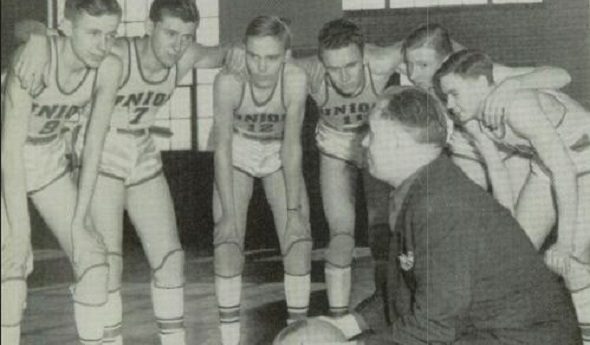
“Although Union stood seventh in the city tally, the Red Hawks won the Area Tournament Crown in three smashing, spine-tingling battles,” stated the sports editor in the 1943 Aurora - Union’s yearbook. “In fast games the Hawks overcame Catholic and beat the Creston Bears … as well as whipping Davis Tech for their final victory.”
In April, the MHSAA confirmed that competition would end with area, city or conference meets in track, and again in tennis and golf, because of transportation, participation issues, and the “prospects of closing of some of the schools early.”
Various fans and media members grumbled about the unsatisfying conclusion to the prep sports calendars.
Hope
The coaching ranks were heavily hit by the war, as numerous mentors were tapped by the armed forces to lead physical fitness programs. Despite initial concerns, few “of the state’s 400 football-playing prep schools” dropped the sport come the 1943-44 school year. As it would turn out, because of the travel constraints, attendance increased as more and more sports fans turned to high school competition for entertainment.
Smith stated in October that he had “yet to find anyone who is definitely against bringing the (basketball) championship tournament back to life. There seems to be overwhelming sentiment in favor of the revival. The schools right-about face on the state cage classic which annually drew 700 prep teams and 11,000 players is explained by the fact coaches now feel the federal government is strongly in favor of any attempt to encourage or extend athletics. Last year schoolmen were not certain what the government’s attitude on sports would be and were hesitant about continuing athletics in pre-war style.”
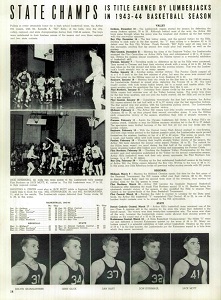 Only 258 of 614 schools replied to a questionnaire about restoring the winter basketball state championships, but 73 percent of respondents were in favor of such, and in December, the Representative Council voted to resume the final rounds of the tournaments.
Born October 1918 in St. Johns, Michigan at the peak of the “Spanish Flu” pandemic, Hal Schram was a 25-year-old sports reporter for the Lansing State Journal when he covered the restart.
“State championship basketball and track competition once more became a part of (the) Michigan high school athletic program when the Representative Council of the MHSAA voted to reinstate these two state-wide tournaments after a suspension of one year,” he wrote.
According to Schram, “It was believed that student working hours, transportation, scarcity of balls and general lack of interest” still necessitated cancellation of golf and tennis tournaments for the year. Conduction of a swimming championship was left “in the hands of a committee representing schools which sponsor the sport … subject to the approval of the representative committee.”
Plans were to return the final rounds of the basketball tournament to Jenison Field House on the campus of Michigan State, which had hosted those rounds from 1940-42. However, the facility was in use by Army trainees for a physical fitness program.
“We would like to have the finals staged here very much,” said MSC athletic director Ralph Young, “but our obligations to the army come first.”
“Despite the hitch, the executive committee opted to stay in Lansing, playing Class A and C semifinal contests at the Boys Vocational School fieldhouse, and Class B and D semi games at Sexton High School. Finals were held at the Vocational gym.
“Fifty-five hundred spectators jammed their way into every nook and cranny of the Boys Vocational school fieldhouse last night to see four high school teams (Saginaw Arthur Hill, Marshall, Lansing St. Mary, Benton Harbor St. John) win championships in the Lower Peninsula tournament finals. With all seats taken almost before the first game started, the big floor was completely encircled by people sitting and standing before the finish,” wrote State Journal sports editor George S. Alderton. “By 6 o’clock, when the Class D game started, all seats in the side bleachers had been filled and most of the end bleachers were gone. The last vacancy was occupied before the Class C game started at 7:15 o’clock and from that time on, those who came either stood or seized a seat left by some departing fan. In many instances two sat down when one departed. Corners of the court were seething masses of humanity …”
United Press International wire reports indicated that 8,500 in total saw the Finals, as fans shifted in and out of the venue in support of the participating teams. “Some people had to be turned away at the finals,” said Smith, “and that certainly shows that people need and want this kind of relaxation.” The previous three Finals at MSC had drawn between 6,000-7,000 fans, while the 1939 Finals at I.M.A in Flint drew 5,000 and the 1938 event at Grand Rapids Civic Auditorium saw 6,000 attend.
“Lighting was so poor in the press box Friday night for the semi-finals,” added Alderton, “that workers came equipped with candles for the finals on Saturday night and propped them against their typewriters.”
Ishpeming hosted the Upper Peninsula Finals, as Escanaba, Crystal Falls, Channing and Amasa swept titles, respectively, in Classes B, C, D and Class E – the state’s smallest classification, reserved only for the smallest U.P. schools based on enrollment.
“Only complaint,” noted the Marquette Mining Journal, “was from those who couldn’t get in or were caught in a jam of fans seeking general admission seats. … Probably another 100 to 200 could have been accommodated if they were permitted to sit on the floor all along the court lines, but this would have been hazardous to players and fans …”
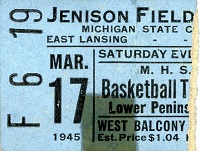 (The Lower Peninsula finals returned to Jenison in 1945 – where they stayed, uninterrupted, through 1970 – and were played before 7,833 spectators that first season back. Locals were delighted as they watched Lansing Sexton top Benton Harbor’s undefeated Tigers, 31-30. Michigan Governor Harry Kelly “personally presented the Class B championship trophy to Sturgis Capt. Tom Tobar, congratulated Capt. Larry Thomson of East Lansing and then shook hands with the captains of the Class A contest before the game started.”)
In mid-May, “some 800 Michigan prep trackmen, survivors of 40 regionals at 10 centers” headed to Michigan State College to determine statewide champs. Only Kalamazoo in Class A and Birmingham in Class B held the chance to “repeat” as team champions. Instead, Saginaw Arthur Hill capped a stellar sports year, earning its first Class A team track title to go with its recently-earned basketball crown. (Earlier in the school year, the Lumberjacks also had opened their own football field.)
East Grand Rapids earned its second track title, grabbing the Class B crown. Fowlerville and Glen Arbor Leelanau brought home titles in Class C and D, respectively.
All sports – including golf and tennis which had gone three years without competing in a true state title round – returned to their original formats with the start of the 1944-45 school year.
In May 1945, Germany surrendered to the Allies, followed by Imperial Japan’s surrender, announced in August.
Participation in prep sports and attendance numbers would explode across the state and the nation in the coming years, tied to multiple factors, including, of course, the baby boom that followed World War II.
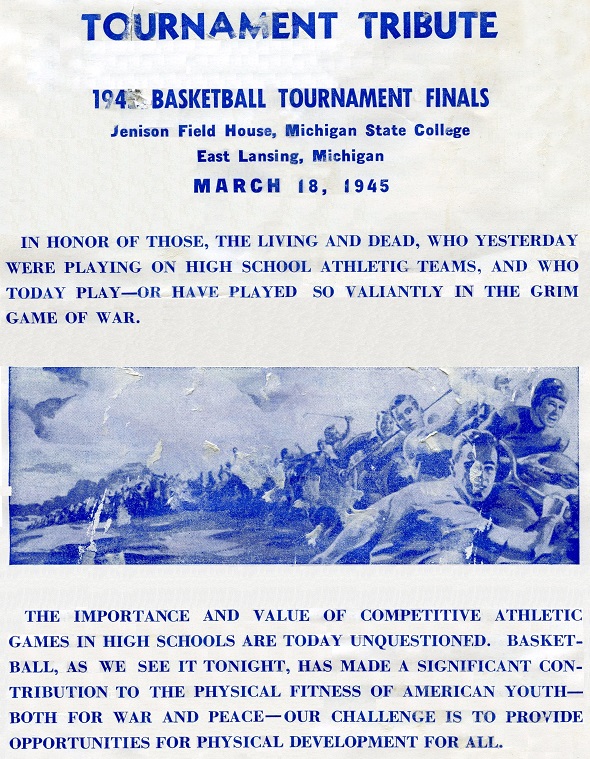
 Ron Pesch has taken an active role in researching the history of MHSAA events since 1985 and began writing for MHSAA Finals programs in 1986, adding additional features and "flashbacks" in 1992. He inherited the title of MHSAA historian from the late Dick Kishpaugh following the 1993-94 school year, and resides in Muskegon. Contact him at [email protected] with ideas for historical articles.
PHOTOS: (Top) Grand Rapids Union was among "Area" boys basketball champions in 1943. (2) Lewis Forsythe, left, and Charles Forsythe were among leaders during the MHSAA's first decades (3) The Saginaw Arthur Hill yearbook for 1944 tells of fitness training undertaken by students. (4) Julian W. Smith served as interim MHSAA executive director while Charles Forsythe was serving in the military. (5) Flint Northern's Bill Hamilton earned all-state honors in 1942. (6) Western Michigan College was among hosts of 1943 Area tournaments. (7) Arthur Hill's yearbook celebrates the 1943-44 boys basketball championship. (8) Basketball Finals returned to Jenison Field House in 1945. (9) The MHSAA paid tribute to World War II veterans in its 1945 Basketball Finals program.