

10 to Remember: Spring 2015
June 25, 2015
By Geoff Kimmerly
Second Half editor
The close of June officially ends of another school year. And this season’s MHSAA Finals provided another strong finish with a number of memorable moments sure to be recalled for years to come.
Below is one person’s list of the 10 most significant, drawn from the title-earning performances of 129 teams and hundreds of individuals this spring.
10. Rockford Holds On for Third Straight Girls Lacrosse Title
The Rams saw an 8-1 lead dissolve to a one-goal advantage after Bloomfield Hills Marian scored in the 22nd minute of the second half of their Division 1 Final. Rockford goalie Katie Elwell turned away a shot to tie the game with 55 seconds left, and her team won a jumpball deep on its side of the field with 36 seconds to play to hold on to a 10-9 victory – and claim a third straight MHSAA championship. Rockford is one of three programs to win four MHSAA titles during the 11 seasons of tournament sponsorship. Marian is a two-time runner-up.
9. Hartland Baseball Goes 10 Innings to Win First MHSAA Title
Hartland scored in the first inning of the Division 1 Final in pursuit of its first MHSAA championship in the sport – but then didn’t score again until the bottom of the 10th inning. Junior pitcher John Baker threw all 10 innings for the Eagles, allowing only five hits and striking out 11 batters, and he also had two hits and drove in the game’s first run. Portage Northern also was making its first MHSAA Final appearance in baseball.
8. Northville Girls Tennis Joins First-time Champs; Nguyen Joins Elite
The Northville girls tennis team was one of 32 teams over all sports that won their first MHSAA championships during the 2014-15 school year. The Wildcats finished an impressive five points ahead of Midland Dow, winning three doubles and two singles flights. Utica’s Davina Nguyen, meanwhile, finished as one of the most accomplished champions in MHSAA history, becoming only the sixth player to win at least three titles at No. 1 singles. Nguyen also won in Division 1 as a freshman and junior.
7. Cranbrook Kingswood Regains Boys Lacrosse Title on Last-Second Winner
Johnny Wagner scored 177 goals over his three-season varsity career for Bloomfield Hills Cranbrook Kingswood, but his last had to be the most spectacular. Three days after sending the Cranes to the Final with an overtime game-winning goal, Wagner scored in the Division 2 championship decider with 10.5 seconds to play to give his team the final edge in a 10-9 victory over Okemos. The winner was his fifth goal of the game.
6. Gull Lake Girls Soccer Wins Again on Shootout Success
The only shots to find the net in the Division 2 Final came during an overtime shootout won by Gull Lake to give the Blue Devils a 1-0 victory and their third straight MHSAA championship. That’s not to say the game lacked for excitement, with the teams combining for 37 shots. Gull Lake had also won its Regional Semifinal in a shootout and finished the spring 25-1-1. Fenton was making its first MHSAA Finals appearance in the sport, seeking its first title in any sport since 1993.
5. Warren Regina Softball Stuns After Slow Start
Teams that open 3-11 usually don’t finish as championship contenders – but those teams don’t have the MHSAA’s winningest coach, Diane Laffey, running the show to go with a strong group of upperclassmen who emerged from a competative Detroit Catholic League Central. Regina won its sixth MHSAA title and first since 2007 by downing favored Caledonia 5-0 in the Division 1 Final. Senior Marissa Tiano struck out nine batters in giving up only two hits after giving up only four hits in a 7-1 Semifinal win over Mattawan.
4. DeWitt Boys Golf Sticks Winning Shots; Carlson Goes All-Time Low
DeWitt senior Geoffry Croley birdied off the flagstick on the No. 18 hole at Forest Akers East to help the Panthers edge Cranbrook Kingswood 594-595 and claim the Lower Peninsula Division 2 title, its first since 2011. His younger brother, freshman Joey, made par on his final hole (No. 16) to also help secure the win. Meanwhile, Hamilton’s Nick Carlson finished his high school career with a second individual title and the all-time low 36-hole score in MHSAA Finals history, a 134, to edge Matt Harmon’s 135 for East Kentwood in 2001.
3. Saline Unbeatable in Claiming First Girls Soccer Title
The Hornets compiled one of the most impressive seasons in MHSAA girls soccer history in making their first Final and then winning it. Saline gave up a mere four goals – tied for third-fewest in MHSAA history – in 25 games and finished with a 22-0-3 record capped by a 4-0 win over Grand Blanc in the Division 1 championship game. The team’s 22 shutouts also rank tied for third in MHSAA girls soccer history. Senior Taylor Mulder set a school record with 43 goals this season with her second of this game.
2. Legend of Beaubien Grows with Monroe St. Mary Softball Title
Meghan Beaubien already was known by those who follow softball statewide – not many sophomores get a chance to commit to the University of Michigan so early. But what she and the Kestrels did in winning the program’s first MHSAA championship was pretty legendary. Monroe St. Mary Catholic Central outscored its postseason opponents by a combined 29-0 over seven games, beating Bronson 2-0 in the Division 3 Final with Beaubien taking a perfect game into the seventh inning and hitting a two-run homer.
1. Fisher, Saline Finish Strong in Boys Track and Field Final
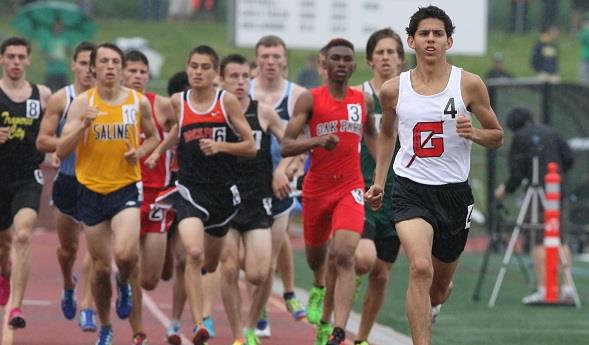
The Lower Peninsula Division 1 Final was filled with notable finishes – including a pair that will be listed in the national record book next month. Saline won its second MHSAA title in the sport and first since 2006, finishing ahead of East Kentwood – champion five of the last six seasons. The Hornets were keyed by a 3,200 relay of Logan Wetzel, Josiah Humphrey, Austin Welch and Kevin Hall that finished in 7:38.97 to rank among the best all-time in U.S. high school history Grand Blanc senior Grant Fisher posted the second-fastest 1,600 time in U.S. high school history, going 4:00.28.; he graduated with five individual MHSAA Finals titles. Grand Rapids Kenowa Hills’ Donavan Brazier also re-set the all-Finals record in the 800, running 1:48.98.
PHOTO: Grant Fisher, far right, set an MHSAA all-Finals record in the 1,600 that also ranks as the second-fastest in U.S. high school history. (Click to see more from RunMichigan.com. Photos by John Brabbs.)
Why Athletes Should See A Sport Psychologist
By
Elizabeth Swanson
Henry Ford Health
January 9, 2024
Whether at the professional or intramural level, there are so many benefits to being an athlete. Participating in a sport teaches communication skills, how to overcome adversity—and regular exercise has so many incredible health effects on the mind and body.
 But that’s not to say athletes don’t have their own set of challenges. Pressures to perform, physical injuries and intense schedules can take a toll on anyone’s mental health, which is where a sport psychologist comes in.
“It’s helpful that a sport psychologist knows the culture of athletics and the typical stressors that athletes face,” says Seth Swary, Ph.D., a sport psychology clinician at the Henry Ford Center for Athletic Medicine. “We’re familiar with the influence the world of athletics can have on someone and how it can affect their well-being.
“Athletes have a whole team around them to help them perform — athletic trainers, nutritionists, etc.— so why shouldn’t they have an expert who is dedicated to supporting their mental health? A sport psychologist acts as a strength-training coach for the mind.”
Mental Health Challenges That Athletes Face & How Sport Psychology Can Help
Athletes often have a built-in support system: teammates and coaches who know what they’re going through and trainers and physicians who can help manage aches and injuries. But still, it’s not always easy. Some of the difficulties that athletes face include:
- Increased attention on body image. Especially if you play a sport that requires revealing outfits — or a sport with increased focus on weight — it might be difficult to maintain a healthy body image. For some, this can lead to an increased risk of developing an eating disorder.
- The pressure to perform. “If you’re an athlete at the college or professional level and play badly during a game, you get roasted on Twitter,” says Dr. Swary. “But even if you’re not in the public eye, there is pressure to perform — from coaches, teammates, family members.”
- Navigating demanding schedules. “I work with many college athletes and their schedules are packed — practicing at least two hours a day, team meetings, traveling to and from games — and then they’re trying to keep up with school,” says Dr. Swary. “It can be stressful.”
- Debilitating physical injuries. The physical demand of sports can also bring about its own set of challenges — especially when injuries occur. “You’re not only dealing with surgery and rehabilitation, but you’re also out of the game for a while,” says Dr. Swary.
- Making career transitions. “I’ve worked with many athletes who are transitioning from one level of athletics to another (for example, middle school to high school, high school to college, college to professional) along with athletes who are transitioning out of their career,” says Dr. Swary. “They wonder how they can leave this sport they’ve been doing their whole lives — some since they were 3 or 4 years old. It can be a huge part of their identity and a tough transition to make. Even more so if it’s an injury that abruptly derails their career. We can provide them with ways to make a smooth, healthy transition.”
That said, nothing “bad” has to happen to benefit from sport psychology. As Dr. Swary says, you don’t see a personal trainer because you’re not strong, you see a personal trainer because you could benefit from being stronger. It’s the same with sport psychology — and it can help improve your performance.
“We have specific skills we work on for performance optimization,” says Dr. Swary. “How do we talk to ourselves? How do we respond in certain situations? How do we stay in the moment when we’re distracted?
“A high school athlete may have had a rough day at school; then they have to refocus and find energy at the end of the day for their game. It can be helpful for any athlete at any time.”
Reviewed by Seth Swary, Ph.D., a sport psychology clinician at the Henry Ford Center for Athletic Medicine.
To learn more about the sport psychology program at Henry Ford or to request an appointment, visit henryford.com/sportpsychology.