

10 to Remember: Spring 2015
June 25, 2015
By Geoff Kimmerly
Second Half editor
The close of June officially ends of another school year. And this season’s MHSAA Finals provided another strong finish with a number of memorable moments sure to be recalled for years to come.
Below is one person’s list of the 10 most significant, drawn from the title-earning performances of 129 teams and hundreds of individuals this spring.
10. Rockford Holds On for Third Straight Girls Lacrosse Title
The Rams saw an 8-1 lead dissolve to a one-goal advantage after Bloomfield Hills Marian scored in the 22nd minute of the second half of their Division 1 Final. Rockford goalie Katie Elwell turned away a shot to tie the game with 55 seconds left, and her team won a jumpball deep on its side of the field with 36 seconds to play to hold on to a 10-9 victory – and claim a third straight MHSAA championship. Rockford is one of three programs to win four MHSAA titles during the 11 seasons of tournament sponsorship. Marian is a two-time runner-up.
9. Hartland Baseball Goes 10 Innings to Win First MHSAA Title
Hartland scored in the first inning of the Division 1 Final in pursuit of its first MHSAA championship in the sport – but then didn’t score again until the bottom of the 10th inning. Junior pitcher John Baker threw all 10 innings for the Eagles, allowing only five hits and striking out 11 batters, and he also had two hits and drove in the game’s first run. Portage Northern also was making its first MHSAA Final appearance in baseball.
8. Northville Girls Tennis Joins First-time Champs; Nguyen Joins Elite
The Northville girls tennis team was one of 32 teams over all sports that won their first MHSAA championships during the 2014-15 school year. The Wildcats finished an impressive five points ahead of Midland Dow, winning three doubles and two singles flights. Utica’s Davina Nguyen, meanwhile, finished as one of the most accomplished champions in MHSAA history, becoming only the sixth player to win at least three titles at No. 1 singles. Nguyen also won in Division 1 as a freshman and junior.
7. Cranbrook Kingswood Regains Boys Lacrosse Title on Last-Second Winner
Johnny Wagner scored 177 goals over his three-season varsity career for Bloomfield Hills Cranbrook Kingswood, but his last had to be the most spectacular. Three days after sending the Cranes to the Final with an overtime game-winning goal, Wagner scored in the Division 2 championship decider with 10.5 seconds to play to give his team the final edge in a 10-9 victory over Okemos. The winner was his fifth goal of the game.
6. Gull Lake Girls Soccer Wins Again on Shootout Success
The only shots to find the net in the Division 2 Final came during an overtime shootout won by Gull Lake to give the Blue Devils a 1-0 victory and their third straight MHSAA championship. That’s not to say the game lacked for excitement, with the teams combining for 37 shots. Gull Lake had also won its Regional Semifinal in a shootout and finished the spring 25-1-1. Fenton was making its first MHSAA Finals appearance in the sport, seeking its first title in any sport since 1993.
5. Warren Regina Softball Stuns After Slow Start
Teams that open 3-11 usually don’t finish as championship contenders – but those teams don’t have the MHSAA’s winningest coach, Diane Laffey, running the show to go with a strong group of upperclassmen who emerged from a competative Detroit Catholic League Central. Regina won its sixth MHSAA title and first since 2007 by downing favored Caledonia 5-0 in the Division 1 Final. Senior Marissa Tiano struck out nine batters in giving up only two hits after giving up only four hits in a 7-1 Semifinal win over Mattawan.
4. DeWitt Boys Golf Sticks Winning Shots; Carlson Goes All-Time Low
DeWitt senior Geoffry Croley birdied off the flagstick on the No. 18 hole at Forest Akers East to help the Panthers edge Cranbrook Kingswood 594-595 and claim the Lower Peninsula Division 2 title, its first since 2011. His younger brother, freshman Joey, made par on his final hole (No. 16) to also help secure the win. Meanwhile, Hamilton’s Nick Carlson finished his high school career with a second individual title and the all-time low 36-hole score in MHSAA Finals history, a 134, to edge Matt Harmon’s 135 for East Kentwood in 2001.
3. Saline Unbeatable in Claiming First Girls Soccer Title
The Hornets compiled one of the most impressive seasons in MHSAA girls soccer history in making their first Final and then winning it. Saline gave up a mere four goals – tied for third-fewest in MHSAA history – in 25 games and finished with a 22-0-3 record capped by a 4-0 win over Grand Blanc in the Division 1 championship game. The team’s 22 shutouts also rank tied for third in MHSAA girls soccer history. Senior Taylor Mulder set a school record with 43 goals this season with her second of this game.
2. Legend of Beaubien Grows with Monroe St. Mary Softball Title
Meghan Beaubien already was known by those who follow softball statewide – not many sophomores get a chance to commit to the University of Michigan so early. But what she and the Kestrels did in winning the program’s first MHSAA championship was pretty legendary. Monroe St. Mary Catholic Central outscored its postseason opponents by a combined 29-0 over seven games, beating Bronson 2-0 in the Division 3 Final with Beaubien taking a perfect game into the seventh inning and hitting a two-run homer.
1. Fisher, Saline Finish Strong in Boys Track and Field Final
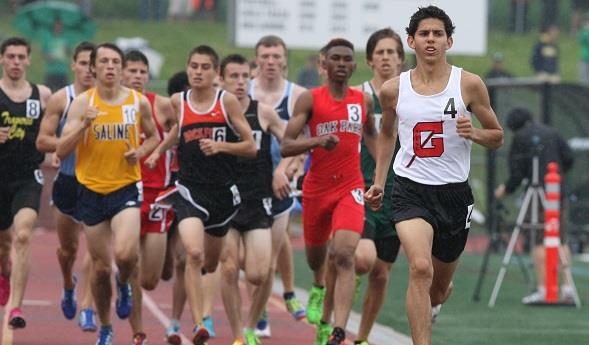
The Lower Peninsula Division 1 Final was filled with notable finishes – including a pair that will be listed in the national record book next month. Saline won its second MHSAA title in the sport and first since 2006, finishing ahead of East Kentwood – champion five of the last six seasons. The Hornets were keyed by a 3,200 relay of Logan Wetzel, Josiah Humphrey, Austin Welch and Kevin Hall that finished in 7:38.97 to rank among the best all-time in U.S. high school history Grand Blanc senior Grant Fisher posted the second-fastest 1,600 time in U.S. high school history, going 4:00.28.; he graduated with five individual MHSAA Finals titles. Grand Rapids Kenowa Hills’ Donavan Brazier also re-set the all-Finals record in the 800, running 1:48.98.
PHOTO: Grant Fisher, far right, set an MHSAA all-Finals record in the 1,600 that also ranks as the second-fastest in U.S. high school history. (Click to see more from RunMichigan.com. Photos by John Brabbs.)
Workout Basics: Warm-Ups & Cool-Downs
February 3, 2021

By Nick Parkinson, M.Ed., AT, ATC, TSAC-F
Henry Ford Health Systems
You may know a good warm-up — and cool-down — are essential to getting a good workout. You may also know that warming up your muscles and stretching them out after exercise can help prevent injury and keep you at the top of your game.
They’re the two bookends that help maximize a workout. Unfortunately, a lot of exercise enthusiasts don’t know how to warm up and cool down correctly.
Warm-Up Basics
A warm-up is exactly what it sounds like: The goal is to warm up your muscles and prepare your body for whatever you’re asking it to do. Warming up increases your body temperature and helps blood flow to the muscles that you’re using.
So if you’re going to play soccer, your warm-up should touch all of the muscles in your legs and core. Shooting hoops? You’ll need to add shoulders and arms to your routine. Circuit training at the gym? Choose a warm-up that flexes all of the muscles you’re about to use.
The thing that all warm-ups have in common is that they require dynamic (or constantly moving) motion, not static stretching (holding poses for a certain amount of time). In fact, static stretching prior to a workout can inhibit power and strength, especially if you’re doing something like weightlifting.
The anatomy of a solid warm-up:
• Before any activity, do about 10 minutes of light cardiovascular activity, whether walking, biking or jogging.
• Dynamic stretches. After you get your muscles moving, do a series of lunges, jumping jacks or toe touches to stretch a bit.
• Dive in. When you start your workout, begin slowly and gradually increase power and speed.
Cool-Down Basics
After you’ve put your body through a challenge, a good cool-down is essential. It helps slow down your heart rate gradually, relax your muscles and stretch them out.
Cool-down routines should always include some type of motion before you get to static stretching, especially if you’ve just finished a high-intensity workout. Static stretching improves flexibility and performance and it can also help stave off future injury.
As with warm-ups, the right cool-down exercises depend on the activity you engaged in. If you biked for 20 miles, you might coast on your cycle for a while before coming to a stop. If you ran, you might jog or walk before you begin stretching. As with your warm-up, the key is addressing every muscle group you worked during your workout.
The anatomy of a solid cool-down:
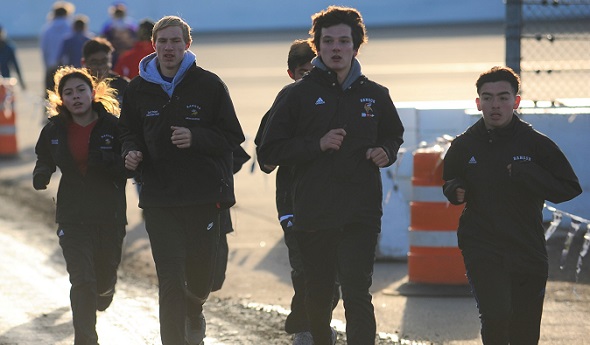
• At the end of your workout, slow the pace and intensity of whatever activity you’re doing. So, if you’re running, slow to a jog and then a walk for 5 to 10 minutes before stopping.
• Stretch out the muscles you work, but don’t push past the point where you feel tight. Then, hold the position for at least 30 seconds. That’s how long it takes for the body to overcome its stretch reflex.
• Breathe through your stretches and make sure to finish your cool-down with deep, belly breaths.
Running short on time? Target muscle groups you may have injured in the past or that tend to get sore after activity. Cooling down will preserve your athleticism — and your ability to participate in daily activities — over the long term.
Be Good to Your Body
While there’s some controversy about whether warming up and cooling down can help prevent injury, there’s little dispute that they can help you ease in and out of activity.
The key is to find something that works for you. Your warm-up could be as simple as walking to the gym and doing a set of jumping jacks when you arrive. Your cool-down might just involve ending your workout 10 minutes early so you can slow down.
It doesn’t have to be complicated. It just has to give your heart and blood vessels a chance to breathe before and after activity.
Nick Parkinson, M.Ed., AT, ATC, TSAC-F, is the Supervisor of Athletic Training with Henry Ford Sports Medicine and also leads Sports Performance training at the William Clay Ford Center for Athletic Medicine. Learn more about Nick.
Want to learn more? Henry Ford Health System sports medicine experts are treating the whole athlete, in a whole new way. From nutrition to neurology, and from injury prevention to treatment of sports-related conditions, they can give your athlete a unique game plan.
Visit henryford.com/sports or call (313) 972-4216.