

10 to Remember: Spring 2015
June 25, 2015
By Geoff Kimmerly
Second Half editor
The close of June officially ends of another school year. And this season’s MHSAA Finals provided another strong finish with a number of memorable moments sure to be recalled for years to come.
Below is one person’s list of the 10 most significant, drawn from the title-earning performances of 129 teams and hundreds of individuals this spring.
10. Rockford Holds On for Third Straight Girls Lacrosse Title
The Rams saw an 8-1 lead dissolve to a one-goal advantage after Bloomfield Hills Marian scored in the 22nd minute of the second half of their Division 1 Final. Rockford goalie Katie Elwell turned away a shot to tie the game with 55 seconds left, and her team won a jumpball deep on its side of the field with 36 seconds to play to hold on to a 10-9 victory – and claim a third straight MHSAA championship. Rockford is one of three programs to win four MHSAA titles during the 11 seasons of tournament sponsorship. Marian is a two-time runner-up.
9. Hartland Baseball Goes 10 Innings to Win First MHSAA Title
Hartland scored in the first inning of the Division 1 Final in pursuit of its first MHSAA championship in the sport – but then didn’t score again until the bottom of the 10th inning. Junior pitcher John Baker threw all 10 innings for the Eagles, allowing only five hits and striking out 11 batters, and he also had two hits and drove in the game’s first run. Portage Northern also was making its first MHSAA Final appearance in baseball.
8. Northville Girls Tennis Joins First-time Champs; Nguyen Joins Elite
The Northville girls tennis team was one of 32 teams over all sports that won their first MHSAA championships during the 2014-15 school year. The Wildcats finished an impressive five points ahead of Midland Dow, winning three doubles and two singles flights. Utica’s Davina Nguyen, meanwhile, finished as one of the most accomplished champions in MHSAA history, becoming only the sixth player to win at least three titles at No. 1 singles. Nguyen also won in Division 1 as a freshman and junior.
7. Cranbrook Kingswood Regains Boys Lacrosse Title on Last-Second Winner
Johnny Wagner scored 177 goals over his three-season varsity career for Bloomfield Hills Cranbrook Kingswood, but his last had to be the most spectacular. Three days after sending the Cranes to the Final with an overtime game-winning goal, Wagner scored in the Division 2 championship decider with 10.5 seconds to play to give his team the final edge in a 10-9 victory over Okemos. The winner was his fifth goal of the game.
6. Gull Lake Girls Soccer Wins Again on Shootout Success
The only shots to find the net in the Division 2 Final came during an overtime shootout won by Gull Lake to give the Blue Devils a 1-0 victory and their third straight MHSAA championship. That’s not to say the game lacked for excitement, with the teams combining for 37 shots. Gull Lake had also won its Regional Semifinal in a shootout and finished the spring 25-1-1. Fenton was making its first MHSAA Finals appearance in the sport, seeking its first title in any sport since 1993.
5. Warren Regina Softball Stuns After Slow Start
Teams that open 3-11 usually don’t finish as championship contenders – but those teams don’t have the MHSAA’s winningest coach, Diane Laffey, running the show to go with a strong group of upperclassmen who emerged from a competative Detroit Catholic League Central. Regina won its sixth MHSAA title and first since 2007 by downing favored Caledonia 5-0 in the Division 1 Final. Senior Marissa Tiano struck out nine batters in giving up only two hits after giving up only four hits in a 7-1 Semifinal win over Mattawan.
4. DeWitt Boys Golf Sticks Winning Shots; Carlson Goes All-Time Low
DeWitt senior Geoffry Croley birdied off the flagstick on the No. 18 hole at Forest Akers East to help the Panthers edge Cranbrook Kingswood 594-595 and claim the Lower Peninsula Division 2 title, its first since 2011. His younger brother, freshman Joey, made par on his final hole (No. 16) to also help secure the win. Meanwhile, Hamilton’s Nick Carlson finished his high school career with a second individual title and the all-time low 36-hole score in MHSAA Finals history, a 134, to edge Matt Harmon’s 135 for East Kentwood in 2001.
3. Saline Unbeatable in Claiming First Girls Soccer Title
The Hornets compiled one of the most impressive seasons in MHSAA girls soccer history in making their first Final and then winning it. Saline gave up a mere four goals – tied for third-fewest in MHSAA history – in 25 games and finished with a 22-0-3 record capped by a 4-0 win over Grand Blanc in the Division 1 championship game. The team’s 22 shutouts also rank tied for third in MHSAA girls soccer history. Senior Taylor Mulder set a school record with 43 goals this season with her second of this game.
2. Legend of Beaubien Grows with Monroe St. Mary Softball Title
Meghan Beaubien already was known by those who follow softball statewide – not many sophomores get a chance to commit to the University of Michigan so early. But what she and the Kestrels did in winning the program’s first MHSAA championship was pretty legendary. Monroe St. Mary Catholic Central outscored its postseason opponents by a combined 29-0 over seven games, beating Bronson 2-0 in the Division 3 Final with Beaubien taking a perfect game into the seventh inning and hitting a two-run homer.
1. Fisher, Saline Finish Strong in Boys Track and Field Final
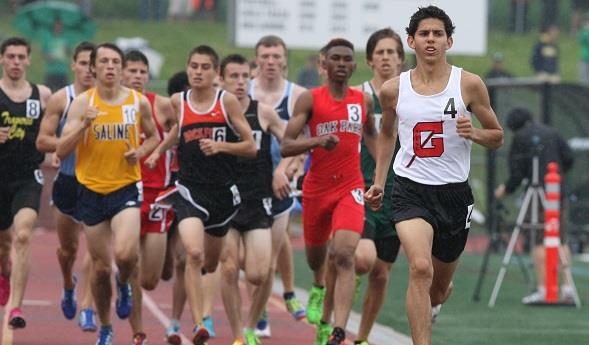
The Lower Peninsula Division 1 Final was filled with notable finishes – including a pair that will be listed in the national record book next month. Saline won its second MHSAA title in the sport and first since 2006, finishing ahead of East Kentwood – champion five of the last six seasons. The Hornets were keyed by a 3,200 relay of Logan Wetzel, Josiah Humphrey, Austin Welch and Kevin Hall that finished in 7:38.97 to rank among the best all-time in U.S. high school history Grand Blanc senior Grant Fisher posted the second-fastest 1,600 time in U.S. high school history, going 4:00.28.; he graduated with five individual MHSAA Finals titles. Grand Rapids Kenowa Hills’ Donavan Brazier also re-set the all-Finals record in the 800, running 1:48.98.
PHOTO: Grant Fisher, far right, set an MHSAA all-Finals record in the 1,600 that also ranks as the second-fastest in U.S. high school history. (Click to see more from RunMichigan.com. Photos by John Brabbs.)

More States Begin Mental Health Efforts
January 2, 2020
Editor’s Note: This is part of a series on NFHS News addressing the challenges of mental health issues in high school athletics. This article explores one statewide approach to this important subject.
Suicide is a serious public health problem. It is the second-leading cause of death of high school-aged individuals in the United States. (National Vital Statistics Report 2016 Data Published by the CDC July 2018)
In Oregon, the suicide rate is higher than the national average, and a recent survey of 11th-graders found that within the past year, 18 percent seriously considered suicide and 7 percent attempted suicide. (Youth Suicide Annual Report 2017 & Oregon Healthy Teens Survey 2017)
More concerning is the fact that the rate of completed suicides in youth has been increasing since 2011. Not only does suicide lead to a life lost much too early, it leaves a devastating impact on those left behind.
Fortunately, suicides are preventable. The Oregon Youth Suicide Intervention and Prevention Plan was created calling for “Zero Suicide ... through collective action among health and behavioral health systems, schools, communities, parents and other systems that touch the lives of youth.” (Youth Suicide Annual Report 2017) For numerous reasons, schools are being used as the primary means of dissemination and implementation of suicide prevention interventions.
One group of school personnel that had not been traditionally considered in school-based efforts are school activities personnel: coaches, athletic trainers and athletic administrators. These individuals spend a great deal of time with students, developing relationships that may go beyond what a student typically has with a teacher.
 Coaches, athletic trainers and athletic administrators are in the ideal position to recognize behavioral warning signs or be the point person for students to go to if they have concerns about a peer. This is vital as youth considering suicide often talk about suicide and exhibit behaviors and/or moods associated with increased suicide risk. Additionally, activities personnel are school leaders who are often known and trusted by parents, thus creating more opportunities for dialogue on suicide prevention.
Realizing the impact youth suicide has on school communities and the prevention opportunities that exist, the leadership of the Oregon School Activities Association (OSAA), the Oregon Athletic Coaches Association, the Oregon Athletic Directors Association and the Oregon Athletic Trainers’ Society partnered to promote the role of high school activities personnel in preventing youth suicide. While these groups had multiple means of reaching out to the intended audience, the leadership realized help was needed from experts for a statewide education campaign to be successful. The Suicide Intervention Coordinator for the Oregon Health Authority (the state agency charged with overseeing Oregon’s health-related programs) was contacted and agreed to assist in developing a statewide educational campaign geared to activities personnel.
The Campaign
It was determined that a series of articles geared specifically to activities personnel would be written by the Oregon Health Authority and then disseminated by the OSAA throughout the academic year.
The articles typically contained two pages of practical information and tips. The campaign was not designed to replace a formal suicide gatekeeper training; rather, it served to promote awareness of the role activities personnel play in countering the rising problem. The articles and additional resources were also posted to the OSAA website.
The OSAA Foundation provided funding for a poster that was provided to schools to be placed in locker rooms, team rooms, athletic training rooms and other areas where students congregate. The primary goal of the poster was to provide students with contact information for crisis lines.
Toward the end of the campaign, workshops were presented by a representative from the American Foundation for Suicide Prevention at the Oregon Athletic Directors Association’s annual statewide conference. The goal was to provide information on programs and policies that athletic administrators could implement at their schools.
While the campaign only spanned the 2017-18 academic year, the leadership of the stakeholder groups believed there was still more that could be done. In 2018-19, a campaign on anti-hazing and anti-bullying (which is a risk factor for suicide) was implemented using a similar approach as the suicide prevention campaign.
In addition, the groups coordinated a high school coaches’ symposium that included breakout sessions on suicide prevention, hazing prevention and character education.
Lessons Learned
Individuals who work with students involved with high school activity programs realize the power and opportunities which exist for positive character development. The focus of this campaign was to highlight a significant and growing public health problem – youth suicide. The goal of the campaign was to increase awareness and provide appropriate resources – not to create experts in suicide prevention.
The collaborative nature of this campaign strengthened the relationships between the different groups working together with a specific purpose. The groups have now partnered on several additional campaigns – the aforementioned anti-hazing/anti-bullying campaign and promoting the development of Emergency Action Plans.
The campaign also allowed the groups to work closely with state public health officials. While the OSAA had previously partnered with state public health officials regarding air quality policies and a guidance document for medical providers on pre-participation physical exams, this campaign provided several new and distinct advantages.
State public health officials were able to see the positive impact of participation in high school activity programs beyond just the activity itself – namely the positive mentorship relationships that may develop. They were also impressed by the large audience the campaign reached and the feedback provided (due to the expansive network of activities administrators, coaches and athletic trainers that the OSAA reaches). Ideally, this will spur additional collaborations in the future.
A major challenge for schools and school personnel is the competing demands for time and resources for the many worthy interventions and activities. Unfortunately, it is impossible to commit to all interventions and activities that may benefit students. While there was a monetary cost for the posters to be distributed to schools, development of the actual campaign articles and presentations were done by individuals as part of their job related to suicide prevention, so the campaign was relatively inexpensive. Since it was distributed throughout the year, it did not require a large time commitment from activities personnel and the monthly articles kept the issue front and center.
Conclusion
The statewide Youth Suicide Awareness Campaign is just one example of how the unique role of school activities personnel can be leveraged and how stakeholder organizations and state public health agencies can maximize their impact and reach through collaboration. While we will continue to review suicide incidence in Oregon during the coming years, the campaign is seen as a success at this point. It has strengthened relationships between the involved entities, and it promoted the role of coaches, athletic trainers and athletic administrators as mentors and trusted individuals to make an impact that extends beyond wins and losses.
— Sam Johnson, Rob Younger, Peter Weber, NFHS News, March 12, 2019
Colorado Institutes Mental Health Requirement
In a major step aimed at improving mental health of students across Colorado high schools, the CHSAA Board of Directors approved as a requirement that all coaches take a course on student mental health.
It is among the major topics facing high school students today. According to the U.S. Department of Health & Human Services, 31 percent of high school students reported symptoms of depression in 2017, and 17 percent reported they seriously considered attempting suicide.
 So, starting this fall, all coaches must take a course “Student Mental Health and Suicide Prevention” on the NFHS Learning Center, or a district-led mental health training. The NFHS Learn course is free.
In order to be a registered coach, this requirement must be satisfied. Unregistered coaches are not permitted to coach, per CHSAA bylaws. Other required courses or training are based around concussion, first aid, mandatory reporting, and the CHSAA coaches course.
“CHSAA’s vision is to deconstruct the stereotypes around mental health and help start the conversations that need to happen around our kids,” said CHSAA commissioner Rhonda Blanford-Green. “The mental and physical well-being of our student participants is our priority.”
The decision was made with the full support of the Sports Medicine Advisory Committee (SMAC), which discussed the topic at length during its meeting last school year.
“The committee was focused on finding great tools that we can give to our schools and coaches to help provide awareness around mental health, which is among the most important issues our students face,” said Jenn Roberts-Uhlig, the CHSAA staff liaison to SMAC. “We believe it is important for coaches to not be afraid to look for the signs and symptoms of a student who is struggling with their mental health, and this training will provide valuable instruction in how to do that.”
— Ryan Casey/CHSAA, June 27, 2019