

10 to Remember: Spring 2015
June 25, 2015
By Geoff Kimmerly
Second Half editor
The close of June officially ends of another school year. And this season’s MHSAA Finals provided another strong finish with a number of memorable moments sure to be recalled for years to come.
Below is one person’s list of the 10 most significant, drawn from the title-earning performances of 129 teams and hundreds of individuals this spring.
10. Rockford Holds On for Third Straight Girls Lacrosse Title
The Rams saw an 8-1 lead dissolve to a one-goal advantage after Bloomfield Hills Marian scored in the 22nd minute of the second half of their Division 1 Final. Rockford goalie Katie Elwell turned away a shot to tie the game with 55 seconds left, and her team won a jumpball deep on its side of the field with 36 seconds to play to hold on to a 10-9 victory – and claim a third straight MHSAA championship. Rockford is one of three programs to win four MHSAA titles during the 11 seasons of tournament sponsorship. Marian is a two-time runner-up.
9. Hartland Baseball Goes 10 Innings to Win First MHSAA Title
Hartland scored in the first inning of the Division 1 Final in pursuit of its first MHSAA championship in the sport – but then didn’t score again until the bottom of the 10th inning. Junior pitcher John Baker threw all 10 innings for the Eagles, allowing only five hits and striking out 11 batters, and he also had two hits and drove in the game’s first run. Portage Northern also was making its first MHSAA Final appearance in baseball.
8. Northville Girls Tennis Joins First-time Champs; Nguyen Joins Elite
The Northville girls tennis team was one of 32 teams over all sports that won their first MHSAA championships during the 2014-15 school year. The Wildcats finished an impressive five points ahead of Midland Dow, winning three doubles and two singles flights. Utica’s Davina Nguyen, meanwhile, finished as one of the most accomplished champions in MHSAA history, becoming only the sixth player to win at least three titles at No. 1 singles. Nguyen also won in Division 1 as a freshman and junior.
7. Cranbrook Kingswood Regains Boys Lacrosse Title on Last-Second Winner
Johnny Wagner scored 177 goals over his three-season varsity career for Bloomfield Hills Cranbrook Kingswood, but his last had to be the most spectacular. Three days after sending the Cranes to the Final with an overtime game-winning goal, Wagner scored in the Division 2 championship decider with 10.5 seconds to play to give his team the final edge in a 10-9 victory over Okemos. The winner was his fifth goal of the game.
6. Gull Lake Girls Soccer Wins Again on Shootout Success
The only shots to find the net in the Division 2 Final came during an overtime shootout won by Gull Lake to give the Blue Devils a 1-0 victory and their third straight MHSAA championship. That’s not to say the game lacked for excitement, with the teams combining for 37 shots. Gull Lake had also won its Regional Semifinal in a shootout and finished the spring 25-1-1. Fenton was making its first MHSAA Finals appearance in the sport, seeking its first title in any sport since 1993.
5. Warren Regina Softball Stuns After Slow Start
Teams that open 3-11 usually don’t finish as championship contenders – but those teams don’t have the MHSAA’s winningest coach, Diane Laffey, running the show to go with a strong group of upperclassmen who emerged from a competative Detroit Catholic League Central. Regina won its sixth MHSAA title and first since 2007 by downing favored Caledonia 5-0 in the Division 1 Final. Senior Marissa Tiano struck out nine batters in giving up only two hits after giving up only four hits in a 7-1 Semifinal win over Mattawan.
4. DeWitt Boys Golf Sticks Winning Shots; Carlson Goes All-Time Low
DeWitt senior Geoffry Croley birdied off the flagstick on the No. 18 hole at Forest Akers East to help the Panthers edge Cranbrook Kingswood 594-595 and claim the Lower Peninsula Division 2 title, its first since 2011. His younger brother, freshman Joey, made par on his final hole (No. 16) to also help secure the win. Meanwhile, Hamilton’s Nick Carlson finished his high school career with a second individual title and the all-time low 36-hole score in MHSAA Finals history, a 134, to edge Matt Harmon’s 135 for East Kentwood in 2001.
3. Saline Unbeatable in Claiming First Girls Soccer Title
The Hornets compiled one of the most impressive seasons in MHSAA girls soccer history in making their first Final and then winning it. Saline gave up a mere four goals – tied for third-fewest in MHSAA history – in 25 games and finished with a 22-0-3 record capped by a 4-0 win over Grand Blanc in the Division 1 championship game. The team’s 22 shutouts also rank tied for third in MHSAA girls soccer history. Senior Taylor Mulder set a school record with 43 goals this season with her second of this game.
2. Legend of Beaubien Grows with Monroe St. Mary Softball Title
Meghan Beaubien already was known by those who follow softball statewide – not many sophomores get a chance to commit to the University of Michigan so early. But what she and the Kestrels did in winning the program’s first MHSAA championship was pretty legendary. Monroe St. Mary Catholic Central outscored its postseason opponents by a combined 29-0 over seven games, beating Bronson 2-0 in the Division 3 Final with Beaubien taking a perfect game into the seventh inning and hitting a two-run homer.
1. Fisher, Saline Finish Strong in Boys Track and Field Final
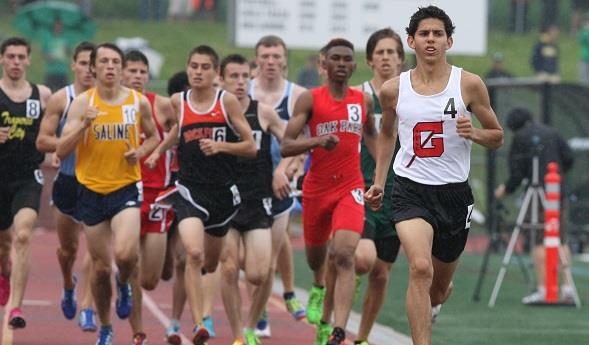
The Lower Peninsula Division 1 Final was filled with notable finishes – including a pair that will be listed in the national record book next month. Saline won its second MHSAA title in the sport and first since 2006, finishing ahead of East Kentwood – champion five of the last six seasons. The Hornets were keyed by a 3,200 relay of Logan Wetzel, Josiah Humphrey, Austin Welch and Kevin Hall that finished in 7:38.97 to rank among the best all-time in U.S. high school history Grand Blanc senior Grant Fisher posted the second-fastest 1,600 time in U.S. high school history, going 4:00.28.; he graduated with five individual MHSAA Finals titles. Grand Rapids Kenowa Hills’ Donavan Brazier also re-set the all-Finals record in the 800, running 1:48.98.
PHOTO: Grant Fisher, far right, set an MHSAA all-Finals record in the 1,600 that also ranks as the second-fastest in U.S. high school history. (Click to see more from RunMichigan.com. Photos by John Brabbs.)
2018-19 Concussion Data Reinforces Trends
September 26, 2019
By Geoff Kimmerly
Second Half editor
Data on student-athlete concussions collected by the Michigan High School Athletic Association from member high schools during the 2018-19 school year further reinforced findings from the first three years of reporting, and will contribute significantly as a number of MHSAA-associated groups work during the coming year to reduce the incidence of those injuries.
The 2018-19 concussion report found student-athletes at MHSAA member high schools encountered a total of 3,686 head injuries during the past school year – 3.0 percent more than in 2017-18. But that slight increase barely affected two key ratios. The number of injuries per member school was 4.9, up just a tenth of a percent from 2017-18, and for the second straight year only 1.3 percent of participants in MHSAA sports experienced a head injury, still down from 1.4 in 2016-17 and 1.6 percent the first year of the study. Total participation in MHSAA sports for 2018-19 was 281,992 – with students counted once for each sport they played.
The MHSAA has continued to invite Michigan’s universities, health care systems and the National Federation of State High School Associations (NFHS) to take part in analyzing the data and resulting questions that have arisen during the past three years. The 2018-19 results will be examined by the MHSAA’s newly-formed Sports Medicine Advisory Committee and also undergo analysis by representatives of Michigan State University’s Institute for the Study of Youth Sports. Furthermore, the MHSAA is directing its sport committees to study the data as they consider adjustments that could be made to rules for practice and competition.
“The 2018-19 concussion survey further reinforced the findings and trends we have seen emerge; not only in specific sports, but across all of our activities – and this latest set of results also raises new questions,” MHSAA Executive Director Mark Uyl said. “We must continue to look at how changes to playing rules and improvements in equipment may be beneficial moving forward, and also how we can further educate administrators, coaches, athletes and parents to identify and provide treatment for these injuries as soon as possible. We also are excited for the opportunity to have more eyes on these results as we continue to explore more ways to make our games safer.”
As first mandated in 2015-16, member schools are required to report head injuries to the MHSAA identifying the sport that each student-athlete was participating in and whether the injury was sustained during practice or competition. Schools also are required to designate at which level – varsity, junior varsity or freshman – the injury occurred.
The full report of all head injuries experienced during 2018-19 by student-athletes at MHSAA member high schools – including percentages by sport (per 1,000 participants), gender and team level, as well as data tracking when athletes returned to play – is available on the Health & Safety page of the MHSAA Website.
Keeping with the first three years of this survey, the MHSAA continued to receive data from more than 99 percent of its member high schools after the fall, winter and spring seasons. Member junior high and middle schools also were allowed, although not mandated, to report their head injuries; and those findings are not part of the published report.
Boys in 2018-19 experienced 2,404 – or 65 percent – of concussion injuries, just a percent less than during 2017-18, and not surprisingly as boys have a much higher participation in contact sports. More than half of head injuries – 59 percent – were experienced by varsity athletes, a slight increase of three percent from the previous year. A total of 2,441 head injuries – or 66 percent – came in competition as opposed to practice. Just more than half took place during either the middle of practice or middle of competition as opposed to the start or end, and 51 percent of injuries were a result of person-to-person contact.
The MHSAA also asked schools to report the number of days between the head injury and the athlete’s return to activity – and the two largest groups returned to activity after either 6 to 10 days of rest (24 percent) or 11 to 15 days (23 percent). All of these findings were within 1-3 percent of those discovered from the 2017-18 data.
Contact sports again revealed the most head injuries. Ranking first was football, 11 and 8-player combined, with 44 head injuries per 1,000 participants – an increase of three per 1,000 from 2017-18 but the same ratio as 2016-17 and still down from 49 head injuries per 1,000 football participants shown by the first study in 2015-16. Ice hockey again revealed the second-most injuries per 1,000, with 35 (also up three from a year ago but still down from 36 injuries per 1,000 from 2016-17 and 38 per 1,000 in 2015-16), and girls soccer was third with 25 head injuries per 1,000 participants for the second year in a row. Wrestling followed with 22 head injuries per 1,000 participants.
Continuing a noticeable trend of the last few years, the next three sports to show the highest incidences of head injuries were girls sports – girls lacrosse, competitive cheer and basketball also revealed 20 per 1,000 participants, although basketball was down two injuries per 1,000 participants or nearly 10 percent from the previous year. Boys lacrosse (16), boys soccer (14), girls volleyball (11), softball (11) and gymnastics (10) also showed double-digit head injuries per 1,000 participants.
Females again reported significantly more concussions than males playing the same or similar sports – soccer, basketball and baseball/softball. Female soccer players reported nearly double the concussions per 1,000 participants as male soccer players (25 to 14), while female basketball players reported nearly triple the number of concussions per 1,000 participants (20 to 7). Softball players also reported nearly triple the concussions per 1,000 participants of baseball players (11 to 4).
Schools report possible concussions online via the MHSAA Website. Reports are then examined by members of the MHSAA staff, who follow up with school administrators as those student-athletes continue to receive care and eventually return to play. Student privacy is protected.
The reporting of concussions is part of a three-pronged advance by the MHSAA in concussion care begun during the 2015-16 school year. The MHSAA completed in spring 2017 the largest-ever state high school association sideline concussion testing pilot program, with a sample of schools from across the state over two years using one of two screening tests designed to detect concussions. The MHSAA also was the first state association to provide all participants at every member high school and junior high/middle school with insurance intended to pay accident medical expense benefits – covering deductibles and co-pays left unpaid by other policies – resulting from head injuries sustained during school practices or competitions and at no cost to either schools or families.
Previously, the MHSAA also was among the first state associations to adopt a return-to-play protocol that keeps an athlete out of activity until at least the next day after a suspected concussion, and allows that athlete to return to play only after he or she has been cleared unconditionally for activity by a doctor (M.D. or D.O.), physician’s assistant or nurse practitioner.
In addition, the MHSAA’s Coaches Advancement Program – which includes courses that must be completed by all varsity head coaches hired for the first time at a member school – provides substantial instruction on concussion care. Separately, rules meetings that are required viewing for high school varsity and subvarsity head and assistant coaches at the start of each season include detailed training on caring for athletes with possible head injuries.