

10 to Remember: Winter 2012-13
April 4, 2013
By Geoff Kimmerly
Second Half editor
This winter in Michigan will be remembered by some as lasting seemingly forever. But at least we had plenty to enjoy over the five weeks from the end of February through March.
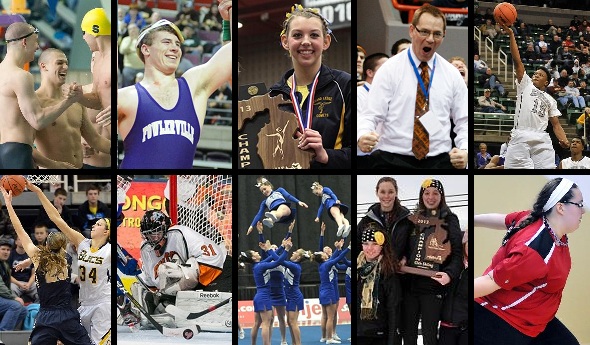
Below are 10 stories from this winter's Finals that we're likely to recall for years to come. They aren't necessarily the 10 most exciting moments, but rather 10 stories of particular significance covering every sport the MHSAA sponsors during this mostly-indoor season.
A few that just missed the list: Livonia Stevenson winning that hockey town's first hockey title, St. Ignace's first perfect girls basketball finish, Flint Beecher's last-second success in the Class C Boys Basketball Final, East Grand Rapids' four-point win in Division 3 swimming and diving and the emergence of Troy's Christina Shabet as the MHSAA's top gymnast.
There are plenty of others we could mention as well. Feel free to post about them after checking out our 10.
Saline Seniors Leave Mark
One of the most impressive swimming and diving classes in MHSAA history finished its high school career March 9 in Holland the same way it began four seasons ago. Saline won its fourth-straight Lower Peninsula Division 1 championship anchored by seniors David Boland, Josh Ehrman, Michael Bundas and Adam Whitener, who combined hold four Division 1 Finals individual and two relay records. Ehrman finished his prep career with the all-class/division records in the 200-yard individual medley and 100 breaststroke, and those four hold the all-class/division record in the 200 medley relay with a time of 1:30.01 – good also for third in the national record book. Click to read more.
Fowlerville’s Coon Finishes with 4
Only 16 others had accomplished what Fowlerville’s Adam Coon achieved to finish his MHSAA wrestling career. And none had done so wrestling at the heaviest weights. On March 2 at The Palace of Auburn Hills, Coon became the 17th athlete to win four MHSAA wrestling individual titles by picking up his second at 285 pounds after also winning two at 215. He finished his career with a record of 211-3 and won 194 straight matches dating to his freshman season. Click to read more.
Comets Shine for 6th Consecutive Gymnastics Win
Despite graduating the Division 1 all-around champion (again) and facing a talented Canton team (again), Grand Ledge won the team title again – for the sixth-straight time, the longest streak in MHSAA gymnastics history. On March 8 at Canton High School, the Comets scored 149.350 points – fifth-most in MHSAA Finals history. What are the chances for seven in a row? They’ll have a strong start: junior Presley Allison won the Division 2 all-around title the next day, and freshman Rachel Hogan won the Division 1 floor competition. Click to read more.
Hudson Completes Drive for 5
The Tigers won three of the final four matches to edge Hesperia 32-24 in the Division 4 Team Wrestling Final on Feb. 23 at Kellogg Arena and earn their fifth-straight MHSAA title – tying the 2002-06 Davison teams for the longest such streak since the Team Finals began in 1988. Hudson was loaded with 11 Individual Finals qualifiers, including three who went on to win their weights the following weekend. Click to read more.
This Time, It’s Romulus’ Turn
Romulus advanced to Boys Basketball Finals weekend at Breslin Center for the fourth time in six seasons, and on March 23 left with its first MHSAA championship since 1986. The Eagles had just fallen short a number of times during the recent run, but controlled from the tip in downing Detroit Southeastern 61-49 to claim the Class A title. Romulus finished this season 27-1. Click to read more.
Grand Haven Wins Repeat Class A Final
Only a few things about Grand Haven were the same this season as in 2011-12, including one significant advantage – 6-foot-5 center Abby Cole. After putting up 23 points, 19 rebounds and 12 blocks in a Semifinal win over Westland John Glenn, she tallied 11 points, seven rebounds and eight blocks in a 60-54 overtime win over Grosse Pointe South on March 16 at the Breslin Center to give the Buccaneers two straight Class A title wins – both over the Blue Devils. Click to read more.
Puck Stops Here as Brighton Marches On
The Bulldogs claimed their second-straight Division 1 hockey championship March 9 at Compuware Arena with what has become a characteristic defensive stand, this time in a 2-1 win over 10-time champ Detroit Catholic Central. Brighton goalie James Milletics stopped 37 of 38 shots against him, and his team finished a 12-game winning streak during which it gave up only 12 goals total. Click to read more.
No Stopping Carlson’s Cheer Dynasty
All four MHSAA cheer champions March 2-3 at the Grand Rapids DeltaPlex were repeat winners from 2012, but Carlson faced an intriguing set of circumstances. Although coach Danielle Jokela basically had served as a co-coach with Christine Wilson through four titles over the previous five seasons, this was her first time leading the team solo with Wilson now coaching Brighton. And the Marauders pulled out a third-straight title despite losing all-stater Annie Hajec to an injury during the Regional the weekend before. Click to read more.
Trojans Skiers Second No Longer
Traverse City Central’s girls skiing team had finished MHSAA runner-up five straight seasons before hoisting its first championship trophy since 2005 on Feb. 25 at Boyne Mountain. The Trojans finished with 81 points, 11 better than runner-up Walled Lake Central. Shannon Weaver was the individual runner-up in both the slalom and giant slalom to lead the effort. Click to read more.
Vandercook Lake Wins Battle of Bowling Powers
After facing each other and splitting the last two Division 4 titles, it seemed fate that Vandercook Lake and Sandusky should meet again in the 10th year of the MHSAA tournament on March 1 at Sunnybrook Golf and Bowl. The teams were separated by only six pins with three frames to roll before Vandercook Lake pulled away for a 1,322-1,166 win. The Jayhawks' Malloree Ambs won the individual title the next day. Click to read more.
Women & ACL Injuries: Know Risks, Steps for Prevention
August 10, 2021

Whether you’re a casual jogger or elite athlete, you’re at risk for an injury to your anterior cruciate ligament (ACL). If you’re a woman, you are at even greater risk for these injuries.
But there are steps you can take to prevent them.
“Among athletes, women are more than twice as likely to have an ACL injury than men,” says Nithin Natwa, M.D., a sports medicine specialist and primary care physician at Henry Ford Health System. “Once you have an ACL injury, you are at greater risk for having further soft tissue injuries in the future. That’s why it is important to prevent these injuries and follow your treatment plan if injured.”
What Is An ACL Injury?
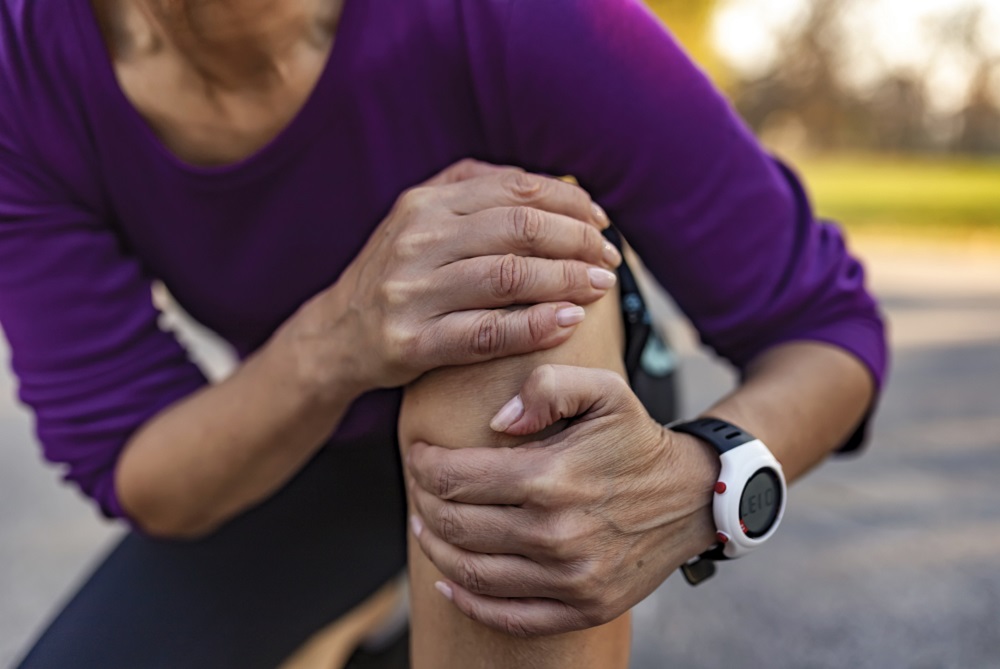
An ACL injury is a strain or tear in the ACL, one of the four major ligaments that support the knee so it can flex and bend. The ACL is a strong band of tissue that helps connect your thigh bone (femur) to your shin bone (tibia). “An ACL injury usually occurs without contact when you turn suddenly while running or land off-balance on one leg. These actions overload the knee joint and cause the ACL to be torn,” says Dr. Natwa.
In the United States, 100,000 people have ACL injuries each year. Anyone can experience an ACL injury, though athletes participating in sports like football, basketball, soccer and gymnastics are at highest risk. And summer is a peak time for outdoor sports injuries.
Seek immediate care if you have any of these signs of an ACL injury:
• An audible “pop” in the knee
• Intense knee pain and rapid-onset swelling (within hours)
• Loss of range of motion
• An unstable feeling or locking of your knee
The most common treatment for ACL injuries is surgery followed by physical therapy. After treatment, you can expect to return to normal activities in 6 to 9 months. However, peak athletic performance can take up to two years.
Why Are Women At Higher Risk For ACL Injuries?
According to Dr. Natwa, the differences in athletic training techniques for males versus females have left women at greater risk for ACL injuries. “There has been more emphasis on overall conditioning and mechanics for boys participating in sports compared to girls,” he says.
As a result, women are at greater risk for ACL tears and sprains due to:
• Differences in neuromuscular control: Without conditioning from an early age, women may not have the same ability to land and perform athletic motions that men do. For example, women are at higher risk for an ACL injury after landing from a jump.
• Strength imbalance for muscles that support the knee: Female athletes tend to have more defined quadriceps muscles but weaker hamstrings than men, putting them at greater risk for injury.
According to Dr. Natwa, there are many theories about women’s risk for ACL injury that lack scientific evidence, including:
• Width of the pelvis: Some people have suggested that the wider width of a woman’s pelvis puts more pressure on the knee joint and increases the risk for injury. However, this difference has not been shown to impact a women’s risk for ACL tears or sprains.
• Knee anatomy: The ACL runs through a section of the femur called the intercondylar notch. Women tend to have a narrower notch than men. Regardless of gender, individuals who possess smaller notch dimensions appear to be at greater risk for injury than individuals with larger notches.
• Hormones: Men and women have different hormone levels. But there is currently no concrete evidence that female hormones place women at higher risk for ACL injures.
Steps To Prevent ACL Injuries – Conditioning Early, Often
“The best way to prevent ACL injuries is to begin and maintain regular conditioning exercises at an early age,” Dr. Natwa says. “The more frequently you engage in proper exercises, the lower your risk for injury.”
Consult with a sports medicine specialist, physical therapist or athletic trainer to develop a training routine to prevent ACL and other injuries. Your training program should include exercises that:
• Strengthen the muscles that support your knee: Add strength training to build up your calves, hamstrings and quadriceps muscles. These muscles help stabilize your knee as you move. By strengthening these muscle groups evenly, you can lower your risk for injury.
• Improve overall neuromuscular control: Focus on adding neuromuscular exercises that train your nerves and muscles to react and communicate. For example, you may work on your balance by standing on one leg or sit upright on an exercise ball for short periods of time. And core exercises can strengthen the muscles that support your abdomen and back and help improve your posture as you move. These moves can strengthen your joints and help you learn appropriate balance and technique.
“Exercise really is the best medicine. It can improve your balance and agility as you participate in a sport or prevent injury as you move through your daily activities,” says Dr. Natwa. “Consider adding these exercises to your wellness program.”
Dr. Nithin Natwa is a sports medicine doctor who sees patients at Henry Ford Macomb Health Center in Chesterfield and Henry Ford Macomb Orthopedics and Wound Care in Clinton Township.
Want to learn more? Henry Ford Health System sports medicine experts are treating the whole athlete, in a whole new way. From nutrition to neurology, and from injury prevention to treatment of sports-related conditions, they can give your athlete a unique game plan. To find a sports medicine physician at Henry Ford, visit henryford.com or call 1-800-436-7936.