

10 to Remember: Winter 2012-13
April 4, 2013
By Geoff Kimmerly
Second Half editor
This winter in Michigan will be remembered by some as lasting seemingly forever. But at least we had plenty to enjoy over the five weeks from the end of February through March.
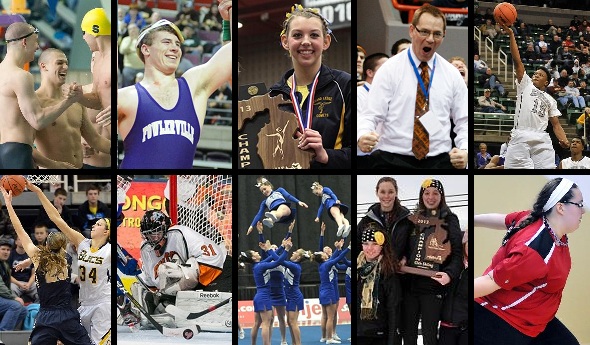
Below are 10 stories from this winter's Finals that we're likely to recall for years to come. They aren't necessarily the 10 most exciting moments, but rather 10 stories of particular significance covering every sport the MHSAA sponsors during this mostly-indoor season.
A few that just missed the list: Livonia Stevenson winning that hockey town's first hockey title, St. Ignace's first perfect girls basketball finish, Flint Beecher's last-second success in the Class C Boys Basketball Final, East Grand Rapids' four-point win in Division 3 swimming and diving and the emergence of Troy's Christina Shabet as the MHSAA's top gymnast.
There are plenty of others we could mention as well. Feel free to post about them after checking out our 10.
Saline Seniors Leave Mark
One of the most impressive swimming and diving classes in MHSAA history finished its high school career March 9 in Holland the same way it began four seasons ago. Saline won its fourth-straight Lower Peninsula Division 1 championship anchored by seniors David Boland, Josh Ehrman, Michael Bundas and Adam Whitener, who combined hold four Division 1 Finals individual and two relay records. Ehrman finished his prep career with the all-class/division records in the 200-yard individual medley and 100 breaststroke, and those four hold the all-class/division record in the 200 medley relay with a time of 1:30.01 – good also for third in the national record book. Click to read more.
Fowlerville’s Coon Finishes with 4
Only 16 others had accomplished what Fowlerville’s Adam Coon achieved to finish his MHSAA wrestling career. And none had done so wrestling at the heaviest weights. On March 2 at The Palace of Auburn Hills, Coon became the 17th athlete to win four MHSAA wrestling individual titles by picking up his second at 285 pounds after also winning two at 215. He finished his career with a record of 211-3 and won 194 straight matches dating to his freshman season. Click to read more.
Comets Shine for 6th Consecutive Gymnastics Win
Despite graduating the Division 1 all-around champion (again) and facing a talented Canton team (again), Grand Ledge won the team title again – for the sixth-straight time, the longest streak in MHSAA gymnastics history. On March 8 at Canton High School, the Comets scored 149.350 points – fifth-most in MHSAA Finals history. What are the chances for seven in a row? They’ll have a strong start: junior Presley Allison won the Division 2 all-around title the next day, and freshman Rachel Hogan won the Division 1 floor competition. Click to read more.
Hudson Completes Drive for 5
The Tigers won three of the final four matches to edge Hesperia 32-24 in the Division 4 Team Wrestling Final on Feb. 23 at Kellogg Arena and earn their fifth-straight MHSAA title – tying the 2002-06 Davison teams for the longest such streak since the Team Finals began in 1988. Hudson was loaded with 11 Individual Finals qualifiers, including three who went on to win their weights the following weekend. Click to read more.
This Time, It’s Romulus’ Turn
Romulus advanced to Boys Basketball Finals weekend at Breslin Center for the fourth time in six seasons, and on March 23 left with its first MHSAA championship since 1986. The Eagles had just fallen short a number of times during the recent run, but controlled from the tip in downing Detroit Southeastern 61-49 to claim the Class A title. Romulus finished this season 27-1. Click to read more.
Grand Haven Wins Repeat Class A Final
Only a few things about Grand Haven were the same this season as in 2011-12, including one significant advantage – 6-foot-5 center Abby Cole. After putting up 23 points, 19 rebounds and 12 blocks in a Semifinal win over Westland John Glenn, she tallied 11 points, seven rebounds and eight blocks in a 60-54 overtime win over Grosse Pointe South on March 16 at the Breslin Center to give the Buccaneers two straight Class A title wins – both over the Blue Devils. Click to read more.
Puck Stops Here as Brighton Marches On
The Bulldogs claimed their second-straight Division 1 hockey championship March 9 at Compuware Arena with what has become a characteristic defensive stand, this time in a 2-1 win over 10-time champ Detroit Catholic Central. Brighton goalie James Milletics stopped 37 of 38 shots against him, and his team finished a 12-game winning streak during which it gave up only 12 goals total. Click to read more.
No Stopping Carlson’s Cheer Dynasty
All four MHSAA cheer champions March 2-3 at the Grand Rapids DeltaPlex were repeat winners from 2012, but Carlson faced an intriguing set of circumstances. Although coach Danielle Jokela basically had served as a co-coach with Christine Wilson through four titles over the previous five seasons, this was her first time leading the team solo with Wilson now coaching Brighton. And the Marauders pulled out a third-straight title despite losing all-stater Annie Hajec to an injury during the Regional the weekend before. Click to read more.
Trojans Skiers Second No Longer
Traverse City Central’s girls skiing team had finished MHSAA runner-up five straight seasons before hoisting its first championship trophy since 2005 on Feb. 25 at Boyne Mountain. The Trojans finished with 81 points, 11 better than runner-up Walled Lake Central. Shannon Weaver was the individual runner-up in both the slalom and giant slalom to lead the effort. Click to read more.
Vandercook Lake Wins Battle of Bowling Powers
After facing each other and splitting the last two Division 4 titles, it seemed fate that Vandercook Lake and Sandusky should meet again in the 10th year of the MHSAA tournament on March 1 at Sunnybrook Golf and Bowl. The teams were separated by only six pins with three frames to roll before Vandercook Lake pulled away for a 1,322-1,166 win. The Jayhawks' Malloree Ambs won the individual title the next day. Click to read more.
2018-19 Concussion Data Reinforces Trends
September 26, 2019
By Geoff Kimmerly
Second Half editor
Data on student-athlete concussions collected by the Michigan High School Athletic Association from member high schools during the 2018-19 school year further reinforced findings from the first three years of reporting, and will contribute significantly as a number of MHSAA-associated groups work during the coming year to reduce the incidence of those injuries.
The 2018-19 concussion report found student-athletes at MHSAA member high schools encountered a total of 3,686 head injuries during the past school year – 3.0 percent more than in 2017-18. But that slight increase barely affected two key ratios. The number of injuries per member school was 4.9, up just a tenth of a percent from 2017-18, and for the second straight year only 1.3 percent of participants in MHSAA sports experienced a head injury, still down from 1.4 in 2016-17 and 1.6 percent the first year of the study. Total participation in MHSAA sports for 2018-19 was 281,992 – with students counted once for each sport they played.
The MHSAA has continued to invite Michigan’s universities, health care systems and the National Federation of State High School Associations (NFHS) to take part in analyzing the data and resulting questions that have arisen during the past three years. The 2018-19 results will be examined by the MHSAA’s newly-formed Sports Medicine Advisory Committee and also undergo analysis by representatives of Michigan State University’s Institute for the Study of Youth Sports. Furthermore, the MHSAA is directing its sport committees to study the data as they consider adjustments that could be made to rules for practice and competition.
“The 2018-19 concussion survey further reinforced the findings and trends we have seen emerge; not only in specific sports, but across all of our activities – and this latest set of results also raises new questions,” MHSAA Executive Director Mark Uyl said. “We must continue to look at how changes to playing rules and improvements in equipment may be beneficial moving forward, and also how we can further educate administrators, coaches, athletes and parents to identify and provide treatment for these injuries as soon as possible. We also are excited for the opportunity to have more eyes on these results as we continue to explore more ways to make our games safer.”
As first mandated in 2015-16, member schools are required to report head injuries to the MHSAA identifying the sport that each student-athlete was participating in and whether the injury was sustained during practice or competition. Schools also are required to designate at which level – varsity, junior varsity or freshman – the injury occurred.
The full report of all head injuries experienced during 2018-19 by student-athletes at MHSAA member high schools – including percentages by sport (per 1,000 participants), gender and team level, as well as data tracking when athletes returned to play – is available on the Health & Safety page of the MHSAA Website.
Keeping with the first three years of this survey, the MHSAA continued to receive data from more than 99 percent of its member high schools after the fall, winter and spring seasons. Member junior high and middle schools also were allowed, although not mandated, to report their head injuries; and those findings are not part of the published report.
Boys in 2018-19 experienced 2,404 – or 65 percent – of concussion injuries, just a percent less than during 2017-18, and not surprisingly as boys have a much higher participation in contact sports. More than half of head injuries – 59 percent – were experienced by varsity athletes, a slight increase of three percent from the previous year. A total of 2,441 head injuries – or 66 percent – came in competition as opposed to practice. Just more than half took place during either the middle of practice or middle of competition as opposed to the start or end, and 51 percent of injuries were a result of person-to-person contact.
The MHSAA also asked schools to report the number of days between the head injury and the athlete’s return to activity – and the two largest groups returned to activity after either 6 to 10 days of rest (24 percent) or 11 to 15 days (23 percent). All of these findings were within 1-3 percent of those discovered from the 2017-18 data.
Contact sports again revealed the most head injuries. Ranking first was football, 11 and 8-player combined, with 44 head injuries per 1,000 participants – an increase of three per 1,000 from 2017-18 but the same ratio as 2016-17 and still down from 49 head injuries per 1,000 football participants shown by the first study in 2015-16. Ice hockey again revealed the second-most injuries per 1,000, with 35 (also up three from a year ago but still down from 36 injuries per 1,000 from 2016-17 and 38 per 1,000 in 2015-16), and girls soccer was third with 25 head injuries per 1,000 participants for the second year in a row. Wrestling followed with 22 head injuries per 1,000 participants.
Continuing a noticeable trend of the last few years, the next three sports to show the highest incidences of head injuries were girls sports – girls lacrosse, competitive cheer and basketball also revealed 20 per 1,000 participants, although basketball was down two injuries per 1,000 participants or nearly 10 percent from the previous year. Boys lacrosse (16), boys soccer (14), girls volleyball (11), softball (11) and gymnastics (10) also showed double-digit head injuries per 1,000 participants.
Females again reported significantly more concussions than males playing the same or similar sports – soccer, basketball and baseball/softball. Female soccer players reported nearly double the concussions per 1,000 participants as male soccer players (25 to 14), while female basketball players reported nearly triple the number of concussions per 1,000 participants (20 to 7). Softball players also reported nearly triple the concussions per 1,000 participants of baseball players (11 to 4).
Schools report possible concussions online via the MHSAA Website. Reports are then examined by members of the MHSAA staff, who follow up with school administrators as those student-athletes continue to receive care and eventually return to play. Student privacy is protected.
The reporting of concussions is part of a three-pronged advance by the MHSAA in concussion care begun during the 2015-16 school year. The MHSAA completed in spring 2017 the largest-ever state high school association sideline concussion testing pilot program, with a sample of schools from across the state over two years using one of two screening tests designed to detect concussions. The MHSAA also was the first state association to provide all participants at every member high school and junior high/middle school with insurance intended to pay accident medical expense benefits – covering deductibles and co-pays left unpaid by other policies – resulting from head injuries sustained during school practices or competitions and at no cost to either schools or families.
Previously, the MHSAA also was among the first state associations to adopt a return-to-play protocol that keeps an athlete out of activity until at least the next day after a suspected concussion, and allows that athlete to return to play only after he or she has been cleared unconditionally for activity by a doctor (M.D. or D.O.), physician’s assistant or nurse practitioner.
In addition, the MHSAA’s Coaches Advancement Program – which includes courses that must be completed by all varsity head coaches hired for the first time at a member school – provides substantial instruction on concussion care. Separately, rules meetings that are required viewing for high school varsity and subvarsity head and assistant coaches at the start of each season include detailed training on caring for athletes with possible head injuries.