


10 to Remember: Winter 2012-13
April 4, 2013
By Geoff Kimmerly
Second Half editor
This winter in Michigan will be remembered by some as lasting seemingly forever. But at least we had plenty to enjoy over the five weeks from the end of February through March.
Below are 10 stories from this winter's Finals that we're likely to recall for years to come. They aren't necessarily the 10 most exciting moments, but rather 10 stories of particular significance covering every sport the MHSAA sponsors during this mostly-indoor season.
A few that just missed the list: Livonia Stevenson winning that hockey town's first hockey title, St. Ignace's first perfect girls basketball finish, Flint Beecher's last-second success in the Class C Boys Basketball Final, East Grand Rapids' four-point win in Division 3 swimming and diving and the emergence of Troy's Christina Shabet as the MHSAA's top gymnast.
There are plenty of others we could mention as well. Feel free to post about them after checking out our 10.
Saline Seniors Leave Mark
One of the most impressive swimming and diving classes in MHSAA history finished its high school career March 9 in Holland the same way it began four seasons ago. Saline won its fourth-straight Lower Peninsula Division 1 championship anchored by seniors David Boland, Josh Ehrman, Michael Bundas and Adam Whitener, who combined hold four Division 1 Finals individual and two relay records. Ehrman finished his prep career with the all-class/division records in the 200-yard individual medley and 100 breaststroke, and those four hold the all-class/division record in the 200 medley relay with a time of 1:30.01 – good also for third in the national record book. Click to read more.
Fowlerville’s Coon Finishes with 4
Only 16 others had accomplished what Fowlerville’s Adam Coon achieved to finish his MHSAA wrestling career. And none had done so wrestling at the heaviest weights. On March 2 at The Palace of Auburn Hills, Coon became the 17th athlete to win four MHSAA wrestling individual titles by picking up his second at 285 pounds after also winning two at 215. He finished his career with a record of 211-3 and won 194 straight matches dating to his freshman season. Click to read more.
Comets Shine for 6th Consecutive Gymnastics Win
Despite graduating the Division 1 all-around champion (again) and facing a talented Canton team (again), Grand Ledge won the team title again – for the sixth-straight time, the longest streak in MHSAA gymnastics history. On March 8 at Canton High School, the Comets scored 149.350 points – fifth-most in MHSAA Finals history. What are the chances for seven in a row? They’ll have a strong start: junior Presley Allison won the Division 2 all-around title the next day, and freshman Rachel Hogan won the Division 1 floor competition. Click to read more.
Hudson Completes Drive for 5
The Tigers won three of the final four matches to edge Hesperia 32-24 in the Division 4 Team Wrestling Final on Feb. 23 at Kellogg Arena and earn their fifth-straight MHSAA title – tying the 2002-06 Davison teams for the longest such streak since the Team Finals began in 1988. Hudson was loaded with 11 Individual Finals qualifiers, including three who went on to win their weights the following weekend. Click to read more.
This Time, It’s Romulus’ Turn
Romulus advanced to Boys Basketball Finals weekend at Breslin Center for the fourth time in six seasons, and on March 23 left with its first MHSAA championship since 1986. The Eagles had just fallen short a number of times during the recent run, but controlled from the tip in downing Detroit Southeastern 61-49 to claim the Class A title. Romulus finished this season 27-1. Click to read more.
Grand Haven Wins Repeat Class A Final
Only a few things about Grand Haven were the same this season as in 2011-12, including one significant advantage – 6-foot-5 center Abby Cole. After putting up 23 points, 19 rebounds and 12 blocks in a Semifinal win over Westland John Glenn, she tallied 11 points, seven rebounds and eight blocks in a 60-54 overtime win over Grosse Pointe South on March 16 at the Breslin Center to give the Buccaneers two straight Class A title wins – both over the Blue Devils. Click to read more.
Puck Stops Here as Brighton Marches On
The Bulldogs claimed their second-straight Division 1 hockey championship March 9 at Compuware Arena with what has become a characteristic defensive stand, this time in a 2-1 win over 10-time champ Detroit Catholic Central. Brighton goalie James Milletics stopped 37 of 38 shots against him, and his team finished a 12-game winning streak during which it gave up only 12 goals total. Click to read more.
No Stopping Carlson’s Cheer Dynasty
All four MHSAA cheer champions March 2-3 at the Grand Rapids DeltaPlex were repeat winners from 2012, but Carlson faced an intriguing set of circumstances. Although coach Danielle Jokela basically had served as a co-coach with Christine Wilson through four titles over the previous five seasons, this was her first time leading the team solo with Wilson now coaching Brighton. And the Marauders pulled out a third-straight title despite losing all-stater Annie Hajec to an injury during the Regional the weekend before. Click to read more.
Trojans Skiers Second No Longer
Traverse City Central’s girls skiing team had finished MHSAA runner-up five straight seasons before hoisting its first championship trophy since 2005 on Feb. 25 at Boyne Mountain. The Trojans finished with 81 points, 11 better than runner-up Walled Lake Central. Shannon Weaver was the individual runner-up in both the slalom and giant slalom to lead the effort. Click to read more.
Vandercook Lake Wins Battle of Bowling Powers
After facing each other and splitting the last two Division 4 titles, it seemed fate that Vandercook Lake and Sandusky should meet again in the 10th year of the MHSAA tournament on March 1 at Sunnybrook Golf and Bowl. The teams were separated by only six pins with three frames to roll before Vandercook Lake pulled away for a 1,322-1,166 win. The Jayhawks' Malloree Ambs won the individual title the next day. Click to read more.
Great Lakes Skate: Playoff Change Scores
July 7, 2019
The MHSAA has lengthened the ice hockey postseason from two weeks to three, allowing more rest for players, flexibility for officials, and the potential for larger crowds throughout, scoring a hat trick for all.
By Rob Kaminski
MHSAA benchmarks editor
Longtime coordinator of off-ice officials for the MHSAA Ice Hockey Finals Jim Gagleard often noticed it during his annual three days traversing the hallways and locker rooms beneath the stands at USA Hockey Arena in Plymouth.
“You could see it in the players throughout the weekend down underneath the arena there. The players at times seem worn out, tired,” said Gagleard, who spends the winter months assigning officials and working games for the Livonia Ice Hockey Officials Association, and has overseen officials and teams earning coveted trips to Plymouth for the Semifinals and Finals since 2004.
Cody Inglis had pondered the two-week speed-skate to the championships in the sport since he arrived at the MHSAA and took charge of the administration of the tournament as assistant director five years ago. Occasionally, the topic would surface at meetings of the MHSAA Ice Hockey Committee.
“It seemed at times to be a battle of attrition rather than the best team sometimes winning the tournament,” Inglis said. “We mentioned to the (Michigan High School) Hockey Coaches Association the possibility of shortening the regular season by a week to lengthen the postseason by a week. We heard some sympathetic voices, and really put it on the coaches to discuss it. The coaches association deserves a great deal of credit.”
Led by MHSHCA Executive Director Don Wright, the coaches association presented a proposal to the MHSAA Ice Hockey Committee which passed at the end of January, thus slating it for MHSAA Representative Council action this spring.
The problem was, ice hockey depends upon nearly 100 percent of facilities which are not school-operated. Thus, scheduling can be problematic if not coordinated well in advance.
“In conversations with coaches at USA Hockey Arena during the Finals this winter, many of the coaches said they do a majority of scheduling for the coming season immediately after this one, so awaiting a May Representative Council decision would be too late,” Inglis said.
Through discussion with MHSAA Executive Director Mark Uyl and Associate Director Tom Rashid, along with Ice Hockey Committee members Pete Ryan, John Thompson and Sean Jacques – who all serve on the MHSAA Representative Council – it was decided that the proposal would move up to the March Council agenda.
“From a scheduling standpoint for ADs and working with arenas, we needed to give them a firm date as to the start of Regionals and end of the regular season. We realized we had to get this done sooner than later. They can lock in times now, and we won’t be scrambling later,” said Ryan, who recently completed his tenure as athletic director for Saginaw Township Community Schools, which has sent Heritage High School to the MHSAA Semifinals the last two winters.
“This has been a discussion item for at least three years, and really picked up momentum this year with the coaches association. The inclement weather this winter might have been a blessing; schools still got their games in, and realized we could still have the tournament as scheduled.”
The proposal was approved, changing the number of weeks for the MHSAA Tournament in ice hockey from two to three, spreading the maximum of six games that may be played from the start of Regionals through Finals over 20 days instead of the previous 13.
“From the coaches perspective, especially for teams getting to the final four, there’s no doubt the tournament is a grind. To get to the Finals, it might mean playing six games in 12 days, whereas schools might only play twice a week during the regular season,” said Wright, who coached Chelsea High School for nearly 20 years. “Most everyone takes Sunday off, so there really is very limited time to even practice. Add to that the fact that it’s the playoffs and you’re getting everyone’s best game, everyone’s top effort.
“From a student-athlete and school sport standpoint, moving to three weeks gives kids more school time and more practice time. It was a no-brainer. Everybody saw it the same. Getting done in March vs May was spectacular.”
The dates for the start of the regular season and Finals (second Saturday in March) will remain the same, as will the total number of regular-season games allowed. However, the MHSAA Tournament will begin on the third Monday before the Finals instead of two weeks before.
For the 2019-20 season, that means the tournament will begin as early as Monday, Feb. 24, with all Regionals concluding by Wednesday, March 4. All Quarterfinals then take place Saturday, March 7, moving from the traditional Tuesday-Wednesday format. Semifinals will follow nearly a full week later under the current Thursday-Friday format, with the three Finals on Saturday, March 14.
One of the huge benefits for schools will be the period of time between the Quarterfinals and Semifinals, particularly for schools traveling from the Upper Peninsula or far northern Lower Peninsula.
“I feel this will be a benefit for UP schools in particular. As it was, a team like ourselves had to leave home on a Tuesday and if we kept winning, we were sleeping in hotel rooms for four straight nights,” said Corey Markham, who coached Houghton to a runner-up finish in 2019. “This does take a toll on a team. With the new format, a UP team would only have to spend two nights in a hotel if it made it all the way to the championship game.”
Jacques, one of Markham’s neighbors in Copper Country, has traveled the same path many times as Calumet’s athletic director, in addition to officiating the sport.
 “The coaches really wanted this, for sure,” Jacques said. “They have to be extremely happy that we don’t cram six big games into two weeks anymore. And, if those Quarterfinals are played closer geographically, like Marquette, then there could be even less travel so kids can get back to classes, sleep at home and eat meals at home.”
It is 300-plus miles from Calumet to Sault Ste. Marie, and only 112 to Marquette. The vast area and sparse population in the UP have always presented certain logistical issues for its schools at tournament time, but the new timeframe will bring welcome relief for teams.
“From a coaches standpoint, preparation time has to be a lot better for everyone,” Jacques said. “Going from Copper Country to, say, the Sault, you win and you’re not going back home. So, you’ve got a couple days before the next game, but you’re traveling, maybe getting in a practice around Novi, so coaches have little time to look at the next opponent. A lot of the time, you’re going in blind, so to speak.”
Moving the Quarterfinals to Saturday also should attract larger crowds and provide a better spotlight for the sport, while moving it away from nights traditionally saturated with District and Regional basketball games whether during the boys or girls tournaments.
“Attendance-wise, the Saturday Quarterfinals are going to be great,” said Wright. “If you didn’t know until late Wednesday if your school was going to play Friday, it was difficult for people to arrange fan buses and other travel considerations. Saturdays will make the Quarterfinal crowds bigger, and then whoever wins, people can plan.”
That extra time is a huge shot in the arm for administrators who wear many hats.
“From my standpoint, arranging fan buses was a challenge on such short notice when the Quarterfinals were Wednesday and the Semis were Friday. You had to find a bus, get prices, send out information ... we love it, but it’s a very time-sensitive operation, and the new format will help in that regard,” Jacques said.
Markham agrees. Proof was provided in March, as Houghton’s crowds at USA Hockey Arena were impressive given the short turnaround. With future Quarterfinals instead played on Saturdays and closer to homes throughout the state, the MHSAA should expect larger turnouts.
“The Saturday Quarterfinals will be great for all the teams and fans involved,” Markham said. “There will be time to travel, and obviously most people have greater free time on a Saturday versus a weekday. Also people will have more time to plan for the game with the extended timeframe.”
The weekend dates are easier for rinks to schedule as well, which should allow for an attractive list of suitors as potential hosts.
“It is easier to run a weekend event compared to a weekday event,” said Wright, whose primary job now is facilitating Arctic Coliseum in Chelsea. “There is more availability during the weekend than on a weeknight in terms of sheer hours.”
Inglis cautions that in some circumstances the mileage total might increase – for instance UP schools which advance and must go back and forth across the bridge – but the positives outweigh the negatives.
“No matter what format we implement, there’s going to be travel,” Inglis said. “More importantly, this format allows the players to go back and be students. And, of course, health and safety are big components. The student-athletes will have more time to recover physically as well as mentally.”
While the most notable rest period now will take place from the final horn of the Quarterfinal until the puck drops for the Semifinals, the greater number of days to play the same number of Regional games is equally as important.
To earn a Regional title up until now, schools had to win as many as three games in six days. The Regionals will now stretch out over a 10-day span.
Such a luxury could actually serve to lessen travel, keeping schools closer to home early in the tournament. Where decades ago it was more problematic finding arenas, that is not the case today.
“There are more sheets of ice available today, and the other side of it is that even though there are more schools represented than ever before, there are fewer teams due to the number of co-op programs,” said Ryan. “So scheduling ice is not a problem.”
During the 2018-19 season, a fewer number of sites hosted more games around the state during Regional week, necessitating a significant number of doubleheaders.
Preliminary figures for 2019 indicate a drop in total ice hockey tournament attendance, from 45,975 the previous year to 41,611 this past March. (Editor’s Note: Two Regional sites had yet to report at the time of printing for this issue of benchmarks) However, attendance for the Quarterfinals (6,324 from 4,754) and the Semifinals-Finals at USA Hockey Arena (10,631 from 9,780) both showed increases this year over 2018.
 One trend that stayed the same was the fervor for high school hockey in the Upper Peninsula, where the Regional at Michigan Tech University typically ranks No. 1 in attendance. Hosted on a rotating basis by Houghton, Hancock and Calumet, the site drew 2,542 fans this past March. In 2018 that venue led the way with 4,100 fans, while the facility drew 1,888 in 2017 to pace all Regionals.
The biggest dip in 2019 came at the Regional level below the bridge, where crowds were down several thousand. Poor weather conditions likely played a factor, and moving from multiple sites to one Regional site also could have affected attendance. On nights where doubleheaders were played, early starts might have had an adverse effect, or perhaps it was the late faceoff for the second games.
“This year, it seemed like when I traveled around to different sites during the Regionals, the crowds were down a bit,” Gagleard said. “There were some schools having solid seasons that just didn’t get the student sections I thought they would. I’d rather see more hosts, or sites, and allow more fans to be engaged.”
Inglis indicated that change could be coming with the 2019-20 season.
“We will be staying with Regional sites – at least in terminology – but have the ability to use different rinks and hosts as needed to eliminate the doubleheaders,” said Inglis.
The more widespread format to come could possibly boost attendance, and unquestionably, will bolster an extremely critical element of the game – officiating.
“Even in Week 2 next year, the Regional Finals can be one of three days, so all officials aren’t working on the same days,” said Inglis. “This absolutely helps us, and it’s a good thing for assigners.
“This should allow some of our better qualified and most deserving officials to officiate some of the most important games as the tournament progresses.”
The bottom line of the playoff schedule expansion is that ice hockey will move in line with the majority of MHSAA tournaments. With the exception of team wrestling, which is unique due to the individual makeup of the event, all other MHSAA team sports have at least three weeks to accumulate the five or six wins necessary to claim a championship.
“At no time during regular season do we ask schools to play six games in two weeks, especially in a physically demanding sport like ice hockey – during the tournament, no less – when the stakes are greatest and the intensity is at its highest,” said Inglis.
The end result should provide a more polished product for a showcase that is quickly becoming one of the highlights of the MHSAA winter tournament season each March.
Lengthened Format a Shot on Goal for Ice Hockey
Success in athletics at all levels hinges on teamwork – people putting the goals of many above personal acclaim. This is especially true in interscholastic athletics, where one of our founding missions is to instill that belief in our young people to prepare them for arenas beyond the playing boundaries of our games.
It is just as critical for administrators and coaches to keep those values in mind when making decisions which affect the many students for whom we are responsible as it pertains to athletic competition. When it all comes together – coaches, administrators and governing bodies shooting for the same goal – that is another kind of teamwork that leads to a win-win situation which strengthens our programs.
The MHSAA hockey tournament had been a real challenge in terms of the potential of six games played in 13 days; teams don’t come close to that kind of pace during the regular season. By expanding the tournament by one week, without increasing the total length of the season at all, we believe we’ve found the right balance between games and rest during both the regular season and MHSAA tournament. We are excited that school communities will have more time to plan and get behind those teams that are making runs through the Regional tournament, and we will really be able to showcase high school hockey all across the state on “Quarterfinal Saturday” in getting many communities, teams and rinks involved.
The extended time from that round to the Semifinals and Finals should allow for greater team preparation and heightened fan anticipation leading up to the pinnacle of that sport for winters to come.
– Mark Uyl, MHSAA Executive Director
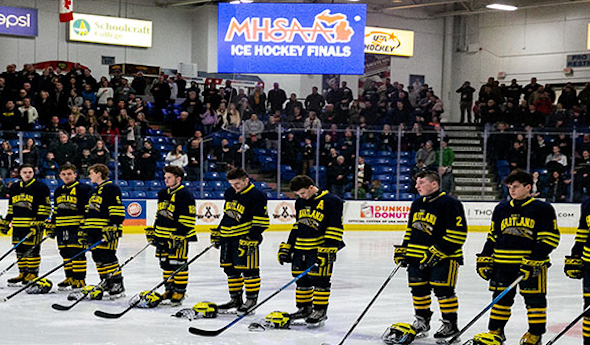
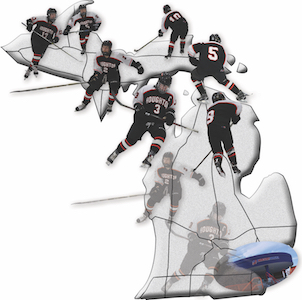
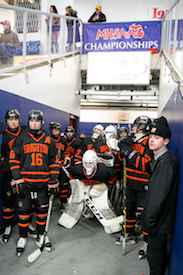
PHOTOS: (Top) Hartland lines up for the national anthem during MHSAA Finals weekend at USA Hockey Arena. (Middle) Houghton and others from the Upper Peninsula faced long continuous trips to the Finals during the previous tournament format. (Below) Brighton prepares to take the ice. (Photos by Andrew Knapik.)