

10 to Remember: Winter 2014-15
April 2, 2015
By Geoff Kimmerly
Second Half editor
As one might imagine, six straight weekends of MHSAA Finals produce enough highlights to distract us from our seemingly endless Michigan winters.
As explained to preface “10 to Remember” many times before, all championships are lifetime memories for those who achieved them. Those listed below are just one person’s thoughts on which moments from this season will continue to be discussed most in the seasons to come.
10. Brother Rice Rides Team Effort to Repeat
Birmingham Brother Rice repeated as Lower Peninsula Division 1 swimming and diving champion, and did so by winning by more than 100 points for the second consecutive season. But what made this Warriors finish so impressive was that it didn’t include a single individual championship – they won the opening and closing relays of the meet and took seven second-place individual finishes along the way.
9. Kearsley Sweeps Bowling Championships … Again
Flint Kearsley varsity bowlers are guaranteed one other title this season – MHSAA champions. Both the girls and boys teams won team titles in Division 2, just as they had in 2014. The Kearsley girls again defeated Bay City Western in the championship match, this time by a mere 30 pins, 1,242-1,212. The Kearsley boys also earned their title by defeating Bay City Western, and by only seven pins – 1,351-1,344.
8. Rockford/Sparta Owns the Weekend
Rockford hosted the MHSAA Gymnastics Finals, making the cliché “bringing home the title” a short trip – twice. The Rams, a co-op with Sparta, won the team competition by 1.750 points over reigning champion Canton; Rockford’s only other MHSAA gymnastics championship also was the first in any sport in school history, in the Lower Peninsula in 1989. Juniors Madi Myers and Morgan Korf led the effort with the third and fourth-highest all-around scores of the Team Final – and Korf came back the next day with a stunning move to take the Division 1 individual championship. She had finished 18th in Division 1 as a sophomore.
7. Breckenridge Returns to Cheer Elite
In its second season back as a competitive program, Breckenridge added to its stature as one of the most powerful competitive cheer programs in MHSAA history by claiming the Division 4 championship by nearly 24 points over runner-up Pewamo-Westphalia. Breckenridge has won eight MHSAA titles in cheer, but didn’t have a team for six seasons because of low participation until bringing back the program for 2013-14.
6. Cowboys Lasso First Basketball Title
First Detroit Western International won its first Detroit Public School League championship since 1922. Then it made its first MHSAA Semifinals since 1974. The Cowboys capped this season with its first MHSAA Final victory, a nail-biter 62-59 over Saginaw Arthur Hill in Class A. Western also defeated Detroit Catholic League A-B champion Detroit U-D Jesuit in the Semifinal, and finished the season 26-0.
No team traveled farther to the MHSAA Basketball Finals than the Calumet girls – and it can be argued that no team came from farther away in expectation to become an MHSAA champion. The unranked Copper Kings traveled more than 500 miles to arrive at the Breslin Center, then defeated top-ranked Laingsburg in a Class C Semifinal and perennial power Flint Hamady in the championship game to claim its first MHSAA title in the sport.
4. Skatzka, Olson Become Latest of the Greatest
Richmond’s Devin Skatzka and Davison’s Lincoln Olson pushed the list of MHSAA four-time individual champions to 21 by finishing their careers with big victories. Olson actually was the 20th, winning his match at 135 pounds by technical fall in Division 1. Skatzka then became No. 21 with four MHSAA titles, with a technical fall in the 160-pound match in Division 3.
3. Brighton Claims First Title in Final Match
Few Finals in any sport this winter carried the drama of Brighton’s 31-25 win over Hartland in Division 1 wrestling. Bulldogs 112-pounder Lee Grabowski entered the final match carrying his team’s three-point lead but facing the scenario that if he lost even by decision, and the team score went to 28-28, Brighton would lose the tie-breaker. Oh, and Grabowski was facing an opponent he’d lost to twice in league competition earlier in the winter. Grabowski won a 4-2 decision this time, and Brighton won its first team title.
2. Godwin Heights, Powers North Central Cap 3-Season Surges
Wyoming Godwin Heights and Powers North Central made the MHSAA record book by adding to a pair of the most successful three-season runs in boys basketball history – and capping them with championships. Godwin Heights won its first MHSAA title, downing Detroit Henry Ford 85-68 in the Class B Final, to finish the last three seasons a combined 74-5. North Central, meanwhile, downed Morenci 67-47 in Class D to win its first title since 1984 and cap a three-season 75-5 run.
1. Record Comeback Sends Saints Home as Champs
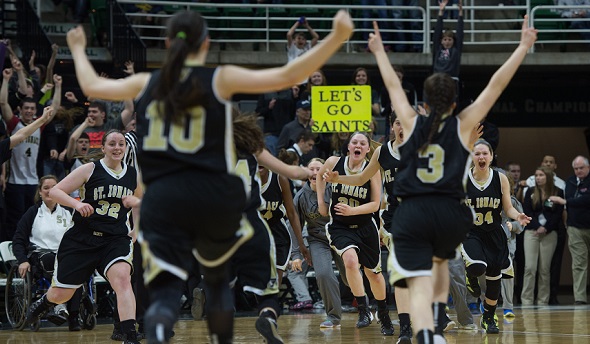
St. Ignace trailed undefeated Pittsford by 20 points two minutes into the Class D Final when it launched a comeback equaled by only one other team in MHSAA girls basketball history. The Saints tied the score with 35 seconds to play in regulation and continued the rally in the extra period to claim a 64-60 title-clinching victory. Detroit Cass Tech, in the 1987 Class A Final, also had come back from 20 down in the third quarter to win. The championship was St. Ignace’s fifth in girls basketball.
PHOTO: St. Ignace basketball players celebrate after the Saints tied the largest comeback in MHSAA Finals history on the way to claiming the Class D title. (Click to see more at HighSchoolSportsScene.com.)
How To Stay Hydrated: 7 Tips For An Active Summer
By
Nick Parkinson, M.Ed., AT, ATC, TSAC-F
Henry Ford Health
June 4, 2024
Not only is water an essential nutrient, it makes up your entire being. We’re 40 to 70 percent water, depending on fitness level and age. And while staying hydrated is always important, it may become more challenging as the weather heats up. Hard-working muscles generate more heat when they’re surrounded by hot air, making it harder for your body to maintain a normal temperature.
 Even a 1 to 2 percent loss of body weight from water can compromise your performance and impact your body’s ability to cool itself. The heart pumps harder, circulation slows and muscles fatigue more quickly. If the loss creeps up to 3 or 4 percent, you’ll be at increased risk of developing heat-related illness and injury, including cramps, heat exhaustion and heat stroke.
Even when you’re not active, your body loses more than a quart of water every day through urine, perspiration, sweat and breath, according to the National Institutes of Health. And most days, it’s more than 2.5 quarts.
The goal, of course, is to replace what’s lost. And with a little planning and preparation, you can during any outdoor activity, no matter what the thermometer says. Here’s how:
- Drink before you’re thirsty. Need to quench your thirst? Chances are you’re already dehydrated. Your best defense against dehydration is drinking water on a consistent basis so you never reach the point of thirst.
- Take frequent water breaks. While you might not want to disrupt your workout for a water break, taking time out for some much-needed liquid nourishment will pay off in the long run. Drink 8 to 10 ounces of water (about one full glass) before starting any activity. Once the games begin, drink another 7 to 10 ounces every 20 to 30 minutes.
- Track your intake. Many people don’t know how much water they should drink daily—or even how much water they’re typically downing. If you’re sipping on a 16-ounce bottle, drink eight of them each day—and even more if you’re exercising heavily.
- Consider an electrolyte drink. Working out for more than an hour? Consider sipping a sports drink—or nibbling on some pretzels or a banana to restore lost electrolytes (minerals in the blood that regulate bodily systems). Your body loses important electrolytes like sodium, potassium and chloride when you sweat. A good sports drink can help you replenish them. Coconut water is a great choice, but there are a slew of healthy, low-sugar options on the market.
- Munch on water-rich produce. Water-packed snacks, including melon, berries, bell peppers and grapes, are all good options. A bonus: All of these foods boast a decent hit of electrolytes, too!
- Step on the scale. Weigh yourself before and after a workout. If the scale shows a loss, replenish it with water (gulp 20 to 24 ounces of water for every pound lost). If you’ve lost 3 percent or more of your body weight, chances are you’re severely dehydrated.
- Watch your urine stream. It may seem gross, but checking your pee is probably the best way to determine whether you’re dehydrated. If it looks like watered down, colored lemonade, you’re probably in the clear. But if it’s a deep yellow or light orange, you’re probably not drinking enough fluids.
Keep in mind that heat exhaustion happens quickly—especially during summer activities. It can easily turn into heat stroke, a dangerous condition that can lead to organ damage, seizures, coma and even death. If you feel dehydrated, dizzy or overheated, get out of the sun, sip some water (slowly) and apply cooling compresses to your head, neck and chest. If your symptoms don’t improve quickly, get to a doctor or call 9-1-1.
Nick Parkinson, M.Ed., AT, ATC, TSAC-F, is the supervisor of athletic training and sports performance at Henry Ford Health. Learn more about Nick.
To find a sports medicine provider at Henry Ford Health, visit henryford.com/athletes or call 313-651-1969.