

10 to Remember: Winter 2014-15
April 2, 2015
By Geoff Kimmerly
Second Half editor
As one might imagine, six straight weekends of MHSAA Finals produce enough highlights to distract us from our seemingly endless Michigan winters.
As explained to preface “10 to Remember” many times before, all championships are lifetime memories for those who achieved them. Those listed below are just one person’s thoughts on which moments from this season will continue to be discussed most in the seasons to come.
10. Brother Rice Rides Team Effort to Repeat
Birmingham Brother Rice repeated as Lower Peninsula Division 1 swimming and diving champion, and did so by winning by more than 100 points for the second consecutive season. But what made this Warriors finish so impressive was that it didn’t include a single individual championship – they won the opening and closing relays of the meet and took seven second-place individual finishes along the way.
9. Kearsley Sweeps Bowling Championships … Again
Flint Kearsley varsity bowlers are guaranteed one other title this season – MHSAA champions. Both the girls and boys teams won team titles in Division 2, just as they had in 2014. The Kearsley girls again defeated Bay City Western in the championship match, this time by a mere 30 pins, 1,242-1,212. The Kearsley boys also earned their title by defeating Bay City Western, and by only seven pins – 1,351-1,344.
8. Rockford/Sparta Owns the Weekend
Rockford hosted the MHSAA Gymnastics Finals, making the cliché “bringing home the title” a short trip – twice. The Rams, a co-op with Sparta, won the team competition by 1.750 points over reigning champion Canton; Rockford’s only other MHSAA gymnastics championship also was the first in any sport in school history, in the Lower Peninsula in 1989. Juniors Madi Myers and Morgan Korf led the effort with the third and fourth-highest all-around scores of the Team Final – and Korf came back the next day with a stunning move to take the Division 1 individual championship. She had finished 18th in Division 1 as a sophomore.
7. Breckenridge Returns to Cheer Elite
In its second season back as a competitive program, Breckenridge added to its stature as one of the most powerful competitive cheer programs in MHSAA history by claiming the Division 4 championship by nearly 24 points over runner-up Pewamo-Westphalia. Breckenridge has won eight MHSAA titles in cheer, but didn’t have a team for six seasons because of low participation until bringing back the program for 2013-14.
6. Cowboys Lasso First Basketball Title
First Detroit Western International won its first Detroit Public School League championship since 1922. Then it made its first MHSAA Semifinals since 1974. The Cowboys capped this season with its first MHSAA Final victory, a nail-biter 62-59 over Saginaw Arthur Hill in Class A. Western also defeated Detroit Catholic League A-B champion Detroit U-D Jesuit in the Semifinal, and finished the season 26-0.
No team traveled farther to the MHSAA Basketball Finals than the Calumet girls – and it can be argued that no team came from farther away in expectation to become an MHSAA champion. The unranked Copper Kings traveled more than 500 miles to arrive at the Breslin Center, then defeated top-ranked Laingsburg in a Class C Semifinal and perennial power Flint Hamady in the championship game to claim its first MHSAA title in the sport.
4. Skatzka, Olson Become Latest of the Greatest
Richmond’s Devin Skatzka and Davison’s Lincoln Olson pushed the list of MHSAA four-time individual champions to 21 by finishing their careers with big victories. Olson actually was the 20th, winning his match at 135 pounds by technical fall in Division 1. Skatzka then became No. 21 with four MHSAA titles, with a technical fall in the 160-pound match in Division 3.
3. Brighton Claims First Title in Final Match
Few Finals in any sport this winter carried the drama of Brighton’s 31-25 win over Hartland in Division 1 wrestling. Bulldogs 112-pounder Lee Grabowski entered the final match carrying his team’s three-point lead but facing the scenario that if he lost even by decision, and the team score went to 28-28, Brighton would lose the tie-breaker. Oh, and Grabowski was facing an opponent he’d lost to twice in league competition earlier in the winter. Grabowski won a 4-2 decision this time, and Brighton won its first team title.
2. Godwin Heights, Powers North Central Cap 3-Season Surges
Wyoming Godwin Heights and Powers North Central made the MHSAA record book by adding to a pair of the most successful three-season runs in boys basketball history – and capping them with championships. Godwin Heights won its first MHSAA title, downing Detroit Henry Ford 85-68 in the Class B Final, to finish the last three seasons a combined 74-5. North Central, meanwhile, downed Morenci 67-47 in Class D to win its first title since 1984 and cap a three-season 75-5 run.
1. Record Comeback Sends Saints Home as Champs
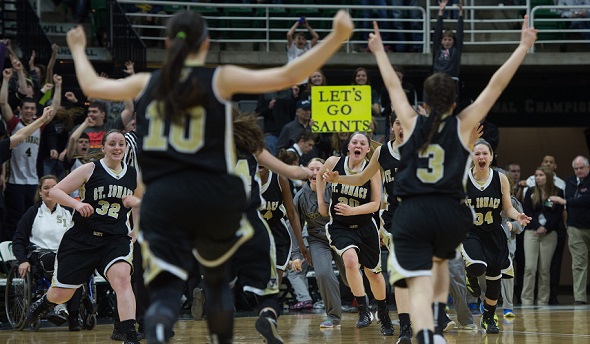
St. Ignace trailed undefeated Pittsford by 20 points two minutes into the Class D Final when it launched a comeback equaled by only one other team in MHSAA girls basketball history. The Saints tied the score with 35 seconds to play in regulation and continued the rally in the extra period to claim a 64-60 title-clinching victory. Detroit Cass Tech, in the 1987 Class A Final, also had come back from 20 down in the third quarter to win. The championship was St. Ignace’s fifth in girls basketball.
PHOTO: St. Ignace basketball players celebrate after the Saints tied the largest comeback in MHSAA Finals history on the way to claiming the Class D title. (Click to see more at HighSchoolSportsScene.com.)
5 Concussion Myths Debunked
November 8, 2022
Awareness about the dangers of concussions is at an all-time high. In response, athletic organizations — from Pop Warner football (a nonprofit program for kids 5 to 16) to USA Hockey — have safe-play protocols in place. But misconceptions about injury — prevention, management and return to play — are still all too common.
 "It's great that parents, coaches and athletes are focused on the potential for concussions, but they also need to be aware of the complexities involved in evaluating, diagnosing and managing concussion," says Jeffrey Kutcher, M.D., a sports neurologist who treats athletes at the Henry Ford Kutcher Clinic for Concussion and Sports Neurology.
The best way to get the knowledge you need? Learn how to separate fact from fiction.
Separating Concussion Fact From Fiction
Here’s the truth behind five common concussion myths:
Myth #1: Concussions are only caused by blows to the head.
Concussions happen in response to force. While they often result from a blow to the head, they can also occur after a hit to the neck, shoulders or anywhere else on the body. To cause brain injury, the force of the impact only needs to cause the head to move rapidly back and forth (think whiplash from a car crash or a spill down the stairs).
Myth #2: Concussions always involve a loss of consciousness.
A very small percentage of all concussions, 10 percent or less, result in a loss of consciousness. For the remaining injuries, parents, coaches and medical providers should watch for additional symptoms such as:
· Confusion
· Balance problems
· Slurred speech
· Physical complaints including headache, nausea and vomiting.
Myth #3: You should keep a person awake overnight after a concussion has occurred.
It's important to observe and interact with a recently concussed person for the first few hours to recognize the potential signs of a more serious injury. However, if they are interacting normally after four hours, it’s okay to let them sleep. If you have any doubts or questions, always err on the side of caution and seek medical attention.
Myth #4: After a concussion, kids should avoid digital media until they feel better.
Unless digital activities or screen time significantly worsen symptoms, there's no reason to avoid them. "You shouldn't force people who have suffered a concussion to rest too much — or deprive them of sensory input — if they are comfortable engaging in activity," Dr. Kutcher says. What’s more, taking away activities that bring a person joy or keep them socially connected could end up prolonging their recovery by creating additional symptoms.
Myth #5: All physical activity should be avoided after a concussion.
It’s important to rest for the first two to three days after a concussion. However, you need to be careful not to rest too much or avoid all activity for too long.
Engaging in physical, mental and social activities can be beneficial. But knowing how much to do and when to take it easy can be difficult. If you have any questions, consult a sports neurologist for specific recommendations.
Ground Rules for Concussion Prevention and Management
When it comes to preventing concussion, common sense offers the greatest impact, Dr. Kutcher notes. He recommends starting with these four tenets:
- Whenever possible, limit the amount of contact in practices and games.
- Wear proper fitting and certified helmets or other head protection whenever appropriate.
- Spread contact drills out over time as much as possible.
- Practice good technique and play by the rules.
Athletes — especially those who play contact sports — should undergo an annual neurological evaluation that includes a comprehensive, focused neurological history and examination. This information provides a critical point of reference for medical professionals.
Knowing the truth about concussions — including what to watch for and what to do if one occurs — is really the best game plan.
Dr. Jeffrey Kutcher is a sports neurologist at the Henry Ford Concussion and Sports Neurology Clinic and the global director of the Kutcher Clinic.
Want to learn more? Henry Ford Health System sports medicine experts are treating the whole athlete, in a whole new way. From nutrition to neurology, and from injury prevention to treatment of sports-related conditions, they can give your athlete a unique game plan.
Visit henryford.com/sports or call (313) 972-4216 for an appointment within 24 business hours.