

10 to Remember: Winter 2014-15
April 2, 2015
By Geoff Kimmerly
Second Half editor
As one might imagine, six straight weekends of MHSAA Finals produce enough highlights to distract us from our seemingly endless Michigan winters.
As explained to preface “10 to Remember” many times before, all championships are lifetime memories for those who achieved them. Those listed below are just one person’s thoughts on which moments from this season will continue to be discussed most in the seasons to come.
10. Brother Rice Rides Team Effort to Repeat
Birmingham Brother Rice repeated as Lower Peninsula Division 1 swimming and diving champion, and did so by winning by more than 100 points for the second consecutive season. But what made this Warriors finish so impressive was that it didn’t include a single individual championship – they won the opening and closing relays of the meet and took seven second-place individual finishes along the way.
9. Kearsley Sweeps Bowling Championships … Again
Flint Kearsley varsity bowlers are guaranteed one other title this season – MHSAA champions. Both the girls and boys teams won team titles in Division 2, just as they had in 2014. The Kearsley girls again defeated Bay City Western in the championship match, this time by a mere 30 pins, 1,242-1,212. The Kearsley boys also earned their title by defeating Bay City Western, and by only seven pins – 1,351-1,344.
8. Rockford/Sparta Owns the Weekend
Rockford hosted the MHSAA Gymnastics Finals, making the cliché “bringing home the title” a short trip – twice. The Rams, a co-op with Sparta, won the team competition by 1.750 points over reigning champion Canton; Rockford’s only other MHSAA gymnastics championship also was the first in any sport in school history, in the Lower Peninsula in 1989. Juniors Madi Myers and Morgan Korf led the effort with the third and fourth-highest all-around scores of the Team Final – and Korf came back the next day with a stunning move to take the Division 1 individual championship. She had finished 18th in Division 1 as a sophomore.
7. Breckenridge Returns to Cheer Elite
In its second season back as a competitive program, Breckenridge added to its stature as one of the most powerful competitive cheer programs in MHSAA history by claiming the Division 4 championship by nearly 24 points over runner-up Pewamo-Westphalia. Breckenridge has won eight MHSAA titles in cheer, but didn’t have a team for six seasons because of low participation until bringing back the program for 2013-14.
6. Cowboys Lasso First Basketball Title
First Detroit Western International won its first Detroit Public School League championship since 1922. Then it made its first MHSAA Semifinals since 1974. The Cowboys capped this season with its first MHSAA Final victory, a nail-biter 62-59 over Saginaw Arthur Hill in Class A. Western also defeated Detroit Catholic League A-B champion Detroit U-D Jesuit in the Semifinal, and finished the season 26-0.
No team traveled farther to the MHSAA Basketball Finals than the Calumet girls – and it can be argued that no team came from farther away in expectation to become an MHSAA champion. The unranked Copper Kings traveled more than 500 miles to arrive at the Breslin Center, then defeated top-ranked Laingsburg in a Class C Semifinal and perennial power Flint Hamady in the championship game to claim its first MHSAA title in the sport.
4. Skatzka, Olson Become Latest of the Greatest
Richmond’s Devin Skatzka and Davison’s Lincoln Olson pushed the list of MHSAA four-time individual champions to 21 by finishing their careers with big victories. Olson actually was the 20th, winning his match at 135 pounds by technical fall in Division 1. Skatzka then became No. 21 with four MHSAA titles, with a technical fall in the 160-pound match in Division 3.
3. Brighton Claims First Title in Final Match
Few Finals in any sport this winter carried the drama of Brighton’s 31-25 win over Hartland in Division 1 wrestling. Bulldogs 112-pounder Lee Grabowski entered the final match carrying his team’s three-point lead but facing the scenario that if he lost even by decision, and the team score went to 28-28, Brighton would lose the tie-breaker. Oh, and Grabowski was facing an opponent he’d lost to twice in league competition earlier in the winter. Grabowski won a 4-2 decision this time, and Brighton won its first team title.
2. Godwin Heights, Powers North Central Cap 3-Season Surges
Wyoming Godwin Heights and Powers North Central made the MHSAA record book by adding to a pair of the most successful three-season runs in boys basketball history – and capping them with championships. Godwin Heights won its first MHSAA title, downing Detroit Henry Ford 85-68 in the Class B Final, to finish the last three seasons a combined 74-5. North Central, meanwhile, downed Morenci 67-47 in Class D to win its first title since 1984 and cap a three-season 75-5 run.
1. Record Comeback Sends Saints Home as Champs
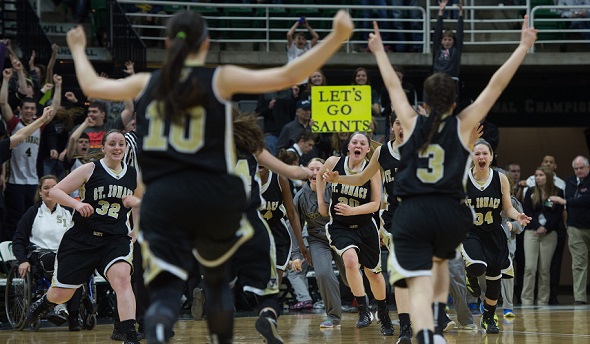
St. Ignace trailed undefeated Pittsford by 20 points two minutes into the Class D Final when it launched a comeback equaled by only one other team in MHSAA girls basketball history. The Saints tied the score with 35 seconds to play in regulation and continued the rally in the extra period to claim a 64-60 title-clinching victory. Detroit Cass Tech, in the 1987 Class A Final, also had come back from 20 down in the third quarter to win. The championship was St. Ignace’s fifth in girls basketball.
PHOTO: St. Ignace basketball players celebrate after the Saints tied the largest comeback in MHSAA Finals history on the way to claiming the Class D title. (Click to see more at HighSchoolSportsScene.com.)
Hastings' Life-Saving Response Reinforces Vital Importance of Being Prepared
By
Geoff Kimmerly
MHSAA.com senior editor
August 23, 2022
HASTINGS – Preseason silence, mixed with anticipation, made Hastings High School’s gym feel especially pristine last week.
 The raucousness is returning soon as the school’s volleyball teams are into their first matches of a new season, with winter sports bringing everyone inside in a few months. This is a place where big-game memories are made – but one from a scrimmage June 14 certainly will stick with many who were at Hastings High that day.
That evening, Potterville junior Da’Marion Hicks was playing in a basketball scrimmage when he suffered a heart attack due to a valve that later required open-heart surgery.
During a period of just a few minutes that could have meant his life, Hastings staff, students and a doctor who fortunately happened to be watching his son’s team from the stands, responded to assist Hicks before it was too late. In fact, he’s expected to be cleared to return this upcoming basketball season.
It’s a situation everyone hopes will never happen, but very occasionally it does. And when it did this time, Hastings – with crucial assistance coming out of the bleachers – showed what can be done to assure a best-possible result.
“We debriefed after this whole thing, and we actually had six people from our school (there) trained in CPR and AED use. Enough people felt comfortable enough to take some action to cause it to have a good outcome,” Hastings athletic director Mike Goggins said. “I think more times than not in a situation like this, bad results don’t come from people trying to help. Bad results come from people being afraid to help. What was great about this situation was … lots of people took the initiative to jump in.”
As another school year begins, Hastings’ ready response should continue to reinforce the importance of being prepared for the scariest of situations. (The Grand Rapids Press spoke with Hicks as he was beginning his recovery; click here to read.)
Emergency planning for sports venues has emerged as an important topic especially over the last decade, and the National Federation of State High School Associations (NFHS) and National Athletic Trainers’ Association (NATA) detail how these should work, with the “Anyone Can Save A Life” plan provided to all member schools by the MHSAA at the start of the 2015-16 school year.
Goggins said that while Hastings doesn’t necessarily have a “formal” plan like those linked above, what his department does is “saturate” his teams’ coaches and athletes with knowledge of where to find AEDs – and Hastings also has created a setup whereby a person is never more than one minute from an AED while on school property.
That evening, four boys basketball teams were playing on adjacent courts – including Potterville against Wyoming Tri-unity Christian. Goggins himself wasn’t at the school at the time (although he quickly arrived after being notified of the situation), but the following is the collection of information he has gathered over the last two months.
- Hicks had felt especially fatigued that evening and actually had mentioned to a few Hastings players during their scrimmage earlier that night that he was having a hard time catching his breath – definitely rare for a three-sport athlete who had run the 400 meters at an MHSAA Track & Field Finals a few weeks earlier.
- Hicks went to his bench for a break during the Tri-unity scrimmage, and laid down. Goggins said Potterville teammates thought Hicks was just gassed, but then noticed his eyes rolling back into his head. They started yelling for help.
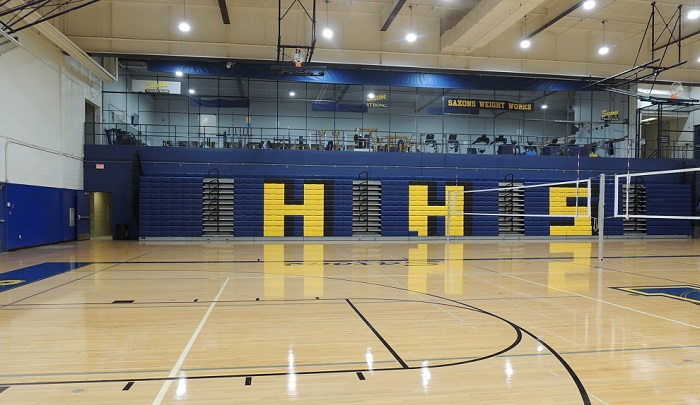
- Hastings boys basketball coach Rich Long sprang into action, running over to the Potterville bench and then calling into the crowd to see if anyone with medical expertise could help a student in distress. Meanwhile, Long was joined by Hastings’ strength coach (and U.S. Marine) James Avery – who was training athletes in the weight room in the balcony overlooking the gym – and Dr. Luke Van Klompenberg, an emergency medicine physician at Holland Hospital who was there watching his son play for Tri-unity.
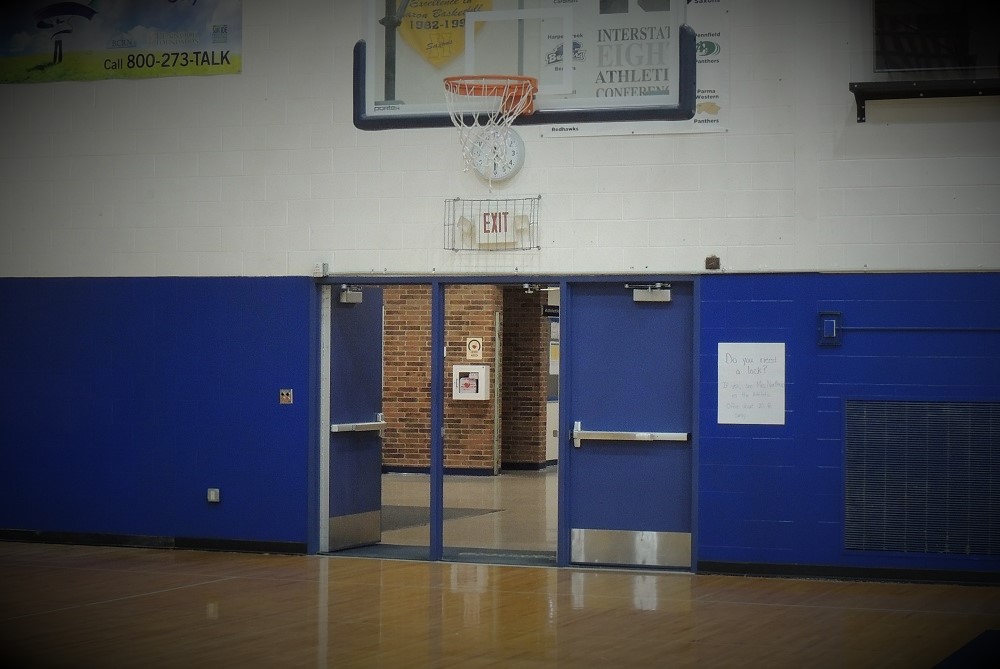
- Long sent an athlete to retrieve the closest AED, located on the wall just outside the gym doors. He also sent a parent to call 9-1-1, and Saxons boys track & field coach Lin Nickels sent multiple athletes to set up a relay near the school’s doors to direct paramedics when they arrived.
- Van Klompenberg, meanwhile, couldn’t find Hicks’ pulse, and the athlete’s breathing was shallow. Avery had begun chest compressions, the AED was used, and as the ambulance arrived Hicks was beginning to regain some consciousness. He was transported to the local Spectrum Health Pennock hospital, then to Helen DeVos Children's Hospital in Grand Rapids.
“It was one of those things where it just worked,” Goggins said. “My message, if nothing else, is we all practice it for a time that may never come – but the more you can saturate your people with the idea of A, being prepared, and B, don’t be afraid to take action … that’s really I think the key.”
 Beginning this year, the MHSAA is requiring all head coaches at the varsity, junior varsity and freshman levels to have CPR certification. That training almost always includes direction in the use of an AED.
Hastings has been on this track for a while. The MHSAA’s first CPR requirement for coaches was added for the 2015-16 school year, just for varsity head coaches – but Goggins made it a requirement for all of his coaches at all levels at that time.
Hastings also has taken AED prep to another level. There are 16 throughout the district – one each at the four elementary schools, two at the middle school and 10 at the high school – and they represent an even bigger investment in the life-saving technology as the district’s school board purchased those 16 a year ago to replace 12 that were nearing their expirations.
Goggins said doctors have told him that if Hicks had not received care for even 4-5 more minutes, he would not have survived because of the damage done to his heart and brain. Potterville athletic director and boys basketball coach Jake Briney said surgeons have broken things down to a 45-second window that made the difference between a good result and a sad one.
Coincidentally, Briney had scheduled a game this upcoming season against Wyoming Tri-unity Christian; Potterville should be tough, and Tri-unity is last season’s Division 4 runner-up. But the events of June 14 will make the events of this upcoming Jan. 14 much more meaningful.
Briney said Potterville also has formed a close relationship with Hastings. Multiple Saxons administrators have checked in, including Goggins almost daily during the first weeks after the incident.
Briney is filled with nothing but praise for Hastings’ preparation. And both athletic directors noted a similar effect at their schools as another school year begins.
“It really, really made the training, made you look at it through a different lens,” Briney said.
“Our fall coaches are now like, ‘You know, if Heather (Coipel, Hastings’ trainer) wanted to stop by and run through the AED procedure again, that would be great,’” Goggins said. “(Or) ‘Where is the AED? We have one at the fieldhouse, right? Where’s the closest one for me again?’ They’re just doublechecking.”
 Geoff Kimmerly joined the MHSAA in Sept. 2011 after 12 years as Prep Sports Editor of the Lansing State Journal. He is a senior editor of MHSAA.com's editorial content and has served as MHSAA Communications Director since January 2021. Contact him at [email protected] with story ideas for the Barry, Eaton, Ingham, Livingston, Ionia, Clinton, Shiawassee, Gratiot, Isabella, Clare and Montcalm counties.
PHOTOS (Top) An AED, located just outside the doors to Hastings’ gymnasium, was used to save Da’Marion Hicks’ life June 14. (Middle) Strength coach James Avery emerged from the balcony weight room to assist in Hicks’ care that evening. (Photos by Geoff Kimmerly.)