


AD Inducted to National Hall of Fame
May 7, 2014
By Geoff Kimmerly
Second Half editor
Winter gets hectic so quickly that we’re forced to save some intriguing items that come our way for a sunnier day – and that day is today.
Following are news, notes and a few key links collected over the last few months, including the national Hall of Fame induction of a longtime Michigan athletic director, local recognition for another and statewide acclaim for a group of students putting their video production equipment to good use benefiting all.
Ann Arbor AD Honored Nationally
Former Ann Arbor Huron athletic director Jane Bennett was among five inducted into the National Interscholastic Athletic Administrators Association Hall of Fame in December.
Bennett served 26 years as a teacher, coach, athletic director and assistant principal in Michigan before spending the last decade as a principal at two schools in Montana. She served as athletic director at Huron for 15 years through 2002-03. The NIAAA reported that during her final decade in that position, participation in athletics doubled.
Bennett, who received her bachelor’s and master’s degrees from the University of Michigan, began her career at Huron in 1977 as varsity softball coach and became a math teacher and the co-director of athletics a year later. She coached the softball team 14 seasons before moving into the full-time athletic director position. Bennett was co-founder of the Michigan High School Softball Coaches Association and served as MHSSCA president from 1982-87.
Among other achievements at Huron, Bennett was a leader in a successful campaign to gain voter approval of a $60 million bond package, which included $20 million to improve and expand athletic facilities. She also developed curriculum for an annual varsity captains/head coaches leadership training program and composed handbooks/guidebooks for coaches, athletes and parents.
Bennett also was a valuable contributor to the Michigan Interscholastic Athletic Administrators Association and the NIAAA. She was president of the MIAAA in 1993-94 and a state conference speaker on several occasions. Bennett also served in various NIAAA leadership positions including on the committee that developed the Leadership Training Institute in 1996.
Bennett was named MIAAA Athletic Director of the Year in 1998 and received its State Award of Merit in 1997. She received the MHSAA’s Women in Sports Leadership Award in 1995 and was inducted into the MHSSCA Hall of Fame in 1995. Prior to her selection to the NIAAA Hall of Fame, Bennett was honored with the NIAAA Distinguished Service Award in 1998 and the NIAAA Thomas E. Frederick Award of Excellence in 2000. In 2005, she was inducted into the National Council of Secondary School Athletic Directors Hall of Fame, having served as its president in 2003 and been selected as its Athletic Director of the Year in 1998.
PSL's Ward: 'Pillar' of Detroit Athletics
Alvin Ward, the executive director of athletics for the Detroit Public School League and a member of the MHSAA Representative Council, received a 2014 Pillar in the Community Award in April from the Coast II Coast All-Stars, a Detroit-based pro basketball team that plays in the American Basketball Association.
Ward has served as a teacher, assistant principal and principal as well for Detroit Public Schools, and directs programs with a combined 500 coaches and 4,500 athletes.
Linked up
- This winter, the MHSAA Representative Council adopted a number of football practice rules changes aimed at improving player acclimatization at the start of fall and reducing head trauma and injuries. The Adrian Daily Telegram’s Doug Donnelly got responses from a number of coaches from that area of the state; click to find out why they feel these changes are important.
- Port Huron Times Herald writer Paul Costanzo let people know about our Student Advisory Council through the experience of Marlette’s Connor Thomas, one of our juniors and a great contributor this school year.
Power of Awareness
The Kimberly Anne Gillary Foundation works to educate Michigan schools on sudden cardiac arrest and train personnel in CPR and the use of an AED (automated external defibrillator). The video below teaches us again about the importance of awareness.
Saginaw Heritage was awarded $5,000 in April as the winner of the Gillary Foundation’s High School AED Contest. Students were asked to create a 3-minute video emphasizing the importance of Michigan high schools being adequately prepared to respond to a sudden cardiac arrest or related event on school property.
Randy and Sue Gillary created the foundation after their 15-year-old daughter Kimberly – an athlete at Troy Athens – died after suffering sudden cardiac arrest in 2000. The contest judges were Kimberly’s sisters Emily Kucinich, Jennifer Gregroy and Katie Gillary.
As of April 1, the Gillary Foundation had raised $1.2 million and donated 650 AEDs to schools – with three lives having been saved with donated AEDs. For more, click www.kimberlysgift.org.
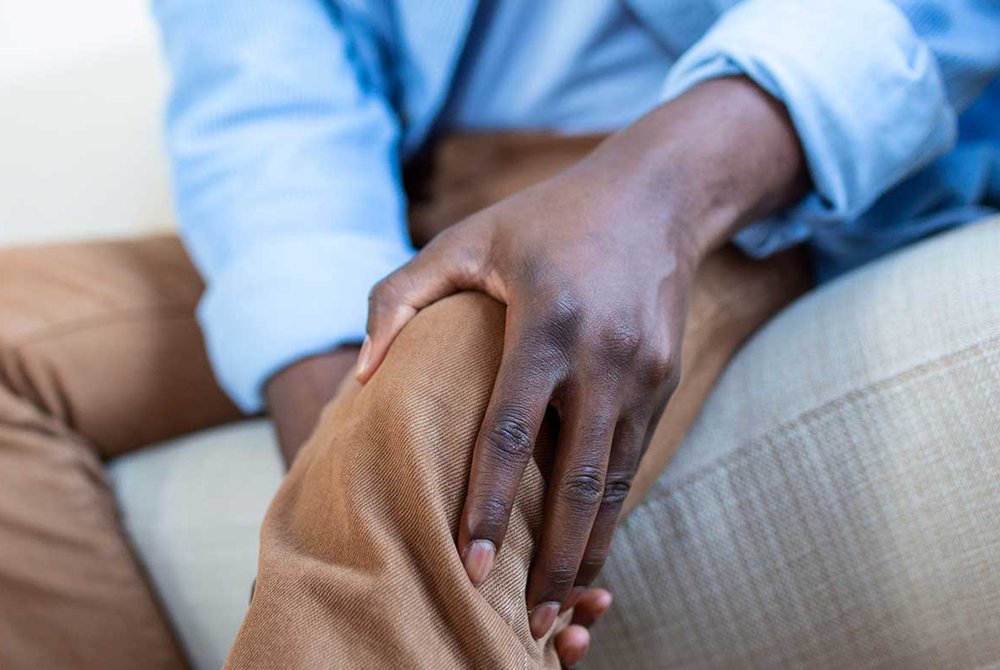
Symptoms of a Meniscus Tear — and When to Seek Treatment
April 2, 2024
Meniscus tears are not one size fits all: Sometimes they cause no pain, other times they’re excruciating.
 Once in a while they heal or adapt on their own, but more often than not they require physical therapy or surgery.
“Your meniscus is a fiber elastic cartilage that acts as a shock absorber for the knee,” says Ahmad Bazzi, M.D., a sports medicine physician at Henry Ford Health. “It also helps stabilize the knee joint. But when it tears — which can occur in young athletes after a pivot injury or in older people who have arthritis — it can be painful.”
Here, Dr. Bazzi shares symptoms of a meniscus tear and when to see a doctor.
What Does A Meniscus Tear Feel Like?
Depending upon the level of injury and type of tear, meniscus tears can either be asymptomatic or cause symptoms like:
- Locking. When the meniscus tears, a piece of it might move into the knee joint, causing mechanical issues like stiffness and locking of the knee joint.
- Catching or clicking. This often feels like a sudden ‘click’ in the knee joint, where it suddenly gives out while you’re walking or doing certain movements.
- Localized pain on the inner or outer part of the knee. In young athletes, a meniscus tear often causes an impaired range of motion and localized pain on the inner or outer part of the knee.
- Pain and swelling. In older people, a meniscus tear often causes swelling and an overall aching pain in the knee.
Treatment Options For Meniscus Tears
A meniscus tear can only heal on its own if the tear is on the outer part of the knee where it has better access to blood supply. If you’re experiencing pain a few days after injury and you have limited range of motion, instability and/or swelling in the knee, Dr. Bazzi recommends seeing a doctor to get an examination and, if needed, an MRI for diagnosis.
“It’s hard to tell what type of meniscus tear you have if you haven’t seen a doctor,” says Dr. Bazzi. “If you have a mechanically unstable tear and it goes untreated, it could lead to worsening range of motion and stiffness, or worsening arthritis. It’s important to get seen by a doctor to get an accurate diagnosis and the proper treatment. It may take one to three months for a full recovery.”
Here, Dr. Bazzi shares treatment options:
Surgery
If someone is having mechanical symptoms like locking or catching, surgery may be considered right away, especially if it’s an athlete younger than 40 years old. “Meniscus tear surgery has a shorter recovery compared to other knee surgeries,” says Dr. Bazzi. “Surgery could either consist of a meniscectomy, which is partial or complete removal of the meniscus, or sometimes just a meniscus repair.”
Hyaluronic acid or cortisone injections
Non-operative treatments are often recommended for older people who have degenerative tears due to arthritis. “This is because meniscus surgery doesn’t often relieve their pain since they have underlying arthritis, meaning they have cartilage loss in the meniscus,” says Dr. Bazzi.
Instead, a cortisone injection, which is an anti-inflammatory medication that can be injected into the knee, can reduce inflammation, swelling and pain caused by arthritis.
A hyaluronic acid injection may also be considered, which adds cushioning in the knee. “Hyaluronic acid is one of the substances that make up our cartilage, so this injection helps us mimic the lost cartilage,” says Dr. Bazzi. “It also has anti-inflammatory properties.”
Physical therapy
Physical therapy is another great option, especially for older people who need non-operative treatment options. It can help the knee adapt to the tear, reduce pain and encourage full range of motion. “Physical therapy for meniscus tears focuses on balance exercises and exercises to strengthen the muscles around the knee,” says Dr. Bazzi. “This helps to uphold the knee joint to achieve full range of motion and strength while being pain-free.”
To find a sports medicine provider at Henry Ford Health, visit henryford.com/athletes or call 313-651-1969.
Reviewed by Ahmad Bazzi, M.D., a sports medicine physician who sees patients at Henry Ford Medical Center – Fairlane.