


AD Inducted to National Hall of Fame
May 7, 2014
By Geoff Kimmerly
Second Half editor
Winter gets hectic so quickly that we’re forced to save some intriguing items that come our way for a sunnier day – and that day is today.
Following are news, notes and a few key links collected over the last few months, including the national Hall of Fame induction of a longtime Michigan athletic director, local recognition for another and statewide acclaim for a group of students putting their video production equipment to good use benefiting all.
Ann Arbor AD Honored Nationally
Former Ann Arbor Huron athletic director Jane Bennett was among five inducted into the National Interscholastic Athletic Administrators Association Hall of Fame in December.
Bennett served 26 years as a teacher, coach, athletic director and assistant principal in Michigan before spending the last decade as a principal at two schools in Montana. She served as athletic director at Huron for 15 years through 2002-03. The NIAAA reported that during her final decade in that position, participation in athletics doubled.
Bennett, who received her bachelor’s and master’s degrees from the University of Michigan, began her career at Huron in 1977 as varsity softball coach and became a math teacher and the co-director of athletics a year later. She coached the softball team 14 seasons before moving into the full-time athletic director position. Bennett was co-founder of the Michigan High School Softball Coaches Association and served as MHSSCA president from 1982-87.
Among other achievements at Huron, Bennett was a leader in a successful campaign to gain voter approval of a $60 million bond package, which included $20 million to improve and expand athletic facilities. She also developed curriculum for an annual varsity captains/head coaches leadership training program and composed handbooks/guidebooks for coaches, athletes and parents.
Bennett also was a valuable contributor to the Michigan Interscholastic Athletic Administrators Association and the NIAAA. She was president of the MIAAA in 1993-94 and a state conference speaker on several occasions. Bennett also served in various NIAAA leadership positions including on the committee that developed the Leadership Training Institute in 1996.
Bennett was named MIAAA Athletic Director of the Year in 1998 and received its State Award of Merit in 1997. She received the MHSAA’s Women in Sports Leadership Award in 1995 and was inducted into the MHSSCA Hall of Fame in 1995. Prior to her selection to the NIAAA Hall of Fame, Bennett was honored with the NIAAA Distinguished Service Award in 1998 and the NIAAA Thomas E. Frederick Award of Excellence in 2000. In 2005, she was inducted into the National Council of Secondary School Athletic Directors Hall of Fame, having served as its president in 2003 and been selected as its Athletic Director of the Year in 1998.
PSL's Ward: 'Pillar' of Detroit Athletics
Alvin Ward, the executive director of athletics for the Detroit Public School League and a member of the MHSAA Representative Council, received a 2014 Pillar in the Community Award in April from the Coast II Coast All-Stars, a Detroit-based pro basketball team that plays in the American Basketball Association.
Ward has served as a teacher, assistant principal and principal as well for Detroit Public Schools, and directs programs with a combined 500 coaches and 4,500 athletes.
Linked up
- This winter, the MHSAA Representative Council adopted a number of football practice rules changes aimed at improving player acclimatization at the start of fall and reducing head trauma and injuries. The Adrian Daily Telegram’s Doug Donnelly got responses from a number of coaches from that area of the state; click to find out why they feel these changes are important.
- Port Huron Times Herald writer Paul Costanzo let people know about our Student Advisory Council through the experience of Marlette’s Connor Thomas, one of our juniors and a great contributor this school year.
Power of Awareness
The Kimberly Anne Gillary Foundation works to educate Michigan schools on sudden cardiac arrest and train personnel in CPR and the use of an AED (automated external defibrillator). The video below teaches us again about the importance of awareness.
Saginaw Heritage was awarded $5,000 in April as the winner of the Gillary Foundation’s High School AED Contest. Students were asked to create a 3-minute video emphasizing the importance of Michigan high schools being adequately prepared to respond to a sudden cardiac arrest or related event on school property.
Randy and Sue Gillary created the foundation after their 15-year-old daughter Kimberly – an athlete at Troy Athens – died after suffering sudden cardiac arrest in 2000. The contest judges were Kimberly’s sisters Emily Kucinich, Jennifer Gregroy and Katie Gillary.
As of April 1, the Gillary Foundation had raised $1.2 million and donated 650 AEDs to schools – with three lives having been saved with donated AEDs. For more, click www.kimberlysgift.org.

Referee Camaraderie: Bloopers, 'Nerding' Out, Lots of Laughs Create Powerful Bond
By
Pam Shebest
Special for MHSAA.com
February 13, 2024
KALAMAZOO — When it comes to blooper highlights, four MHSAA hockey officials don’t hesitate to share their miscues.
 One of them, Bob Corak, even has his pratfalls set to music on an internet site called Zebras with Pucks.
Laughter is the sound of the day when the four gather every Tuesday after their yoga class at Nisker’s Char-Grill & Slap Shot Hockey Bar in Kalamazoo.
The camaraderie between Corak, Corey Butts, Nick Schrippa and Nat Swanson is evident, but the tone gets more serious once the talk turns to officiating.
“We’ve all played, we’ve all coached to some extent, but officiating is just what speaks to us,” Schrippa said. “That’s our niche.
“Every player on the ice has a fan in the stands. Every player on the ice has support on the bench. We’re the only support we have in the arena. We’re the only ones we can lean on. We’re kind of on an island.”
Most times the friends are part of different four-man crews made up of two referees and two linesmen for South Central High School Hockey League games. But that just gives them more to talk about when they get together on Tuesdays.
 “We spend an hour every Tuesday with Bob’s wife (Susan) just kicking the crap out of us and then come to (Nisker’s) to debrief,” Schrippa said. Susan Corak runs Be Well Yoga and Fitness in Kalamazoo.
"We never talk about the workout. Somebody will bust out a phone and we’ll go over a video and we’ll talk about a situation, talk about rule differences,” he continued. “We are nerds to the nth degree, and that’s just how we’re wired.”
Yoga is a good way to keep in shape, the four friends agree.
“I’m a little older than most of the referees I meet,” said Corak, who retired after 35 years with Pfizer in information technology. "It keeps me limber, keeps me in shape to an extent, not a lot of cardio but the strength is there that we get from yoga, especially the core, plus injury prevention.
“If I’m not skating, I’m officiating or I’m working the books for the association (Kalamazoo Ice Hockey Officials Association).”
Corak assists in the scheduling, billing, etc., leading Schrippa to quip: “Remember when Bob said he did information technology? We take full advantage of that. He is, in fact, the glue that holds a lot of our shenanigans together. He really is.”
Referees vs. Linesmen
Butts and Corak prefer wearing the referees’ armbands, while Schrippa and Swanson like working the lines.
“’I’m a smaller guy,” said Butts, who has been officiating for 14 years. “Linesmen typically tend to be 6-foot-5. When you’re smaller than most of the players, it doesn’t work out well.
“I like the freedom to be able to get out of the way. It’s a high traffic area as a linesman.”
When not spending evenings officiating, Butts is the penalty box timekeeper for the ECHL Kalamazoo Wings home games. His day job as a third-party examiner for the state of Michigan means he gives driving tests, and that leads to some interesting conversations.
“I’ve given most of (the players) their driver’s licenses,” he said. “I’ve had a group of players in the middle of a high school hockey game, getting ready to drop the puck at the start of the third period, and they’re trying to schedule a driver’s test for the next day. I’m like, ‘Guys, not now. Talk to me after work.’”
 Swanson is the newest of the quartet, moving to the area three years ago from Syracuse, N.Y., where he started officiating at age 11.
He is a pilot in the U.S. Air Force International Guard in Battle Creek flying MQ-9 Reaper Drones.
“I like refereeing better (than being a linesman) because I like managing the game and look at the big picture,” Swanson said. “Sometimes it’s great to be a linesman because they get to communicate with the players, crack jokes and sometimes throw the referee under the bus, ‘Yeah, I agree that was a terrible call. But you’ve got to move on.’”
All four also officiate college and youth hockey, which can lead to a dilemma.
“Those are all different rule books, so we don’t have to know just one set of rules,” Schrippa said. “None of them are what you see on TV.
“While we have a couple hundred people in the building who are yelling at us that we got it wrong because that’s what they saw on ESPN, that’s not how it works. So not only do we have to know the rules, we have to know the differences in the rules.”
With mentorship programs available, some current prep players are also officials for younger leagues.
“They’re learning, we’re teaching them,” Corak said. “We have games with them as officials, then we’ll officiate their games when they play for their schools.”
Swanson added: “I think that makes them better players because they understand the rules, where they can bend rules and where they can’t.”
 That is what led Schrippa to officiating.
“(Late referee) Mike Martin was officiating a game and pulled me aside,” he said. “I was 22 years old and he asked if I wanted to become a ref.
“‘(Heck) you’ve broken all the rules,’ he told me. ‘You probably know most of them already. He wasn’t wrong. I talked to a couple friends who had done it, and they talked me into doing it 29 seasons ago. I fell in love with it.”
Fun with bloopers
All four laugh as they regale each other with their funniest and most embarrassing moments.
For Schrippa, it was the college game where he made his refereeing debut.
“I was given the rookie lap,” he said. “I was jazzed. I came out of the gate, turned left, went around the back of the net, got to the blue line, caught a toe pick and Supermanned, slid from the blue line to the top of the next faceoff circle and was soaked because the ice hadn’t set yet.
“I got a standing ovation from the few hundred fans that were in the rink. Both my linesmen were doubled over laughing. It was a very cold first period.”
Something similar happened to Swanson.
 “I was taking a hot lap, not seeing they’ve got a carpet out for somebody, hitting the carpet and Supermanning,” he recalled. “Then having a linesman watch you do it as there’s a few hundred people in the stands and give a big washout sign.”
Butts and Swanson had moments that actually delayed the start of a game.
For Butts, “I forgot my pants because I washed them separate and my wife had to bring them to me, and we could not start the game until my pants arrived,” he said, while the others laughed and nodded in agreement.
Swanson actually found himself at the wrong rink one time.
“I’m like, ‘Where is everybody?’” he said. “My phone starts ringing. ‘Hey dude, game starts in 15 minutes. You going to be here? Uh, yes, in 20.’’’
The four agree most officials go through highs and lows, funny times and embarrassing times, and that’s one thing that brings them all together.
“What’s unique about what we do is I could meet another official from Sweden tomorrow who I’ve never met before, and within minutes we’ve already got that relationship,” said Schrippa, who is the Southwest Michigan communications representative for the Michigan Department of Transportation (MDOT).
“That’s something we all share, we all know that feeling, we all understand that bond and it just takes a second. It’s so neat, it’s powerful.”
 Pam Shebest served as a sportswriter at the Kalamazoo Gazette from 1985-2009 after 11 years part-time with the Gazette while teaching French and English at White Pigeon High School. She can be reached at [email protected] with story ideas for Calhoun, Kalamazoo and Van Buren counties.
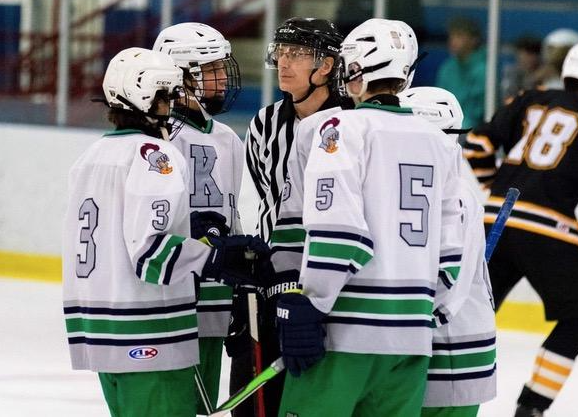
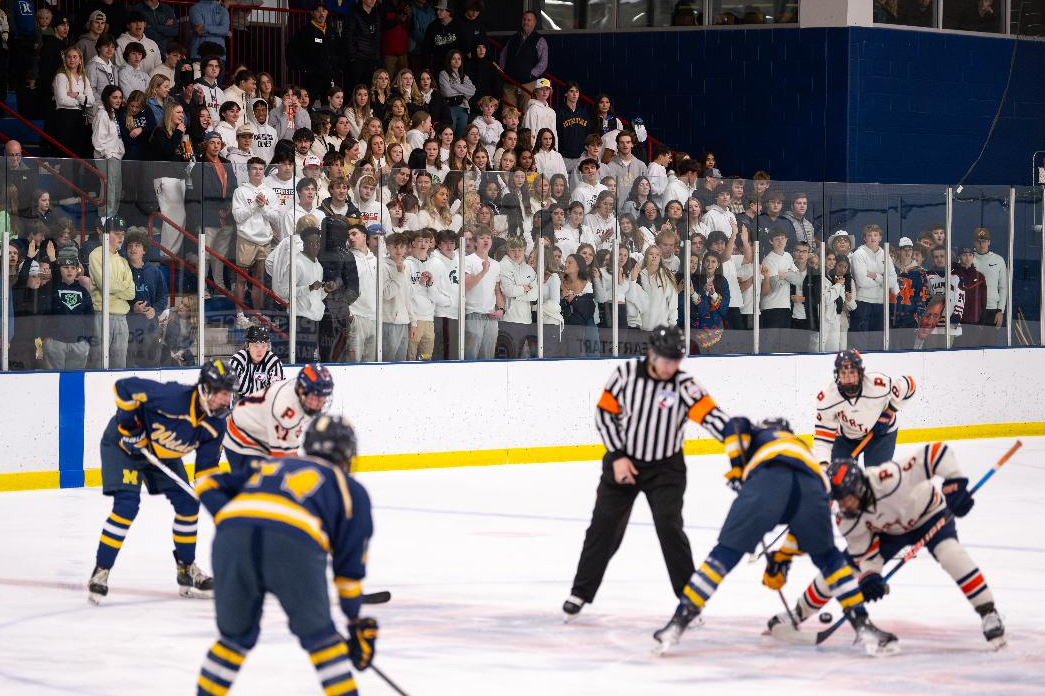
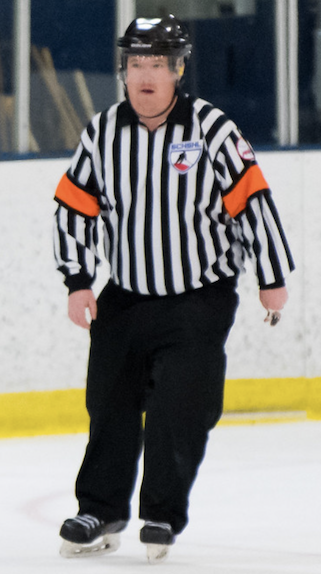
PHOTOS (Top) MHSAA hockey officials, from left: Nick Schrippa, Bob Corak, Nat Swanson and Corey Butts get together recently for one of their weekly hangouts. (2) Schrippa makes a call. (3) Corak, center, confers with a group of players. (4) Swanson prepares to drop the puck. (5) Butts monitors the game action. (Top photo by Pam Shebest; following photos provided by respective officials.)