


AD Inducted to National Hall of Fame
May 7, 2014
By Geoff Kimmerly
Second Half editor
Winter gets hectic so quickly that we’re forced to save some intriguing items that come our way for a sunnier day – and that day is today.
Following are news, notes and a few key links collected over the last few months, including the national Hall of Fame induction of a longtime Michigan athletic director, local recognition for another and statewide acclaim for a group of students putting their video production equipment to good use benefiting all.
Ann Arbor AD Honored Nationally
Former Ann Arbor Huron athletic director Jane Bennett was among five inducted into the National Interscholastic Athletic Administrators Association Hall of Fame in December.
Bennett served 26 years as a teacher, coach, athletic director and assistant principal in Michigan before spending the last decade as a principal at two schools in Montana. She served as athletic director at Huron for 15 years through 2002-03. The NIAAA reported that during her final decade in that position, participation in athletics doubled.
Bennett, who received her bachelor’s and master’s degrees from the University of Michigan, began her career at Huron in 1977 as varsity softball coach and became a math teacher and the co-director of athletics a year later. She coached the softball team 14 seasons before moving into the full-time athletic director position. Bennett was co-founder of the Michigan High School Softball Coaches Association and served as MHSSCA president from 1982-87.
Among other achievements at Huron, Bennett was a leader in a successful campaign to gain voter approval of a $60 million bond package, which included $20 million to improve and expand athletic facilities. She also developed curriculum for an annual varsity captains/head coaches leadership training program and composed handbooks/guidebooks for coaches, athletes and parents.
Bennett also was a valuable contributor to the Michigan Interscholastic Athletic Administrators Association and the NIAAA. She was president of the MIAAA in 1993-94 and a state conference speaker on several occasions. Bennett also served in various NIAAA leadership positions including on the committee that developed the Leadership Training Institute in 1996.
Bennett was named MIAAA Athletic Director of the Year in 1998 and received its State Award of Merit in 1997. She received the MHSAA’s Women in Sports Leadership Award in 1995 and was inducted into the MHSSCA Hall of Fame in 1995. Prior to her selection to the NIAAA Hall of Fame, Bennett was honored with the NIAAA Distinguished Service Award in 1998 and the NIAAA Thomas E. Frederick Award of Excellence in 2000. In 2005, she was inducted into the National Council of Secondary School Athletic Directors Hall of Fame, having served as its president in 2003 and been selected as its Athletic Director of the Year in 1998.
PSL's Ward: 'Pillar' of Detroit Athletics
Alvin Ward, the executive director of athletics for the Detroit Public School League and a member of the MHSAA Representative Council, received a 2014 Pillar in the Community Award in April from the Coast II Coast All-Stars, a Detroit-based pro basketball team that plays in the American Basketball Association.
Ward has served as a teacher, assistant principal and principal as well for Detroit Public Schools, and directs programs with a combined 500 coaches and 4,500 athletes.
Linked up
- This winter, the MHSAA Representative Council adopted a number of football practice rules changes aimed at improving player acclimatization at the start of fall and reducing head trauma and injuries. The Adrian Daily Telegram’s Doug Donnelly got responses from a number of coaches from that area of the state; click to find out why they feel these changes are important.
- Port Huron Times Herald writer Paul Costanzo let people know about our Student Advisory Council through the experience of Marlette’s Connor Thomas, one of our juniors and a great contributor this school year.
Power of Awareness
The Kimberly Anne Gillary Foundation works to educate Michigan schools on sudden cardiac arrest and train personnel in CPR and the use of an AED (automated external defibrillator). The video below teaches us again about the importance of awareness.
Saginaw Heritage was awarded $5,000 in April as the winner of the Gillary Foundation’s High School AED Contest. Students were asked to create a 3-minute video emphasizing the importance of Michigan high schools being adequately prepared to respond to a sudden cardiac arrest or related event on school property.
Randy and Sue Gillary created the foundation after their 15-year-old daughter Kimberly – an athlete at Troy Athens – died after suffering sudden cardiac arrest in 2000. The contest judges were Kimberly’s sisters Emily Kucinich, Jennifer Gregroy and Katie Gillary.
As of April 1, the Gillary Foundation had raised $1.2 million and donated 650 AEDs to schools – with three lives having been saved with donated AEDs. For more, click www.kimberlysgift.org.
Gooding & King Work to Fill SW Michigan's Officiating Ranks, Schedules
By
Pam Shebest
Special for MHSAA.com
December 12, 2023
KALAMAZOO – Cheer them or boo them, without officials, there are no games. That’s just a fact in the sports world.
 Two area men are tasked with supplying those officials for Southwest Michigan schools, and it is not always as easy as it seems.
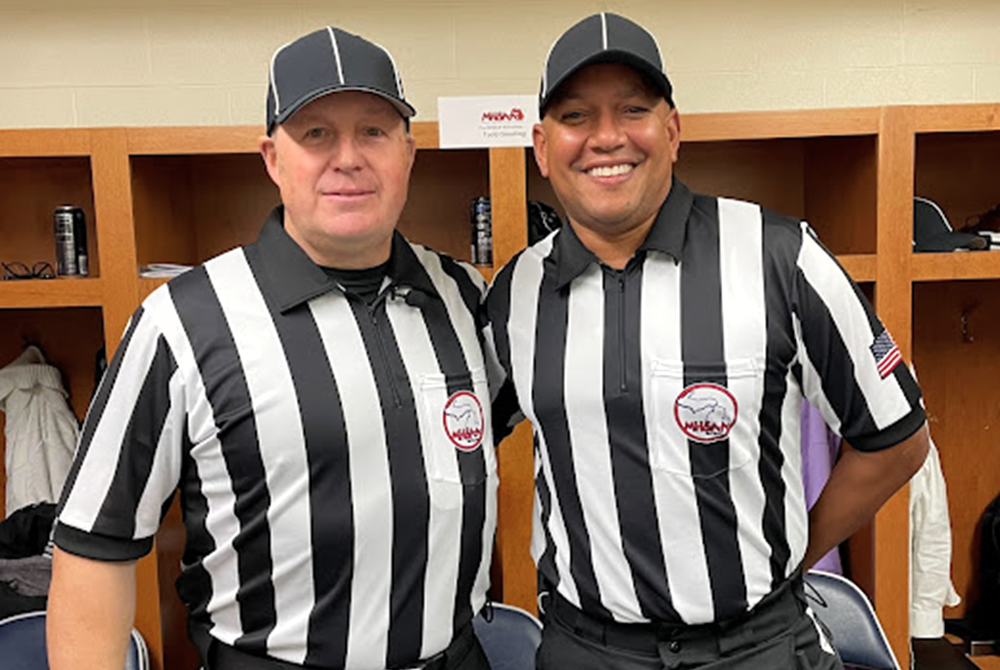
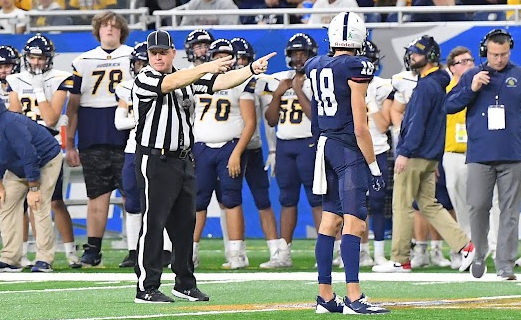
Portage’s Todd Gooding is in charge of assigning football referees for 70 schools across eight leagues, with 500 officials on his staff.
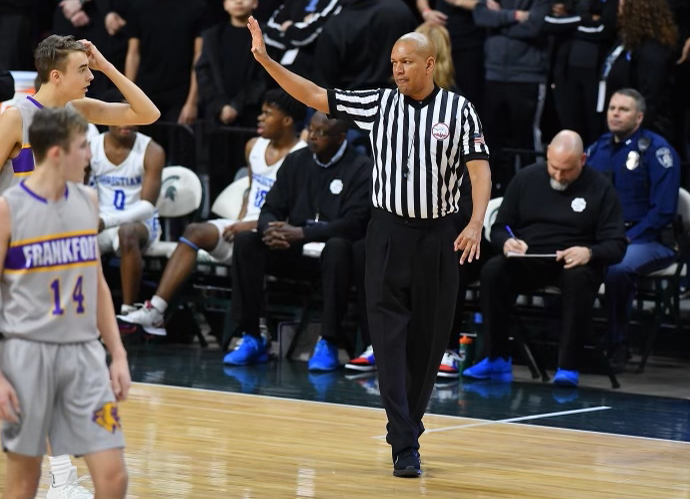
Vicksburg’s Rob King assigns officials for girls and boys basketball in five leagues and has 290 men and women on his roster to work 1,100 games throughout the hoops season.
“We have six females on staff,” King said. “We’re looking to add more. I think the girls who are playing enjoy having a female ref on the court with them, plus it shows them they can do this, too.”
Although totals were dropping a few percentage points every year, the MHSAA still registered an average of 10,317 officials annually during the decade ending in 2019-20. But the beginning of the COVID-19 pandemic that spring played a large part in a decrease in registered officials by 12 percent for 2020-21, down to 8,090.
The last two school years saw a bounce-back of four percent, and recruiting and retaining efforts continue. But Gooding and King – also veteran officials themselves, Gooding for 25 years and King for 24 – and their assigning colleagues across the state have the closest look at the effects of fewer officials as they work to schedule at the local level and make sure everything is covered.
Doing so gets even harder with unforeseen roadblocks.
One of those challenges for Gooding came in August when extreme heat forced most schools to reschedule or delay their football games.
“Everyone was trying to get their games in,” he said. “We were moving start times back, then we were moving days. Football is a little different than basketball or baseball because you can only play within so many days, so we were really squeezed against the schedule.
 “I had a school or two reach out on Monday or Tuesday (before the Friday night game), so they looked ahead at the heat. Some of them waited, waited, waited, and then in some cases, it posed some big challenges because most of those crews had been spoken for.”
For a typical football Friday, Gooding staffs 30 or 35 games, “which is really difficult because everybody wants to play Friday night.”
Some referees in both football and basketball “double dip” by officiating games at freshman or junior varsity levels on nights other than Friday.
Gooding said at one time he hoped to go to seven officials for a football game, but with a shortage of officials, “Right now we’re just lucky to staff five in the games we have, and we’re still very short.
“Parents are a key component to a shortage of officials. A lot of it is more at the youth level, but everyone has to remember the sportsmanship aspect. Without officials there are no games, and sometimes we lose track of that, and that’s one reason there’s a shortage.”
Still, King noted that officiating provides more advantages than disadvantages.
“Everyone hears about the bad stuff, getting yelled at by fans and coaches, but those are so small,” he said.
“After a season of doing this, you learn to block out that stuff and realize it’s just part of the game. Fifty percent of people are mad at you every time you blow the whistle, so you get used to that.”
Pay raises in some leagues enticed many of those who “retired” to return, King said, but both he and Gooding agree the camaraderie developed while officiating is what makes it most special.
“It’s more about the time you spend on the floor with guys, in the locker room, driving to games, grabbing something to eat after the games, just talking about life, just building friendships,” King said. “That’s the part you remember.”
Gooding added some games stick in his memory more than others.
“My first varsity game (refereeing) was Lawton playing Saugatuck,” he said. “I show up and Channel 3 was there. I wondered what’s going on.
“Both schools were 0-8, both senior classes were 0-35. Somebody had to win, and it was my first varsity game. I think Saugatuck won, and it was close to 25 years ago.”
Another memory came as he officiated a basketball game.
 “A girl from Benton Harbor (Kysre Gondrezick in 2016) had 72 points,” he said. “It’s in the record books. and you’re just one small part of that and you remember them.”
Officiating is not only for adults. Even teenagers still in high school can become referees as part of the MHSAA Legacy Program.
King recently hosted an officiating summit at Paw Paw for high school athletes.
“There are nine schools in the Wolverine Conference and six of them brought 10 to 15 kids,” he said. “Myself and another official presented on basketball. They also did something on other sports.
“We got the kids up blowing the whistles and doing some of the signals. Three reached out wanting to get involved.”
King said officiating is a great way to earn money, especially while in college.
“You’ll work maybe two or three hours at the most and make $150 to $300 depending on the level,” he said. “Your friends will have to work six-, seven-, eight-hour days to make that much money.
“You can also block your schedule. We have a software with a calendar on it. If there are days you know you can’t work because you have classes or other things, you just block those days out, so you control your own schedule.”
With training, freshmen and sophomores can work junior high/middle school games, and juniors and seniors are able to officiate at the freshman and junior varsity levels.
“Usually what we do is get you a mentor,” King said, “and you work with that mentor and make some money.”
Those Legacy officials hopefully continue in the avocation, eventually becoming the next mentors.
Officiating, like school sports in general, is a cycle that’s constantly in motion – both when it comes to filling the ranks and filling the schedule to cover games ahead.
For example, although football season is over, “I don’t know if there really is an offseason,” Gooding said. “Leagues are going to start giving me their schedules. We’ll get those into an Arbiter system. Everything’s assigned by Arbiter, a computer system where officials get their assignments.
“I’ll start evaluating the crews, reach out to the crew chiefs. They’ll let me know any changes in their crew dynamics. I’ll evaluate the year gone by, how they performed and then start getting ready to work on getting those games staffed. That will start after the new year.”
For more information on officiating, including the Legacy Program, go to the Officials page of MHSAA.com.
 Pam Shebest served as a sportswriter at the Kalamazoo Gazette from 1985-2009 after 11 years part-time with the Gazette while teaching French and English at White Pigeon High School. She can be reached at [email protected] with story ideas for Calhoun, Kalamazoo and Van Buren counties.
PHOTOS (Top) Todd Gooding, left and Rob King take a photo together while officiating the Division 4 Final at Ford Field in 2022. (Middle) Gooding signals during that contest between Goodrich and Grand Rapids South Christian. (Below) King officiates the 2019 Division 4 Boys Basketball Final at Breslin Center. (Photos courtesy of Gooding and King.)