


AD Inducted to National Hall of Fame
May 7, 2014
By Geoff Kimmerly
Second Half editor
Winter gets hectic so quickly that we’re forced to save some intriguing items that come our way for a sunnier day – and that day is today.
Following are news, notes and a few key links collected over the last few months, including the national Hall of Fame induction of a longtime Michigan athletic director, local recognition for another and statewide acclaim for a group of students putting their video production equipment to good use benefiting all.
Ann Arbor AD Honored Nationally
Former Ann Arbor Huron athletic director Jane Bennett was among five inducted into the National Interscholastic Athletic Administrators Association Hall of Fame in December.
Bennett served 26 years as a teacher, coach, athletic director and assistant principal in Michigan before spending the last decade as a principal at two schools in Montana. She served as athletic director at Huron for 15 years through 2002-03. The NIAAA reported that during her final decade in that position, participation in athletics doubled.
Bennett, who received her bachelor’s and master’s degrees from the University of Michigan, began her career at Huron in 1977 as varsity softball coach and became a math teacher and the co-director of athletics a year later. She coached the softball team 14 seasons before moving into the full-time athletic director position. Bennett was co-founder of the Michigan High School Softball Coaches Association and served as MHSSCA president from 1982-87.
Among other achievements at Huron, Bennett was a leader in a successful campaign to gain voter approval of a $60 million bond package, which included $20 million to improve and expand athletic facilities. She also developed curriculum for an annual varsity captains/head coaches leadership training program and composed handbooks/guidebooks for coaches, athletes and parents.
Bennett also was a valuable contributor to the Michigan Interscholastic Athletic Administrators Association and the NIAAA. She was president of the MIAAA in 1993-94 and a state conference speaker on several occasions. Bennett also served in various NIAAA leadership positions including on the committee that developed the Leadership Training Institute in 1996.
Bennett was named MIAAA Athletic Director of the Year in 1998 and received its State Award of Merit in 1997. She received the MHSAA’s Women in Sports Leadership Award in 1995 and was inducted into the MHSSCA Hall of Fame in 1995. Prior to her selection to the NIAAA Hall of Fame, Bennett was honored with the NIAAA Distinguished Service Award in 1998 and the NIAAA Thomas E. Frederick Award of Excellence in 2000. In 2005, she was inducted into the National Council of Secondary School Athletic Directors Hall of Fame, having served as its president in 2003 and been selected as its Athletic Director of the Year in 1998.
PSL's Ward: 'Pillar' of Detroit Athletics
Alvin Ward, the executive director of athletics for the Detroit Public School League and a member of the MHSAA Representative Council, received a 2014 Pillar in the Community Award in April from the Coast II Coast All-Stars, a Detroit-based pro basketball team that plays in the American Basketball Association.
Ward has served as a teacher, assistant principal and principal as well for Detroit Public Schools, and directs programs with a combined 500 coaches and 4,500 athletes.
Linked up
- This winter, the MHSAA Representative Council adopted a number of football practice rules changes aimed at improving player acclimatization at the start of fall and reducing head trauma and injuries. The Adrian Daily Telegram’s Doug Donnelly got responses from a number of coaches from that area of the state; click to find out why they feel these changes are important.
- Port Huron Times Herald writer Paul Costanzo let people know about our Student Advisory Council through the experience of Marlette’s Connor Thomas, one of our juniors and a great contributor this school year.
Power of Awareness
The Kimberly Anne Gillary Foundation works to educate Michigan schools on sudden cardiac arrest and train personnel in CPR and the use of an AED (automated external defibrillator). The video below teaches us again about the importance of awareness.
Saginaw Heritage was awarded $5,000 in April as the winner of the Gillary Foundation’s High School AED Contest. Students were asked to create a 3-minute video emphasizing the importance of Michigan high schools being adequately prepared to respond to a sudden cardiac arrest or related event on school property.
Randy and Sue Gillary created the foundation after their 15-year-old daughter Kimberly – an athlete at Troy Athens – died after suffering sudden cardiac arrest in 2000. The contest judges were Kimberly’s sisters Emily Kucinich, Jennifer Gregroy and Katie Gillary.
As of April 1, the Gillary Foundation had raised $1.2 million and donated 650 AEDs to schools – with three lives having been saved with donated AEDs. For more, click www.kimberlysgift.org.
Macomb Lutheran North Standout on Mend After Knee Injury
October 3, 2023
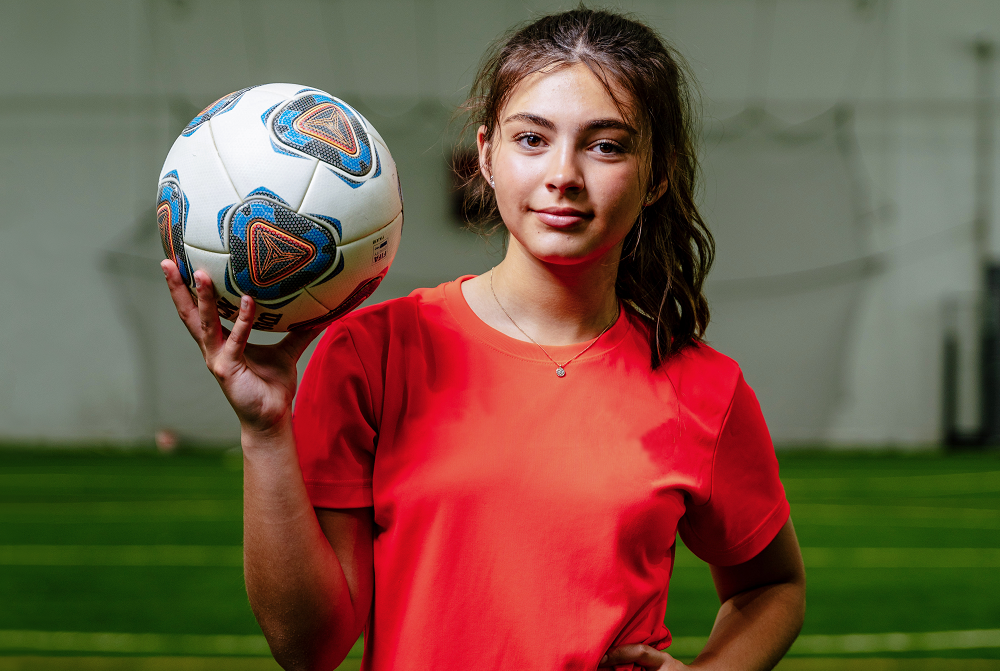
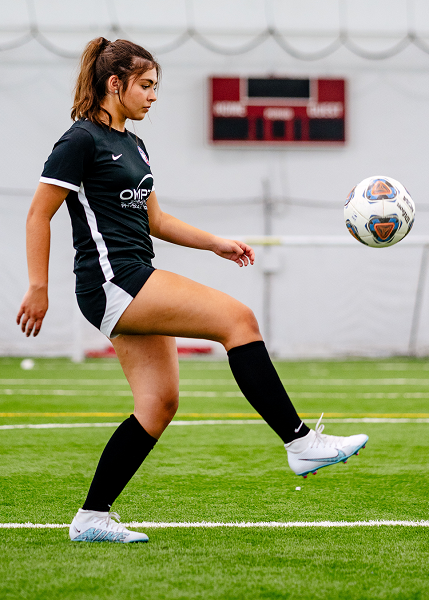
Macomb Lutheran North freshman Emiliana Manzo has already achieved a long list of accomplishments, including a 3.8 grade-point average while juggling two sports she loves.
 As a point guard, she led her basketball team to an undefeated season in its division. She is also a center attacking midfielder, sometimes playing forward, on the 2009 Nationals Girls Academy Blue soccer team, ranked No. 1 in Michigan and 14th in the country.
In June of 2022, Emiliana hit a detour on her sports journey when she was participating in a club soccer national championship in Oceanside, Calif. With a few seconds left in the game and her team up 2-1, she ran 20 yards full speed to get to the ball. Hyperextending her left knee, she felt two pops. It was the first time she experienced an injury.
“I was screaming and crying and got taken off the field on a golf cart,” explains Emiliana. The trainer felt she was OK. Fortunately, she had the next day off and her knee was feeling better. The following day she played again, and 20 minutes into the game she knew there was an issue.
“Someone hit me from behind and I heard the pop again. I knew there was a problem.”
Emiliana’s father Vince Manzo said she experienced swelling, and the athletic trainer thought she may have a meniscus injury; however, she was able to continue to walk around during the championship in California before heading home.
Finding the Right Provider
Back in Michigan, Emiliana saw a few surgeons during her evaluation to seek treatment. When she met with Vasilios Bill Moutzouros, MD, chief of Sports Medicine at Henry Ford Health, she felt she met the right match.
“He treated me like an athlete and made me feel really comfortable,” she says.
 Vince adds that both he and Emiliana were also appreciative of something Dr. Moutzouros said during her evaluation: “He emphasized to Emiliana that she was an athlete before this injury, and she would be an athlete after the injury.”
A detailed evaluation by Dr. Moutzouros revealed Emiliana had a complete anterior cruciate ligament (ACL) tear and medial and lateral meniscal tears. The meniscus, a C-shaped piece of tough, rubbery cartilage, acts as a shock absorber between the shinbone and the thighbone. It is one of the most common knee injuries. The ACL, one of the strong bands of tissue that help connect the thigh bone (femur) to the shinbone (tibia), is also prone to injury during sports when there are sudden stops or changes in direction.
Emiliana required physical therapy to get the swelling down and increase mobility before surgical repair.
Dr. Moutzouros reconstructed her ACL with her own patellar tendon graft and repaired her medial meniscus.
“She handled the surgery well and has been working very hard in her rehabilitation,” he says. “Her high-level soccer experience likely helped in her recovery as her range of motion and strengthening advanced so quickly.”
Understandably, Emiliana was nervous and scared when she went into surgery but expressed appreciation for the little things from Henry Ford like hearing “great music” as she was entering surgery, which gave her a sense of calm.
“That’s when I knew I picked the right doctor,” she said.
The Road to Recovery
As part of her recovery, after surgery which took place in July of 2022, Emiliana has undergone six months of physical therapy to increase mobility and strength training to get her leg strong again.
She also participated in the Return to Sport Program at the Henry Ford Center for Athletic Medicine to optimize recovery.
“We loved it,” says Vince. “It gave us peace of mind.”
Dr. Moutzouros explains that ACL prevention and rehabilitation programs are critical, especially for women because they have a four times greater risk of ACL tear than men. He says performance training post-surgery, along with an injury prevention program for those playing cutting sports, can markedly reduce the likelihood of future ACL injury.
“At Henry Ford, we work with physical therapists across the Midwest as well as our own. They do a great job in following our Henry Ford specific post-ACL reconstruction protocol,” he says. “After therapy runs its course, we strongly encourage our athletes to undergo performance training to allow a smooth transition back to sport.”
Nick Parkinson, supervisor of Athletic Training and Sports Performance at Henry Ford Health, emphasizes that the return to sport program is designed to bridge the gap between rehabilitation and returning to full activity in your chosen sport.
“Many times, insurance limits rehabilitation to regaining activities of daily living and not necessarily rebuilding the skills needed to play a sport or return to activity,” Nick says. “This program provides an affordable option to fill this need and return athletes to competition at the highest level.”
As for Emiliana, who hopes to play soccer in college and pursue a career in the medical field, she says this experience has taught her to not be afraid of injuries and treatment. She has also used the experience to volunteer for a program through the Girls Academy which serves as an advisory board to come up with ideas to help with mental and physical issues girls her age may be facing.
“For other kids who experience injuries, I’ve learned that this does not define you,” she said. “You can push through it, recover from it and be way better than you even were before.”
To find a sports medicine doctor or athletic trainer at Henry Ford, visit henryford.com/athletes.