


AD Inducted to National Hall of Fame
May 7, 2014
By Geoff Kimmerly
Second Half editor
Winter gets hectic so quickly that we’re forced to save some intriguing items that come our way for a sunnier day – and that day is today.
Following are news, notes and a few key links collected over the last few months, including the national Hall of Fame induction of a longtime Michigan athletic director, local recognition for another and statewide acclaim for a group of students putting their video production equipment to good use benefiting all.
Ann Arbor AD Honored Nationally
Former Ann Arbor Huron athletic director Jane Bennett was among five inducted into the National Interscholastic Athletic Administrators Association Hall of Fame in December.
Bennett served 26 years as a teacher, coach, athletic director and assistant principal in Michigan before spending the last decade as a principal at two schools in Montana. She served as athletic director at Huron for 15 years through 2002-03. The NIAAA reported that during her final decade in that position, participation in athletics doubled.
Bennett, who received her bachelor’s and master’s degrees from the University of Michigan, began her career at Huron in 1977 as varsity softball coach and became a math teacher and the co-director of athletics a year later. She coached the softball team 14 seasons before moving into the full-time athletic director position. Bennett was co-founder of the Michigan High School Softball Coaches Association and served as MHSSCA president from 1982-87.
Among other achievements at Huron, Bennett was a leader in a successful campaign to gain voter approval of a $60 million bond package, which included $20 million to improve and expand athletic facilities. She also developed curriculum for an annual varsity captains/head coaches leadership training program and composed handbooks/guidebooks for coaches, athletes and parents.
Bennett also was a valuable contributor to the Michigan Interscholastic Athletic Administrators Association and the NIAAA. She was president of the MIAAA in 1993-94 and a state conference speaker on several occasions. Bennett also served in various NIAAA leadership positions including on the committee that developed the Leadership Training Institute in 1996.
Bennett was named MIAAA Athletic Director of the Year in 1998 and received its State Award of Merit in 1997. She received the MHSAA’s Women in Sports Leadership Award in 1995 and was inducted into the MHSSCA Hall of Fame in 1995. Prior to her selection to the NIAAA Hall of Fame, Bennett was honored with the NIAAA Distinguished Service Award in 1998 and the NIAAA Thomas E. Frederick Award of Excellence in 2000. In 2005, she was inducted into the National Council of Secondary School Athletic Directors Hall of Fame, having served as its president in 2003 and been selected as its Athletic Director of the Year in 1998.
PSL's Ward: 'Pillar' of Detroit Athletics
Alvin Ward, the executive director of athletics for the Detroit Public School League and a member of the MHSAA Representative Council, received a 2014 Pillar in the Community Award in April from the Coast II Coast All-Stars, a Detroit-based pro basketball team that plays in the American Basketball Association.
Ward has served as a teacher, assistant principal and principal as well for Detroit Public Schools, and directs programs with a combined 500 coaches and 4,500 athletes.
Linked up
- This winter, the MHSAA Representative Council adopted a number of football practice rules changes aimed at improving player acclimatization at the start of fall and reducing head trauma and injuries. The Adrian Daily Telegram’s Doug Donnelly got responses from a number of coaches from that area of the state; click to find out why they feel these changes are important.
- Port Huron Times Herald writer Paul Costanzo let people know about our Student Advisory Council through the experience of Marlette’s Connor Thomas, one of our juniors and a great contributor this school year.
Power of Awareness
The Kimberly Anne Gillary Foundation works to educate Michigan schools on sudden cardiac arrest and train personnel in CPR and the use of an AED (automated external defibrillator). The video below teaches us again about the importance of awareness.
Saginaw Heritage was awarded $5,000 in April as the winner of the Gillary Foundation’s High School AED Contest. Students were asked to create a 3-minute video emphasizing the importance of Michigan high schools being adequately prepared to respond to a sudden cardiac arrest or related event on school property.
Randy and Sue Gillary created the foundation after their 15-year-old daughter Kimberly – an athlete at Troy Athens – died after suffering sudden cardiac arrest in 2000. The contest judges were Kimberly’s sisters Emily Kucinich, Jennifer Gregroy and Katie Gillary.
As of April 1, the Gillary Foundation had raised $1.2 million and donated 650 AEDs to schools – with three lives having been saved with donated AEDs. For more, click www.kimberlysgift.org.
Midland Heroes Win 'Match of Life' In Saving Another On Way to Regional
By
Paul Costanzo
Special for MHSAA.com
February 22, 2023
Wilson Shinske woke up Saturday hoping to accomplish something great.
 But the Midland senior had no idea just how great and impactful his accomplishment would be, and that it would happen well before he stepped on a wrestling mat.
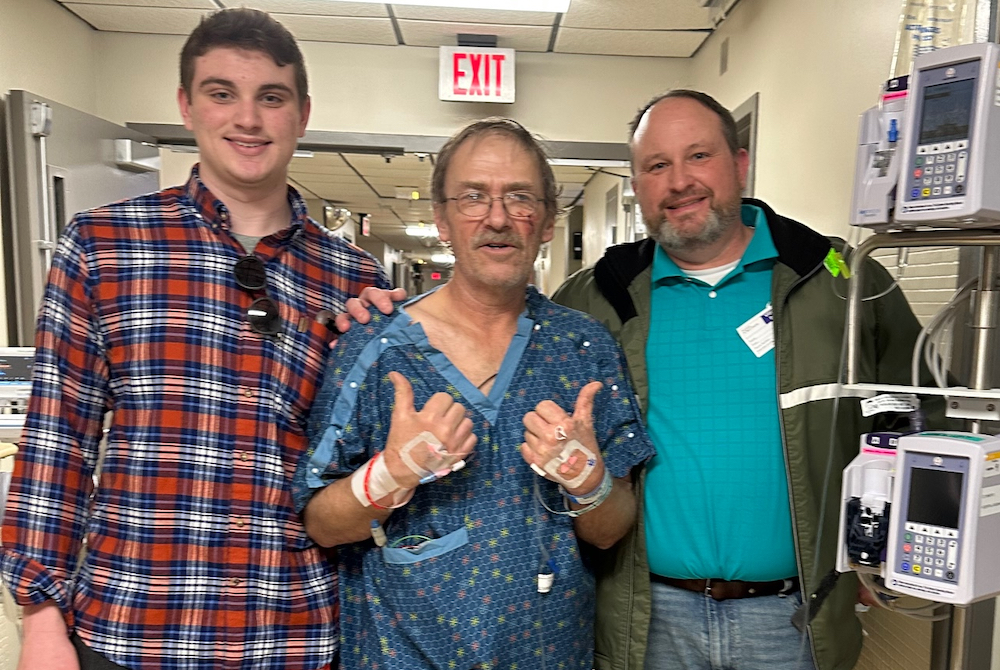
On the way to the Division 1 Wrestling Regional at Hartland, Shinske and his dad, Steve, pulled a man from a burning vehicle on I-75 and helped resuscitate him on the side of the road. As the man was taken by ambulance to a local hospital, the Shinskes got back in their own vehicle and made it to the meet in time for weigh-ins.
“The entire way there, I was thinking, ‘It doesn’t matter if I lose or if I win today, this was a win,’” Wilson Shinske said. “Being on the wrestling team is about being part of something bigger than yourself. Yeah, I lost both of my matches, and it was like that journey has ended. But knowing what I did earlier, I won the match of life.”
Shinske finished his wrestling season with a 21-11 record after dropping his pair of Regional matches at 215 pounds. While all of that was certainly important to him, and the end of any senior season can be tough, the events of Saturday morning put a lot of things in perspective.
“I can tell you that I was proud as hell of him,” Steve Shinske said. “I was super proud of how he handled the morning. I was proud – I’m always proud of him when he does a sport, even when he thinks he doesn’t do well. When he lost, I saw him take those losses on Saturday differently than he had in the past in some of those situations. I think he had a different mindset. After he lost the second match, he went over and sat by a wall, and there were some tears shed. There were a ton of emotions, and not just wrestling emotions.”
Wilson Shinske’s day had started like hundreds of wrestlers around the state, as he left Midland around 5:30 a.m. focused on advancing to the MHSAA Individual Finals at Ford Field.
He fell asleep during the ride, but when the car started to slow down well before he thought it should, he knew something was off.
After coming over the Zilwaukee Bridge, Steve Shinske noticed a car fire ahead. As they approached, the retired Midland fireman decided he would stop and see how he could help, figuring he would see someone outside of the vehicle.
 What he saw, however, was the driver slumped over in the front seat of the pickup truck. He pulled to the side of the road, and as he made his way to the truck, so did Wilson, who had now woken up from his pre-meet nap.
“It was 75 at 6 a.m. on a Saturday with no traffic; there’s no way we should be slowing down,” Wilson remembered. “As soon as he put it in park, not even a second later, I’m out of the car.”
As the Shinskes got to the vehicle, Steve noticed the driver – whose name they would later learn is Jerry – still had his foot crammed on the accelerator. That left the rear tires spinning until the tires had burned off and the rims were grinding on the pavement, which caused the fire at the back of the truck. His first move was to put the car in park and shut it off.
They removed Jerry – who they determined was not breathing and did not have a pulse – from the truck, and then Wilson’s training kicked in.
Wilson – a three-sport athlete who carries a 3.8 GPA – plans to study nursing in college, and spends much of his school day working in a hospital as part of a co-op. He’s CPR-certified and plans to work in the ER or a trauma unit.
A point of emphasis in Wilson’s training is to assess the situation in an emergency.
“The car is on fire, the gas tank is in the back of the car, we need to get him away from this,” Wilson said. “We need to get him up in front of our car – put a barrier between us to protect us if something happened. I don’t think there were really any nerves, just more fight or flight. I’m not running away, I’m fighting this. I wasn’t concerned with how cold it was – I wasn’t dressed for 20-degree weather – it was, ‘We have a problem here, let’s fix this problem.’”
Steve started CPR on Jerry while Wilson went back to see if they could find any personal information about him that would help, and 9-1-1 was called.
An off-duty paramedic then arrived on the scene, and put in a call to her supervisor for more assistance. That’s when Wilson took over CPR, and Steve went to put out the fire using snow from the median.
When the supervisor arrived, he brought out an AED to deliver a shock to Jerry’s heart. After some more CPR, Jerry took a gasp of air, and the monitor showed that there was heart activity.
“Then the cavalry came,” Steve said of the rush of emergency vehicles on the scene. He borrowed a fire extinguisher from a police officer to put out the remaining flames, and Jerry was loaded into an ambulance. Wilson said he could see Jerry taking breaths as he was being put into the ambulance.
The whole situation took about 15 to 20 minutes.
“Wilson’s played a lot of sports – football, tennis, he’s wrestled since he’s been 6, he plays golf – he understands that sports gives you perseverance, it gives you a different mindset,” Steve said. “I bet anybody that he works with on the floor at the hospital will tell you that he’s the most outgoing, go-getter co-op student they’ve had. Those things in his life helped him in that situation.”
Jerry survived, and the Shinskes went to visit him in the hospital Monday. While there, they learned from the family that the fire had started to melt the gas tank before Steve was able to put it out. They also learned that Jerry’s wife had recently passed away, and that their quick action had prevented his family from adding another layer of grief in a very short time.
“I love watching (Wilson) wrestle, and I’m going to miss watching him wrestle,” Steve Shinske said. “But watching him on I-75 on Saturday morning was almost better than watching him wrestle. He, as a young man, as a person that’s getting ready to go into the next phase of his life, to be able to handle something like that and not miss a beat was special.”
For Wilson, the experience further cemented his chosen career path, and desire to help others.
“I want to be a part of saving lives more often,” he said. “Not that I want to see people in these situations, but I want to help them when they are.”
 Paul Costanzo served as a sportswriter at The Port Huron Times Herald from 2006-15, including three years as lead sportswriter, and prior to that as sports editor at the Hillsdale Daily News from 2005-06. He can be reached at [email protected] with story ideas for Genesee, Lapeer, St. Clair, Sanilac, Huron, Tuscola, Saginaw, Bay, Arenac, Midland and Gladwin counties.
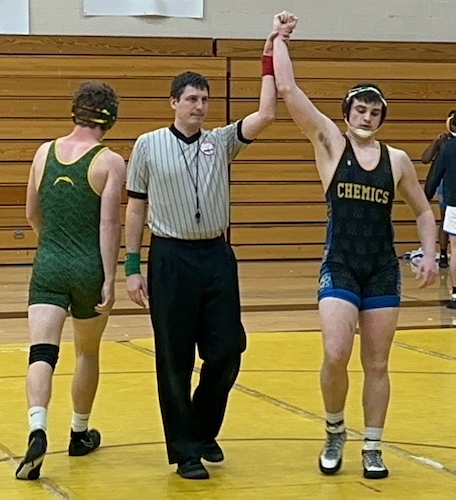
PHOTOS (Top) From left: Wilson Shinske, Jerry and Steve Shinske meet Monday, two days after the father and son helped save Jerry’s life on I-75. (Middle) Wilson Shinske, far right, has his arm raised in victory after a match. (Photos courtesy of the Shinske family, with permission.)