


AD Inducted to National Hall of Fame
May 7, 2014
By Geoff Kimmerly
Second Half editor
Winter gets hectic so quickly that we’re forced to save some intriguing items that come our way for a sunnier day – and that day is today.
Following are news, notes and a few key links collected over the last few months, including the national Hall of Fame induction of a longtime Michigan athletic director, local recognition for another and statewide acclaim for a group of students putting their video production equipment to good use benefiting all.
Ann Arbor AD Honored Nationally
Former Ann Arbor Huron athletic director Jane Bennett was among five inducted into the National Interscholastic Athletic Administrators Association Hall of Fame in December.
Bennett served 26 years as a teacher, coach, athletic director and assistant principal in Michigan before spending the last decade as a principal at two schools in Montana. She served as athletic director at Huron for 15 years through 2002-03. The NIAAA reported that during her final decade in that position, participation in athletics doubled.
Bennett, who received her bachelor’s and master’s degrees from the University of Michigan, began her career at Huron in 1977 as varsity softball coach and became a math teacher and the co-director of athletics a year later. She coached the softball team 14 seasons before moving into the full-time athletic director position. Bennett was co-founder of the Michigan High School Softball Coaches Association and served as MHSSCA president from 1982-87.
Among other achievements at Huron, Bennett was a leader in a successful campaign to gain voter approval of a $60 million bond package, which included $20 million to improve and expand athletic facilities. She also developed curriculum for an annual varsity captains/head coaches leadership training program and composed handbooks/guidebooks for coaches, athletes and parents.
Bennett also was a valuable contributor to the Michigan Interscholastic Athletic Administrators Association and the NIAAA. She was president of the MIAAA in 1993-94 and a state conference speaker on several occasions. Bennett also served in various NIAAA leadership positions including on the committee that developed the Leadership Training Institute in 1996.
Bennett was named MIAAA Athletic Director of the Year in 1998 and received its State Award of Merit in 1997. She received the MHSAA’s Women in Sports Leadership Award in 1995 and was inducted into the MHSSCA Hall of Fame in 1995. Prior to her selection to the NIAAA Hall of Fame, Bennett was honored with the NIAAA Distinguished Service Award in 1998 and the NIAAA Thomas E. Frederick Award of Excellence in 2000. In 2005, she was inducted into the National Council of Secondary School Athletic Directors Hall of Fame, having served as its president in 2003 and been selected as its Athletic Director of the Year in 1998.
PSL's Ward: 'Pillar' of Detroit Athletics
Alvin Ward, the executive director of athletics for the Detroit Public School League and a member of the MHSAA Representative Council, received a 2014 Pillar in the Community Award in April from the Coast II Coast All-Stars, a Detroit-based pro basketball team that plays in the American Basketball Association.
Ward has served as a teacher, assistant principal and principal as well for Detroit Public Schools, and directs programs with a combined 500 coaches and 4,500 athletes.
Linked up
- This winter, the MHSAA Representative Council adopted a number of football practice rules changes aimed at improving player acclimatization at the start of fall and reducing head trauma and injuries. The Adrian Daily Telegram’s Doug Donnelly got responses from a number of coaches from that area of the state; click to find out why they feel these changes are important.
- Port Huron Times Herald writer Paul Costanzo let people know about our Student Advisory Council through the experience of Marlette’s Connor Thomas, one of our juniors and a great contributor this school year.
Power of Awareness
The Kimberly Anne Gillary Foundation works to educate Michigan schools on sudden cardiac arrest and train personnel in CPR and the use of an AED (automated external defibrillator). The video below teaches us again about the importance of awareness.
Saginaw Heritage was awarded $5,000 in April as the winner of the Gillary Foundation’s High School AED Contest. Students were asked to create a 3-minute video emphasizing the importance of Michigan high schools being adequately prepared to respond to a sudden cardiac arrest or related event on school property.
Randy and Sue Gillary created the foundation after their 15-year-old daughter Kimberly – an athlete at Troy Athens – died after suffering sudden cardiac arrest in 2000. The contest judges were Kimberly’s sisters Emily Kucinich, Jennifer Gregroy and Katie Gillary.
As of April 1, the Gillary Foundation had raised $1.2 million and donated 650 AEDs to schools – with three lives having been saved with donated AEDs. For more, click www.kimberlysgift.org.
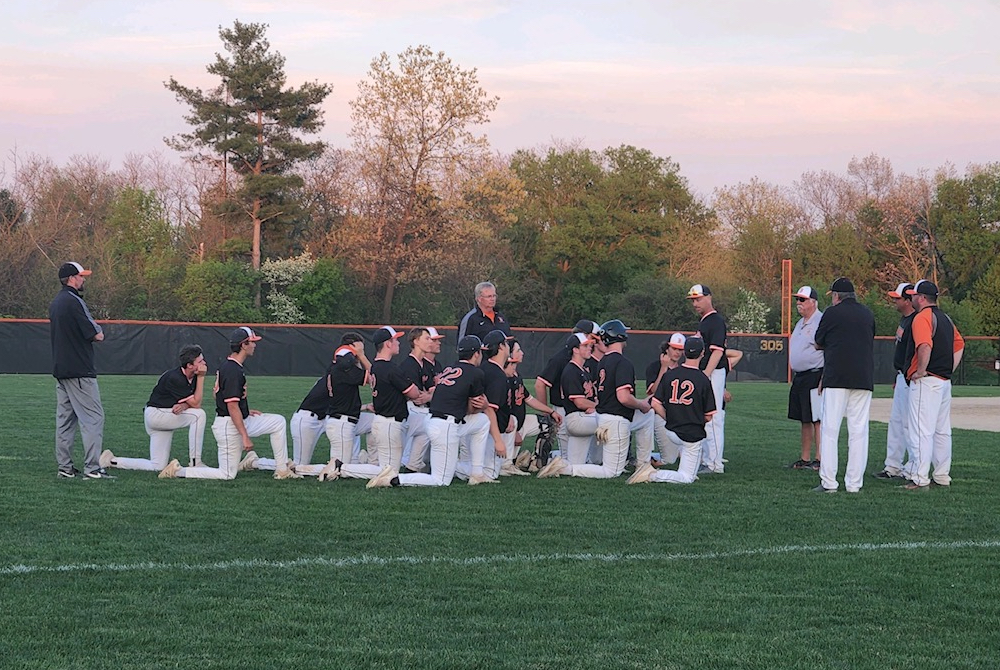
Brighton Baseball, Community Rally as Coach Comes Back Strong from Health Scare
By
Tim Robinson
Special for MHSAA.com
July 13, 2022
At first, Charlie Christner thought it was a case of heartburn.
 It was Jan. 12. He had taught social studies at Scranton Middle School for five hours and now was beginning his prep hour by preparing for his other job as baseball coach at Brighton High School.
“I was actually … in my last hour (of) the day, and just started having heartburn,” he said.
So he made a quick trip to a nearby store to get an over-the-counter heartburn remedy.
“I wanted something to help me before I went to (offseason) hitting,” he recalled.
But the feeling didn’t go away, and about 4 p.m. Christner told his coaches he wasn’t feeling well and was going home.
He didn’t get there.
“I made it about a mile down the road and had to pull over and just started throwing up,” he said. “(I) felt better and started back down the road and stopped, (and) just started throwing up again, and I said ‘I’ve got to get to the hospital.’”
He called his wife, Jackie, who was at home working, and she rushed to the hospital.
Once he was admitted, Christner was diagnosed with pancreatitis.
Waiting out a serious situation
The pancreas is a gland located under the stomach which secretes hormones, including insulin, to aid in digestion.
In Charlie’s case, gallstones had blocked the ducts connecting his pancreas to his small intestine. This, in turn, was leading to part of the tissue in his pancreas beginning to die.
Over the next several weeks, the Christners made several trips to the hospital while he dealt with pain and a gradual buildup of fluid due to a cyst that had formed around the inflammation in his pancreas. The cyst made him feel full all of the time and made it difficult to eat or drink.
The pain medication affected him, too.
“It messed up his thought process a little,” Jackie said. “Some days he didn't know what day it was or, you know, he doesn't remember those days.”
Although the diagnosis was fairly swift — the Christners knew from the beginning what was wrong and what needed to be done — surgery was delayed for nearly two months to let the inflammation in his pancreas go down.
But it was still a serious situation.
“It’s a most sobering experience to have a surgeon come out and tell you your son is very sick and it’s a very serious situation and has a 70 percent chance of survival,” said Dan Christner, who coaches with his son after a long career as a basketball coach at Brighton. “I’ve seen enough missed free throws to know that if you make 70 percent of your free throws, that means 30 percent aren’t going in. It gives you pause, and (you) say let’s make sure we’re a part of that 70 percent.”
 The delay was to help increase those odds.
“They didn't want to do surgery (right away) because of all the inflammation and everything that's going on inside your body,“ Charlie said. “If you have to do it soon, then you end up being in a position where the odds of surviving are less if we have to do emergency surgery. So they delayed it.”
Charlie and Jackie made several trips to and from the hospital during the six weeks after the initial diagnosis.
When he felt up to it, Charlie was working on lesson plans along with administrative tasks while his coaches ran offseason workouts.
“He really wanted to make sure things were coordinated,” Jackie said. “And you know, that's Charlie to a T. He wants to make sure that everything runs smoothly and in that, you know, he's informed of any decisions or changes or things that are happening with the team.”
A veteran coaching staff, led by former Pinckney baseball coach Matt Evans, stepped into the breach.
“I think the big thing on our part was making sure that it was business as usual,” Evans said. “We weren’t going to let Charlie not being there through the winter be an excuse for why we performed or didn’t perform. He’s been a stable force and head of the program for a number of years now. We knew what we needed to do, and so it was about executing a plan that's pretty familiar to us.”
Christner went to a few offseason workouts, watching from a chair.
“(Jackie) would drive me up to hitting and I'd sit in there and watch the guys for as long as I could, 30 minutes or an hour, just to give me something to do," Charlie said. “Otherwise it was, you know, a lot of daytime TV and naps. I did do some stuff with baseball during that time, even if it was just to go watch hitting for an hour and talk to the coaches on how kids are doing. ... It gave me definitely something to do and something to look forward to.”
In the meantime, the Christners were flooded with cards, texts and phone calls of support, prompting Jackie to post regular updates on her Facebook page to lighten that load.
Their families were supportive, as was the community.
“Everybody was so gracious and heartwarming and opened their arms to us and said, ‘anything you need,’” Jackie said. “There's nothing that we really needed that the community could help us with too much because we were just stuck in a hospital, just kind of sitting there waiting for medicines, waiting for diagnosis, waiting for the doctor to progress the treatment, etc. And that was kind of what we needed.”
“I’m proud of the way that everybody came together and did what had to be done, and how excited people were to see him," Evans said. “That speaks to the time that Charlie’s put into this program over the last however many years as a coach, Any time you’re a coach, you look for those moments you can point to as having a positive impact on kids and the baseball community and all those things, and I would say the willingness of everyone to pitch in is a testament to how much he’s appreciated as part of the Brighton baseball community.”
On the way back
Surgery was March 3. Christner’s gallbladder was removed, along with the dead tissue on his pancreas. A pair of cysts were drained, and he went home a few days later.
Christner, always slender in physique, had lost 40 pounds – 10 of which liquid that had been building up in the cysts.
But, albeit from a chair, he was at tryouts March 15.
His voice was weak at first, but he made his presence known.
“When he was back at tryouts, those first couple times, he would cut loose and let out a yell,” Evans said. “And it was ‘OK, Charlie’s back, and he’s in it,’ and that made everyone feel good. Same old Charlie. He’s locked in. Same old competitor.”
A frustrated competitor, at one point, irritated because fungos weren’t being hit by his coaches in the manner he prefers. But he coached from third base, albeit from his normal spot a step or two from the dugout.
He progressed from liquids to solid food (his first solid food was pizza), and returned to the classroom April 12, three months to the day his medical odyssey began.
After an 8-8 start, the Bulldogs won District and Regional titles before falling in a Division 1 Quarterfinal.
The healing continues, but things are back on schedule for Christner, who turned 40 on Saturday.
He’s not outwardly emotional. He appreciates the love and support he and his family have received, but also wishes he could have accomplished more for his team during the time he was critically ill.
Jackie Christner is not as reserved.
“I just thank God every day that he is healthy,” said Jackie, who married Charlie in 2019. “And yes, our bond has strengthened. I think everything for us just knowing that we need each other and we need people in our lives as everybody does. But especially to know that we had each other and he had me. He often said, ‘I don't know what I would do if you weren't here. I don't know what I would do. If I hadn't met you, this would be 10 times harder to go through if you weren't here.’"
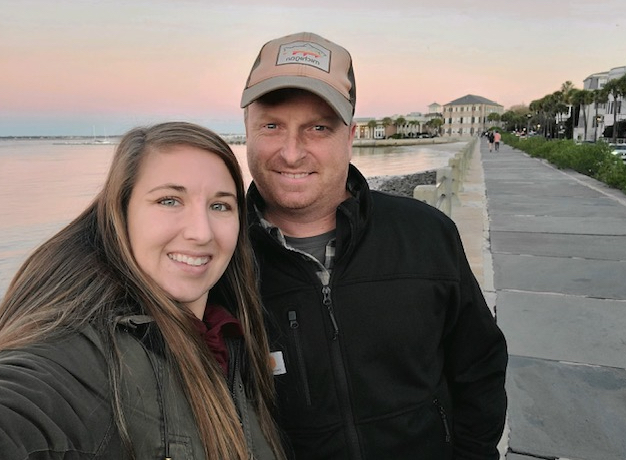
PHOTOS (Top) Brighton varsity baseball coach Charlie Christner, fifth from right, addresses his team. (Middle) Charlie and wife Jackie Christner enjoy a moment on the lakeshore. (Photos courtesy of Jackie Christner.)