


AD Inducted to National Hall of Fame
May 7, 2014
By Geoff Kimmerly
Second Half editor
Winter gets hectic so quickly that we’re forced to save some intriguing items that come our way for a sunnier day – and that day is today.
Following are news, notes and a few key links collected over the last few months, including the national Hall of Fame induction of a longtime Michigan athletic director, local recognition for another and statewide acclaim for a group of students putting their video production equipment to good use benefiting all.
Ann Arbor AD Honored Nationally
Former Ann Arbor Huron athletic director Jane Bennett was among five inducted into the National Interscholastic Athletic Administrators Association Hall of Fame in December.
Bennett served 26 years as a teacher, coach, athletic director and assistant principal in Michigan before spending the last decade as a principal at two schools in Montana. She served as athletic director at Huron for 15 years through 2002-03. The NIAAA reported that during her final decade in that position, participation in athletics doubled.
Bennett, who received her bachelor’s and master’s degrees from the University of Michigan, began her career at Huron in 1977 as varsity softball coach and became a math teacher and the co-director of athletics a year later. She coached the softball team 14 seasons before moving into the full-time athletic director position. Bennett was co-founder of the Michigan High School Softball Coaches Association and served as MHSSCA president from 1982-87.
Among other achievements at Huron, Bennett was a leader in a successful campaign to gain voter approval of a $60 million bond package, which included $20 million to improve and expand athletic facilities. She also developed curriculum for an annual varsity captains/head coaches leadership training program and composed handbooks/guidebooks for coaches, athletes and parents.
Bennett also was a valuable contributor to the Michigan Interscholastic Athletic Administrators Association and the NIAAA. She was president of the MIAAA in 1993-94 and a state conference speaker on several occasions. Bennett also served in various NIAAA leadership positions including on the committee that developed the Leadership Training Institute in 1996.
Bennett was named MIAAA Athletic Director of the Year in 1998 and received its State Award of Merit in 1997. She received the MHSAA’s Women in Sports Leadership Award in 1995 and was inducted into the MHSSCA Hall of Fame in 1995. Prior to her selection to the NIAAA Hall of Fame, Bennett was honored with the NIAAA Distinguished Service Award in 1998 and the NIAAA Thomas E. Frederick Award of Excellence in 2000. In 2005, she was inducted into the National Council of Secondary School Athletic Directors Hall of Fame, having served as its president in 2003 and been selected as its Athletic Director of the Year in 1998.
PSL's Ward: 'Pillar' of Detroit Athletics
Alvin Ward, the executive director of athletics for the Detroit Public School League and a member of the MHSAA Representative Council, received a 2014 Pillar in the Community Award in April from the Coast II Coast All-Stars, a Detroit-based pro basketball team that plays in the American Basketball Association.
Ward has served as a teacher, assistant principal and principal as well for Detroit Public Schools, and directs programs with a combined 500 coaches and 4,500 athletes.
Linked up
- This winter, the MHSAA Representative Council adopted a number of football practice rules changes aimed at improving player acclimatization at the start of fall and reducing head trauma and injuries. The Adrian Daily Telegram’s Doug Donnelly got responses from a number of coaches from that area of the state; click to find out why they feel these changes are important.
- Port Huron Times Herald writer Paul Costanzo let people know about our Student Advisory Council through the experience of Marlette’s Connor Thomas, one of our juniors and a great contributor this school year.
Power of Awareness
The Kimberly Anne Gillary Foundation works to educate Michigan schools on sudden cardiac arrest and train personnel in CPR and the use of an AED (automated external defibrillator). The video below teaches us again about the importance of awareness.
Saginaw Heritage was awarded $5,000 in April as the winner of the Gillary Foundation’s High School AED Contest. Students were asked to create a 3-minute video emphasizing the importance of Michigan high schools being adequately prepared to respond to a sudden cardiac arrest or related event on school property.
Randy and Sue Gillary created the foundation after their 15-year-old daughter Kimberly – an athlete at Troy Athens – died after suffering sudden cardiac arrest in 2000. The contest judges were Kimberly’s sisters Emily Kucinich, Jennifer Gregroy and Katie Gillary.
As of April 1, the Gillary Foundation had raised $1.2 million and donated 650 AEDs to schools – with three lives having been saved with donated AEDs. For more, click www.kimberlysgift.org.

Retired MHSAA Executive Director Roberts Selected for NFHS Hall of Fame
By
Geoff Kimmerly
MHSAA.com senior editor
March 8, 2022
During an award introduction two years ago, MHSAA associate director Tom Rashid described his longtime close friend Jack Roberts as the leader who “took our darkest hours and problems and turned them into positives.”
The MHSAA has faced its share of challenging times, and those may have been among Roberts’ finest hours over 32 years as MHSAA executive director – and admittedly the times when his adrenaline flowed most. But there were many more good times and memorable advances for Michigan school sports under his leadership, and he will be recognized again this summer both for those and a lifetime of service to school sports in this state and across the nation.
John E. “Jack” Roberts was one of 12 honorees announced Tuesday as this year’s inductees into the National High School Sports Hall of Fame by the National Federation of State High School Associations (NFHS). He will be inducted as one of three former state association administrators selected for the 39th Hall of Fame class at a ceremony during the NFHS summer meeting July 1 in San Antonio, Texas.
He began his tenure as MHSAA executive director in 1986, and at the time of his retirement he was the nation’s longest-serving executive director of a state high school athletic association. He was the fourth person to serve the MHSAA in that leadership role full time, following Charles E. Forsythe (1931-42, 1945-68), Allen W. Bush (1968-78) and Vern L. Norris (1978-86).
Roberts will become the Hall of Fame’s ninth inductee from Michigan, joining Forsythe (inducted 1983), River Rouge boys basketball coach Lofton Greene (1986), Warren Regina athletic director, softball and basketball coach Diane Laffey (2000), Fennville basketball and baseball standout Richie Jordan (2001), Grosse Pointe Woods University Liggett boys and girls tennis coach Bob Wood (2005), Bloomfield Hills Cranbrook hockey standout Jim Johnson (2007), Owosso football, basketball and baseball all-stater Brad Van Pelt (2011); and Vermontville Maple Valley baseball national record holder Ken Beardslee (2016).
Roberts also follows in the footsteps of his late father, John Roberts, who served as executive director of the Wisconsin Interscholastic Athletic Association from 1957-85 and was inducted into the National High School Hall of Fame in 2000. They will be the first father-son team in the Hall of Fame.
Jack Roberts began his career serving as an assistant director for the National Federation from 1973-80. He was involved with the implementation of Title IX at the local and state levels and made immense contributions as the NFHS representative to the landmark Amateur Sports Act of 1978, and also played a significant role in the NFHS rules-writing process as the organization started writing and publishing rules for a number of new sports during the 1970s.
The MHSAA enjoyed continued growth under Roberts’ guidance, particularly in the number of Michigan students participating in athletics and in the number of MHSAA-sponsored tournament sports available to them. Several key rules changes came under Roberts’ watch and direction, and he made the MHSAA a national leader in health and safety efforts particularly in the areas of head injury care, heart safety initiatives and heat management strategies.
“I had a head start in this work. Growing up in the home of the executive director of the Wisconsin Interscholastic Athletic Association and then spending most of my 20s working for the National Federation office, and much of it with (longtime NFHS executive director) Cliff Fagan, was a jumpstart on this career,” Roberts said. “But I’m also satisfied at this point that, to paraphrase Hamilton in the musical ‘Hamilton,’ I didn’t give up on my shot. I was given a shot, I took it and I didn’t waste the chance.
“The job fit me, and I think I maxed the opportunity I had to serve educational athletics in this job, and that’s satisfying to think about at this time.”
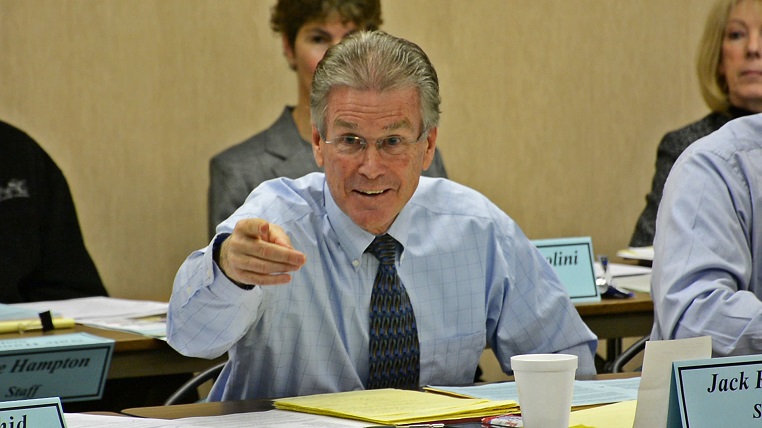 Under Roberts’ leadership, overall participation in high school athletics in Michigan increased 10 percent, and the MHSAA added more than 200 schools in increasing its membership by more than 15 percent at the high school and junior high/middle school levels combined. His tenure saw the addition of girls competitive cheer (1994), girls & boys bowling (2004) and girls & boys lacrosse (2005) to the MHSAA Tournament sport lineup, the creation of a separate wrestling tournament to determine champions by team format (1988), and 8-player football (2010, first playoffs 2011) as many small schools across the state began having trouble fielding 11-player teams because of enrollment and population decreases. Meanwhile, also under his leadership, the 11-player Football Playoffs expanded, doubling to 256 teams in 1999.
Among rules changes put in place during Roberts’ tenure was the addition of opportunities for multiple schools to create cooperative teams in sports where participation is lagging. He also helped Michigan become a national leader in improving sportsmanship; a comprehensive package enacted in 1996 set a statewide tone for appropriate behavior and perspective that continues to make an impact today.
Perhaps the most significant influences by Roberts came on the topics of health and safety. The MHSAA has led nationally in concussion care with its first programming in 2000 and return-to-play protocols enacted in 2010, and with mandated concussion reporting and insurance for those who suffer head injuries rolled out in 2015. A heat management policy and CPR requirements for coaches were introduced in 2013.
Also under this leadership, the first program for coaches education was launched in 1987 and evolved into the Coaches Advancement Program, with nearly 34,000 courses administered as part of CAP since 2004-05. The Women in Sports Leadership Conference was created in 1989 and remains the first, largest and longest-running program of its type in the country, regularly drawing upwards of 500 participants. The first of now-annual statewide Athletic Director In-Service Programs was conducted in 1992, and Michigan also remains a national leader in student services thanks to a variety of programs that were introduced under Roberts’ leadership.
Internally, he put the MHSAA on the leading edge nationally when it came to use the technology, especially in the realm of communications, where he put special emphasis on telling the story of school sports. “I think I was considered a conservative as to rules for eligibility and competition, and a progressive in how we delivered services to schools and school sports,” Roberts said.
In addition to his work specifically in Michigan, Roberts carried significant influence at the national level. He served as part of the NFHS Board of Directors and led the creation of the NFHS Network for video productions in 2012, serving as that board’s chairperson. He also has served on the board of directors of the National Association of Sports Officials (NASO).
“For 32 years, Jack Roberts was the epitome of what leadership looks like. He was the strongest advocate for high school sports that anyone could ever hope for,” said MHSAA Executive Director Mark Uyl, who succeeded Roberts in 2018. “He is without question one of the preeminent pioneers and difference-makers in the world of high school sports over the past 100 years.
“And other than my father, there has not been a man who has had a bigger impact and positive influence on my life personally than Jack Roberts.”
The National High School Hall of Fame was started in 1982 by the NFHS, and the rest of this year’s class is made up of athletes, coaches, administrators and an official. The 12 individuals were chosen after a two-level selection process involving a screening committee composed of active high school state association administrators, coaches and officials, and a final selection committee composed of coaches, former athletes, state association officials, media representatives and educational leaders. Nominations were made through NFHS member associations. Also chosen for this class were athletes Notah Begay (New Mexico), Walter Payton (Mississippi), Sanya Richards-Ross (Florida) and Thurman Thomas (Texas); sport coaches Ray Crowe (Indiana), Ron Kordes (Kentucky) and Lamar Rogers (Tennessee); administrators E. Wayne Cooley (Iowa) and Becky Oakes (Missouri), official Jeff Risk (North Dakota) and speech/debate coach Susan McLain (Oregon). (Click for more.)
Roberts came to the MHSAA in 1986 from the Fellowship of Christian Athletes, which he served as executive vice president. He is a 1970 graduate of Dartmouth College and taught English and coached football at high schools in Milwaukee and Denver before joining the NFHS staff.
He and his wife Peggy reside in East Lansing, and in retirement they together have increased their contributions to environmental matters and international refugee issues while both serving in leadership roles. Jack Roberts has served as board president for the Refugee Development Center in Lansing for 13 years, and Peggy Roberts served six years as chairperson of the board for Lansing’s Fenner Nature Center. As part of their environmental work, the Roberts are working within a small group of organizations to help them acquire and preserve land.