


AD Inducted to National Hall of Fame
May 7, 2014
By Geoff Kimmerly
Second Half editor
Winter gets hectic so quickly that we’re forced to save some intriguing items that come our way for a sunnier day – and that day is today.
Following are news, notes and a few key links collected over the last few months, including the national Hall of Fame induction of a longtime Michigan athletic director, local recognition for another and statewide acclaim for a group of students putting their video production equipment to good use benefiting all.
Ann Arbor AD Honored Nationally
Former Ann Arbor Huron athletic director Jane Bennett was among five inducted into the National Interscholastic Athletic Administrators Association Hall of Fame in December.
Bennett served 26 years as a teacher, coach, athletic director and assistant principal in Michigan before spending the last decade as a principal at two schools in Montana. She served as athletic director at Huron for 15 years through 2002-03. The NIAAA reported that during her final decade in that position, participation in athletics doubled.
Bennett, who received her bachelor’s and master’s degrees from the University of Michigan, began her career at Huron in 1977 as varsity softball coach and became a math teacher and the co-director of athletics a year later. She coached the softball team 14 seasons before moving into the full-time athletic director position. Bennett was co-founder of the Michigan High School Softball Coaches Association and served as MHSSCA president from 1982-87.
Among other achievements at Huron, Bennett was a leader in a successful campaign to gain voter approval of a $60 million bond package, which included $20 million to improve and expand athletic facilities. She also developed curriculum for an annual varsity captains/head coaches leadership training program and composed handbooks/guidebooks for coaches, athletes and parents.
Bennett also was a valuable contributor to the Michigan Interscholastic Athletic Administrators Association and the NIAAA. She was president of the MIAAA in 1993-94 and a state conference speaker on several occasions. Bennett also served in various NIAAA leadership positions including on the committee that developed the Leadership Training Institute in 1996.
Bennett was named MIAAA Athletic Director of the Year in 1998 and received its State Award of Merit in 1997. She received the MHSAA’s Women in Sports Leadership Award in 1995 and was inducted into the MHSSCA Hall of Fame in 1995. Prior to her selection to the NIAAA Hall of Fame, Bennett was honored with the NIAAA Distinguished Service Award in 1998 and the NIAAA Thomas E. Frederick Award of Excellence in 2000. In 2005, she was inducted into the National Council of Secondary School Athletic Directors Hall of Fame, having served as its president in 2003 and been selected as its Athletic Director of the Year in 1998.
PSL's Ward: 'Pillar' of Detroit Athletics
Alvin Ward, the executive director of athletics for the Detroit Public School League and a member of the MHSAA Representative Council, received a 2014 Pillar in the Community Award in April from the Coast II Coast All-Stars, a Detroit-based pro basketball team that plays in the American Basketball Association.
Ward has served as a teacher, assistant principal and principal as well for Detroit Public Schools, and directs programs with a combined 500 coaches and 4,500 athletes.
Linked up
- This winter, the MHSAA Representative Council adopted a number of football practice rules changes aimed at improving player acclimatization at the start of fall and reducing head trauma and injuries. The Adrian Daily Telegram’s Doug Donnelly got responses from a number of coaches from that area of the state; click to find out why they feel these changes are important.
- Port Huron Times Herald writer Paul Costanzo let people know about our Student Advisory Council through the experience of Marlette’s Connor Thomas, one of our juniors and a great contributor this school year.
Power of Awareness
The Kimberly Anne Gillary Foundation works to educate Michigan schools on sudden cardiac arrest and train personnel in CPR and the use of an AED (automated external defibrillator). The video below teaches us again about the importance of awareness.
Saginaw Heritage was awarded $5,000 in April as the winner of the Gillary Foundation’s High School AED Contest. Students were asked to create a 3-minute video emphasizing the importance of Michigan high schools being adequately prepared to respond to a sudden cardiac arrest or related event on school property.
Randy and Sue Gillary created the foundation after their 15-year-old daughter Kimberly – an athlete at Troy Athens – died after suffering sudden cardiac arrest in 2000. The contest judges were Kimberly’s sisters Emily Kucinich, Jennifer Gregroy and Katie Gillary.
As of April 1, the Gillary Foundation had raised $1.2 million and donated 650 AEDs to schools – with three lives having been saved with donated AEDs. For more, click www.kimberlysgift.org.
MHSAA Neck Guard Requirement Rooted in 1999 'Impossible to Forget' Injury
By
Ron Pesch
MHSAA historian
February 3, 2022
Dan DiCristofaro has made it a mission to remind schools, coaches, athletic directors, and other officials of the need to enforce an equipment rule, added to the MHSAA hockey rule book more than 20 years ago.
“Officials are not trying to give out misconduct penalties,” wrote DiCristofaro in a recent email, “but the avoidance by so many players to wear this piece of equipment as intended in its unaltered state or to even wear a neck guard at all has become almost the norm instead of the exception.”
“This is mandatory,” emphasized the long-time hockey official during a recent conversation. “It’s required, not recommended. Required.”
As a witness to an unforgettable occurrence during a game, DiCristofaro wants others to do what they can to reduce the odds of that moment happening again.
Rivals
The Wednesday, Feb. 10, 1999, game between Trenton and Redford Catholic Central was a rematch – the second game of a home-and-home series that had been played for years. Two of the state’s hockey powerhouses, the foes were certainly familiar with each other.
“The rivalry between Trenton and Catholic Central has probably gone on since the 60s,” recalled Trenton coach Mike Turner.
 “They were usually two of the best teams in the state,” added Gordon St. John, Catholic’s coach at the time.
Both coaches were speaking in 2010, for REPLAY, a sports television series created by Gatorade, built around the re-staging of games between high school rivals. Fox Sports Net broadcast the game.
“If you go into our gymnasium, you will find 42 state banners,” noted Fr. Richard Ranalletti, principal at CC from 2000 to 2010. “Thirteen of them are in hockey” (1959, 1961, 1968, 1974, 1994, 1997, 1999, 2000, 2001, 2002, 2003, 2005, 2009). Founded in 1928, Detroit Catholic Central had moved to Redford Township 50 years later. (The campus moved again in 2005, this time to Novi.)
The city of Trenton was founded in 1834. A 1901 report in the Free Press speaks of architect Edward C. Leyen completing plans “for a high school building for the board of education of Trenton.”
“Since 1975, there’s 12 state championship banners (1976, 1979, 1980, 1982, 1986, 1991, 1996, 1998, 2003, 2004, 2008, 2009) hanging in our arena,” said Jerry Brown, Mayor of Trenton in his interview for the program.
Hank Minckiewicz, sports editor for the News-Herald in Trenton, summed it up: “Back in 1999, there was not a bigger rivalry in the state than Trenton and Catholic Central.”
Fifth-ranked Trenton had downed No. 1 CC, 1-0, at Redford Arena earlier in the 1999 season – the Shamrocks’ only loss at that point in the annual chase for a state title. The second game between the schools was played at Trenton’s Kennedy Recreation Center, then a single rink arena, before a full house. Catholic Central opened a 4-1 lead before the Trojans, dressed in their home white jerseys, stormed back to tie the game at 4-4 with about five minutes to play.
Nightmare Come to Life
The moment on the ice, caught on videotape, appears harmless enough.
“Late in the game, a Trenton player knocked a CC player off balance, sending his leg back into the air.” recounted Bill Roose in the Detroit Free Press, describing the freak accident that nearly took the life of Trojans senior Kurt LaTarte.
A 6-foot defenseman, LaTarte had been near the play and initially continued toward the puck, but then circled back and headed to the Trenton bench.
Lori Holcomb, a team trainer for Trenton, recalled the moment for REPLAY, documenting the night.
“Kurt was coming on to the bench, and he was kind of holding the side of his face and his neck and he said, ‘The kid’s boot hit me in the chin … I think my chin is cut.’
‘It was clean and straight,” she continued, “like surgical.”
It wouldn’t remain that way.
Guardian Angels
“The gash across the right side of his neck was four inches long and two inches wide,” wrote Roose in touching on the horror that quickly unfolded.
Chaos erupted on the Trenton bench as the color of LaTarte’s jersey changed from white to red.
“The game was so intense. … It was so jam-packed with people,” remembered DiCristofaro. “You couldn’t even hear yourself because it was so loud. We did not know that this had happened during the game until a linesman who happened to be standing next to the bench saw what was going on. … He’s the one who blew his whistle loud and kept blowing it for the play to actually stop.
“Once it all hit home and the play stopped … everybody went stone silent. Once everybody knew what was happening and everybody was informed, the players started kneeling, a lot of them were crying.”
The game was ended.
“Fortunately,” stated Roose, “(there were) a few guardian angels among the … spectators.”
Dr. David Wolf, nurse Leslie Zancanaro and firefighter Alec Lesko were all at the game because they had sons on Trenton’s team.
Wolf would accompany LaTarte to the hospital, “detailing his injuries to emergency room doctors” at Oakwood/Seaway Hospital in Trenton. Surgery that night repaired vein and muscle damage. On Friday, he was released from University of Michigan Hospitals in Ann Arbor. A week later, LaTarte was back in school.
In a follow-up article in the Free Press, the LaTarte Family thanked all involved with saving Kurt’s life.
DiCristofaro had officiated the game.
The Injury
Regrettably, this was far from the first time a hockey player had suffered such an injury. While certainly not common, and not always fatal, cuts like these are extremely serious. And for all involved – from spectator to player – impossible to forget.
Simply put, carotid arteries carry oxygenated blood to the head, face, and brain through the neck, while the jugular veins passing through the neck handle deoxygenated blood. Disruption to these vessels can quickly create major precarious problems instantly.
Few hockey fans can forget the horrific story of Clint Malarchuk, goalie for the Buffalo Sabres of the National Hockey League, nearly “bleeding to death on the ice when a skate severed his jugular vein,” in 1989. Many had forgotten that a similar injury to carotid arteries occurred to NHL player Jackie Leclair of the Montreal Canadians in 1954. (It would happen again in 2008, this time to Richard Zednick of the Florida Panthers). There have been various near misses and close calls in the NHL and professional hockey’s minor leagues.
Reports of cuts to the neck in Canada appeared in both U.S. and Canadian newspapers, including one causing the death of a 29-year-old father of two, Maurice Ayotte, who was playing amateur hockey in December 1973.
In another instance, a team trainer and a teammate were credited with saving the life of Kim Crouch of the Markham, Ontario Waxers in January 1975. An 18-year-old junior league goalie, he had been cut while making a save. The near tragedy inspired Kim’s father, Edward M. Crouch, to design a neck protector.
 “Maybe this neck guard will prevent other boys from going through what he did,” Edward told The Canadian Press. “It’s a combination of a baby’s bib and a turtleneck sweater.”
By the fall of 1976, the initial “Kim Crouch Safety Collar” – weighing 3½ ounces and made of Nylon Ballistic Material and closed-cell foam – was available in stores. Two years later, it was being worn by several NHL and minor league goalies, and within five years, other manufacturers had throat protectors on the market.
Yet, their existence didn’t ensure broad acceptance or use.
It would take a series of tragic episodes that occurred within a span of two years to alter equipment requirements for youth hockey above the border.
In December 1983, a Montreal, Quebec boy, James Lechman, who played for the Class BB Rosemont team, died. Down on the ice in a scramble in front of his team’s net, the Rosemont goalie’s skate accidentally clipped the 15-year-old’s neck while he tried to block a shot.
In October 1984, Henry Reimer of the Richmond, British Columbia Sockeyes, a 17-year-old “standout centre” in the B.C. Junior Hockey League, survived a throat slit suffered when a teammate fell prior to a game during warmups, and his skate clipped Reimer. Fifty stitches – “30 internal and 20 external” – were required to close the wound. “Only the swift action of trainers and ambulance attendants prevented a tragedy,” stated the Vancouver, B.C. Province.
“If it was millimetres, either way,” Sockeyes’ coach Vic LeMire would later say, “he would be a statistic.”
A month later, Stephane Saint-Aubin, an 18-year-old Repentigny Olympiques player in the Junior AA Quebec league, died due to a similar injury. It was his first game with the team.
CCM and Cooper released new or redesigned versions of protectors that covered the neck and upper chest in 1985. Following his injury, Reimer, who would play college hockey on scholarship for the University of Illinois, worked with a Michigan company to develop another design.
But in September 1985, misfortune struck again within the same B.C. Junior Hockey League. Abbotsford British Columbia Falcons forward Jeff Butler, another 18-year-old, died after being cut on the throat by the “freshly sharpened, razor-sharp” blade of a teammate’s skate, according to another Province report.
The exhibition game, played before a crowd of just 200, was called off after the incident, midway through the second period. Doctors had labored to save Butler’s life but were unsuccessful.
“There are not words to describe what happened,” said coach Larry Romanchych to the Vancouver Sun.
Romanchych, who had previously played with Chicago and Atlanta in the NHL, immediately went to work searching for neck protectors. After examining the various types available, he purchased Crouch Collars.
“After what happened Saturday. I will never let my own (12-year-old) son on the ice without one,” vowed Romanchych. “And I will never let anybody who plays for me go without one. (The players) will get used to them, the same way we got used to playing with helmets. It’s just a shame that something … has to happen before we do anything about it.”
New Requirement
Some leagues in Canada took action and began to require players and goalies to wear neck guards. Players complained, stating the guards were uncomfortable and/or too hot to wear, and the rules were not always enforced. Heartbreaking accidents continued to occur.
The Canadian Standards Association (CSA)/Bureau de Normalisation du Quebec (BNQ) began work to establish guidelines for protection to be met by manufacturers. The injury to Malarchuk (an Alberta, Canada native) would ensure the passage of a national directive.
Still, it took time.
Challenges arose for manufacturers to distribute products to Canada’s more than 400,000 players, especially to small cities. That presented some implementation delays, but as of Jan. 1, 1994, it was a requirement to wear a Canadian Standards Association-approved throat protector (sometimes referred to as a neck laceration guard) labeled or stamped with the initials BNQ for all participants across the Canada Amateur Hockey Association.
Another death, this time in Sweden in 1995, moved the country to require all hockey players to wear neck guards.
Back in Michigan
“Neck guards are mandatory for youth hockey players in Canada,” wrote Anjali J. Sekhar days after LaTarte’s injury in an article for the Port Huron Times-Herald. “And while they are not mandatory in the United States, many people believe it’s common sense to wear them.”
While recognizing that the piece of equipment did not guarantee tragedy would always be avoided, the MHSAA still responded promptly to what had happened in Trenton. In May 1999, the MHSAA’s Representative Council, following Canada’s lead, instituted a mandatory neck guard rule for scholastic athletes in 2000.
Like our northern neighbors, the equipment worn by players must bear a label from BNQ. Today, the MHSAA is one of only two high school governing bodies in the United States to require hockey neck guards.
REPLAY by Gatorade
In May 2010, Gatorade reunited former members of the 1999 game from both DCC and Trenton, including LaTarte, their teams’ original coaching staffs, and two of the three officials from the game for a full-check, regulation-length replay of the contest. (Ironically, only weeks before, both schools had won MHSAA hockey titles.)
“For Trenton hockey alumni, redemption has come after years of waiting as they defeated their Detroit Catholic Central counterparts by a score of 4-2,” stated a news release following the contest.
 “From the moment Compuware Arena's doors opened, to the ceremonial puck-drop by game day commissioner, ‘Mr. Hockey®’ Gordie Howe, to the final horn sounding, excitement filled the arena. The teams, which hit the ice in front of nearly 4,000 people, were joined by Detroit hockey legends Scotty Bowman and Brendan Shanahan who provided their expertise and guidance as honorary coaches to the Catholic Central and Trenton squads, respectively.”
Prior to the game, training for former players had lasted eight weeks.
“We’re thinking this game was going to be more fun and ceremonial and casual,” said DiCristofaro, laughing at the memory. “The first few minutes shocked us with the physicality. This was serious hockey.
“These guys are running at each other. They were 17 and 18 years old again. There were some serious body checks. We had to start intervening immediately before somebody got hurt.
“They really went all-out with training and practice and off-ice conditioning to get ready for this game.”
“I knew this was an awesome opportunity to get the teams together and close this chapter,” said LaTarte. “Seeing how this came together, it was definitely worth every ounce of sweat.”
Prompting the Memory
Sadly, these memories of the happy ending were prompted by another much more recent nightmare. This January, once again, the razor-blade sharpness of an unintended air-bound ice skate took a life, this time in Connecticut. The player was Teddy Balkind, a 16-year-old sophomore at St. Luke’s School in New Canaan. The contest was with Brunswick School, located in Greenwich. In a letter written by Mark Davis, St. Luke’s head of school, to school families and reported in the media, he clarified details of the accident, misreported by some of the media:
“Teddy did not fall and was not lying on the ice. He was skating upright and low. During the normal course of play, another player’s leg momentarily went into the air and, through no fault of anyone’s, or any lack of control, his skate cut Teddy.”
Recommend, but not Require
“’Commercially manufactured throat guards designed specifically for ice hockey are required for all players, including goaltenders during regular season and tournament play,’ Connecticut Interscholastic Athletic Conference rules state,” noted the Toronto Star in coverage. “St. Luke’s and Brunswick play in the Fairchester Athletic Association, which like most prep school conferences follows the policy of USA Hockey and the NCAA, which recommend rather than require neck guards.”
“Founded on Oct. 29, 1937, in New York City … the organization was known as the Amateur Hockey Association of the United States (AHAUS) and changed to its present name in June 1991. While youth hockey is a main focus, USA Hockey also has vibrant junior and adult hockey programs that provide opportunities for players of all ability levels. The organization also supports a growing disabled hockey program.”
The Player Safety and Health Information page on USA Hockey’s website, while recommending neck laceration protectors and expressing concern about such injuries, stated (as of Feb. 3, 2022), “There is sparse data on neck laceration prevalence, severity and neck laceration protector (neck guard) effectiveness.”
“USA Hockey recommends that all players wear a neck laceration protector, choosing a design that covers as much of the neck area as possible. Further research & improved standards testing will better determine the effectiveness of neck laceration protectors.”
 Ron Pesch has taken an active role in researching the history of MHSAA events since 1985 and began writing for MHSAA Finals programs in 1986, adding additional features and "flashbacks" in 1992. He inherited the title of MHSAA historian from the late Dick Kishpaugh following the 1993-94 school year, and resides in Muskegon. Contact him at [email protected] with ideas for historical articles.
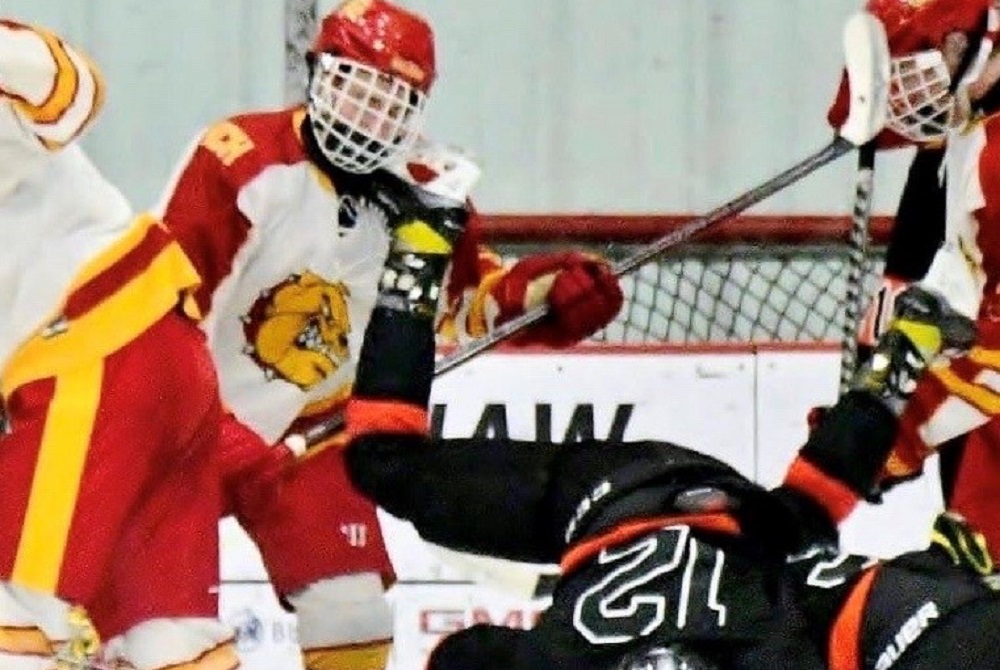
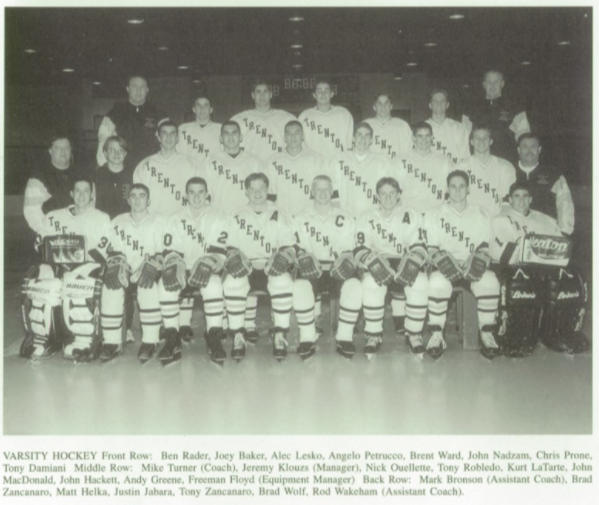
PHOTOS (Top) The neck guard worn by this player may have prevented injury as another skater toppled in front of the goal. (2) The 1999 Trenton hockey team. (3) The Kim Crouch Safety Collar was the first neck guard of its kind. (4) The 1999 Detroit Catholic Central hockey team. (Top photo by Judy Gill; other photos collected by Ron Pesch.)