


AD Inducted to National Hall of Fame
May 7, 2014
By Geoff Kimmerly
Second Half editor
Winter gets hectic so quickly that we’re forced to save some intriguing items that come our way for a sunnier day – and that day is today.
Following are news, notes and a few key links collected over the last few months, including the national Hall of Fame induction of a longtime Michigan athletic director, local recognition for another and statewide acclaim for a group of students putting their video production equipment to good use benefiting all.
Ann Arbor AD Honored Nationally
Former Ann Arbor Huron athletic director Jane Bennett was among five inducted into the National Interscholastic Athletic Administrators Association Hall of Fame in December.
Bennett served 26 years as a teacher, coach, athletic director and assistant principal in Michigan before spending the last decade as a principal at two schools in Montana. She served as athletic director at Huron for 15 years through 2002-03. The NIAAA reported that during her final decade in that position, participation in athletics doubled.
Bennett, who received her bachelor’s and master’s degrees from the University of Michigan, began her career at Huron in 1977 as varsity softball coach and became a math teacher and the co-director of athletics a year later. She coached the softball team 14 seasons before moving into the full-time athletic director position. Bennett was co-founder of the Michigan High School Softball Coaches Association and served as MHSSCA president from 1982-87.
Among other achievements at Huron, Bennett was a leader in a successful campaign to gain voter approval of a $60 million bond package, which included $20 million to improve and expand athletic facilities. She also developed curriculum for an annual varsity captains/head coaches leadership training program and composed handbooks/guidebooks for coaches, athletes and parents.
Bennett also was a valuable contributor to the Michigan Interscholastic Athletic Administrators Association and the NIAAA. She was president of the MIAAA in 1993-94 and a state conference speaker on several occasions. Bennett also served in various NIAAA leadership positions including on the committee that developed the Leadership Training Institute in 1996.
Bennett was named MIAAA Athletic Director of the Year in 1998 and received its State Award of Merit in 1997. She received the MHSAA’s Women in Sports Leadership Award in 1995 and was inducted into the MHSSCA Hall of Fame in 1995. Prior to her selection to the NIAAA Hall of Fame, Bennett was honored with the NIAAA Distinguished Service Award in 1998 and the NIAAA Thomas E. Frederick Award of Excellence in 2000. In 2005, she was inducted into the National Council of Secondary School Athletic Directors Hall of Fame, having served as its president in 2003 and been selected as its Athletic Director of the Year in 1998.
PSL's Ward: 'Pillar' of Detroit Athletics
Alvin Ward, the executive director of athletics for the Detroit Public School League and a member of the MHSAA Representative Council, received a 2014 Pillar in the Community Award in April from the Coast II Coast All-Stars, a Detroit-based pro basketball team that plays in the American Basketball Association.
Ward has served as a teacher, assistant principal and principal as well for Detroit Public Schools, and directs programs with a combined 500 coaches and 4,500 athletes.
Linked up
- This winter, the MHSAA Representative Council adopted a number of football practice rules changes aimed at improving player acclimatization at the start of fall and reducing head trauma and injuries. The Adrian Daily Telegram’s Doug Donnelly got responses from a number of coaches from that area of the state; click to find out why they feel these changes are important.
- Port Huron Times Herald writer Paul Costanzo let people know about our Student Advisory Council through the experience of Marlette’s Connor Thomas, one of our juniors and a great contributor this school year.
Power of Awareness
The Kimberly Anne Gillary Foundation works to educate Michigan schools on sudden cardiac arrest and train personnel in CPR and the use of an AED (automated external defibrillator). The video below teaches us again about the importance of awareness.
Saginaw Heritage was awarded $5,000 in April as the winner of the Gillary Foundation’s High School AED Contest. Students were asked to create a 3-minute video emphasizing the importance of Michigan high schools being adequately prepared to respond to a sudden cardiac arrest or related event on school property.
Randy and Sue Gillary created the foundation after their 15-year-old daughter Kimberly – an athlete at Troy Athens – died after suffering sudden cardiac arrest in 2000. The contest judges were Kimberly’s sisters Emily Kucinich, Jennifer Gregroy and Katie Gillary.
As of April 1, the Gillary Foundation had raised $1.2 million and donated 650 AEDs to schools – with three lives having been saved with donated AEDs. For more, click www.kimberlysgift.org.
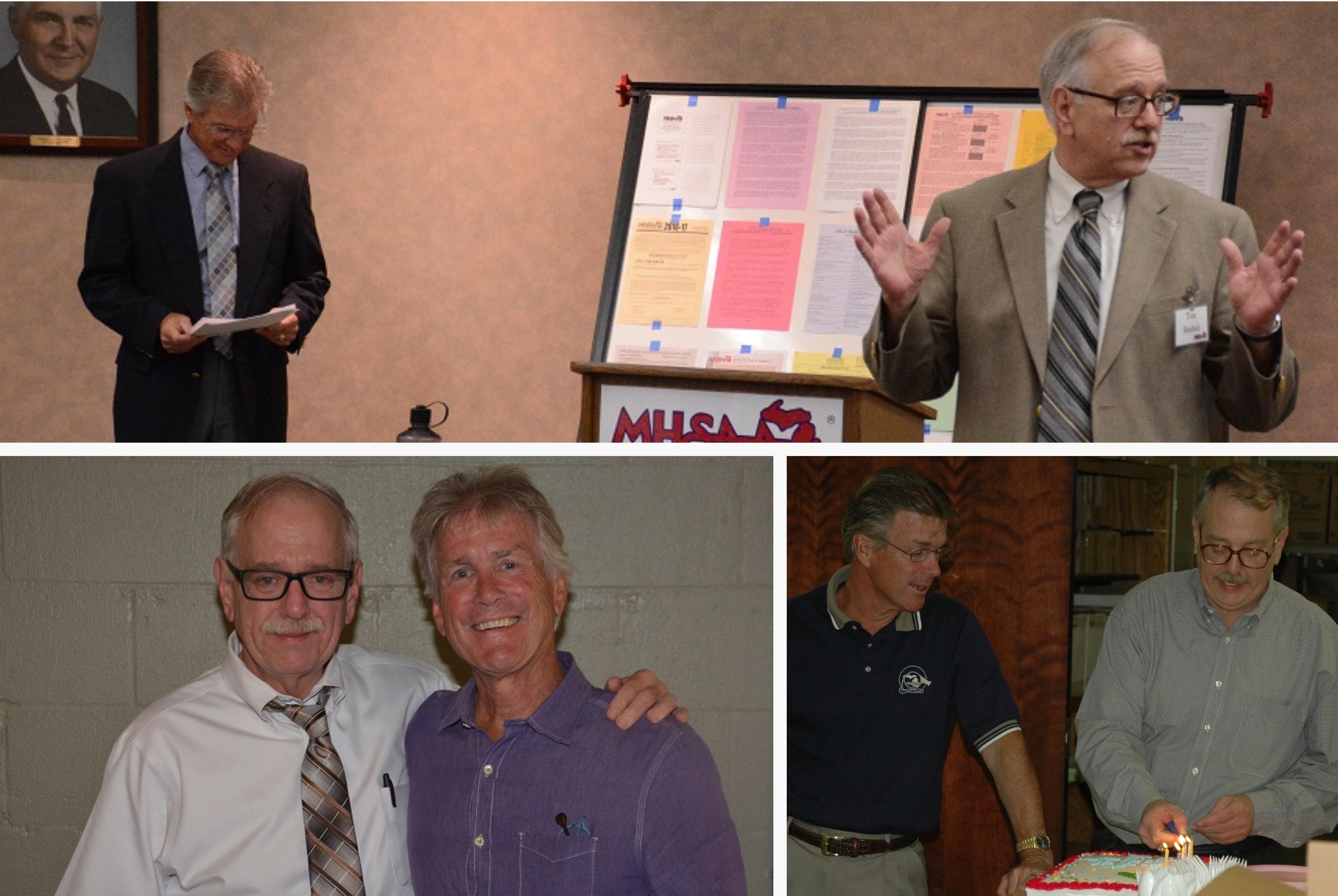
Jack Roberts, on Tom Rashid: One More Call
By
John E. (Jack) Roberts
MHSAA Executive Director, 1986-2018
December 9, 2021
More than a decade ago, with his knowledge, I placed in my “Will & Instructions Upon Death” that Tom Rashid was to be the one and only person to speak at my funeral or memorial service. A short number of years later, Tom told me that I was to do the same for him. Obviously, we knew that we could not both keep our promise to the other. But I must say, if Tom does not actually show up for my funeral, that will be the first time he has not kept a promise to me.
I understand there will be a time in the future, when the weather warms and COVID wanes, when school administrators across Michigan can gather in force to show their respects to Tom, and when I will provide the eulogy that Tom asked of me. But Tom’s recent death reminds us how uncertain life can be and suggests that I say some things now, before it’s too late.
Tom was the unparalleled master of award presentations; and for more than a dozen years he wrote and delivered polished praise on award recipients at the annual conference of the Michigan Interscholastic Athletic Administrators Association. My tribute now isn’t an awards presentation or hall-of-fame induction, so I won’t recount the particulars of Tom’s career; but what you will see here is the importance of Tom’s life … the themes that distinguish him from any other person I’ve known.
Tom comes from a large, complicated and compassionate family of parents, aunts, uncles, brothers, sisters, nephews and nieces who mourn his loss at levels few of us can fathom. Over the years, and for many years, he was the caretaker for several family members; and he was generous with all of them. My hope for each family member now – and for many days, weeks and months to come – is that you are at peace. Tom’s pain is over; and his place in eternity is secure. Tom purchased a reserved seat.
Tom often joked that his only good habit was prayer. That’s not really true, of course. But for as long as I’ve known Tom, he talked to God many times a day; and I’ve always had the feeling that he talked to God the same way he talked to us: bluntly, forcefully, passionately, honestly, loudly, making very plain what he had on his mind.
Tom was a rigorous practitioner of his devout Catholic faith; and, the God whom Tom believed in is a big God … the president, general manager and head coach of a huge, diverse team whose game plan is a large, loving Gospel of limitless parameters and possibilities. I have no doubt that, both in times of need and not, members of the Roberts family – including both my parents, my sister, my wife and our children and grandchildren – have been specific in his petitions to God. I have no doubt that Tom’s daily prayers included many of you, and your loved ones as well.
In addition to Tom’s immediate family is the even larger and even more complicated family Tom developed through a long, illustrious career in Michigan school sports administration: a full 25 years with the Archdiocese of Detroit, until 2003, when I invited him to join me at the MHSAA office in East Lansing.
During my 32 years as the executive director of the MHSAA, I never saw another like Tom … never, anywhere. He talked to anybody, anytime of the day or night, about any question or problem they might have. Usually, Tom didn’t need to give me notes reviewing his telephone conversations. From my adjacent office, and given his forceful voice, I could hear Tom’s every word, very clearly.
Tom had the ability to anticipate what I might need and take care of it without my asking. It is no exaggeration to say that Tom would do anything for me. For example, Tom’s reluctance to travel and his fear of flying are well known to many of you. I believe the one and only time that Tom flew in an airplane was in 2003, when I ordered him to fly to Texas so that he might receive the highest award of the National High School Coaches Association. He had never flown before; he has never flown since.
Most remarkable was not merely Tom’s unselfish, unlimited, legendary availability to athletic administrators at any hour of the day or night, nor his experienced, learned grasp of the subject matter in answering their calls. What was more remarkable was his effort to help school administrators through their hard times. On many occasions these callers had made an error of commission or omission. They had made a mistake or an oversight; and Tom was supremely compassionate in guiding them through the local fallout from disappointed athletes and disgruntled adults. Secure in himself and our mission to be servant-leaders, Tom very often shared or completely shouldered unjustified blame so others would not. He gave cover to countless local school administrators every year of his MHSAA career so that those administrators might survive and even thrive in their careers.
Among my remarkably loyal MHSAA staff, Tom still stands out. And he earned the enduring loyalty of those with whom he worked. I think especially of his successor at the Archdiocese of Detroit, Vic Michaels: I doubt that more than two days ever passed between their almost daily telephone conversations … usually in the morning … for the full 15 years that my office was next to Tom’s at the MHSAA. I have never, ever been witness to anything like that; and I know there is no one in our good work who misses our dear colleague more than Vic.
But most remarkable of all was Tom’s ability to turn an adversary into an ally. He could have a knock-down, drag-out argument with a person one day, and by the next day, and for years to come, that person was Tom’s greatest advocate and admirer.
Well … maybe second-greatest advocate and admirer. Because no one in athletic administration – no one – loved Tom more than I. And no one in our work told him this more than I did.
I have written often about my admiration and affection for Tom. I have spoken both publicly and privately of it, on many occasions. But let me say it one more time, here, as we celebrate his life, and mourn our loss …
Tom and I provide proof that opposites attract, and we tag-teamed MHSAA’s leadership. One of us was very outgoing and vocal, the other more reserved and reticent. One of us was loud, the other more subdued. One of us was more comfortable on the phone, the other with the pen. One of us had no idea what to do with apostrophes, while the other would put them in the correct places. One of us was more spontaneous and extemporaneous, the other a more detailed planner and measurer of consequences. One of us hated to travel, the other sent messages to him from distant oceans and continents every year on Christmas or New Year’s Day to thank him for his life and service. But in our hearts, where one’s core values are harbored, we were almost identical twins.
I doubt that any two people who were side-by-side in the workplace for 15 years expressed their gratitude for each other more than we did, nor any two co-workers who said “I love you” to one another as often as we did. We each felt in deep debt to the other for myriad gifts and gestures that improved our careers and our lives.
Over the years, Tom and I developed the strategy of making one more telephone call before we made a final decision in a difficult matter … making one more call that sometimes made a difference in the controversial decision we had to make or in how that decision was accepted by those it affected. Tom loved to be the one to make those calls. And, sometimes, that “one more call” made all the difference.
Throughout my adult life, whenever I’ve attended a funeral or memorial service, I’ve found myself asking what it is I should learn and try to emulate from the life of the deceased. If you should find your mind and heart doing anything like that now, may I suggest these two answers.
First, Tom’s life and death remind us that we should not delay a single day in telling those with whom we work that we appreciate them and are grateful for what they do. And, if it is true and you are able, say you love them. Tom did this more often than anyone I’ve known.
And the second message is this. Tom’s life stands for faithfulness … faithfulness to his God, faithfulness to his family, faithfulness to his colleagues and friends, and faithfulness to his work and the mission of not just amateur athletics, but particularly school-operated, educational athletics. His was a steadfast faithfulness, never-a-day-off faithfulness, you-come-first faithfulness.
So Tom, my dear friend, once again I say, “I love you.”
And, “Rest in peace, Tom. God knows, you rarely rested in life.”
I would give anything for just one more call.