

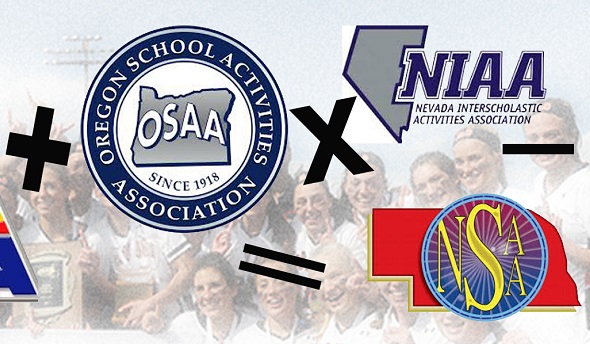
Add, Subtract, Divide, Multiply: MHSAA Not Alone
July 25, 2017
By Rob Kaminski
MHSAA benchmarks editor
This is the third part in a series on MHSAA tournament classification, past and present, that will be published over the next two weeks. This series originally ran in this spring's edition of MHSAA benchmarks.
As the MHSAA faces its most recent classification task with 8-Player Football, and opinions continue to swirl about as to the method, timeframe, location and other procedures, a look around the country provides plenty of company among state association brethren factoring variables into their own equations.
In the Pacific Northwest, the Oregon School Activities Association Football Playoffs are under public scrutiny as leadership ponders a five or six classification format beginning with the 2018-19 school year.
The OSAA has crowned six champions on the gridiron since 2006-07. Many of the state’s smaller schools would like to keep it that way, while larger schools lean toward a five-classification system, citing larger leagues, ease of travel and credibility to state championships as the advantages.
Still others would prefer more than six classes, pointing to safety issues and the opportunity to increase participation numbers as positives.
Moving southeast of Oregon, the Nevada Interscholastic Activities Association recently voted to hold serve on a classification proposal that was volleyed to the membership.
However, changes still could be forthcoming by as early as the 2018-19 season which would add a fifth classification in more populated southern Nevada while allowing northern schools to participate in four classifications. Such divisions could mean no state championship for the fifth class in southern Nevada.
Because of that, the NIAA wants equal numbers of schools in each classification on both ends of the state. Complicating the issue is the fact that the 24 largest schools in the state, by enrollment, are all in Clark County in Southern Nevada.
Across Nevada’s border into Arizona, charter schools are asking the Arizona Interscholastic Association to reconsider classification that was voted upon and approved in September 2015. That agreement called for the largest 33 percent of charter schools by enrollment to be placed in the state’s largest school classification, 3A, the middle 33 percent into 2A, and the smallest 33 percent into 1A.
Less than two years later the charter schools have had a change of heart and have asked to be considered the same as other Arizona public schools and be placed appropriately by enrollment beginning with the 2018-19 school year.
The situation in Arizona further illustrates how the public/private debate that all state associations have faced throughout existence now has the added dynamic of rapidly growing charter schools in today’s educational system, along with virtual school enrollment.
In the nation’s heartland, Nebraska has retooled its football classifications by using enrollment of boys students only in its schools rather than total enrollment. The Nebraska School Activities Association football-playing schools will kick off the 2018 season using this alignment.
Nebraska has three classes of 11-player football, with the smallest class divided in two, Class C-1 and C-2. The state also will have 8-player football for boys enrollments under 47, and the NSAA will sponsor a new 6-player tournament in 2018 for schools with 27 or fewer boys.
“This is a good proposal because some schools have a sizable imbalance between the number of boys and girls, and there’s a large gap (in enrollment) between the largest and smallest schools in Classes A and B,” NSAA executive director Jim Tenopir said. “I think this addresses both of those concerns.”
Swimmers in Georgia, meanwhile, will feel like they are moving with the current, rather than upstream in 2017-18, as the Georgia High School Association recently doubled the number of team championship events from two to four.
Swim enthusiasts can also count on longer days at the finals, as the top 30 finishers from the prelims will advance to the finals instead of 20, and all championship events will have three heats versus two.
Tecumseh Finds 2nd-Half Stride Again to Reach 1st Final in 50 Years
By
Dean Holzwarth
Special for MHSAA.com
March 21, 2025
EAST LANSING – Tecumseh coach Kristy Zajac wasn’t too worried when her team got off to a sluggish start during the first half of Friday’s Division 2 Semifinal.
The second half has proved to be when her team is at its best.
Tecumseh overcame a double-digit deficit and rallied to defeat Frankenmuth 52-43 at the Breslin Center, earning the program’s first championship game appearance in 50 years.
“Every game all year we start slow, but finish strong, and we were able to pull it out tonight,” Zajac said. “I’m super proud of these girls because they fought back, and this is a great win for our program.”
Tecumseh will play for the Division 2 championship at 6:15 p.m. Saturday, seeking its first Finals title since 1974 and after also finishing Class B runner-up in 1975.
Tecumseh, which outscored Frankenmuth 34-20 during the second half Friday, improved to 26-1. It's only loss was to Division 1 finalist Rockford.
 The win was bittersweet, though, after junior Maddy VanBlack suffered an apparent leg injury during the final minute.
“Super special for our girls, but that last play of the game is just so hard,” Zajac said. “She’s worked so hard to get back to us after missing almost two years of seasons, and that’s why these girls are all in tears. I feel so terrible for her, and we’re hoping she’s OK.”
Frankenmuth led 30-20 midway through the third quarter after a 3-pointer from Clare Conzelmann. However, Tecumseh slowly chipped away at the deficit and eventually tied it at 32-32 with a 10-2 run to end the third quarter.
Miss Basketball Award finalist Alli Zajac struggled with foul trouble, but her teammates picked her up and ignited the second-half blitz.
“It’s not a great thing that I was in foul trouble, but I’m kind of glad that I was just so I can see how well they work together when I'm not in there with them,” Alli Zajac said. “It was amazing to see other girls step up.”
One was senior Ashlyn Moorhead, who drained 4-of-6 3-point attempts and finished with 14 points.
“I loved seeing her knock down those 3s and hit those pull-up jumpers,” Kristy Zajac said. “She stepped into beast mode in the second half. She started slow, but I knew she had it in her and stepped up that confidence.”
Said Moorhead: “I knew that my teammates and coaches had confidence in me. I just went up and let it fly.”
Sophomore Addi Zajac also fueled the comeback with 16 points and 14 rebounds.
“She’s one of the best rebounders I’ve ever seen, and we knew that other people had to step up and they did,” Kristy Zajac said. “That’s what is great about this team. There’s not one person you can shut down and then try to beat us. You have to beat all of us.”
An 11-0 run in the fourth quarter sealed the win.
“These girls deserve this,” Kristy Zajac said. “They’ve worked hard for this, and they’ve put in the time.”
The Eagles were in search of a return trip to the Final after finishing runner-up in 2023, but suffered through a five-minute scoring drought during the final quarter and shot a dismal 8-of-27 during the second half.
“One day short of what our goal was,” Frankenmuth coach Joe Jacobs said. “The first half went in our favor, but then they made shots in the second half and the game got away from us. But it doesn’t take away from what these girls accomplished, and we have three seniors that have been here two times, so it was a special opportunity for them.”
Conzelmann led the Eagles with 15 points and three blocked shots. Macy Donovan and Isabelle Bernthal finished with nine and eight points, respectively.
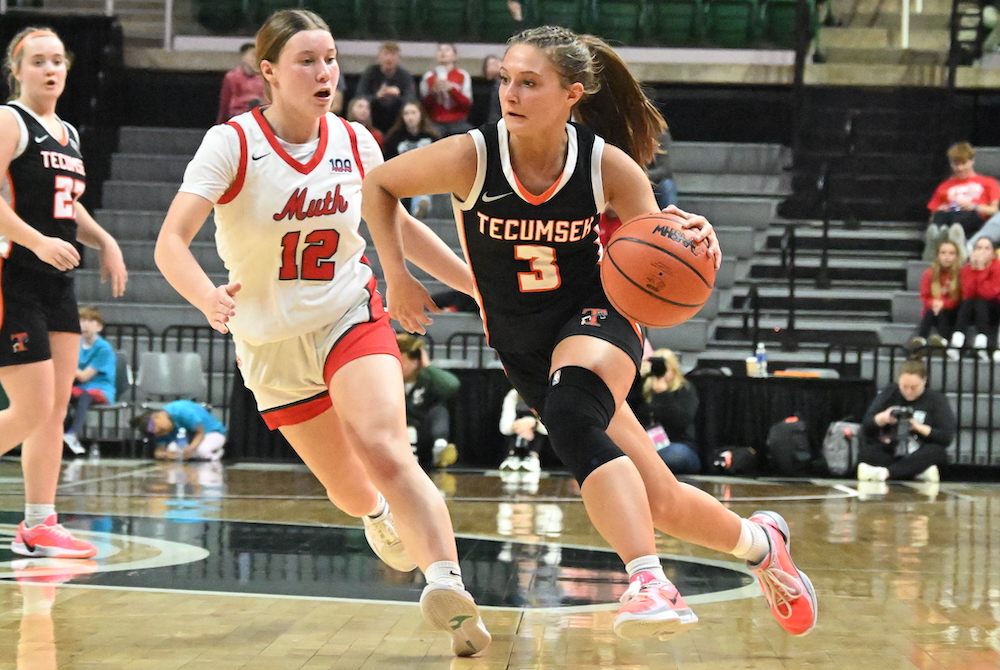
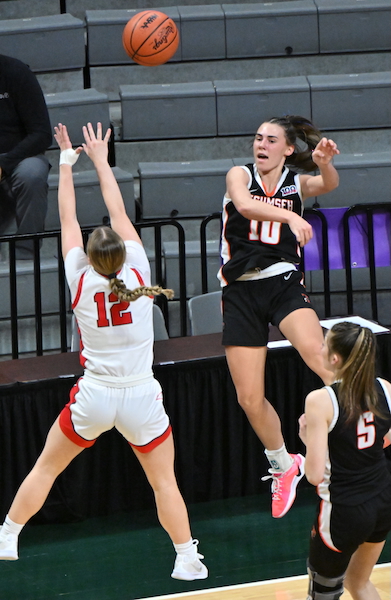
PHOTOS: Tecumseh’s Makayla Schlorf (3) makes her move toward the basket with Frankenmuth’s Grace Brenner guarding her Friday at Breslin Center. (Middle) Chloe Bullinger (10) keeps the ball inbounds, sending it over Brenner’s outstretched arms. (Photos by Keionna Banks/Hockey Weekly Action Photos.)