

Add, Subtract, Divide, Multiply: MHSAA Not Alone
July 25, 2017
By Rob Kaminski
MHSAA benchmarks editor
This is the third part in a series on MHSAA tournament classification, past and present, that will be published over the next two weeks. This series originally ran in this spring's edition of MHSAA benchmarks.
As the MHSAA faces its most recent classification task with 8-Player Football, and opinions continue to swirl about as to the method, timeframe, location and other procedures, a look around the country provides plenty of company among state association brethren factoring variables into their own equations.
In the Pacific Northwest, the Oregon School Activities Association Football Playoffs are under public scrutiny as leadership ponders a five or six classification format beginning with the 2018-19 school year.
The OSAA has crowned six champions on the gridiron since 2006-07. Many of the state’s smaller schools would like to keep it that way, while larger schools lean toward a five-classification system, citing larger leagues, ease of travel and credibility to state championships as the advantages.
Still others would prefer more than six classes, pointing to safety issues and the opportunity to increase participation numbers as positives.
Moving southeast of Oregon, the Nevada Interscholastic Activities Association recently voted to hold serve on a classification proposal that was volleyed to the membership.
However, changes still could be forthcoming by as early as the 2018-19 season which would add a fifth classification in more populated southern Nevada while allowing northern schools to participate in four classifications. Such divisions could mean no state championship for the fifth class in southern Nevada.
Because of that, the NIAA wants equal numbers of schools in each classification on both ends of the state. Complicating the issue is the fact that the 24 largest schools in the state, by enrollment, are all in Clark County in Southern Nevada.
Across Nevada’s border into Arizona, charter schools are asking the Arizona Interscholastic Association to reconsider classification that was voted upon and approved in September 2015. That agreement called for the largest 33 percent of charter schools by enrollment to be placed in the state’s largest school classification, 3A, the middle 33 percent into 2A, and the smallest 33 percent into 1A.
Less than two years later the charter schools have had a change of heart and have asked to be considered the same as other Arizona public schools and be placed appropriately by enrollment beginning with the 2018-19 school year.
The situation in Arizona further illustrates how the public/private debate that all state associations have faced throughout existence now has the added dynamic of rapidly growing charter schools in today’s educational system, along with virtual school enrollment.
In the nation’s heartland, Nebraska has retooled its football classifications by using enrollment of boys students only in its schools rather than total enrollment. The Nebraska School Activities Association football-playing schools will kick off the 2018 season using this alignment.
Nebraska has three classes of 11-player football, with the smallest class divided in two, Class C-1 and C-2. The state also will have 8-player football for boys enrollments under 47, and the NSAA will sponsor a new 6-player tournament in 2018 for schools with 27 or fewer boys.
“This is a good proposal because some schools have a sizable imbalance between the number of boys and girls, and there’s a large gap (in enrollment) between the largest and smallest schools in Classes A and B,” NSAA executive director Jim Tenopir said. “I think this addresses both of those concerns.”
Swimmers in Georgia, meanwhile, will feel like they are moving with the current, rather than upstream in 2017-18, as the Georgia High School Association recently doubled the number of team championship events from two to four.
Swim enthusiasts can also count on longer days at the finals, as the top 30 finishers from the prelims will advance to the finals instead of 20, and all championship events will have three heats versus two.
Inland Lakes Stacking Successes as Expectations Continue to Grow
By
Tom Spencer
Special for MHSAA.com
March 21, 2025
Now that another great girls basketball season is over, Daryl Vizina is spending more time off the court.
 But the Indian River Inland Lakes coach is spending just as much time in court.
Vizina, who serves as probate judge in Cheboygan County, has been balancing coaching and estates since 2019. At the time he was first elected, he also was coaching middle school boys basketball for Inland Lakes.
He took over the girls varsity basketball program in 2020, assuming the helm of a team coming off a 3-18 season. And, the Bulldogs hadn’t won a District championship in three decades or a conference title in two.
Inland Lakes now has won three straight Division 4 District titles. The Bulldogs reached a Regional Final for second time in three years, falling to St. Ignace. And, after capturing the Ski Valley Conference trophy a year ago, the Bulldogs racked up 21 wins against just five very close losses this winter in finishing second in the league.
The Bulldogs and Vizina are looking forward to returning next winter with even higher expectations. They will graduate only two seniors this spring.
The culture has changed from expecting a few wins to winning every time the Bulldogs step on the court.
“Winning comes at a price,” said Vizina, who was riding a bus back from a middle school game at Central Lake as the election results were being tabulated for his first term on the judicial bench. “The expectations are a blessing in a lot of ways but they also cause a lot of strain on the program. The girls walk into the gym every day knowing we’re expecting to perform, expecting to play well, and it’s a different state of mind.”
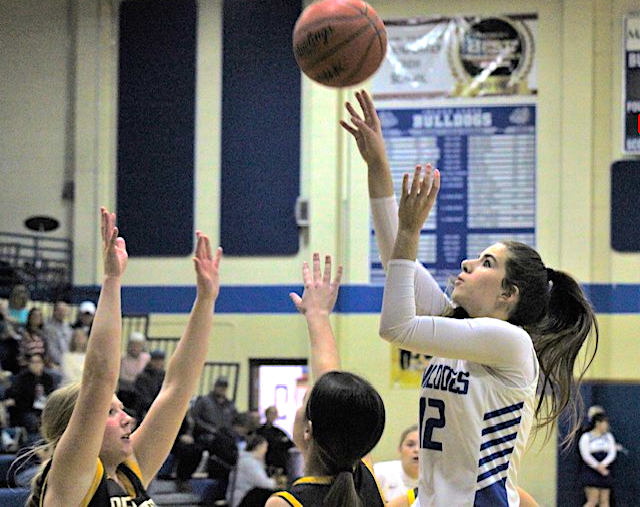
 Next year’s expected returnees include center Ava Belford, who just had a terrific freshman season. Junior forward Chloe Robinson, who averaged 15 points and eight rebounds, will also be back, as will defensive standouts Elizabeth Furman, a sophomore, and junior Mary Myshock.
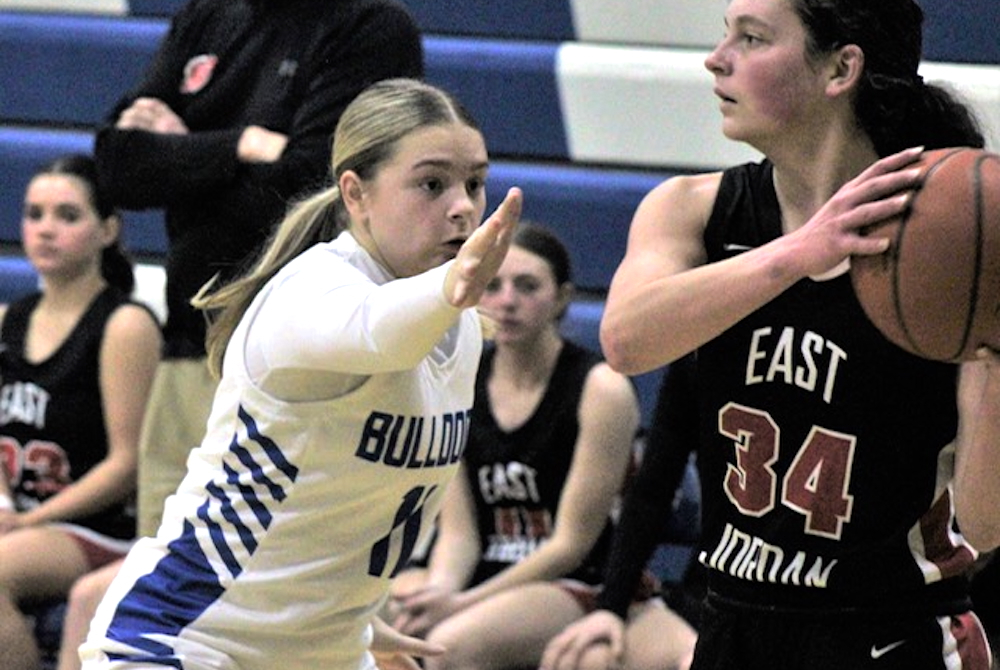
Furman and Myshock are considered among the best defenders in the area. They combined to shut down or slow down other teams’ leading scorers and were key reasons the Bulldogs held opponents to fewer than 40 points in 18 games.
“I would expect we are going to be better next year,” Vizina said. “We’ve got some young players that if they (experience) the growth I anticipate I think they are going to become really great ball players, and we have a core of older players that will be returning that are high-level.”
But you never can be certain, Vizina noted.
“You don’t know how much time people are willing to put in during the summer,” admitted Vizina. “You don’t know about injuries and other things that happen outside our control. But if we take care of business and we have good health and keep on the trajectory we’re on, I would expect us to be really, really good next year.”
The Bulldogs were only a few points shy of an undefeated regular season as the largest margin of defeat was only seven points – to this year’s conference champion, Gaylord St. Mary. The Bulldogs played their conference rival twice, as they always do, and fell short in overtime in the other contest.
“Our four regular-season losses were by a grand total of 14 points,” Vizina recalled. “If you look at really how close to being even better than 21-5 we were, we had a lot of success.”
The Bulldogs have patterned their play after the Michigan State Spartans and longtime coach Tom Izzo. In particular, they like the Spartans’ transitional offense.
 “I am a big Michigan State guy,” Vizina said. “They are such a threat to run on you the other (way).”
Pressure defense and rotating eight to 10 players most games – and sometimes all 11 rostered players – has been a point of emphasis for Vizina since his middle school coaching days.
“We want to guard people the minute they get off the bus,” Vizina said, while noting the Bulldogs’ previous history featured a sit-back zone style. “It was really a struggle to get the girls to play fast, both transitional offense and fullcourt defenses. This year is the first year they really started to buy into it.”
Other keys to the Bulldogs’ success are the establishment of more youth programs and the increase of the school’s top female athletes making basketball their number one sport.
“Most of our great athletes in the school play basketball, and with a lot of them it’s become their primary sport, and I think that’s so important because where you really make ground is in the summer time,” Vizina explained. “They can choose between softball or volleyball or going to the beach, or basketball.”
Inland Lakes started a third and fourth-grade team five years ago, and some of those players made big contributions to the varsity this year.
“With our youth programs, we’ve got girls starting to fall in love with basketball at a young age,” Vizina said. “They’re now coming in as freshmen playing good minutes on varsity, and it’s really rewarding to see that bear fruit.”
 Tom Spencer is a longtime MHSAA-registered basketball and soccer official, and former softball and baseball official, and he also has coached in the northern Lower Peninsula area. He previously has written for the Saginaw News, Bay County Sports Page and Midland Daily News. He can be reached at [email protected] with story ideas for Manistee, Wexford, Missaukee, Roscommon, Ogemaw, Iosco, Alcona, Oscoda, Crawford, Kalkaska, Grand Traverse, Benzie, Leelanau, Antrim, Otsego, Montmorency, Alpena, Presque Isle, Cheboygan, Charlevoix and Emmet counties.
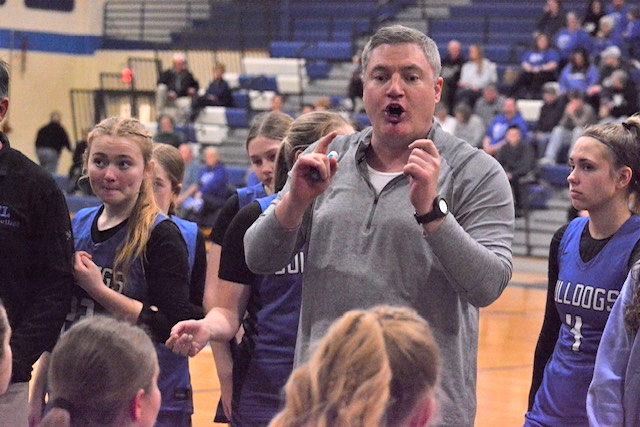
PHOTOS (Top) Inland Lakes junior Mary Myshock (11) defends during a game against East Jordan this season. (Middle) Bulldogs coach Daryl Vizina directs his team during a timeout. (Below) Junior Chloe Robinson (12) puts up a jumper over a pair of defenders. (Photos by Jared Greenleaf/Cheboygan Tribune.)