

Add, Subtract, Divide, Multiply: MHSAA Not Alone
July 25, 2017
By Rob Kaminski
MHSAA benchmarks editor
This is the third part in a series on MHSAA tournament classification, past and present, that will be published over the next two weeks. This series originally ran in this spring's edition of MHSAA benchmarks.
As the MHSAA faces its most recent classification task with 8-Player Football, and opinions continue to swirl about as to the method, timeframe, location and other procedures, a look around the country provides plenty of company among state association brethren factoring variables into their own equations.
In the Pacific Northwest, the Oregon School Activities Association Football Playoffs are under public scrutiny as leadership ponders a five or six classification format beginning with the 2018-19 school year.
The OSAA has crowned six champions on the gridiron since 2006-07. Many of the state’s smaller schools would like to keep it that way, while larger schools lean toward a five-classification system, citing larger leagues, ease of travel and credibility to state championships as the advantages.
Still others would prefer more than six classes, pointing to safety issues and the opportunity to increase participation numbers as positives.
Moving southeast of Oregon, the Nevada Interscholastic Activities Association recently voted to hold serve on a classification proposal that was volleyed to the membership.
However, changes still could be forthcoming by as early as the 2018-19 season which would add a fifth classification in more populated southern Nevada while allowing northern schools to participate in four classifications. Such divisions could mean no state championship for the fifth class in southern Nevada.
Because of that, the NIAA wants equal numbers of schools in each classification on both ends of the state. Complicating the issue is the fact that the 24 largest schools in the state, by enrollment, are all in Clark County in Southern Nevada.
Across Nevada’s border into Arizona, charter schools are asking the Arizona Interscholastic Association to reconsider classification that was voted upon and approved in September 2015. That agreement called for the largest 33 percent of charter schools by enrollment to be placed in the state’s largest school classification, 3A, the middle 33 percent into 2A, and the smallest 33 percent into 1A.
Less than two years later the charter schools have had a change of heart and have asked to be considered the same as other Arizona public schools and be placed appropriately by enrollment beginning with the 2018-19 school year.
The situation in Arizona further illustrates how the public/private debate that all state associations have faced throughout existence now has the added dynamic of rapidly growing charter schools in today’s educational system, along with virtual school enrollment.
In the nation’s heartland, Nebraska has retooled its football classifications by using enrollment of boys students only in its schools rather than total enrollment. The Nebraska School Activities Association football-playing schools will kick off the 2018 season using this alignment.
Nebraska has three classes of 11-player football, with the smallest class divided in two, Class C-1 and C-2. The state also will have 8-player football for boys enrollments under 47, and the NSAA will sponsor a new 6-player tournament in 2018 for schools with 27 or fewer boys.
“This is a good proposal because some schools have a sizable imbalance between the number of boys and girls, and there’s a large gap (in enrollment) between the largest and smallest schools in Classes A and B,” NSAA executive director Jim Tenopir said. “I think this addresses both of those concerns.”
Swimmers in Georgia, meanwhile, will feel like they are moving with the current, rather than upstream in 2017-18, as the Georgia High School Association recently doubled the number of team championship events from two to four.
Swim enthusiasts can also count on longer days at the finals, as the top 30 finishers from the prelims will advance to the finals instead of 20, and all championship events will have three heats versus two.
Saline Tops Podium for 1st Time Since 2013 as Multiple Past Runners-Up Take Next Step
By
Steve Vedder
Special for MHSAA.com
March 15, 2025
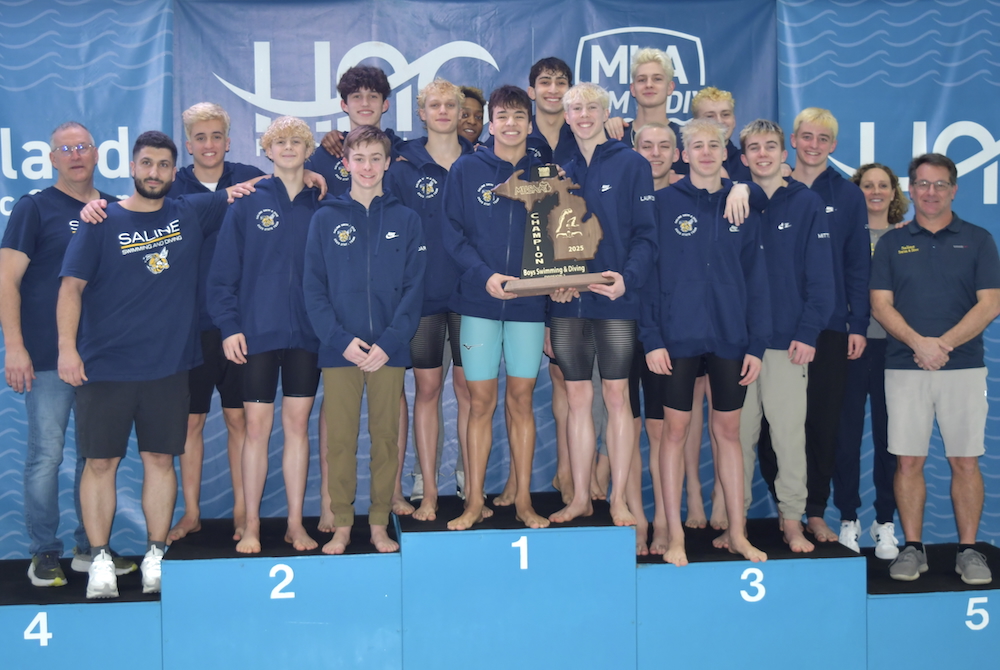
HOLLAND – Saline boys swimming & diving coach Todd Brunty said the quest for his team’s Lower Peninsula Division 1 Finals championship Saturday began exactly 365 days ago after losing out to rival Ann Arbor Pioneer by 30 points.
"First, everyone has to believe in the opportunity or the possibility of it," he explained. "You have to be a team that expects to compete. It's the old cliché: You've got to believe you can do it.
“Three hundred and sixty five days ago, we believed we had the talent to do it. We didn't quite perform like we wanted a year ago, but coming into today we thought we had a chance."
Saline cast aside the disappointment of finishing runner-up last year by winning the team meet at Holland Aquatics Center with 291.5 points, outdistancing the 263 scored by the four-time reigning champ Pioneers. Northville was third with 224 points, Zeeland fourth at 176 and Detroit Catholic Central fifth with 175 points.
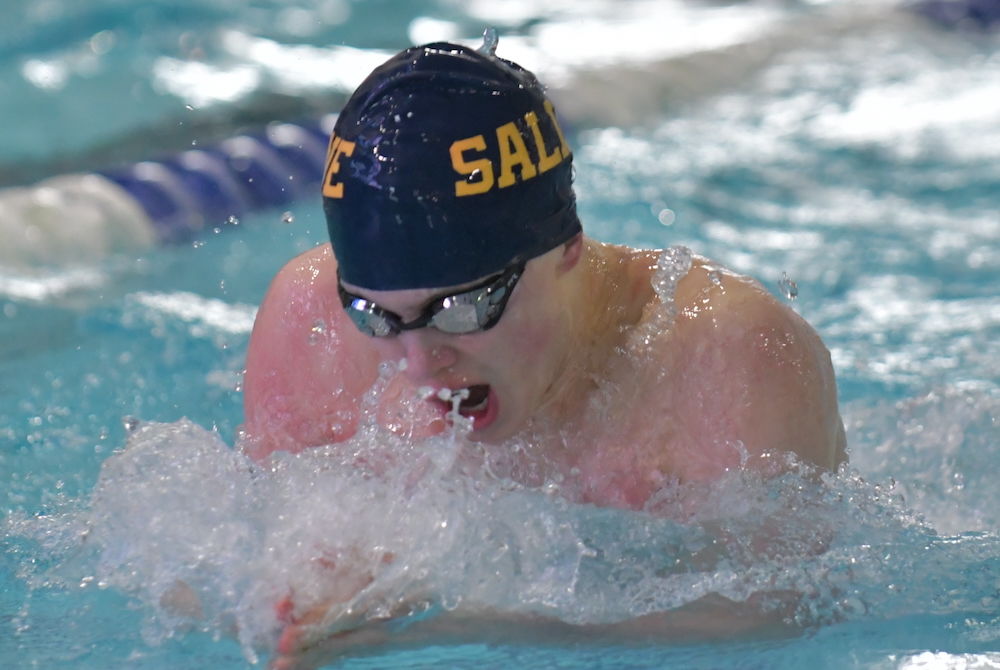
Sophomore Issac Adanin captured the 200-yard individual medley (1:48.24) and 100 breaststroke (56.23) titles to lead Saline’s scoring. Diego Valdes won the 100 butterfly (49.15) for the Hornets.
The championship was their first since winning four straight Division 1 titles from 2010-13. Saline also finished runner-up in 2016.
 Last year, Adanin was runner-up in the IM and fourth in the breaststroke.
"I had a slow start (this season). It was smooth, then I gradually got faster," he said. "I really hoped I (could win both races). I was kind of young last year, so I didn't have large expectations. But I've been to a lot of big meets in club, so I learned how to get better. It was harder this year, different, because (the meet) was so stacked."
Joining Adanin as a double individual winner was Detroit Catholic Central sophomore Camren Turowski, who finished off an unbeaten season in the 50-yard freestyle by winning that event in 20.41 seconds and won the 100 free with a Division 1 meet record time of 45 seconds.
Turowski had elected to give up lacrosse and football at the middle school level a few years ago because it seemed he was always fighting injuries. "I kept getting injured, and I wanted to save my body for swimming," he said.
Now he’s putting the hurt on swim opponents. Both performances Saturday were All-America qualifying times and came on the heels of earlier this season breaking the Oakland County and Detroit Catholic Central record of 45.25 in the 100 free while setting a conference and school record of 20.69 in the 50.
A year ago Turowski, an avid wake surfer, finished runner-up at the Finals in the 50 while helping three relays place among the top two. It was that second-place finish, in fact, that Turowski credits for driving his transformation from a good swimmer into an outstanding one.
"Last year I didn't win (the 50 free), and I didn't like that," he said. "In swimming you need to improve in small increments, which means a lot. That means progress, which is what you need.
"I think it was a stronger field this year, very competitive in the 100. But I planned to win. I don't like to lose."
Detroit Catholic Central coach Jessica Stoddard said Turowski is the kind of swimmer who pays attention to coaching details, strives for perfection and is always seeking the next challenge.
 "He comes in and asks what he needs to work on. He's very coachable," she said. "He's always first in and last out."
Zeeland's Owen Stevens achieved his goal Saturday by breaking the 11-year-old Division 1 Finals record in winning the 500 free (4:23.65).
Stevens, a Zeeland West senior and Finals qualifier since his freshman year who will swim at Louisville next season, last lost in the 500 free during his freshman season.
"It was my last high school race in the 500, and I wanted to go out by breaking the record and I did," he said. "It felt good. The record was in the back of my mind, and I thought if I swam my race, I could break it."
Grandville's Jack Merkel won the 100 backstroke (48.69), ending a career of rollercoaster showings at the Finals. He qualified in the backstroke as a freshman, but was slowed by the flu. He then took third in the 100 butterfly and second in the backstroke as both a sophomore and junior.
Merkel said finishing so close to a Finals championship can provide motivation, but the pressure also can raise the expectation meter.
"It can go both ways," he said. "But then I realized that if you finish second, there's only one person in the state better than you. If you're good enough to finish second, you can also win. You have to change your mindset a little bit."
Other champions were East Kentwood's Fidele Byiringiro, who became the first from his school to win diving since Kyle Gahan in 1997. He scored a 448.80.
Northville had a pair of winners with Brady Stenson in the 200 free (1:38.06) and the 400 free relay team (3:06.60). Ann Arbor Pioneer won the 200 free relay (1:24.65).
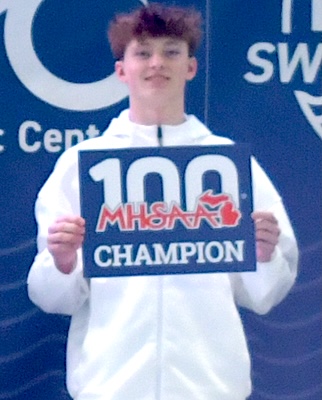
PHOTOS (Top) Saline poses with its championship trophy Saturday at Holland Aquatics Center. (Middle) Camren Turowski stands atop the podium after receiving one of his two championship medals. (Below) Saline’s Issac Adanin swims to the breaststroke championship. (Click for more from High School Sports Scene.)