

Add, Subtract, Divide, Multiply: MHSAA Not Alone
July 25, 2017
By Rob Kaminski
MHSAA benchmarks editor
This is the third part in a series on MHSAA tournament classification, past and present, that will be published over the next two weeks. This series originally ran in this spring's edition of MHSAA benchmarks.
As the MHSAA faces its most recent classification task with 8-Player Football, and opinions continue to swirl about as to the method, timeframe, location and other procedures, a look around the country provides plenty of company among state association brethren factoring variables into their own equations.
In the Pacific Northwest, the Oregon School Activities Association Football Playoffs are under public scrutiny as leadership ponders a five or six classification format beginning with the 2018-19 school year.
The OSAA has crowned six champions on the gridiron since 2006-07. Many of the state’s smaller schools would like to keep it that way, while larger schools lean toward a five-classification system, citing larger leagues, ease of travel and credibility to state championships as the advantages.
Still others would prefer more than six classes, pointing to safety issues and the opportunity to increase participation numbers as positives.
Moving southeast of Oregon, the Nevada Interscholastic Activities Association recently voted to hold serve on a classification proposal that was volleyed to the membership.
However, changes still could be forthcoming by as early as the 2018-19 season which would add a fifth classification in more populated southern Nevada while allowing northern schools to participate in four classifications. Such divisions could mean no state championship for the fifth class in southern Nevada.
Because of that, the NIAA wants equal numbers of schools in each classification on both ends of the state. Complicating the issue is the fact that the 24 largest schools in the state, by enrollment, are all in Clark County in Southern Nevada.
Across Nevada’s border into Arizona, charter schools are asking the Arizona Interscholastic Association to reconsider classification that was voted upon and approved in September 2015. That agreement called for the largest 33 percent of charter schools by enrollment to be placed in the state’s largest school classification, 3A, the middle 33 percent into 2A, and the smallest 33 percent into 1A.
Less than two years later the charter schools have had a change of heart and have asked to be considered the same as other Arizona public schools and be placed appropriately by enrollment beginning with the 2018-19 school year.
The situation in Arizona further illustrates how the public/private debate that all state associations have faced throughout existence now has the added dynamic of rapidly growing charter schools in today’s educational system, along with virtual school enrollment.
In the nation’s heartland, Nebraska has retooled its football classifications by using enrollment of boys students only in its schools rather than total enrollment. The Nebraska School Activities Association football-playing schools will kick off the 2018 season using this alignment.
Nebraska has three classes of 11-player football, with the smallest class divided in two, Class C-1 and C-2. The state also will have 8-player football for boys enrollments under 47, and the NSAA will sponsor a new 6-player tournament in 2018 for schools with 27 or fewer boys.
“This is a good proposal because some schools have a sizable imbalance between the number of boys and girls, and there’s a large gap (in enrollment) between the largest and smallest schools in Classes A and B,” NSAA executive director Jim Tenopir said. “I think this addresses both of those concerns.”
Swimmers in Georgia, meanwhile, will feel like they are moving with the current, rather than upstream in 2017-18, as the Georgia High School Association recently doubled the number of team championship events from two to four.
Swim enthusiasts can also count on longer days at the finals, as the top 30 finishers from the prelims will advance to the finals instead of 20, and all championship events will have three heats versus two.
Cranbrook Extends Finals Win Streak to 3; Farner, Otsego's Smith Claim Multiple Titles
By
Brad Emons
Special for MHSAA.com
March 15, 2025
YPSILANTI – Bloomfield Hills Cranbrook Kingswood is no stranger to MHSAA boys swimming & diving championships.
And the Cranes, led by junior standout A.J. Farner, made it three straight Saturday and seven overall scoring a team-high 357 points to reach the podium. They finished ahead of runner-up Holland Christian (282.5) and third-place East Grand Rapids (264) at the Lower Peninsula Division 3 Finals at Eastern Michigan University’s Jones Natatorium.
Farner figured in four firsts to lead the way, winning the 200-yard freestyle (1:40.15) and 100 backstroke (49.54) while also being part of victorious relay teams in the 200 medley (1:33.78) and 400 freestyle (3:07.95).
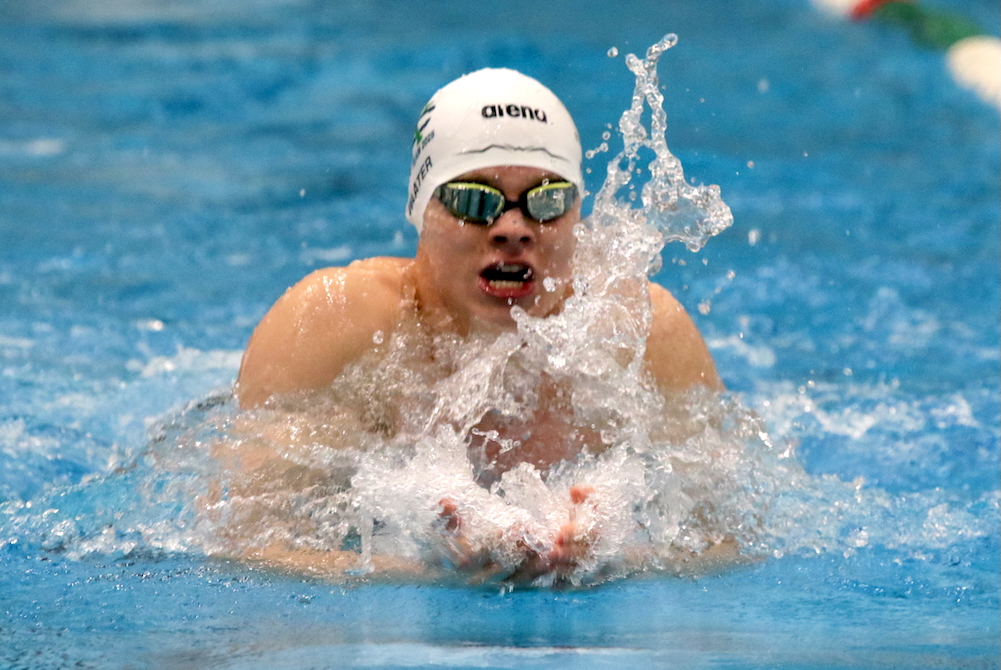
Senior teammate Joseph Wiater also brought home a first in the 100 breaststroke (56.57).
“I didn’t know what to expect coming in, but because of great coaching things went my way, so no complaints,” Farner said. “I have (had) mononucleosis for the past three months. My coaches have done a really good job kind of limiting me and limiting what I’m doing. I didn’t know what to expect, but the team and the coaches did a really good job preparing me. It went my way and better than I expected.”
Cranbrook coach Paul Ellis said Farner has a special quality that can’t often be duplicated.
“A.J. is an incredibly talented kid,” Ellis said. “The reason he is able to come out and do this is he’s a great example of a kid that puts in all work in the offseason. Yes, he’s got a lot of genetic gifts, but that doesn’t set him up without training his tail off and working his butt off. ... He puts in the work out of season, so when he gets here, he can rely on that training even though he runs into a hiccup like mono. He couldn’t do any more than 3,000 yards the past three months and yet he came out here, relied on his training and was incredibly successful in all his races.”
 In his final hurrah as a prep swimmer, Wiater earned his first individual Finals title.
“It was exciting. I swam with so much pride,” Wiater said. “It was just a great time. I’m officially done with swimming. I’m not going anywhere to (swim) college or anything, so I’m super excited that I pulled it off.
“First, I was telling myself, ‘This is it. It’s my last race ever.’ We are competing with Holland Christian for first place and we needed the first. I told myself, ‘I just got to get this. This is my last four lengths, and I’m done the rest of my life.’”
Coming out of Friday’s prelims, Cranbrook boasted a total of 20 individual qualifiers – the most of any school – heading into consolation and finals heats.
Cranbrook’s second-seeded 200 medley relay got the team off to a roaring start by winning going away as freestyle anchor leg Calvin Meeker brought it home in 1:33.78, teaming up with Farner, Wiater and Ethan Xu for a repeat championship in the event.
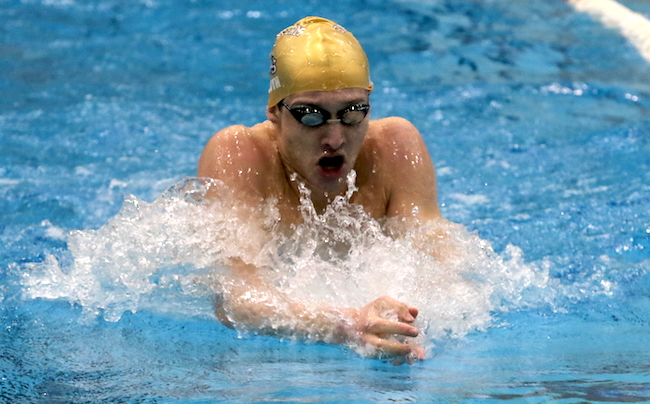
Another of the meet’s individual stars was Otsego junior Liam Smith, who repeated as champion in the 200 individual medley (1:49.07) and 100 butterfly (48.68). His performance in the 200 IM was an All-American automatic time, while his butterfly clocking earned All-America consideration.
“Obviously last year was exciting, this year was exciting, the state meet is always exciting,” Smith said. “You always want to perform your best. I didn’t go my best time, but you can’t complain about winning. I’m good with that.”
Smith, who brought the team’s wooden hammer to the victory podium after winning the 100 butterfly, boasts five individual Finals titles for his career, including three straight in the butterfly.
“Anyone who gets on the podium gets the hammer,” Smith said. “I was a little disappointed in my times, but you can’t do your best every time. I can be happy about winning. It never gets old. It’s awesome.”
In one of the most competitive races of the day, junior Jack Higgins of Detroit Country Day clocked a first-place time of 21.01 in the 50 freestyle to hold off Holland Christian’s Basil Ledesma and Adrian’s Kade Opsal, who tied for second with identical times of 21.26.
Higgins was runner-up a year ago in 20.79 to Grand Rapids Christian senior Ben Sytsma, who went 19.98. Last school year the 6-foot-5, 220-pound Higgins also played football, but decided to concentrate solely on swimming for 2024-25.
“This year was more open for me,” said Higgins, who does plan to play golf this spring for the Yellowjackets. “I’ve been thinking about winning ever since then. I just feel really good to do it. I’ll really reflect on everything after the meet is over, but I just feel really good right now.”
Higgins was also the top seed in the 100 freestyle and became the meet’s second double individual winner with a first-place clocking of 45.95 to better his 46.17 prelim time from Friday.
Meanwhile, Plainwell junior Sam Harper was seeded second in the 500 freestyle but overcame Flint Powers Catholic senior Liam Seifert, the top seed, and touched the wall first in 4:34.62, almost five seconds ahead of the runner-up.
Harper was fourth a year ago in 4:39.90, while Seifert was third in 4:38.03. The two have had a spirited and friendly rivalry.
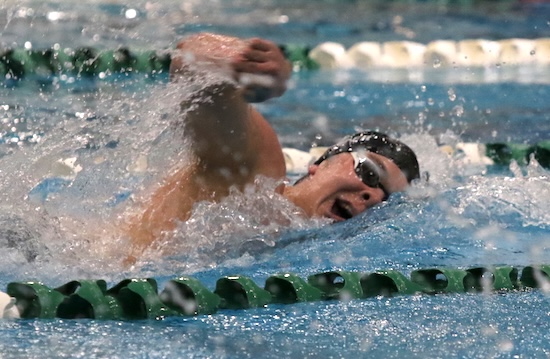 “Me and Seifert go back-and-forth, race-to-race, it has been for a while now,” Harper said. “He’s a good guy, but it’s all good to take this one home. The prelims I was going strong and steady, just making sure I had enough gas in the tank the next day.”
Grand Rapids Christian took a highly-competitive 200 freestyle relay race as seniors Tyler Stinton and Evan Nelson along with juniors Sawyer O’Grady and Emmett Vance posted a time of 1:27.26 to hold off runner-up Spring Lake (1:28.10), Cranbrook (1:28.14), East Grand Rapids (1:28.16) and Hamilton (1:28.62).
In the 1-meter diving, Holland Christian senior Parker Schut held off a strong challenge from Rowen Bishop of East Grand Rapids to earn his first Finals title.
Schut, a year-round diver, finished sixth last year, fifth as a sophomore and ninth as a freshman. He tallied 511.95 points, while Bishop, who posted the best Regional dive score in D3 with a 524.65, wound up with 471.05 on Saturday.
“Wow, I’m very, very excited right now,” said Schut, who plans to continue his diving career at Davenport University where he’ll study business. “Dreamed about it last night, dreamed about it the day before. I’m so excited. I don’t know what else to say. It was my second-to-last dive, my 205, a back 2½ tuck, and it was just perfect top, good kick-out, good entry and I think that’s what finished it off.”
Cranbrook-Kingswood added an exclamation point in the meet’s final event, winning the 400 freestyle relay ahead of Holland Christian (3:08.74) with Sean Lu, Ryan Van Dyke, Xu and Farner comprising the victorious quartet.
“We’ve got great coaches in Paul Ellis, Greg Palmer, Marissa Blumenthal and John Hovy – great leadership,” Farner said. “We’ve had a really great group of seniors the past three or four years on the team. Great guys leading the group. They’ve done a really good job of rallying the team together, making great ideas and goals for our team.”
Meanwhile, Ellis had nothing but praise for his team.
“They are a group that really cares about each other and to me a group of kids – they want to be special, they will do anything asked of them no matter how hard or grueling practices are,” he said. “They always step up. They rally behind each other and they do all the little things – they show up, they show on time, they’re prepared and they bust their butt. And to me, having a group of kids that are coachable, that are willing to work hard, sets the tone for success season-in and season-out.”
PHOTOS (Top) Cranbrook’s Joseph Wiater swims to the championship in the 100 breaststroke during Saturday’s LPD3 Finals at Eastern Michigan University. (Middle) Otsego’s Liam Smith swims to the title in the 200 IM. (Below) Plainwell’s Sam Harper pushes through on the way to the win in the 500 freestyle. (Click for more from High School Sports Scene.)