


Add, Subtract, Divide, Multiply: MHSAA Not Alone
July 25, 2017
By Rob Kaminski
MHSAA benchmarks editor
This is the third part in a series on MHSAA tournament classification, past and present, that will be published over the next two weeks. This series originally ran in this spring's edition of MHSAA benchmarks.
As the MHSAA faces its most recent classification task with 8-Player Football, and opinions continue to swirl about as to the method, timeframe, location and other procedures, a look around the country provides plenty of company among state association brethren factoring variables into their own equations.
In the Pacific Northwest, the Oregon School Activities Association Football Playoffs are under public scrutiny as leadership ponders a five or six classification format beginning with the 2018-19 school year.
The OSAA has crowned six champions on the gridiron since 2006-07. Many of the state’s smaller schools would like to keep it that way, while larger schools lean toward a five-classification system, citing larger leagues, ease of travel and credibility to state championships as the advantages.
Still others would prefer more than six classes, pointing to safety issues and the opportunity to increase participation numbers as positives.
Moving southeast of Oregon, the Nevada Interscholastic Activities Association recently voted to hold serve on a classification proposal that was volleyed to the membership.
However, changes still could be forthcoming by as early as the 2018-19 season which would add a fifth classification in more populated southern Nevada while allowing northern schools to participate in four classifications. Such divisions could mean no state championship for the fifth class in southern Nevada.
Because of that, the NIAA wants equal numbers of schools in each classification on both ends of the state. Complicating the issue is the fact that the 24 largest schools in the state, by enrollment, are all in Clark County in Southern Nevada.
Across Nevada’s border into Arizona, charter schools are asking the Arizona Interscholastic Association to reconsider classification that was voted upon and approved in September 2015. That agreement called for the largest 33 percent of charter schools by enrollment to be placed in the state’s largest school classification, 3A, the middle 33 percent into 2A, and the smallest 33 percent into 1A.
Less than two years later the charter schools have had a change of heart and have asked to be considered the same as other Arizona public schools and be placed appropriately by enrollment beginning with the 2018-19 school year.
The situation in Arizona further illustrates how the public/private debate that all state associations have faced throughout existence now has the added dynamic of rapidly growing charter schools in today’s educational system, along with virtual school enrollment.
In the nation’s heartland, Nebraska has retooled its football classifications by using enrollment of boys students only in its schools rather than total enrollment. The Nebraska School Activities Association football-playing schools will kick off the 2018 season using this alignment.
Nebraska has three classes of 11-player football, with the smallest class divided in two, Class C-1 and C-2. The state also will have 8-player football for boys enrollments under 47, and the NSAA will sponsor a new 6-player tournament in 2018 for schools with 27 or fewer boys.
“This is a good proposal because some schools have a sizable imbalance between the number of boys and girls, and there’s a large gap (in enrollment) between the largest and smallest schools in Classes A and B,” NSAA executive director Jim Tenopir said. “I think this addresses both of those concerns.”
Swimmers in Georgia, meanwhile, will feel like they are moving with the current, rather than upstream in 2017-18, as the Georgia High School Association recently doubled the number of team championship events from two to four.
Swim enthusiasts can also count on longer days at the finals, as the top 30 finishers from the prelims will advance to the finals instead of 20, and all championship events will have three heats versus two.
Preparation Pays Off as Janczarek Caps Lake Orion Career with Best Finals Finish
By
Keith Dunlap
Special for MHSAA.com
March 13, 2025
The recent stretch of warm weather might have melted snow and ice and indicated ski season is over, but don’t tell that to Broden Janczarek.
 Since he left the Division 1 Finals on Feb. 24 at Nub’s Nob, the senior from Lake Orion has been his usual busy self.
He has been to training and racing sessions in Oregon, Colorado, and Canada, adding to his world skiing travels.
Janczarek said the highlight came last summer, when he traveled to Chile (during its winter) to enjoy two weeks of breathtaking scenery, food that was cooked by chefs each day and skiing.
“We were staying right at the base of the mountain,” he said. “We were walking out of our little condo, skiing open to close and then starting right back over the next day.”
While his experiences skiing around the world and on junior circuits are near and dear to him, so is his experience skiing for the high school team, which was beyond fruitful.
During his time in high school, Janczarek:
- Won the Southeast Michigan Ski League giant slalom and slalom titles last year, and the slalom this year. He was second in giant slalom this season.
- Qualified for the MHSAA Division 1 Finals all four years. (This season the Dragons qualified as a team as well.)
- Posted three top-10 finishes at the Finals, including a runner-up in giant slalom this season.
- Accumulated a 4.0 grade-point average in the classroom.
Then again, competing as a skier from Southeast Michigan and nearly beating elite skiers from the Upper Peninsula and the northern part of the Lower Peninsula shouldn’t have been much of a surprise, since he has done it for years at weekend junior competitions.
 “It was nice to kind of show them what’s going on in Southeast Michigan,” Janczarek said.
Janczarek said his love for skiing started early in life, beginning when his dad taught him the sport at age 3. He got serious into racing when he was 7, and by the time he got into high school he was already accomplished, having trained with Pinnacle Alpine Racing based out of Pine Knob.
He said there were two big components that drew him most to the sport.
“Partially the adrenaline rush of racing, but also the community,” he said. “You wouldn’t realize it with skiing because it’s more of a solo sport. But the team bonding you make and the close friendships you have, it can make or break your experiences in the sport. I was fortunate to have some good teammates, some good friends and even better coaches along the way.”
Lake Orion head coach Karl Basigkow said the biggest thing that has separated Janczarek from the rest is the way he prepares for different tracks, gate placement and terrains each course has presented.
“He’s a student of the sport,” Basigkow said. “His technique is excellent. Every race course and venue is different, and with that in mind the tactical side is always in development.”
What also has complemented Janczarek on the slopes has been his time on the pitch as a soccer player.
He played soccer at Lake Orion for all four years of high school primary as a center back, which he said gave him extra cardiovascular endurance for ski races. In turn, he said skiing and all the concentration that sport forces an athlete to develop have helped him be a better soccer player.
“If I had just done one over the other, I wouldn’t have been a better athlete for it,” he said.
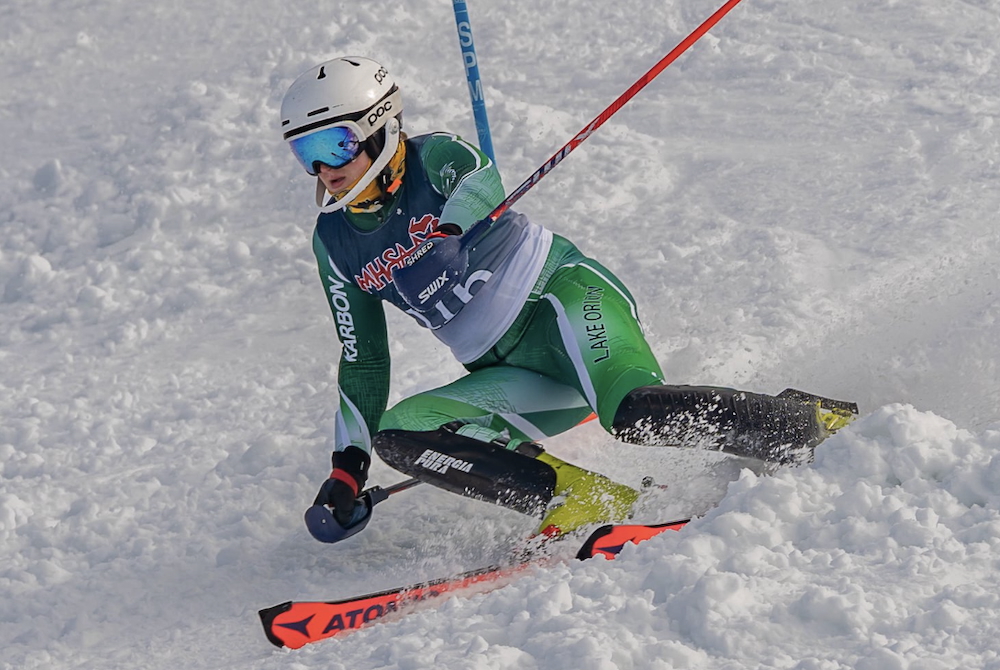
At the Finals, while the biggest accomplishment was finishing second in the giant slalom — which was his best finish at a high school state meet — the biggest compliment to him might have been how he handled one mishap in the slalom.
Janczarek had a straddle on the first run of slalom that pretty much took him out of the competition, but he didn’t hesitate to go up for his second run and finish.
“I know there is a lot of people in the sport of ski racing that if they have a bad run, they’ll just not take their second run or just leave and go home,” he said. “I think it’s important you give your all every time you’re on the ski hill.”
Janczarek will continue to give it his all in college, as he plans to ski for Northern Michigan University.
He said he wants to stick with skiing “as far as it will take him,” whether it’s something beyond college competitively, or just as a coach to influence others.
Basigkow said Janczarek was generous with his time all season in the way he counseled younger skiers on Lake Orion’s team, and saw firsthand how coaching could be in his future.
“Just to get other people the same love for the sport I have,” Janczarek said.
 Keith Dunlap has served in Detroit-area sports media for more than two decades, including as a sportswriter at the Oakland Press from 2001-16 primarily covering high school sports but also college and professional teams. His bylines also have appeared in USA Today, the Washington Post, the Detroit Free Press, the Houston Chronicle and the Boston Globe. He served as the administrator for the Oakland Activities Association’s website from 2017-2020. Contact him at [email protected] with story ideas for Oakland, Macomb and Wayne counties.
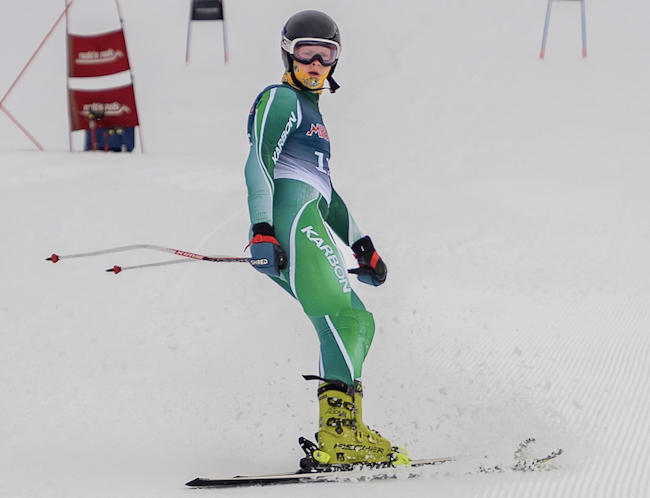
PHOTOS (Top) Lake Orion's Broden Janczarek cuts past a gate during a slalom run at the Division 1 Finals at Nub's Nob. (Middle) Janczarek comes to a stop after a giant slalom run. (Click for more by Tori Burley.)