


Add, Subtract, Divide, Multiply: MHSAA Not Alone
July 25, 2017
By Rob Kaminski
MHSAA benchmarks editor
This is the third part in a series on MHSAA tournament classification, past and present, that will be published over the next two weeks. This series originally ran in this spring's edition of MHSAA benchmarks.
As the MHSAA faces its most recent classification task with 8-Player Football, and opinions continue to swirl about as to the method, timeframe, location and other procedures, a look around the country provides plenty of company among state association brethren factoring variables into their own equations.
In the Pacific Northwest, the Oregon School Activities Association Football Playoffs are under public scrutiny as leadership ponders a five or six classification format beginning with the 2018-19 school year.
The OSAA has crowned six champions on the gridiron since 2006-07. Many of the state’s smaller schools would like to keep it that way, while larger schools lean toward a five-classification system, citing larger leagues, ease of travel and credibility to state championships as the advantages.
Still others would prefer more than six classes, pointing to safety issues and the opportunity to increase participation numbers as positives.
Moving southeast of Oregon, the Nevada Interscholastic Activities Association recently voted to hold serve on a classification proposal that was volleyed to the membership.
However, changes still could be forthcoming by as early as the 2018-19 season which would add a fifth classification in more populated southern Nevada while allowing northern schools to participate in four classifications. Such divisions could mean no state championship for the fifth class in southern Nevada.
Because of that, the NIAA wants equal numbers of schools in each classification on both ends of the state. Complicating the issue is the fact that the 24 largest schools in the state, by enrollment, are all in Clark County in Southern Nevada.
Across Nevada’s border into Arizona, charter schools are asking the Arizona Interscholastic Association to reconsider classification that was voted upon and approved in September 2015. That agreement called for the largest 33 percent of charter schools by enrollment to be placed in the state’s largest school classification, 3A, the middle 33 percent into 2A, and the smallest 33 percent into 1A.
Less than two years later the charter schools have had a change of heart and have asked to be considered the same as other Arizona public schools and be placed appropriately by enrollment beginning with the 2018-19 school year.
The situation in Arizona further illustrates how the public/private debate that all state associations have faced throughout existence now has the added dynamic of rapidly growing charter schools in today’s educational system, along with virtual school enrollment.
In the nation’s heartland, Nebraska has retooled its football classifications by using enrollment of boys students only in its schools rather than total enrollment. The Nebraska School Activities Association football-playing schools will kick off the 2018 season using this alignment.
Nebraska has three classes of 11-player football, with the smallest class divided in two, Class C-1 and C-2. The state also will have 8-player football for boys enrollments under 47, and the NSAA will sponsor a new 6-player tournament in 2018 for schools with 27 or fewer boys.
“This is a good proposal because some schools have a sizable imbalance between the number of boys and girls, and there’s a large gap (in enrollment) between the largest and smallest schools in Classes A and B,” NSAA executive director Jim Tenopir said. “I think this addresses both of those concerns.”
Swimmers in Georgia, meanwhile, will feel like they are moving with the current, rather than upstream in 2017-18, as the Georgia High School Association recently doubled the number of team championship events from two to four.
Swim enthusiasts can also count on longer days at the finals, as the top 30 finishers from the prelims will advance to the finals instead of 20, and all championship events will have three heats versus two.
Providing Opportunities, Molding Leaders Most Rewarding for Hampton Honoree Thompson
By
Geoff Kimmerly
MHSAA.com senior editor
March 7, 2025
A leader on the basketball court as a high school and college standout, and then a leader in the classroom and at every level of educational administration over a 33-year career, Arnetta Thompson has been a staunch advocate for underrepresented groups in sports.
To recognize her work in creating opportunities for those groups, and all students, the Wyoming Godfrey-Lee Public Schools superintendent has been selected as the recipient of this year’s Nate Hampton Champion of Progress in Athletics Award by the Michigan High School Athletic Association.
The Hampton Award was created by the MHSAA’s Representative Council to honor Nate Hampton, who retired in 2021 after serving in education and educational athletics for 50 years, including the last 32 as an MHSAA assistant director. Honorees have championed the promotion and advancement of opportunities for women, minorities and other underrepresented groups within interscholastic athletics, while serving as an administrator, coach, official, educator or school sports leader in Michigan.
 Thompson is the second recipient of the award, as Novi principal Nicole Carter received the inaugural honor last year. Thompson will receive the Hampton Award during the MHSAA Boys Basketball Division 1 Final on March 15 at the Breslin Student Events Center in East Lansing.
“I just feel honored that I’m allowed to be in these spaces, to be selected as a principal or a superintendent, that people believe in me enough to believe I can help their students become better people and reach their goals,” Thompson said. “The rewarding part is seeing those students that you reconnect with or those you stay connected with and see what their paths in life become as a result of crossing paths with me.
“I’m passionate about students – especially students that are not always the top of the class, not the typical student – and helping guide them with the resources and with people that look like them and then opportunities to do some things they hadn’t done and didn’t even think they could do.”
Thompson is in her second school year as superintendent of Godfrey-Lee schools. She previously served 20 years in Grand Rapids Public Schools – as a teacher for six, then as an athletic director, assistant principal, instructional assistant principal and K-8 principal – and also served as an elementary curriculum specialist for Muskegon Public Schools and in multiple roles in the Muskegon Heights Public School Academy System including as superintendent during the 2021-22 school year. She began her professional career as a teacher in Memphis City, Tenn., schools after graduating from Tennessee Tech University.
She is a two-time appointee to the MHSAA Representative Council – previously serving from 2009-13 and currently a two-year term.
“Arnetta Thompson’s work to empower her students and those who have worked for her and with her is simply inspiring,” said MHSAA Executive Director Mark Uyl. “She has brought compassion and vision to every district with which she’s served. The Hampton Award recognizes promotion and advancement of underrepresented groups within interscholastic athletics, and Arnetta has continuously provided leadership in that area including now during a second tenure on the MHSAA Representative Council.”
Thompson earned her bachelor's degree in secondary education biology from Tennessee Tech in 1990, and her master’s in education with a concentration in educational leadership from Western Michigan University in 2001. She went on to also earn an educational specialist degree from Grand Valley State University in 2011 and her doctorate in philosophy from Eastern Michigan University in 2017.
During six years teaching at Memphis City, Thompson also served as varsity head coach of the girls basketball, volleyball and track & field teams. Coming to Grand Rapids Public Schools in 1997, she served as a lead teacher at Grand Rapids Union’s alternative high school, then as athletic director and assistant principal at Grand Rapids Creston. She also served as an assistant girls basketball coach at Grand Rapids Ottawa Hills for one season and coached the Grand Rapids Central varsity for four.
Thompson entered college on a pre-medical track. A professor noticed how she provided assistance to another student during a lab and suggested she consider education.
“My grandmother told me one time she thought I had a gift, and she wanted me to use that gift to fight for those who could not fight for themselves. Going into college with the mindset to go into medicine, and then my professor saying that, and talking with some of my colleagues at that time, I was moving in the direction of becoming an educator, and I thought that was the place for me,” Thompson said. (Education) has been even more than I anticipated. … Just the feeling of being an educator, just to give people opportunities, to mold our younger kids into great community leaders.”
Thompson earned eight varsity letters across three sports for Ottawa Hills before graduating in 1985, garnering all-state recognition in basketball and all-city in volleyball and also competing in track & field. She then played four seasons of basketball at Tennessee Tech, starting on the team that reached the NCAA Tournament in 1988-89.
Thompson has been married to her husband Willie for more than 30 years. They have two daughters, Daenetta Joseph and Arnell Thompson.
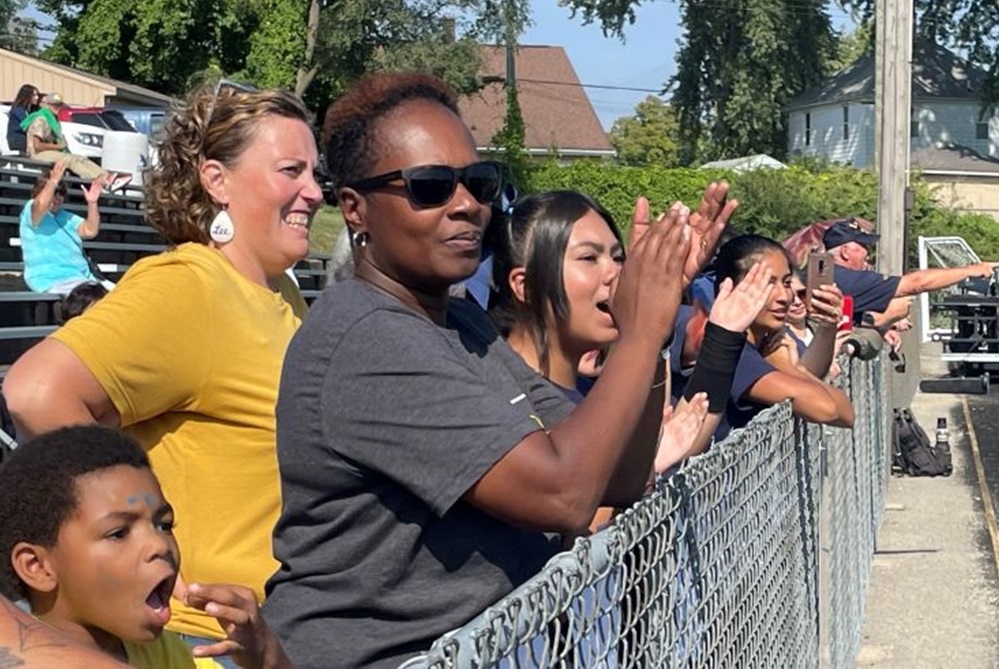
PHOTO Arnetta Thompson, third from left, claps during Godfrey-Lee's 100th anniversary celebration in 2023. (Photo courtesy of the Kent ISD/School News Network.)