

Add, Subtract, Divide, Multiply: MHSAA Not Alone
July 25, 2017
By Rob Kaminski
MHSAA benchmarks editor
This is the third part in a series on MHSAA tournament classification, past and present, that will be published over the next two weeks. This series originally ran in this spring's edition of MHSAA benchmarks.
As the MHSAA faces its most recent classification task with 8-Player Football, and opinions continue to swirl about as to the method, timeframe, location and other procedures, a look around the country provides plenty of company among state association brethren factoring variables into their own equations.
In the Pacific Northwest, the Oregon School Activities Association Football Playoffs are under public scrutiny as leadership ponders a five or six classification format beginning with the 2018-19 school year.
The OSAA has crowned six champions on the gridiron since 2006-07. Many of the state’s smaller schools would like to keep it that way, while larger schools lean toward a five-classification system, citing larger leagues, ease of travel and credibility to state championships as the advantages.
Still others would prefer more than six classes, pointing to safety issues and the opportunity to increase participation numbers as positives.
Moving southeast of Oregon, the Nevada Interscholastic Activities Association recently voted to hold serve on a classification proposal that was volleyed to the membership.
However, changes still could be forthcoming by as early as the 2018-19 season which would add a fifth classification in more populated southern Nevada while allowing northern schools to participate in four classifications. Such divisions could mean no state championship for the fifth class in southern Nevada.
Because of that, the NIAA wants equal numbers of schools in each classification on both ends of the state. Complicating the issue is the fact that the 24 largest schools in the state, by enrollment, are all in Clark County in Southern Nevada.
Across Nevada’s border into Arizona, charter schools are asking the Arizona Interscholastic Association to reconsider classification that was voted upon and approved in September 2015. That agreement called for the largest 33 percent of charter schools by enrollment to be placed in the state’s largest school classification, 3A, the middle 33 percent into 2A, and the smallest 33 percent into 1A.
Less than two years later the charter schools have had a change of heart and have asked to be considered the same as other Arizona public schools and be placed appropriately by enrollment beginning with the 2018-19 school year.
The situation in Arizona further illustrates how the public/private debate that all state associations have faced throughout existence now has the added dynamic of rapidly growing charter schools in today’s educational system, along with virtual school enrollment.
In the nation’s heartland, Nebraska has retooled its football classifications by using enrollment of boys students only in its schools rather than total enrollment. The Nebraska School Activities Association football-playing schools will kick off the 2018 season using this alignment.
Nebraska has three classes of 11-player football, with the smallest class divided in two, Class C-1 and C-2. The state also will have 8-player football for boys enrollments under 47, and the NSAA will sponsor a new 6-player tournament in 2018 for schools with 27 or fewer boys.
“This is a good proposal because some schools have a sizable imbalance between the number of boys and girls, and there’s a large gap (in enrollment) between the largest and smallest schools in Classes A and B,” NSAA executive director Jim Tenopir said. “I think this addresses both of those concerns.”
Swimmers in Georgia, meanwhile, will feel like they are moving with the current, rather than upstream in 2017-18, as the Georgia High School Association recently doubled the number of team championship events from two to four.
Swim enthusiasts can also count on longer days at the finals, as the top 30 finishers from the prelims will advance to the finals instead of 20, and all championship events will have three heats versus two.
Engadine's Rock & Roll Relays Provide Runners with Interval Challenge
By
John Vrancic
Special for MHSAA.com
August 27, 2026
ENGADINE — This was not your ordinary cross country meet.
 Last week’s Engadine Rock & Roll Relays provide interval training for the runners, who do a mile on three occasions during the races and start and finish with music playing in the background.
“It went pretty good,” Engadine junior Ed Frankowiac said. “The breaks are nice, but you have to keep moving. It’s fun. We didn’t have this meet two years ago because it conflicted with a meet in Munising (Larissa Vartti Memorial Invitational), but we’re glad we had it last year. We’re trying to build this up.”
Frankowiak combined with junior Nate Stielstra for the first-place finish as they covered the six miles in 35 minutes, 17.18 seconds on a sunny and mild Aug. 20 day.
Rapid River, however, won the boys meet with five points. The host Eagles scored six and Manistique finished with 11.
The Rapid River girls retained their title by edging the Eagles 5-6.
“This is the second year we got the plaque,” Rockets’ sophomore Victoria Coppock said. “This is a nice boost for our team. Engadine has a couple real good runners.
“This is one of the meets I really look forward to. I think it’s more competitive. It’s also easier to look at placement and know where you are.”
Engadine sophomores Sarah Chapman and Fern Stielstra combined to win the girls race at 44:59.31. Rapid River juniors Kaylee Tyler and Julia Poma were runners-up (47:53.93) followed by Coppock and junior Ashlynn Thompson (49:02.42).
 “All my miles were under seven minutes,” Chapman said. “I’m very happy with my times and how I finished each time. It’s hard to stop and go, but it’s fun. It’s a great way to open the season. I think last year’s experience is helping me. It was nice out there. It wasn’t too hot and we had a nice breeze. I think it went well.”
Engadine junior Birch Bitely, who teamed with Oliver French for a fifth-place finish among the boys (41:08.53), also enjoys this meet.
“It’s a good course,” he said. “There’s one big hill toward the end and a few rolling hills before that. We had better conditions this time. Last year we had rain with temperatures in the 50s. The nice weather made it easier to keep your legs warm.”
Rapid River senior Jae Poma and sophomore Owen Truitt were boys runners-up at 35:40.63, followed by senior teammates Jeb Green and Jon Denkins (38:38.56).
“I really like it,” Poma said. “It’s something different. This helps our speed, and it’s kind of a tune-up for other races. It’s nice to get the break, but you have to keep moving to keep your legs warmed up for your next interval.”
Poma also has some personal and team goals in mind.
“I would like to get under 18 minutes,” he added. “I feel we have a shot at the U.P. (Division 3) title. There’s a lot of good teams out there, but if we work hard I think we have a chance.”
Rapid River senior Camden Holmio and Engadine’s Eli Frankowiak teamed for a sixth-place finish in 48:01.53.
“I was a little excited to run with a guy from another school,” Holmio said. “I think that made it more fun. Interval training is pretty helpful. The breaks are good, but it’s sometimes a little hard to get going after you stop.”
Sophomore Keira Hart, who represented the Manistique girls, ran on a boys team with fellow Emeralds Trent Mason and James King.
“I really wasn’t that nervous, but standing at the starting line alone was the hardest part mentally. It just felt weird because I wasn’t running with the other girls,” she said. “It was a good first meet. It was also kind of a learning experience.”
 John Vrancic has covered high school sports in the Upper Peninsula since joining the Escanaba Daily Press staff in 1985. He is known most prominently across the peninsula for his extensive coverage of cross country and track & field that frequently appears in newspapers from the Wisconsin border to Lake Huron. He received the James Trethewey Award for Distinguished Service in 2015 from the Upper Peninsula Sportswriters and Sportscasters Association.
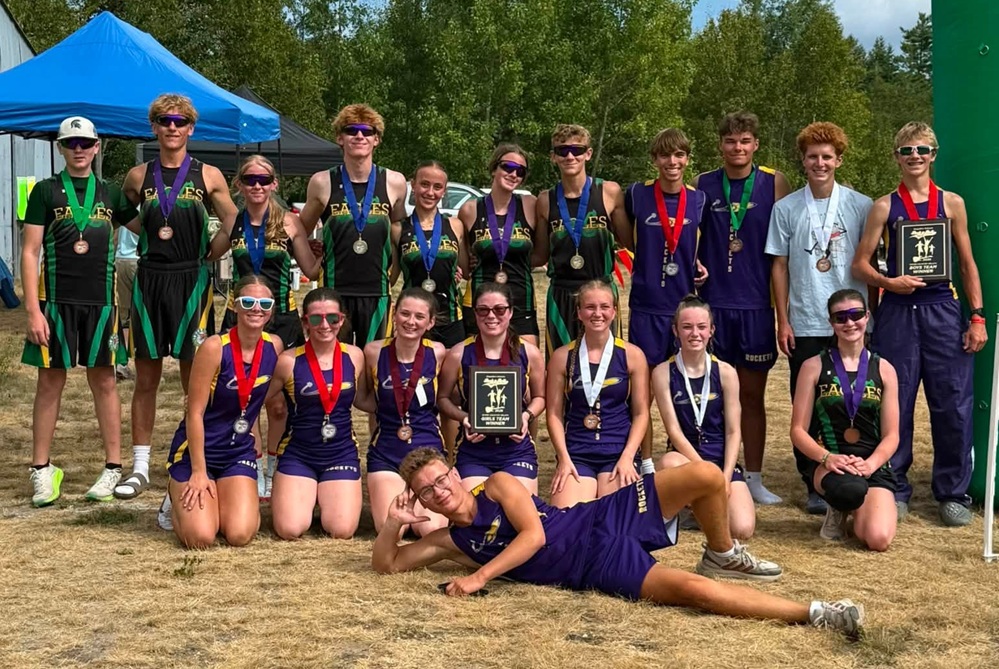
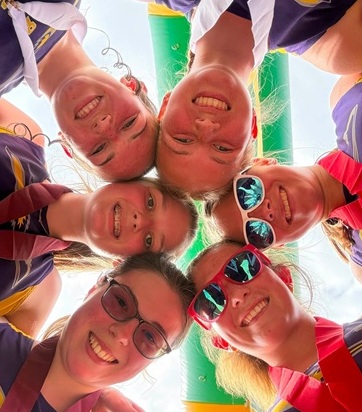
PHOTOS (Top) Rapid River and Engadine medal winners stand for a photo together after the Engadine Rock & Roll Relays. (Middle) The Rockets enjoy a moment together after their win. (Photos courtesy of the Rapid River cross country program.)