

Add, Subtract, Divide, Multiply: MHSAA Not Alone
July 25, 2017
By Rob Kaminski
MHSAA benchmarks editor
This is the third part in a series on MHSAA tournament classification, past and present, that will be published over the next two weeks. This series originally ran in this spring's edition of MHSAA benchmarks.
As the MHSAA faces its most recent classification task with 8-Player Football, and opinions continue to swirl about as to the method, timeframe, location and other procedures, a look around the country provides plenty of company among state association brethren factoring variables into their own equations.
In the Pacific Northwest, the Oregon School Activities Association Football Playoffs are under public scrutiny as leadership ponders a five or six classification format beginning with the 2018-19 school year.
The OSAA has crowned six champions on the gridiron since 2006-07. Many of the state’s smaller schools would like to keep it that way, while larger schools lean toward a five-classification system, citing larger leagues, ease of travel and credibility to state championships as the advantages.
Still others would prefer more than six classes, pointing to safety issues and the opportunity to increase participation numbers as positives.
Moving southeast of Oregon, the Nevada Interscholastic Activities Association recently voted to hold serve on a classification proposal that was volleyed to the membership.
However, changes still could be forthcoming by as early as the 2018-19 season which would add a fifth classification in more populated southern Nevada while allowing northern schools to participate in four classifications. Such divisions could mean no state championship for the fifth class in southern Nevada.
Because of that, the NIAA wants equal numbers of schools in each classification on both ends of the state. Complicating the issue is the fact that the 24 largest schools in the state, by enrollment, are all in Clark County in Southern Nevada.
Across Nevada’s border into Arizona, charter schools are asking the Arizona Interscholastic Association to reconsider classification that was voted upon and approved in September 2015. That agreement called for the largest 33 percent of charter schools by enrollment to be placed in the state’s largest school classification, 3A, the middle 33 percent into 2A, and the smallest 33 percent into 1A.
Less than two years later the charter schools have had a change of heart and have asked to be considered the same as other Arizona public schools and be placed appropriately by enrollment beginning with the 2018-19 school year.
The situation in Arizona further illustrates how the public/private debate that all state associations have faced throughout existence now has the added dynamic of rapidly growing charter schools in today’s educational system, along with virtual school enrollment.
In the nation’s heartland, Nebraska has retooled its football classifications by using enrollment of boys students only in its schools rather than total enrollment. The Nebraska School Activities Association football-playing schools will kick off the 2018 season using this alignment.
Nebraska has three classes of 11-player football, with the smallest class divided in two, Class C-1 and C-2. The state also will have 8-player football for boys enrollments under 47, and the NSAA will sponsor a new 6-player tournament in 2018 for schools with 27 or fewer boys.
“This is a good proposal because some schools have a sizable imbalance between the number of boys and girls, and there’s a large gap (in enrollment) between the largest and smallest schools in Classes A and B,” NSAA executive director Jim Tenopir said. “I think this addresses both of those concerns.”
Swimmers in Georgia, meanwhile, will feel like they are moving with the current, rather than upstream in 2017-18, as the Georgia High School Association recently doubled the number of team championship events from two to four.
Swim enthusiasts can also count on longer days at the finals, as the top 30 finishers from the prelims will advance to the finals instead of 20, and all championship events will have three heats versus two.
Tradition, Big North Competition Drive Petoskey's Quest to Extend Finals Streak
By
Tom Spencer
Special for MHSAA.com
January 24, 2025
At least one thing is certain in boys skiing this winter. Traverse City West and Traverse City Central will not stand in the way of Petoskey winning another Finals championship.
 Actually, and almost most certainly, they’ll help the Northmen make good on their potential.
West and Central, perennial contenders for the Division 1 title, provide regular, tough competition that should help the Northman as they set the sites on a sixth-straight Division 2 championship. West and Central regularly challenge the Northmen as participants in their five Big North Conference meets.
Central won the D1 championship last year, snapping a run of three straight by West. Marquette, which won a second straight in 2020, was the last school to win the D1 championship before the Traverse City teams’ domination.
Petoskey hopes to get at least one win over both the Titans and Trojans during the regular season as the Northmen pursue the BNC title before hitting the slopes of the Regional at Boyne Mountain in Boyne Falls and the Final at Boyne Highlands in Harbor Springs. The league scores are cumulative over the season, leading to naming a champion.
 “If we have all of our successes coming together in one spot, we definitely have a chance to win one of those conference races” said Petoskey coach Ben Crockett, who began guiding the Northmen in 2019. “The experience of competing against another state champion helps all of our programs to stay competitive when we’re in the state Final.”
Last year the Northmen prevailed in a tougher-than-expected Regional at Crystal Mountain before capturing their fifth-straight D2 Finals championship. That Regional featured Harbor Springs, which finished fifth in the Final, and Gaylord, a familiar Big North opponent, along with Benzie Central, Boyne City, Elk Rapids, Houghton, Ironwood, Maple City Glen Lake, Grayling, Onekama and Petoskey St. Michael. The Regional field this year is almost the same as the Upper Peninsula’s Norway replaces Benzie.
And, Petoskey’s last year’s top performers are all back. The Northman also have added sophomore Eli Dettmer, who returned to Northern Michigan after competing in Maine as a freshman. He is expected to play a key role leading up to February’s Final.
Senior Gavin Galbraith is back after winning the individual Finals title in the slalom and finishing third in the giant slalom last season. Junior Taylor Keiswetter and sophomore Mick Galbraith are also back after placing in the top 10 in the giant slalom. Keiswetter finished fifth, and the younger Galbraith placed eighth.
“A lot of the championship team will be returning, so we think we’re in a pretty good position to defend again,” Crockett said. “Gavin Galbraith will be leading that charge as the returning state champion with the speed to contest for another state championship on the individual level and lead the team as they try to get that sixth.”
 While Petoskey will be looking for all four of those skiers to perform well to get back on the podium this winter, that possibility never is taken for granted.
“It is always on our radar, but really on the day I think we’re hoping to have a good performance and everybody ski to their potential,” Crockett said. “We know we have to put in a good effort, and then we have to let the scoring fall where it will.”
Crockett, a 1999 graduate and past Petoskey ski team member, is thrilled to continue as part of the Northmen program. His experience skiing all over North America and Europe during his younger days has been a benefit to the Northmen.
“Skiing was a big part of my athletic career growing up,” Crockett said. “Being able to help this next group of athletes achieve their own goals and dreams has been really fun.”
Last year Orchard Lake St. Mary’s finished runner-up and Pontiac Notre Dame Prep (134) finished third at the Final. The Northmen welcome the competition from downstate and the Upper Peninsula.
“There’s definitely good, competitive skiers coming from spots we don’t really see during the year and face off against when we get to the state meet,” Crockett said.
Effort is the key to maintaining the Petoskey legacy, Crockett emphasizes.
“We really try to honor the tradition of having an excellent program at Petoskey,” Crockett said. “We always try to put in the most effort to continue that legacy into the future.”
 Tom Spencer is a longtime MHSAA-registered basketball and soccer official, and former softball and baseball official, and he also has coached in the northern Lower Peninsula area. He previously has written for the Saginaw News, Bay County Sports Page and Midland Daily News. He can be reached at [email protected] with story ideas for Manistee, Wexford, Missaukee, Roscommon, Ogemaw, Iosco, Alcona, Oscoda, Crawford, Kalkaska, Grand Traverse, Benzie, Leelanau, Antrim, Otsego, Montmorency, Alpena, Presque Isle, Cheboygan, Charlevoix and Emmet counties.
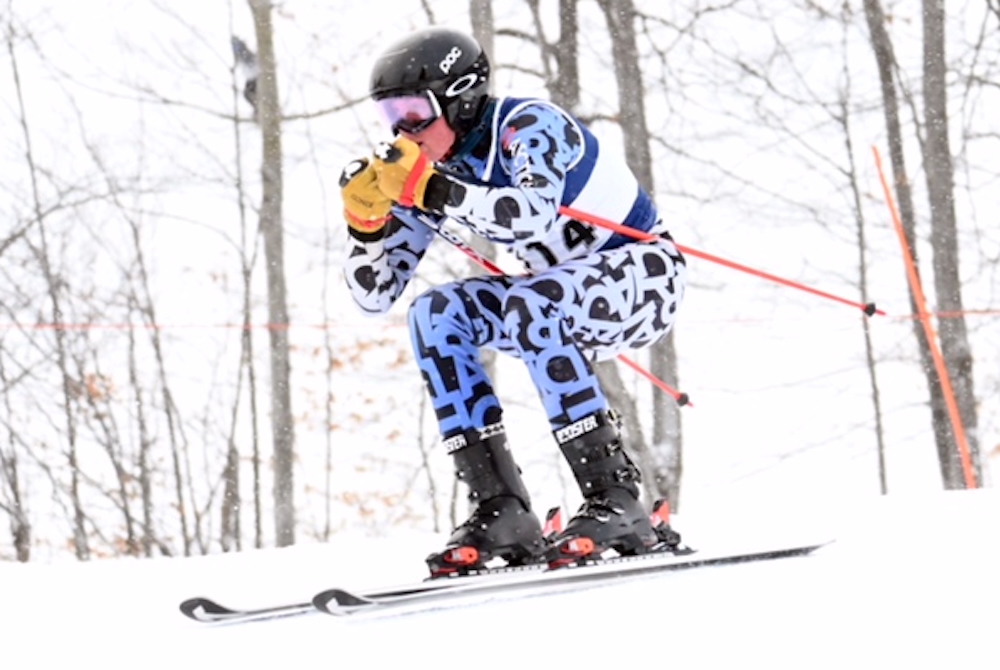
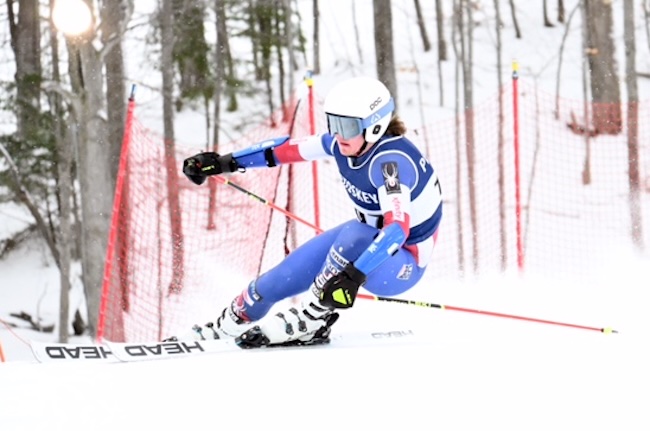
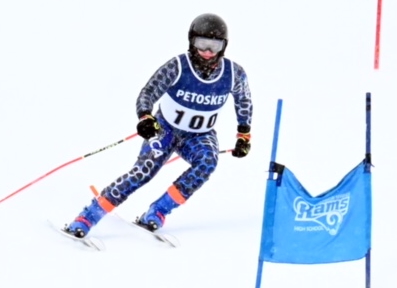
PHOTOS (Top) Petoskey’s Gavin Galbraith races during the Harbor-Petoskey Invitational this season at Boyne Highlands. (Middle) Sophomore Eli Dettmer, an addition to the team this season, leans into a turn during a race at the Harbor-Petoskey Invite. (Below) Carter Walkerdine approaches a gate. (Photos by Drew Kochanny/Petoskey News-Review.)