

Add, Subtract, Divide, Multiply: MHSAA Not Alone
July 25, 2017
By Rob Kaminski
MHSAA benchmarks editor
This is the third part in a series on MHSAA tournament classification, past and present, that will be published over the next two weeks. This series originally ran in this spring's edition of MHSAA benchmarks.
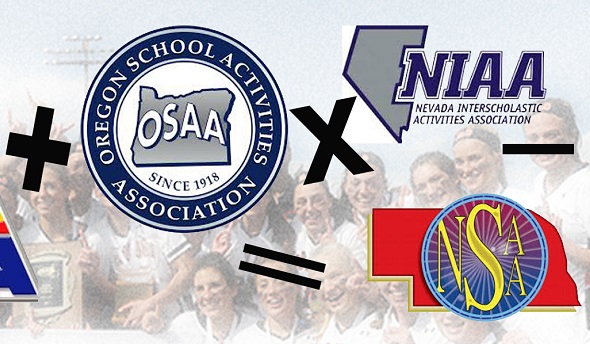
As the MHSAA faces its most recent classification task with 8-Player Football, and opinions continue to swirl about as to the method, timeframe, location and other procedures, a look around the country provides plenty of company among state association brethren factoring variables into their own equations.
In the Pacific Northwest, the Oregon School Activities Association Football Playoffs are under public scrutiny as leadership ponders a five or six classification format beginning with the 2018-19 school year.
The OSAA has crowned six champions on the gridiron since 2006-07. Many of the state’s smaller schools would like to keep it that way, while larger schools lean toward a five-classification system, citing larger leagues, ease of travel and credibility to state championships as the advantages.
Still others would prefer more than six classes, pointing to safety issues and the opportunity to increase participation numbers as positives.
Moving southeast of Oregon, the Nevada Interscholastic Activities Association recently voted to hold serve on a classification proposal that was volleyed to the membership.
However, changes still could be forthcoming by as early as the 2018-19 season which would add a fifth classification in more populated southern Nevada while allowing northern schools to participate in four classifications. Such divisions could mean no state championship for the fifth class in southern Nevada.
Because of that, the NIAA wants equal numbers of schools in each classification on both ends of the state. Complicating the issue is the fact that the 24 largest schools in the state, by enrollment, are all in Clark County in Southern Nevada.
Across Nevada’s border into Arizona, charter schools are asking the Arizona Interscholastic Association to reconsider classification that was voted upon and approved in September 2015. That agreement called for the largest 33 percent of charter schools by enrollment to be placed in the state’s largest school classification, 3A, the middle 33 percent into 2A, and the smallest 33 percent into 1A.
Less than two years later the charter schools have had a change of heart and have asked to be considered the same as other Arizona public schools and be placed appropriately by enrollment beginning with the 2018-19 school year.
The situation in Arizona further illustrates how the public/private debate that all state associations have faced throughout existence now has the added dynamic of rapidly growing charter schools in today’s educational system, along with virtual school enrollment.
In the nation’s heartland, Nebraska has retooled its football classifications by using enrollment of boys students only in its schools rather than total enrollment. The Nebraska School Activities Association football-playing schools will kick off the 2018 season using this alignment.
Nebraska has three classes of 11-player football, with the smallest class divided in two, Class C-1 and C-2. The state also will have 8-player football for boys enrollments under 47, and the NSAA will sponsor a new 6-player tournament in 2018 for schools with 27 or fewer boys.
“This is a good proposal because some schools have a sizable imbalance between the number of boys and girls, and there’s a large gap (in enrollment) between the largest and smallest schools in Classes A and B,” NSAA executive director Jim Tenopir said. “I think this addresses both of those concerns.”
Swimmers in Georgia, meanwhile, will feel like they are moving with the current, rather than upstream in 2017-18, as the Georgia High School Association recently doubled the number of team championship events from two to four.
Swim enthusiasts can also count on longer days at the finals, as the top 30 finishers from the prelims will advance to the finals instead of 20, and all championship events will have three heats versus two.

Century of School Sports: Awards Celebrate Well-Rounded Educational Experience
By
Geoff Kimmerly
MHSAA.com senior editor
January 21, 2025
This week, the MHSAA and Farm Bureau Insurance are announcing the finalists for their 36th Scholar-Athlete Awards. From more than 1,500 candidates, 32 will be selected over the next few weeks to receive this prestigious award.
When the most recent class of winners is announced over three weeks next month, they’ll push the total to 992 who have been honored since the program began during the 1989-90 school year.
That fall, Vestaburg senior Jennifer Bissell and Unionville-Sebewaing senior Scott Kieser were presented with the first of these Farm Bureau-sponsored awards during the MHSAA Football Finals on Nov. 25, 1989, at the Pontiac Silverdome. Although several of the award program’s criteria have changed over the years, the mission has remained consistent: Highlight the value extracurricular activities – including athletics – play in the total education of a high school student, while recognizing that all-around achievement.
Applicants must be graduating seniors during the current school year, carry an unrounded 3.5 (on a 4.0 scale) grade-point average and have won a varsity letter in one of the 28 sports for which the MHSAA sponsors a postseason tournament. Candidates are judged on their academic, athletic and other extracurricular accomplishments, plus community involvement and a short essay on the importance of sportsmanship in educational athletics.
Farm Bureau has partnered on the Scholar-Athlete Awards from the start, awarding $1,088,000 over the first 35 years of recognition. Awards have risen in value from $500 to $1,000 to now $2,000, and 383 schools – more than half of the MHSAA membership – have produced at least one scholarship winner.
Those are just a few of the staggering numbers that have grown with the program over the years.
The first two years saw two award winners each season. In 1991-92, a change was made to award one winner per MHSAA-sponsored sport. In 2005-06, the program was expanded to its current 32 winners based primarily on school enrollment – six boys and six girls from Class A schools, four boys and four girls from Class B, three boys and three girls from Class C, and two girls and two boys from Class D schools, plus two honorees awarded at-large to minority recipients regardless of school size.
There have been 3,817 finalists, not including this year’s class. As noted above, 383 schools have produced a winner, but 624 had produced a finalist through 2023-24 – and although schools have closed or consolidated over the years, that still means that roughly 80 percent of MHSAA member schools over the last four decades have produced at least had at least one candidate advance to the final round.
Midland Dow has the most Finalists (38), while 113 schools have had at least 10. Birmingham Seaholm has set a single-year record this year with six finalists; five schools previously shared the record of five finalists for a single award season.
Eight schools have had 10 or more winners over the first 35 years. Okemos leads that parade with 13, followed by Bloomfield Hills Cranbrook Kingswood and Hillsdale Academy with 12 apiece. Grand Rapids Forest Hills Northern and Midland Dow both have celebrated 11 winners, and Grosse Pointe South, St. Johns and Traverse City Central have produced 10 award winners.
Again, it cannot be overlooked the significance of Farm Bureau’s sponsorship and enthusiasm for this program – the 1.1 million dollars in scholarships speaks for itself, but also that a representative from Farm Bureau annually joins the MHSAA executive director in awarding those scholarships during a ceremony at Breslin Center on MHSAA Boys Basketball Finals weekend.
Also deserving of significant recognition are the judges who make this program a go every year. This year’s 1,513 applications were judged by a 65-member committee of school coaches, counselors, faculty members, administrators and board members from MHSAA member schools.
Previous "Century of School Sports" Spotlights
Jan. 14: Predecessors Laid Foundation for MHSAA's Formation - Read
Jan. 9: MHSAA Blazes Trail Into Cyberspace - Read
Dec. 31: State's Storytellers Share Winter Memories - Read
Dec. 17: MHSAA Over Time - Read
Dec. 10: On This Day, December 13, We Will Celebrate - Read
Dec. 3: MHSAA Work Guided by Representative Council - Read
Nov. 26: Finals Provide Future Pros Early Ford Field Glory - Read
Nov. 19: Connection at Heart of Coaches Advancement Program - Read
Nov. 12: Good Sports are Winners Then, Now & Always - Read
Nov. 5: MHSAA's Home Sweet Home - Read
Oct. 29: MHSAA Summits Draw Thousands to Promote Sportsmanship - Read
Oct. 23: Cross Country Finals Among MHSAA's Longest Running - Read
Oct. 15: State's Storytellers Share Fall Memories - Read
Oct. 8: Guided by 4 S's of Educational Athletics - Read
Oct. 1: Michigan Sends 10 to National Hall of Fame - Read
Sept. 25: MHSAA Record Books Filled with 1000s of Achievements - Read
Sept. 18: Why Does the MHSAA Have These Rules? - Read
Sept. 10: Special Medals, Patches to Commemorate Special Year - Read
Sept. 4: Fall to Finish with 50th Football Championships - Read
Aug. 28: Let the Celebration Begin - Read