

Add, Subtract, Divide, Multiply: MHSAA Not Alone
July 25, 2017
By Rob Kaminski
MHSAA benchmarks editor
This is the third part in a series on MHSAA tournament classification, past and present, that will be published over the next two weeks. This series originally ran in this spring's edition of MHSAA benchmarks.
As the MHSAA faces its most recent classification task with 8-Player Football, and opinions continue to swirl about as to the method, timeframe, location and other procedures, a look around the country provides plenty of company among state association brethren factoring variables into their own equations.
In the Pacific Northwest, the Oregon School Activities Association Football Playoffs are under public scrutiny as leadership ponders a five or six classification format beginning with the 2018-19 school year.
The OSAA has crowned six champions on the gridiron since 2006-07. Many of the state’s smaller schools would like to keep it that way, while larger schools lean toward a five-classification system, citing larger leagues, ease of travel and credibility to state championships as the advantages.
Still others would prefer more than six classes, pointing to safety issues and the opportunity to increase participation numbers as positives.
Moving southeast of Oregon, the Nevada Interscholastic Activities Association recently voted to hold serve on a classification proposal that was volleyed to the membership.
However, changes still could be forthcoming by as early as the 2018-19 season which would add a fifth classification in more populated southern Nevada while allowing northern schools to participate in four classifications. Such divisions could mean no state championship for the fifth class in southern Nevada.
Because of that, the NIAA wants equal numbers of schools in each classification on both ends of the state. Complicating the issue is the fact that the 24 largest schools in the state, by enrollment, are all in Clark County in Southern Nevada.
Across Nevada’s border into Arizona, charter schools are asking the Arizona Interscholastic Association to reconsider classification that was voted upon and approved in September 2015. That agreement called for the largest 33 percent of charter schools by enrollment to be placed in the state’s largest school classification, 3A, the middle 33 percent into 2A, and the smallest 33 percent into 1A.
Less than two years later the charter schools have had a change of heart and have asked to be considered the same as other Arizona public schools and be placed appropriately by enrollment beginning with the 2018-19 school year.
The situation in Arizona further illustrates how the public/private debate that all state associations have faced throughout existence now has the added dynamic of rapidly growing charter schools in today’s educational system, along with virtual school enrollment.
In the nation’s heartland, Nebraska has retooled its football classifications by using enrollment of boys students only in its schools rather than total enrollment. The Nebraska School Activities Association football-playing schools will kick off the 2018 season using this alignment.
Nebraska has three classes of 11-player football, with the smallest class divided in two, Class C-1 and C-2. The state also will have 8-player football for boys enrollments under 47, and the NSAA will sponsor a new 6-player tournament in 2018 for schools with 27 or fewer boys.
“This is a good proposal because some schools have a sizable imbalance between the number of boys and girls, and there’s a large gap (in enrollment) between the largest and smallest schools in Classes A and B,” NSAA executive director Jim Tenopir said. “I think this addresses both of those concerns.”
Swimmers in Georgia, meanwhile, will feel like they are moving with the current, rather than upstream in 2017-18, as the Georgia High School Association recently doubled the number of team championship events from two to four.
Swim enthusiasts can also count on longer days at the finals, as the top 30 finishers from the prelims will advance to the finals instead of 20, and all championship events will have three heats versus two.
Team Growing, Scores Rising as Bark River-Harris Continues to Build in 2nd Season
By
John Vrancic
Special for MHSAA.com
January 6, 2025
ESCANABA —Bark River-Harris gymnastics is only a few meets into its second season as a program. But the Broncos are quickly and impressively building on last year’s debut.
 The second-year program is growing – now offering cooperative program opportunities for athletes from Iron Mountain, Powers North Central, Escanaba Holy Name and Gladstone – and at the Dec. 7 Escanaba Elks Invitational scored a school-record 125.80 points, which also counted as the program’s first-ever team-qualifying score for Regional competition.
“Our level of competition has improved,” coach Alex Zelenak said. “We started last year with five girls, and now we have 10. This helps our depth, although it gets tricky when it gets down to the wire. You have to decide who’s going to some meets.
“We’re just trying to find our way in the early-season meets. We’re also trying to work on our skills and execution, for example staying on (balance) beam, and I think we’ve made some progress. What you put into it is what you get out of it.”
Iron Mountain junior Lucy Baumgartner returned from last year’s team and after qualifying for the 2024 Regionals in Division 2 all-around.
“This is pretty far away, but I’ve been doing gymnastics since I was 4 years old,” she said. “I sometimes drive myself or my mom will drive me over here, depending on the weather. Being able to do this last year really helped. I have a better idea what to expect.”
Baumgartner won vault at the Elks Invitational with a score of 9.2 and uneven bars with an 8.6, and was runner-up on beam (8.3) and in all-around (34.55). She said beam is probably her strongest event.
“I’ve always been pretty shaky, but gained confidence since last year,” she added. “I’m happy with the way the season is going. My floor (exercise) has been a little off because of my (sore) ankle, but it goes with the territory.”
“Lucy is outstanding and very dedicated,” Zelenak added. “Her execution is impeccable. We’re right there with them. I’m excited for the rest of the season.”
Gladstone senior Kristy Karl, a newcomer to the program, placed fourth in all-around (31.55) at Escanaba.
“That was quite a boost,” she said. “I’m waiting for the next qualifier (Friday at Linden). I had never competed in gymnastics before. It’s nice to have this opportunity. This has mostly been a learning experience, but our coach knows a lot.
“This is definitely a lot different from what I expected. Everybody is so quiet during your routines. They want everyone to succeed. It’s nice to be part of a team. I never expected this to happen.”
Karl believes floor exercise is her strongest event.
“That’s probably because I do competitive cheer for Gladstone,” she said. “I come from cheer practice, then my sister (Maggie) and I come here as much as we can. I definitely need to work on beam the most. It's mental. The beam is 42 inches off the floor. Sometimes you just have to do it. It’s the only way to overcome that mental block.”
Zelenak is happy with the team’s overall progress.
“Kristy got a qualifying score on beam, and Maggie came close in two events,” she said. “We have practice two days a week for the dual-sport athletes. It’s hard on the body. You’ve got to have rest days.”
BR-H sophomore Zoey Jorasz also made the Division 2 Regional last season, competing on vault, and joins her teammates in being thankful for this opportunity.
“It’s really cool having more girls,” she said. “You have a chance to make friends from the other schools.
“Vault is probably my strongest event. It’s also my favorite event because you can try different things. There’s lot of options. I think the season is going pretty good, but (I) need to gain confidence on floor. I need one more qualifying score for Regionals in vault.”
North Central sophomore Addysyn DeAngelo did middle school gymnastics in North Dakota.
“I never expected to have this opportunity,” she said. “I moved from North Dakota in eighth grade. This is a big change. When I was younger, gymnastics wasn’t as hard. We pretty much stuck to the basics. This is a good learning experience. You have to be real disciplined. You also have to be willing to come to all practices.
“This has been a pretty good experience. I made a lot of new friends and like the girls I’m working with. … I think it will be fun to go downstate. I haven’t been down there much. That will be a chance to make some new friends.”
 John Vrancic has covered high school sports in the Upper Peninsula since joining the Escanaba Daily Press staff in 1985. He is known most prominently across the peninsula for his extensive coverage of cross country and track & field that frequently appears in newspapers from the Wisconsin border to Lake Huron. He received the James Trethewey Award for Distinguished Service in 2015 from the Upper Peninsula Sportswriters and Sportscasters Association.
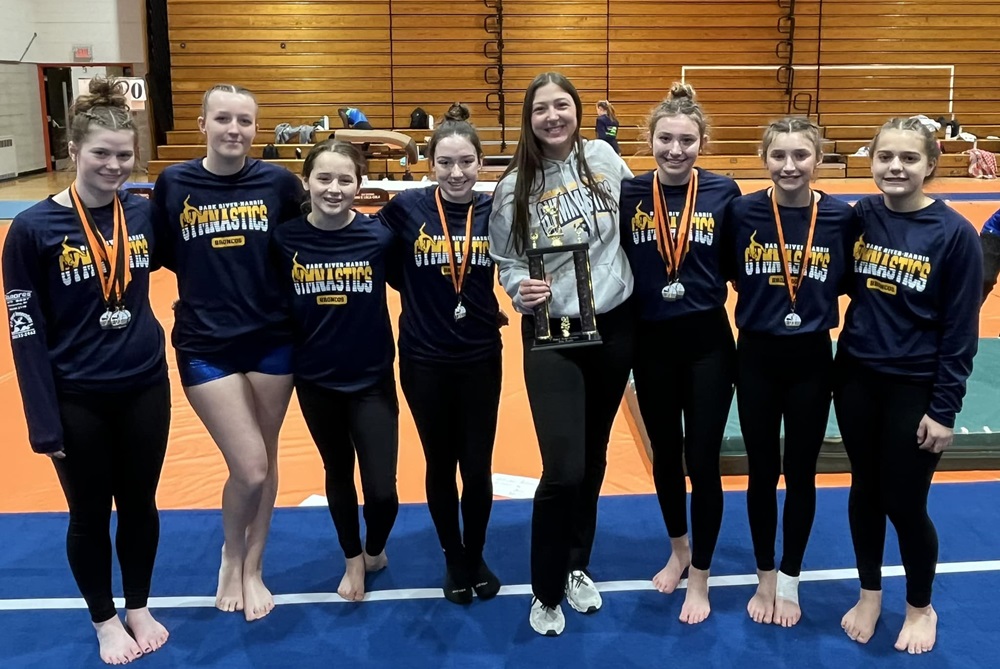
PHOTO The Bark River-Harris gymnastics team takes a photo after finishing runner-up at the Escanaba Elks Invitational. (Photo courtesy of the Bark River-Harris gymnastics program.)